
A lot of families first hear the term bond surrender in the worst possible way. A defendant stops answering. A court date gets missed. A cosigner gets nervous because their house, car, paycheck, or credit may be exposed. Then somebody says, “The bond might be surrendered,” and the panic starts.
If you’re in that spot, the most important thing to know is this. Bond surrender doesn’t mean the case is over, and it doesn’t automatically mean the worst outcome is coming. It means the bond is being withdrawn and the defendant is being put back in custody. That changes the legal and financial picture fast, but it’s still a situation you can manage if you act quickly and understand what happens next.
Understanding Bond Surrender A Guide for Colorado Families
Your family may get this call late at night. A bondsman says the bond is being surrendered, or a cosigner says they can no longer stay on the bond, and within hours the defendant may be back in jail. For Colorado families, the question is not just what the term means. The main concern is what changes right now, who is at risk financially, and what to do before the situation gets worse.
Bond surrender means the surety withdraws the bond and the defendant is returned to custody. Once that happens, the bond that secured release is no longer standing in the same way, and the legal and financial pressure shifts fast for both the defendant and the indemnitor, also called the cosigner.
Families often hear the term at a very tense moment, but the meaning is straightforward. A surrender is a risk decision. It usually happens because the surety believes the bond is no longer safe to keep in place, or because the cosigner no longer wants to carry the financial exposure tied to the defendant’s release.
That distinction matters in real life. A surrender changes custody status, court logistics, and financial responsibility. It does not resolve the criminal case, and it does not determine guilt or innocence.
In Colorado, timing matters. A surrendered defendant may be taken back into custody quickly, and families often have a short window to gather information, contact the jail, review the bond paperwork, and decide whether re-bail is possible. I tell families to focus on three immediate questions: Where is the defendant now, why was the bond surrendered, and what financial obligation is still active under the indemnity agreement?
Clear answers lower panic. They also help families avoid a common mistake, which is treating surrender like a minor paperwork issue when it can affect jail time, collateral, refund expectations, and the cost of getting released again.
Who Can Initiate a Bond Surrender and Why
Two different people usually drive this decision, and their reasons are not the same.

When the surety initiates it
A surety surrender happens when the bail bondsman decides the risk has changed too much. The legal power for that goes back to the structure of the U.S. bail bond industry itself. As noted in the earlier historical record, bond surrender allows the surety to revoke the bond and return the defendant to custody when conditions are breached, protecting the surety from full forfeiture exposure.
Common real-world triggers include:
- Missed court dates: If the defendant fails to appear, the risk changes immediately.
- New arrests or violations: A fresh arrest, drug use, travel outside allowed areas, or ignoring supervision terms can signal noncompliance.
- Loss of contact: If the defendant stops answering calls or disappears from the address on file, the bondsman may conclude the bond is no longer safe to carry.
- Bad information at intake: If the application contained false employment, residence, or identity information, the surety may move to surrender.
The surety’s reason is simple. It’s about risk control.
When the cosigner initiates it
An indemnitor, usually called a cosigner, can also start the process by telling the bail agency they want out. This is more common than many families expect.
A cosigner usually acts because trust has broken down. The defendant may stop checking in, start making reckless choices, or put the cosigner’s money and collateral at risk. Sometimes the change is on the cosigner’s side. A job loss, family emergency, or sudden financial strain can make the original agreement impossible to carry.
Families often wait too long because they feel guilty. Waiting usually increases the risk, not the chances of fixing it.
The trade-off that matters
The surety asks, “Can this defendant still be safely bonded?”
The cosigner asks, “Can I still afford to stand behind this bond?”
Those are different questions, but both can lead to the same result. The defendant goes back into custody, and the bond ends.
What usually doesn’t work is denial. If someone is already missing calls, ignoring dates, or showing signs they won’t comply, hoping the problem disappears can turn a manageable surrender into a much more expensive forfeiture situation.
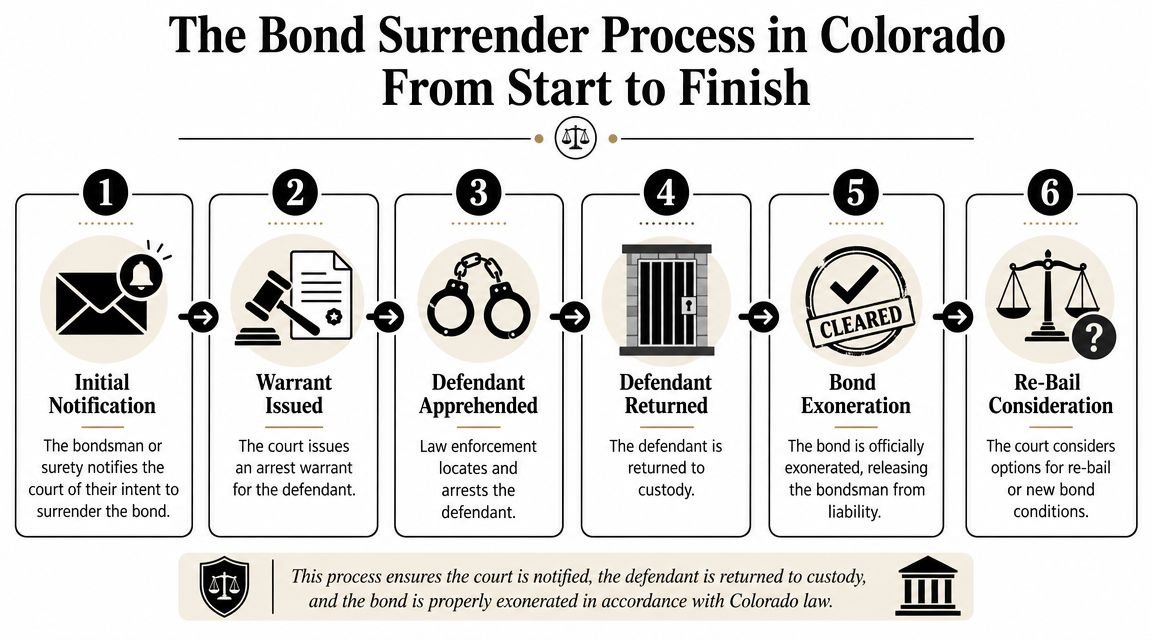
The Bond Surrender Process in Colorado From Start to Finish
A Colorado family usually sees this process start with a hard phone call. The defendant has stopped checking in, missed court, or given the bondsman a reason to believe the bond is no longer safe to keep in place. From that point, timing matters because every delay can raise the legal and financial risk for both the defendant and the cosigner.
Step one is the decision to pull the bond
The process begins when the surety decides to surrender the defendant, or when the cosigner asks to be released from the bond and the agency acts on that request.
This is the moment to stop relying on memory. Save texts, voicemails, missed-call logs, emails, and any notice from the court or bond office. If the dispute later turns on who knew what and when, a clean record helps. In some cases, families also need to think about authenticating text messages for court if messages become part of a hearing or bond dispute.
Step two is locating the defendant
If the defendant is cooperating, the surrender is usually faster and less expensive. The person can arrange to return to custody in an orderly way, which often avoids the added strain of a forced pickup.
If the defendant refuses to cooperate or disappears, the bondsman may use lawful recovery methods allowed under the bond agreement. Families often underestimate this part. A bail contract gives the surety rights that are much broader than an ordinary payment agreement, and those rights exist to reduce the chance of a full bond loss.
Step three is the return to custody
A surrender is not complete because someone says, "the bond is off." The defendant must be returned to custody.
That return usually happens at the jail connected to the pending case or another facility designated for that hold. For families, the practical question is simple. Where is the defendant booked, and when will that booking show in the system? Getting that answer quickly helps with attorney calls, medication issues, work notifications, and planning for the next court date.
Step four is the court paperwork
After the defendant is back in custody, the bondsman files the required surrender paperwork with the court so the record reflects that the surety is withdrawing from the bond.
The exact handling can vary by court and case status, which is why families should ask for the filing name, the case number, and confirmation that the surrender has been entered. I tell people to get specifics, not general reassurance. "It has been filed" is less useful than "the affidavit was filed in case number ___ on ___."
Step five is release of the surety's liability
Once the surrender is completed and accepted, the surety seeks exoneration from further responsibility on that bond. That step matters because an unresolved failure to appear can turn into a much more expensive problem. If you need the distinction explained in plain English, this guide to bond forfeiture in Colorado covers what happens when a bond is not protected in time.
What families should do while this is happening
- Answer every call from the bond office, lawyer, and jail: Delay creates confusion fast.
- Do not conceal the defendant's location: That can damage any chance of a controlled surrender.
- Confirm where the defendant was booked: Families are often given outdated or incomplete location information.
- Ask for the next court date before ending the call: Re-bail decisions often depend on what happens at that hearing.
- Keep the cosigner involved: In Colorado, the indemnitor is not a bystander. The cosigner's money, collateral, and legal exposure are tied to what happens next.
For worried families, the process feels abrupt. On the legal side, though, it follows a clear order. Decision, recovery, return to custody, court filing, and exoneration. Knowing that sequence helps both defendants and cosigners make better decisions early, while there is still room to limit the damage.
Financial and Legal Fallout The Consequences for Everyone
This is the part families usually care about most. What happens to the defendant, and what happens to the person who signed the paperwork?
Consequences for the defendant
The immediate legal consequence is simple. The defendant goes back to jail.
From there, the court may look more closely at compliance history, reliability, and future release conditions. A surrender can make the defendant look riskier, especially if the surrender followed a missed court date, dishonesty, or an attempt to disappear. That doesn’t mean release is impossible. It does mean the next release decision usually gets harder.
Consequences for the cosigner
For a cosigner, the biggest issue is usually money. Many people assume surrender automatically means they get all their money back. That’s usually not how it works.
Data cited in bail industry reporting says surrender fees typically range from 1% to 3% of the bond principal, and those charges are often non-refundable because they cover administrative work tied to the surrender process. The same reporting says a 2025 Pretrial Justice Institute study found 42% of voluntary surrenders in major markets stemmed from fee surprises, which is exactly why cosigners should ask hard questions early about all possible charges and collateral exposure (fee and voluntary surrender background).
Consequences of Bond Surrender at a Glance
| Party | Primary Legal Consequence | Primary Financial Consequence |
|---|---|---|
| Defendant | Return to custody and greater scrutiny on future release | May need to arrange a new bond under stricter conditions |
| Cosigner | End of active backing for the original bond | May lose non-refundable premium amounts, face surrender-related fees, and need to resolve any collateral issues |
| Surety | Seeks exoneration from liability on the bond | Avoids continued exposure to the full bond amount if surrender is completed properly |
What works and what doesn't
What works is getting everything in writing. If you’re a cosigner, keep copies of the contract, payment receipts, text messages, and any warning notices. If your dispute later turns on who knew what and when, records matter. In some situations, guidance on authenticating text messages for court can help you understand how written communications may be used when a disagreement escalates.
What doesn’t work is assuming verbal promises override the bond contract. They usually don’t.
Key point: Ask whether the premium is refundable, whether a surrender fee may apply, and what happens to collateral before the surrender happens, not after.
A common cosigner misunderstanding
Some cosigners believe they’re trapped until the case ends. That’s not always true. In many situations, a cosigner can take steps to withdraw from the arrangement, though the legal and contractual details matter. If that’s your concern, review this explanation of whether a cosigner can be removed from a bail bond.
The financial lesson is straightforward. Early action gives a cosigner more control. Waiting until the defendant has already gone off the radar usually means fewer options and more expense.
Getting Out Again Navigating Re-Bail After a Surrender
A family often learns how serious a surrender is when the phone rings and their first question is simple. Can we get them out again?

The answer is sometimes yes. The harder truth is that a second release is rarely as straightforward as the first. In Colorado, a prior surrender raises concern for both the court and the bond company because it suggests something went wrong with compliance, contact, or trust.
Why re-bail gets harder
After a surrender, the defendant may face tighter bond conditions, a higher bond amount, or a decision that no new surety bond will be approved at all. That outcome depends on why the surrender happened.
If the problem was missed check-ins, loss of contact, a new arrest, or signs the defendant might run, the next application gets closer review. If the surrender happened before a bigger problem developed, the court may still allow release, but families should expect more questions and less flexibility.
For cosigners, this is the point where the risk becomes very real. A second bond can require a new indemnitor, more collateral, stricter reporting terms, or all three.
What helps on a re-bail request
Courts and bond agents want proof that the situation has changed, not just promises that it will. The strongest re-bail requests usually include practical, verifiable details such as:
- Current and reliable contact information
- A working phone that will be answered
- A clear plan for transportation to court
- Proof of work, treatment, or stable housing when available
- A cosigner who understands the renewed financial risk
- A direct explanation for what caused the surrender and what has changed since then
Specifics matter here. “I’ll do better” does not carry much weight. “My sister will drive me to every court date, I am back in treatment, and you can reach me at this number every day after 5 p.m.” is far more useful.
The practical path for defendants and cosigners
Start with custody status. Confirm where the defendant is being held, whether a new bond has been set, and when the next court date is scheduled. Then ask whether the court has placed any restrictions on a new bond.
If re-bail is possible, prepare the application quickly and carefully. Families who need a plain-English breakdown of the release process can review how to bail someone out of jail in Colorado.
Cosigners should slow down long enough to ask one hard question before signing again. Has the underlying problem been fixed, or are you being asked to take on the same risk a second time?
That question matters. I have seen families pay again out of panic, only to end up back in the same position within days. A calm, documented plan gives everyone a better chance of getting through the case without another surrender.
A Proactive Guide to Preventing and Handling Bond Surrender
Most bond surrenders don’t come out of nowhere. There are usually warning signs first. A missed call. A new excuse every week. A defendant who starts treating court dates like suggestions.
How to reduce the chance of surrender
Families can lower the risk if they act like the bond is an active obligation, not a one-time transaction.
- Track every court date: Put dates in your phone, on a paper calendar, and in a shared family message thread.
- Keep the agency updated: If the defendant changes jobs, phones, or address, report it.
- Watch for behavior shifts: If the defendant starts disappearing, using drugs again, or talking about leaving town, treat that as a bond problem now.
- Use support, not denial: Reminders, rides to court, and clear check-ins help more than arguments.
When surrender is being threatened
If you hear the bond may be surrendered, act immediately.
- Call the agency the same day. Silence gets read as risk.
- Ask what triggered the concern. Missed payment, missed court, no contact, new arrest, or contract violation all call for different responses.
- Don’t hide the defendant. That usually destroys credibility and increases exposure.
- Get the defendant to cooperate. Voluntary compliance often reduces chaos.
- Document every communication. Keep names, dates, and copies.
When voluntary surrender makes sense
A cosigner is not powerless. According to the cited industry source, voluntary bond surrender by an indemnitor allows a cosigner to withdraw financial liability by notifying the bail agency, which then coordinates the defendant’s return to custody. The same source says this kind of action does not trigger arrest warrants and ends the cosigner’s liability for the premium and collateral. It also states that 15% to 25% of bonds are voluntarily revoked pre-trial due to relational breakdowns, helping preserve cosigner credit (voluntary surrender and cosigner protection).
That option matters when trust is gone. If the defendant is unraveling and the cosigner sees a skip coming, waiting can be the most expensive choice available.
One more lever to consider
If the problem is the amount of bail rather than the defendant’s willingness to comply, the defense lawyer may need to pursue a change in conditions instead of letting the situation drift toward surrender. In that context, this guide on how to get bail reduced may help families understand one possible route.
How Express Bail Bonds Provides Support During Surrender Situations
A surrender call usually comes after trust has already broken down. A parent cannot reach their son. A spouse learns the defendant missed court prep or started talking about leaving town. A cosigner is scared of losing collateral and needs a clear answer now, not a lecture.
Express Bail Bonds helps families handle that moment in a practical way. The first job is to confirm the bond status, the defendant’s location, and what exposure still sits with the indemnitor. The second is to explain choices in plain language, including whether voluntary cooperation is still possible and what surrender is likely to mean for custody, cost, and any later attempt to get back out.
Families also need someone who can explain the agency side of the process without making it harder to follow. This overview of what a bail bond agent does gives helpful background if you want to understand who is coordinating the paperwork, court communication, and return-to-custody steps.
Local experience matters in Colorado because surrender does not play out the same way for every jail, courthouse, or timeline. A good agency does more than process forms. It answers urgent questions, tells cosigners what to document, explains which fees are typically not refundable, and gives defendants a straight assessment of what cooperation may do for their chances of re-bail later.
Public feedback can also help families decide who they trust during a stressful situation. If you want to review client experiences before making a call, you can look at these client reviews and local feedback and additional Express Bail Bonds reviews.
Common Questions About Bond Surrender in Colorado
Frequently Asked Questions
| Question | Answer |
|---|---|
| What does bond surrender mean in Colorado? | It means the surety withdraws the bond and the defendant is returned to custody. The criminal case continues, but the original bond is no longer carrying the release. |
| Can a cosigner ask for a bond to be surrendered? | Yes. A cosigner may decide they no longer want to stay financially responsible and can contact the bail agency to start that conversation. |
| Does bond surrender mean the defendant is guilty? | No. Surrender affects custody and bond status. It does not decide the criminal charge. |
| Will the defendant go back to jail right away? | Usually, yes. Surrender is tied to returning the defendant to custody, either by cooperation or apprehension. |
| Does a cosigner get all money back after surrender? | Not necessarily. Premiums are often non-refundable, and surrender-related charges may apply depending on the agreement and circumstances. |
| Can the defendant get bonded out again after surrender? | Sometimes. It depends on the court, the reason for the surrender, the defendant’s history, and whether a surety is willing to write a new bond. |
| Is it better to surrender early if the defendant is becoming unreliable? | In many situations, yes. Early action can protect the cosigner and may prevent a worse forfeiture problem later. |
| What should a family do first after learning surrender is possible? | Confirm whether the defendant is already in custody, gather the bond paperwork, save all messages and notices, and speak with a licensed Colorado bail bond agency immediately. |
If you’re dealing with a possible surrender, don’t wait for the situation to sort itself out. Contact Express Bail Bonds for clear guidance, fast answers, and help navigating Colorado bond issues before they become more expensive and harder to fix.