
When someone you care about is sitting in jail, your search history gets desperate fast. You type in things like surety bonds no credit check, hoping there's a clean shortcut that gets them out without another financial problem landing on your family.
That search makes sense. The trouble is that the internet mixes together commercial surety bonds and bail bonds like they're the same thing. They aren't. If you're in Colorado and you need help for an arrest, that confusion wastes time, and time matters.
What matters even more is this. There may still be a workable path, even if credit is rough, money is tight, or you're trying to do this from another city or another state. You just need the actual rules, not sales talk.
The Urgent Search for No Credit Check Bail Bonds
If your phone rang late at night and now you're trying to figure out how to get a spouse, child, parent, or friend out of custody, you're probably worried about two things at once. First, how fast they can be released. Second, whether your own credit is about to become another obstacle.
That's why people search for surety bonds no credit check. They're not looking for theory. They're looking for a way to act right now.
In plain English, a no credit check bond is exactly what it sounds like. Some bonds can be issued without pulling the applicant's credit at all. But that simple phrase causes a lot of trouble in bail cases because many articles are talking about business licensing bonds, not a bond tied to a criminal case.
If you're trying to get someone out of a Colorado jail, start with the basics and get clear on the process for bailing someone out with no money. That gives you a practical frame before you waste hours chasing the wrong kind of bond.
What families usually need to know first
- Speed matters: The sooner you confirm the jail, the case status, and the bond type, the sooner a release can move.
- Search terms can mislead you: A page about notary bonds or license bonds may rank for your question but have nothing to do with a Colorado bail case.
- Credit problems don't always end the conversation: They change the options. They don't automatically remove them.
Practical rule: In a bail emergency, the right question isn't “Can I find any no credit check surety bond?” It's “What will a bondsman actually need from me for this specific defendant and this specific jail?”
That one shift saves people a lot of frustration.
The Reality of No Credit Check Surety Bonds
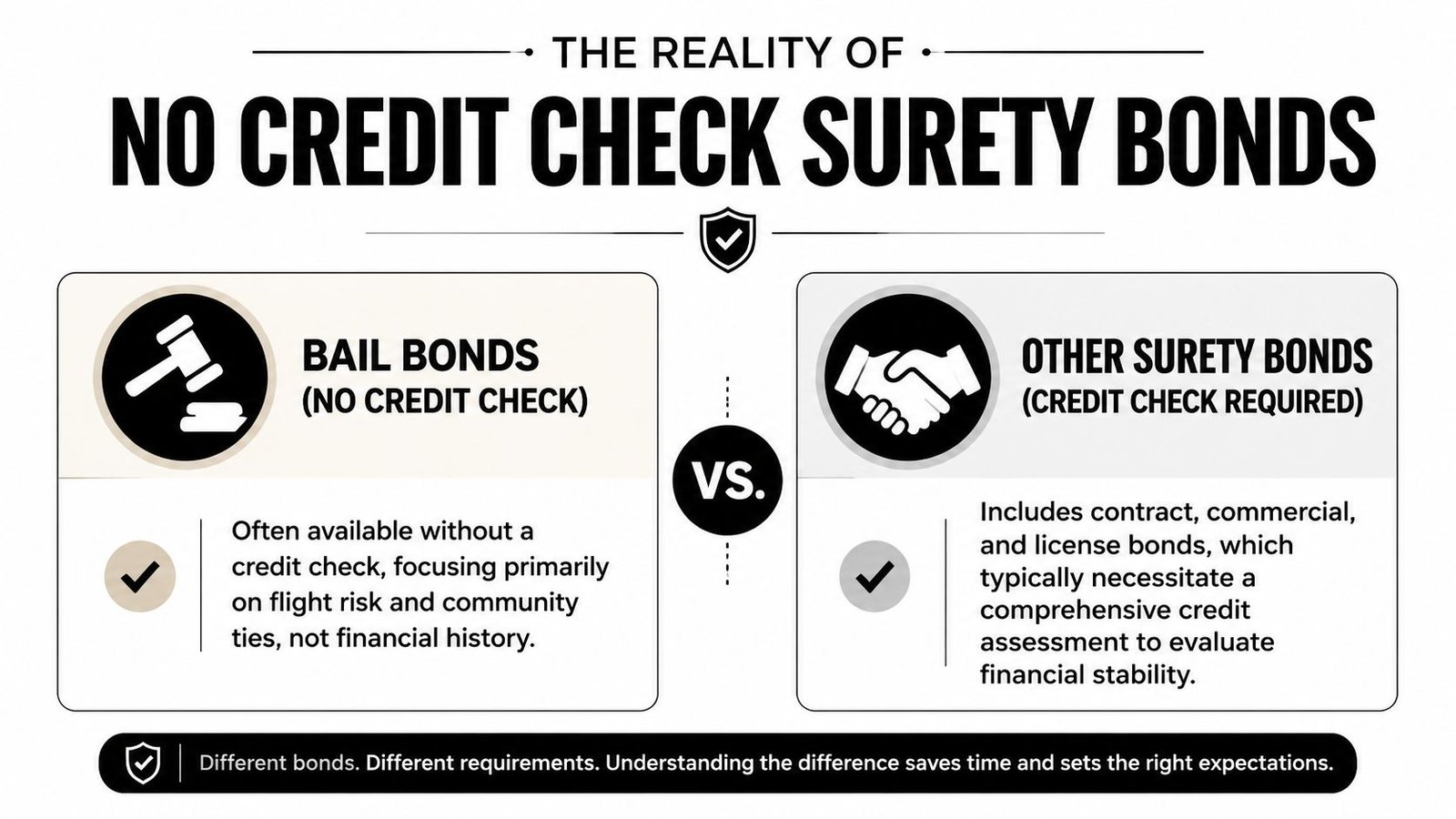
No credit check surety bonds are real. They are not a myth. But most of them live in the low-risk commercial world, not in criminal bail.
Industry guidance says specific bond categories can be issued with no credit check requirements, including notary bonds, CTEC tax preparer bonds, janitorial bonds, ERISA bonds, process server bonds, and many small license bonds under $10,000, often using flat-rate pricing where credit doesn't affect approval or cost, according to Bonds Express on surety bond credit checks. Another industry explanation says approximately 50% of sold surety bonds are issued for a flat premium without any credit check or underwriting analysis, mainly in low-risk, low-limit situations, as outlined by SuretyBonds.com Help.
That's the key distinction. Those bonds work because the surety is dealing with a contained risk, a low bond amount, or a bond type with a predictable claims profile.
Why bail is different
A bail bond isn't just paperwork for compliance. A bondsman is taking on the risk that a defendant will show up in court. That changes everything.
As one industry source puts it, the no-credit-check model works when the surety relies on the bond type's inherent low default probability rather than the principal's financial history, but that approach is generally unavailable for standard bail bonds where the risk of flight is high and personal credit is a primary underwriting factor, according to Grit Insurance's explanation of credit score needs for surety bonds.
So if someone advertises “no credit check surety bonds” and you assume that means any bail bond, you're mixing two separate products.
What this means in practice
Here's what families need to hear.
| Bond type | Usual underwriting logic |
|---|---|
| Low-risk commercial surety bond | Flat-rate pricing, limited exposure, often instant issue |
| Bail bond | Defendant appearance risk, cosigner review, case-specific decision |
That doesn't mean bail is impossible when credit is weak. It means you need to stop expecting the same rules that apply to a small notary bond.
If you want a clearer picture of how a bondsman may review the person signing for the bond, read about a cosigner credit check for bail bonds. That's often where the core decision lies.
The fastest way to lose time is to assume a commercial surety article answers a Colorado bail question. It usually doesn't.
How Bail Bond Underwriting Really Works
People hear the word underwriting and think a computer spits out yes or no based on one score. That's not how bail usually works. A bail agent looks at the whole risk picture.

What an agent is actually looking at
A bail bond review usually focuses on questions like these:
- Does the defendant have ties to the community? Stable housing, local family, and a work history matter.
- Who is signing the bond? The indemnitor or cosigner is often the center of the financial review.
- What are the charges and court conditions? Some cases create more concern than others.
- Can the signer realistically carry the obligation? The issue isn't just credit. It's stability.
If you've ever looked at understanding loan approval steps, you already know the larger idea. Underwriting is about risk, verification, and the ability to follow through on a contract. Bail uses that same logic, but the risk being measured is different.
Credit is part of the file, not the whole file
In broader surety underwriting, applicants with credit scores below 650 who must go through underwriting often pay 3% to 10% of the total bond amount, while stronger-credit applicants often fall into the 0.5% to 3% range, and high-risk programs often charge between 5% and 15%, according to Bonds Express on bad credit surety bonds.
That's a useful comparison because it shows how credit can affect risk pricing in surety generally. But in bail, the practical question is often less about a neat pricing band and more about whether the agency believes the defendant will appear and the cosigner will honor the contract.
What matters most: A weak credit file can hurt, but it usually doesn't tell the whole story. A stable cosigner with solid ties and clear information can carry more weight than people expect.
What to have ready before you call
Bring facts, not panic. That helps more than anything.
- Defendant details: Full legal name, date of birth, jail location, and booking information if you have it.
- Cosigner information: Employer, housing status, relationship to the defendant, and basic financial picture.
- Case facts: Charges, bond amount, and any known court conditions.
- Documents: ID, proof of residence, and anything that supports stability.
For a cleaner overview of what agencies often review, look at common surety bond qualifications. It helps people understand why agents ask the questions they ask.
Your Real Options When Credit Is a Concern
If credit is the problem, you still have options. They aren't all equal, and they don't fit every family, but they're real.
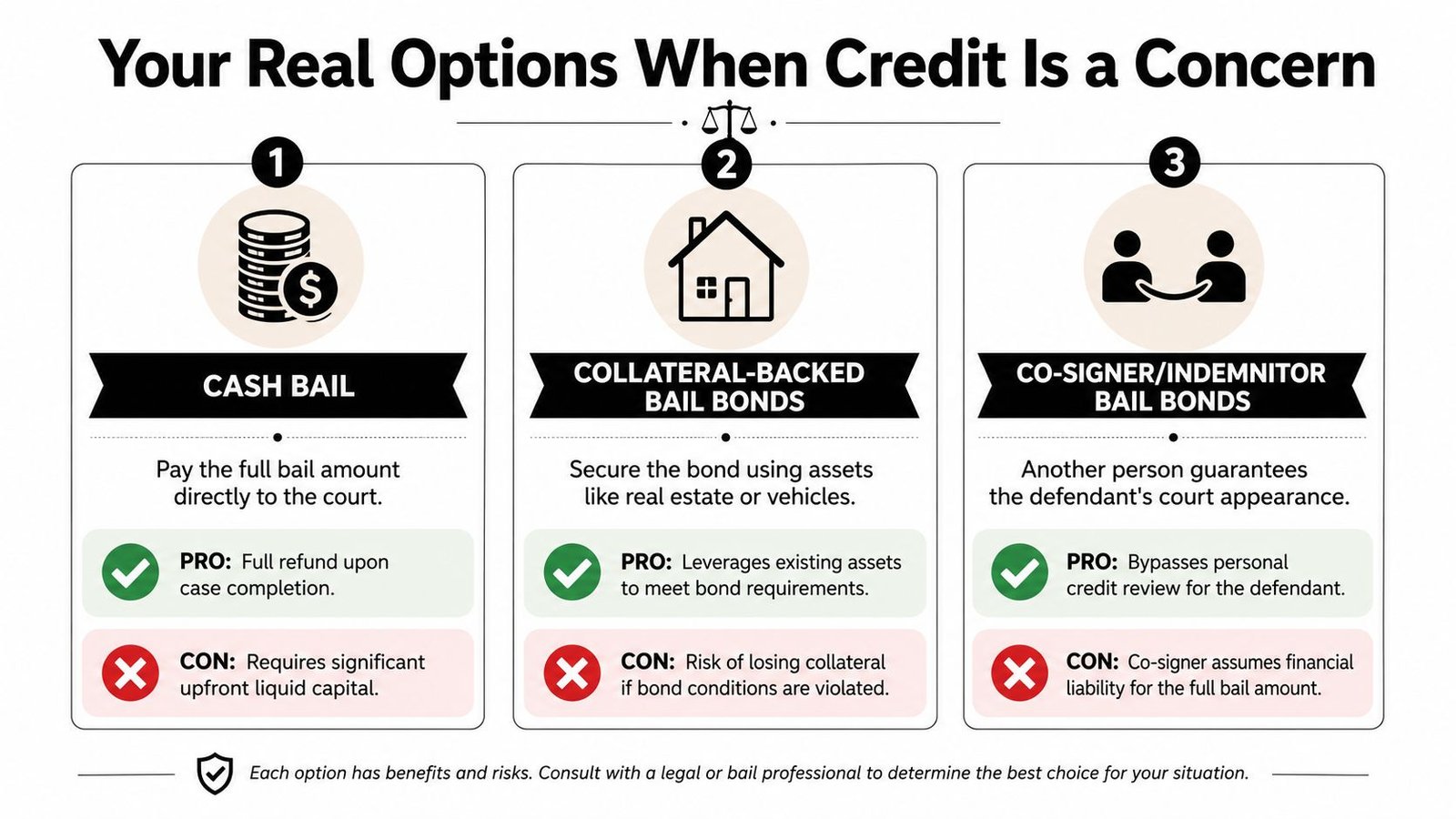
Three paths families usually consider
| Option | Best use | Main risk |
|---|---|---|
| Cash bail | You have liquid funds and want direct payment to court | Large upfront outlay |
| Collateral-backed bond | You own assets but cash is tight | Asset is at risk if conditions are broken |
| Co-signer bond | Someone trustworthy can back the bond | Cosigner carries financial liability |
A relevant surety principle applies here too. Applicants with bad credit can often overcome denial by using a cosigner with good credit, and providing collateral can substitute for a clean credit history, according to ZipBonds on bad credit surety bonds.
That same common-sense logic shows up in bail every day.
Here's a short walkthrough that explains these options in plain terms:
Option one, bring in a stronger cosigner
This is usually the cleanest fix.
A strong cosigner is someone who has steady work, a verifiable address, and a relationship with the defendant that makes sense. Parents, spouses, long-term partners, and close relatives often work better than a casual friend who barely knows the case.
The upside is obvious. You may avoid getting stuck on the primary applicant's weak file. The downside is just as obvious. The cosigner is taking real responsibility.
If you ask someone to cosign, be honest about the risk. Don't minimize it. If the defendant fails to appear, the problem becomes the cosigner's problem too.
Option two, use collateral instead of clean credit
Collateral can help when income or credit alone won't satisfy the agency. Depending on the situation, that can involve real estate, a vehicle, or another acceptable asset.
People get nervous about collateral because they should. It's serious. But serious doesn't mean bad. It means read the agreement carefully, understand the conditions, and ask exactly how collateral is released when the case requirements are satisfied.
If you need the basics, review how bail bond collateral works before you sign anything.
Option three, ask about a payment arrangement
Some families can't produce a full premium immediately, but they can handle a structured payment plan. That won't solve every case, and approval still depends on risk, but it's often a better conversation than assuming you're out of options.
The mistake people make is waiting too long to discuss what they can afford. Say it upfront. A good agent would rather hear the truth than chase paperwork for a plan that was never realistic.
Navigating the Bail Process in Colorado
It is 11:30 at night. Your family member is sitting in a Colorado jail, someone tells you to “find a no credit check surety bond,” and now you are sorting through advice that mixes business surety bonds with bail bonds as if they are the same thing. They are not. For Colorado bail, what matters right now is how fast the bond can be written, who is signing, what the jail requires, and how long release processing will take after the bond is posted.

A typical Colorado bail scenario
The usual sequence is straightforward. The defendant is arrested, booked, and held until bond is set or confirmed. A licensed bail agent checks the jail, confirms the bond amount, reviews the signer, prepares the paperwork, and posts the bond once the file is approved. After that, the family waits on the jail. Release time often depends more on jail staffing and internal processing than on how fast the bond was posted.
County details still matter. The forms may be similar, but the timing is not always the same from one jail to another. That is why families should stop chasing generic “surety bond” articles and get case-specific answers from a Colorado bail agent who knows the local process. If you want to start the paperwork quickly, use this Colorado surety bond online quote form for bail help.
What to watch out for
Bad information causes delays. Confusion causes worse delays.
A lot of websites blur commercial surety bonds and bail bonds, then toss around “no credit check” as if approval is automatic. It is not. For example, BondExchange shows that credit can change pricing on a non-bail surety product, with a Colorado utility deposit bond guide showing higher costs for weaker credit profiles. That is not a bail quote, and it should not be treated like one. It does prove the bigger point. Surety underwriting is not one-size-fits-all, and bail underwriting has its own risk review.
You should also be skeptical of agencies that make the intake process sloppy or vague. The same lesson behind choosing the right lead platform applies here. A clear intake process saves time, reduces mistakes, and gets people to the right next step faster.
Red flags that should slow you down
- Vague promises: “Everybody gets approved” is sales talk, not a real standard.
- No basic case review: If they do not ask about the defendant, the jail, the bond amount, or the signer, they are skipping risk review.
- Money before explanation: You should know what you are signing and what you owe before you pay.
- Unclear collateral terms: If nobody will explain when collateral is returned and under what conditions, stop and ask again.
A good bondsman speaks plainly. You should understand the risk, the paperwork, and the next step before anything gets signed.
Take the Next Step with Express Bail Bonds
The plain truth is this. Surety bonds no credit check is a real concept in the bond world, but for Colorado bail cases it's often the wrong frame. What matters is whether there's a practical route to approval through the right cosigner, acceptable collateral, or a realistic payment setup.
That's where experience matters. You need someone who can move quickly, explain the rules without sugarcoating them, and handle the process without making your family sit in confusion for hours. If you're comparing providers, the same way businesses spend time on choosing the right lead platform to avoid messy intake and wasted follow-up, families should choose a bail agency with a clean process and clear communication.
If you're ready to stop guessing, start with an online surety bond quote. Then talk to a licensed Colorado bail bond agent who can tell you what will work in your case.
If you need fast, honest help, contact Express Bail Bonds. They serve Colorado statewide, handle many documents electronically, and help families move quickly when time matters. If the arrest is in Jefferson County, review their Golden and Jefferson County bail bond help. If the case is in Arapahoe County, start with their Centennial bail bond page. Call or text 720-984-2245 any time to discuss the situation and find the next step.