
The phone usually comes at the worst possible time. Late at night, early in the morning, or in the middle of a workday when you’re already stretched thin. A loved one says they’ve been arrested, they don’t know what happens next, and your first question is simple: how do I get them out if I don’t have the money?
That question is more common than most families realize. In many cases, the person on the outside doesn’t have cash sitting in a bank account, doesn’t know which jail to call, and has never dealt with bail before. Panic makes every step feel harder.
There is a path through this. The key is to stop guessing and move in order. First, confirm where the person is and what the court has set. Then check whether a true no-cost release is available. If it isn’t, look at the most realistic low-money option in Colorado, which is usually a surety bond through a licensed bail bond agent. If even that feels out of reach, there are still practical ways to structure the cost.
Answering the Call A Practical Guide to a Stressful Situation
If you’re reading this right after an arrest, slow down and get organized. The families who get the fastest results are rarely the calmest at first. They’re the ones who gather the right details and act on verified information instead of rumors from the holding tank or advice from a friend who “went through this once.”

The first thing to understand is that “no money” can mean two very different things. Sometimes it means a true no-cost release, such as release on recognizance or an unsecured bond. Other times it means you don’t have enough to pay the full bail amount, but you may still be able to secure release through a smaller, non-refundable premium paid to a bondsman.
That distinction matters. It keeps you from wasting hours chasing fake “free” solutions while your loved one sits in custody.
A lot of first-time families also need help with the immediate basics after an arrest. If you need a quick companion guide for those first decisions, this walkthrough on what to do when someone gets arrested is useful.
Practical rule: Don’t start with “How much is bail?” Start with “Where are they, what exactly are the charges, and has bail even been set yet?”
Once you know those answers, the situation usually becomes much less chaotic. You may not like the options, but at least they’re real options.
Your First 48 Hours What to Do Immediately After an Arrest
The first two days matter. They affect how quickly someone can be located, whether release is possible right away, and whether the court might consider a less restrictive option.
Gather the basic facts first
Before you call anyone, write down everything you know. Even small errors can create delays.
Try to get:
- Full legal name: Use the exact name the person was booked under.
- Date of birth: This helps separate your loved one from someone with a similar name.
- Booking number if available: If the jail gave it to them, this speeds up every conversation.
- Arresting agency and jail location: City police, county sheriff, and state agencies may book into different facilities.
- Charges if known: Even a rough description helps you ask better questions.
If you’re unsure how to start the jail search, this guide on how to find someone arrested can point you in the right direction.
Confirm where the person is being held
Families often lose time by calling the wrong facility. In Colorado, that’s common when someone is arrested in one city but booked into a county detention center.
Use a simple process:
- Call the arresting agency first if you don’t know the jail.
- Ask whether the person has finished booking.
- Confirm the exact detention facility before asking about bond.
- Write down the name of the person you spoke with if the jail provides it.
Don’t assume the person can be released the moment they arrive. Booking has to be completed before most release steps can move forward.
Find out whether bail has been set
A person can be arrested and booked before the bond amount is available. That’s why “go pay it now” advice often goes nowhere.
When you call, ask direct questions:
- Has bond been set yet?
- What type of bond is it?
- Is the person eligible for release right now, or are there holds?
- When is the first appearance or advisement?
If the jail says no bond amount is available yet, the next important event is usually the first court appearance. That’s often the point where the judge reviews release conditions.
Don’t rely on secondhand information from inside the jail. People in custody often misunderstand what staff told them, or they repeat what another inmate thinks will happen.
Pay attention to the first hearing
This hearing matters more than many families realize. Sometimes it’s the first real chance to ask for a lower amount, an unsecured bond, or a recognizance release.
That’s why it helps to understand not only the need for release, but also the court process behind it. A useful outside perspective on understanding the need for bail for a loved one can help families frame what’s happening emotionally and practically.
Contact defense counsel early if release is a problem
If the amount is too high or the conditions seem unnecessary, involve a lawyer quickly. That may be a public defender or private criminal defense attorney, depending on the case.
Ask counsel to focus on facts the court cares about, such as:
| Issue the court may consider | Why it matters |
|---|---|
| Community ties | Stable local ties can support release |
| Employment or caregiving duties | Shows daily obligations and structure |
| Prior court attendance | Helps address concerns about failing to appear |
| Nature of the charges | Release options vary by case type |
| Substance treatment or medical needs | Can affect supervision requests or release arguments |
Keep your notes organized
Use one page or note on your phone for all of this:
- Jail name
- Case number if available
- Bond type
- Court date
- Attorney name
- Any release conditions you were told about
You don’t need a perfect legal strategy in the first few hours. You need clean information. That’s what moves a case from panic to action.
No-Cost Release Options: ROR & Unsecured Bonds from Express Bail Bonds
Before anyone talks about paying a bondsman, the first question should be whether the court will release the person without upfront money at all. Those options exist, and they’re important.
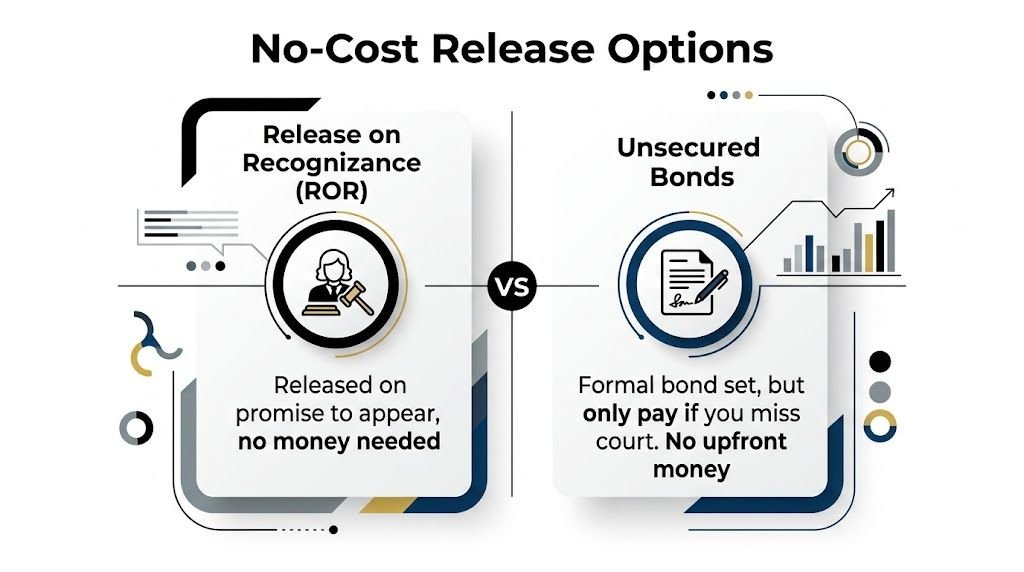
Release on Recognizance, often shortened to ROR, means the defendant is released on a promise to return to court. An unsecured bond also avoids upfront payment, but the person can still owe the bond amount later if they fail to appear.
What these options actually mean
Families often hear “bond” and assume money has to change hands immediately. That isn’t always true.
Here’s the practical difference:
| Release type | Upfront payment | Core idea |
|---|---|---|
| ROR | None | The court releases the person based on a signed promise to appear |
| Unsecured bond | None | The court sets an amount, but no payment is due unless the person misses court |
If you want a deeper explanation of the language courts use, this guide on what released on recognizance means breaks down the term in plain English.
These are real options, not symbolic ones
Non-financial release is not some fringe idea. According to Prison Policy Initiative’s reporting on pretrial detention and release, 80% of defendants in the District of Columbia are released pretrial through non-financial options, and those approaches match money bail’s effectiveness.
That matters because it shows a court can use a no-cost release structure without giving up on court appearance or public safety.
If a person is a good candidate for release without money, that request should be made clearly and early. Waiting to raise it later can keep someone in jail longer than necessary.
Who tends to have the strongest argument
No judge uses a single checklist in every case, but some facts generally help:
- Limited or no prior record: Courts often view first-time or lower-risk defendants differently.
- Stable residence: A fixed address can reduce flight-risk concerns.
- Work, school, or family duties: These can show routine and accountability.
- Non-violent allegations: The type of charge often affects release conditions.
- Good court appearance history: Past compliance matters.
These factors don’t guarantee anything. They help frame the request.
How to ask for it at the hearing
This is where legal representation matters. A public defender or private defense lawyer can argue for recognizance or unsecured release and present facts in a way the court can act on.
If you want a plain-language overview of what happens at a bail hearing, that resource gives a useful general picture of how judges look at release decisions.
The important point is this: the court grants these releases. A bail agent cannot create them. If the court denies a no-cost option, then the next decision becomes how to secure release with the least cash strain possible.
Using a Bail Bond The Most Common Path for a Low-Money Release
At this stage, the court has not approved a free release, and your family still wants your loved one out as fast as possible. In Colorado, the next practical option is usually a surety bond.
A surety bond lets a licensed bail bond company post the full bond amount with the court while you pay a smaller, non-refundable premium for that service. For many families, that is the only realistic way to secure release without coming up with the entire cash bond on short notice.

What a surety bond actually solves
The problem is usually not willingness to help. It is the size of the bond.
If bond is set at an amount your household cannot pay directly to the jail, a surety bond reduces the upfront cash needed to get the person released. The bond company takes on the risk with the court. The cosigner takes on a legal obligation to make sure the defendant appears and follows bond conditions.
That trade-off matters. You avoid tying up the full bond amount in cash, but you do sign a contract, and the premium is the cost of the service whether the case is dismissed, reduced, or won later.
What it usually costs in Colorado
In Colorado, families commonly see a premium in the 10 to 15 percent range, depending on the bond and the circumstances. On larger bonds, a qualified cosigner can sometimes help secure more manageable terms.
That does not mean the release is free. It means the family is paying a fraction of the full bond instead of the entire amount at once.
I tell families to slow down anytime they hear "no money down." Sometimes that means a payment arrangement. Sometimes it means collateral is involved. Sometimes it means the paperwork starts today but the financial obligation is still very real. Before you agree, ask for the premium, payment terms, and collateral requirements in writing.
How the bond process usually works
A clean bond process usually looks like this:
Confirm the basic case details
You need the defendant’s full name, the jail or detention facility, the charges, and the bond amount set by the court.Complete the cosigner application
The indemnitor may need to provide identification, contact information, employment details, and other financial information.Review the contract carefully
Read the premium amount, payment terms, collateral terms if any, and the consequences if the defendant misses court.Sign the bond documents
Many agencies can handle this electronically, which helps when family members are in different cities or states.The bond is posted
After the paperwork is approved and the bond is accepted, the jail begins its release process.
Small mistakes slow releases every day. A wrong birth date, the wrong jail, a nickname instead of a legal name, or an incorrect bond amount can cost hours.
What helps: Accurate information, a reachable cosigner, and honest answers during intake.
What causes trouble: Guessing at case details, hiding financial problems, or assuming approval means the defendant will walk out immediately.
Be careful with no-money-down advertising
Colorado families hear that phrase a lot. It often creates the wrong expectation.
A true zero-cost release usually comes from the court through recognizance or an unsecured bond. A bail bond company cannot create that outcome after the judge has already set a secured bond. If an agency advertises no-money-down bonding, ask what that means in plain English. Ask whether you still owe the premium, whether collateral is required, and what happens if a payment is missed.
A practical guide on how to use a bail bondsman can help you see what a legitimate bond transaction should include before you sign anything.
Questions to ask before agreeing
Use this list before choosing a bond company:
- What is the exact premium? Get the number in writing.
- Is collateral required? If yes, ask what secures it and under what conditions it can be taken.
- Who is the indemnitor? That person is financially responsible under the contract.
- How fast can documents be completed? Remote signing can save time.
- What happens if court dates change or the defendant is transferred? You need a clear communication process.
- How quickly is the bond posted after approval? Speed varies by agency and by jail.
Here’s a short explainer that walks through the process visually:
Choosing a Colorado agency with a clean process
Fast service matters, but clear terms matter more. In Colorado, families should look for a licensed agency that explains the premium plainly, answers questions about cosigner liability, and knows how different county jails handle releases.
For direct help, you can contact Express Bail Bonds 24/7. If the arrest is in the foothills or west metro area, their Jefferson County Golden bail bond information may be useful. For south metro cases, their Centennial bail bond page covers another common service area.
The bottom line is straightforward. If the court does not grant a free release option, a surety bond is usually the most practical low-money path to get someone out of a Colorado jail without posting the full amount yourself.
When You Still Can't Afford the Premium Creative Financial Strategies
Sometimes the premium is still too much. That doesn’t mean the process is over. It means you need to think in layers instead of assuming the only choices are “pay it all” or “do nothing.”
Use more than one responsible person
A single cosigner isn’t the only possible structure. In some situations, multiple family members can share the responsibility and help strengthen the application.
That can work well when one person has stable income, another has stronger credit, and a third can help keep the defendant on track with court reminders and transportation. The practical advantage isn’t just financial. It also shows that the defendant has a support system.
Ask about payment structure, not just price
Families often ask, “Can you lower it?” A better question is, “What are the payment options?”
That opens up more realistic solutions, especially when the issue is timing rather than total ability to pay. If you need examples of common arrangements, this page on bail bond payment options outlines the kinds of structures families usually ask about.
A few approaches that sometimes help:
- Payment plans: Useful when a household has income coming in but not enough immediately.
- Collateral discussions: Property or other assets may sometimes support the bond agreement, depending on the facts.
- Shared family contributions: Smaller contributions from several relatives can close the gap faster than waiting for one person to cover everything.
Be realistic about nonprofit bail help in Colorado
Families often spend valuable time searching for a local charitable bail fund, especially when they’ve heard about free bail assistance in other states.
That search can be frustrating in Colorado. While The Bail Project exists nationally, its map shows no coverage in Colorado, which means nonprofit bail fund support is not a dependable option in places like Denver or Arapahoe.
That doesn’t mean no one will ever help. It means you shouldn’t build your release plan around a resource that may not exist where your loved one is being held.
A hard truth helps more than false hope. If there isn’t a working local bail fund, treat that as background information and move quickly on options that can actually secure release.
Crowdfunding can work if you keep it simple
Some families feel embarrassed asking for help. That’s understandable. But when done carefully, crowdfunding can bridge a premium shortfall without turning the case into public drama.
Keep the request short and factual:
- State the immediate need: The person is in custody and needs release support.
- Avoid arguing the case online: Don’t post police reports, accusations, or emotional attacks.
- Explain how funds will be used: People are more likely to help when the purpose is specific.
- Use one organizer: Too many competing requests create confusion.
Don’t chase fake shortcuts
When money is tight, “instant approval” language can sound tempting. That’s when people sign contracts they don’t understand or pledge collateral they can’t afford to lose.
If an offer sounds like magic, slow down and ask direct questions. Real help is usually straightforward. It may still be difficult, but it won’t require mystery terms or evasive answers.
After the Release Navigating Next Steps and Responsibilities
Getting out of jail is only the first half of the job. Once the defendant is released, the focus shifts from securing freedom to protecting it.

The defendant’s job after release
Every released defendant needs to treat the next court date like it is mandatory. Missing court creates the biggest avoidable disaster in the entire bond process.
The person released should:
- Attend every court date: Even a misunderstanding about time or courtroom can create serious problems.
- Follow every court condition: That may include no-contact orders, sobriety conditions, or travel restrictions.
- Stay reachable: If the bondsman or lawyer can’t contact the defendant, small issues can become major ones.
- Keep paperwork together: Court notices, bond documents, and attorney contact information should stay in one place.
The cosigner’s responsibility is real
A cosigner, also called an indemnitor, isn’t doing a symbolic favor. That person takes on financial risk tied to the bond.
If the defendant disappears or fails to comply, the cosigner may face collection efforts, collateral issues, or both. That’s why nobody should cosign out of guilt, pressure, or confusion.
Know the difference between exoneration and forfeiture
Two terms matter a lot here.
| Term | What it means |
|---|---|
| Bond exoneration | The bond obligation ends after the case or bond responsibility is resolved |
| Bond forfeiture | The court takes action because the defendant failed to appear or violated the bond in a way that triggers loss |
Those outcomes are very different. Exoneration is the normal finish line. Forfeiture is the expensive one.
Watch for misleading claims after release too
Even after a person is out, families still get trapped by bad information. A lot of content pushes “0% down” bail as if there’s no real cost, but in Colorado the 10-15% premium is standard and legally required, and claims of true zero-cost posting often hide collateral demands or cross the line on licensing rules, as discussed in this review of misleading no-money bail bond offers.
That matters because confusion after release leads to missed payments, bad assumptions, and unnecessary disputes.
For a broader overview from another niche of the bail industry, this explanation of how to post bail without money can help clarify why “without money” usually means using a structured release method, not avoiding financial responsibility altogether.
The best bond is the one nobody has to think about again because the defendant shows up, follows the rules, and finishes the case cleanly.
Keep communication open
The safest approach is simple. The defendant should stay in contact with counsel. The cosigner should keep track of court dates. Everyone should assume that small mistakes matter.
That approach doesn’t erase the stress of a criminal case. It does prevent the bail problem from becoming worse than the original arrest.
You Are Not Alone in This There Is a Path Forward
It is 11:30 at night, your phone is at 5%, and someone you care about is sitting in a Colorado jail. In that moment, families do not need sales language or vague promises. They need a realistic plan.
Start with the free options. Ask whether the court will grant release on recognizance or an unsecured bond. If the judge will not, a surety bond is usually the most practical low-money path because it avoids the need to post the full bail amount in cash.
Be careful with any company advertising "no money down" as if release comes with no real cost. In Colorado, the premium on a surety bond is still a real financial obligation, and the terms matter just as much as the price. The right question is not "Can I get someone out for nothing?" It is "What is the fastest legal option I can afford without creating a bigger problem next week?"
I have seen families make good decisions under a lot of pressure once they had a straight answer and a clear sequence of steps.
You do not need to solve the whole case tonight. You need to confirm the bond type, understand the actual cost, and choose the option your family can carry through to the end.
If you need immediate, confidential help, contact Express Bail Bonds. They serve Colorado families statewide, handle much of the process remotely, and are available 24/7 at 720-984-2245 to help you figure out the fastest realistic path to release.