
You've found an apartment, submitted your application, and received an email that says, “Approved contingent on a qualified cosigner.” That sentence can feel like good news and a new problem at the same time. Maybe you're a recent graduate without much rental history, a freelancer whose income doesn't arrive through regular paychecks, or an international applicant without a U.S. credit file.
A cosigner can close that qualification gap, but the arrangement isn't a courtesy signature. It's a legally binding financial backstop. The tenant needs to prepare a complete application and choose someone who can pass a separate screening process. The prospective cosigner needs to understand exactly what they may have to pay, how long the obligation lasts, and what the lease says about renewal, damages, and collection.
When a Landlord Asks for a Cosigner
Maya had a full-time offer after graduation, but her first paycheck hadn't arrived. She had no prior lease in her own name, and the apartment manager wanted more financial history before handing over the keys. Her application wasn't rejected. Instead, the manager asked for a qualified cosigner.
Her father was willing to help, but he had questions. Would he have to live there? Could the landlord pursue him for the entire rent? What documents would he need? Those questions are exactly where many families get stuck, because “cosigner” sounds informal even though the signed agreement can create serious legal responsibility.
A landlord usually requests a cosigner after reviewing the primary applicant's income, credit, employment, identity, or rental history. A weak spot in one area may be enough to trigger the request, particularly for students, first-time renters, and applicants entering an expensive or competitive market. The landlord is asking for another financially stronger person who can serve as a backup payer.
The tenant's preparation
The tenant should ask the property manager for the written qualification policy before approaching anyone. Find out whether the property accepts a cosigner, a guarantor, a professional guarantor service, or only a larger deposit. Requirements vary by landlord and location, so a person who qualifies at one property may not qualify at another.
Prepare a short, honest explanation for the prospective cosigner. Include the monthly rent, lease term, employment status, expected income, and any credit or rental-history issue that caused the request. A clear conversation is safer than asking someone to sign without knowing the exposure.
The cosigner's preparation
The person being asked should request the full lease and every cosigner addendum before submitting personal documents. A plain-language overview of the role is available in this guide to what a cosigner is, but the lease controls the actual obligation.
The rest of the process has two tracks. The tenant must make the application easy to verify. The cosigner must decide whether the obligation fits their finances and risk tolerance. Approval matters, but understanding the contract matters more.
What a Rental Cosigner Actually Is
A rental cosigner is an additional adult who signs a lease or related agreement and accepts responsibility for the tenant's obligations. Depending on the wording, that responsibility may include unpaid rent, late fees, property damage, collection expenses, and other amounts authorized by the lease.
Think of the cosigner as a financial seatbelt. The cosigner usually doesn't drive the car or live in the apartment, but they're expected to absorb the financial impact if the tenant crashes into a payment problem. The obligation comes from a contract, not from a promise between friends or relatives.
“Joint and several liability” is the phrase that causes the most confusion. In everyday language, it can mean the landlord may pursue either the tenant or the cosigner for the full amount owed, rather than limiting each person to a small share. If the tenant misses one payment, the cosigner may need to respond quickly instead of assuming the landlord must exhaust every collection option against the tenant first.
Three roles that sound similar
| Role | Liability | Lives in Unit? | Typical Use |
|---|---|---|---|
| Cosigner | May be directly liable under the lease for the tenant's unpaid obligations | Usually no | Filling an income, credit, or rental-history gap |
| Guarantor | Commonly pays after tenant default under a separate guaranty or addendum | Usually no | Higher-risk, institutional, student, or specialized leases |
| Co-tenant | Shares rent, lease duties, and tenant rights as a leaseholder | Yes | Roommates or partners renting together |
The terminology isn't uniform. Some landlords use “cosigner” and “guarantor” interchangeably, while others distinguish a cosigner who signs the lease from a guarantor who signs a separate promise to pay. Ask which document you're signing and whether you receive any right to occupy the unit.
For a market-specific example, the guide to NYC apartment guarantor rules is useful because New York City commonly applies stricter guarantor standards than ordinary tenant screening. The important lesson is broader than New York: the label doesn't determine the risk. The lease language does.
The Numbers Landlords Screen For
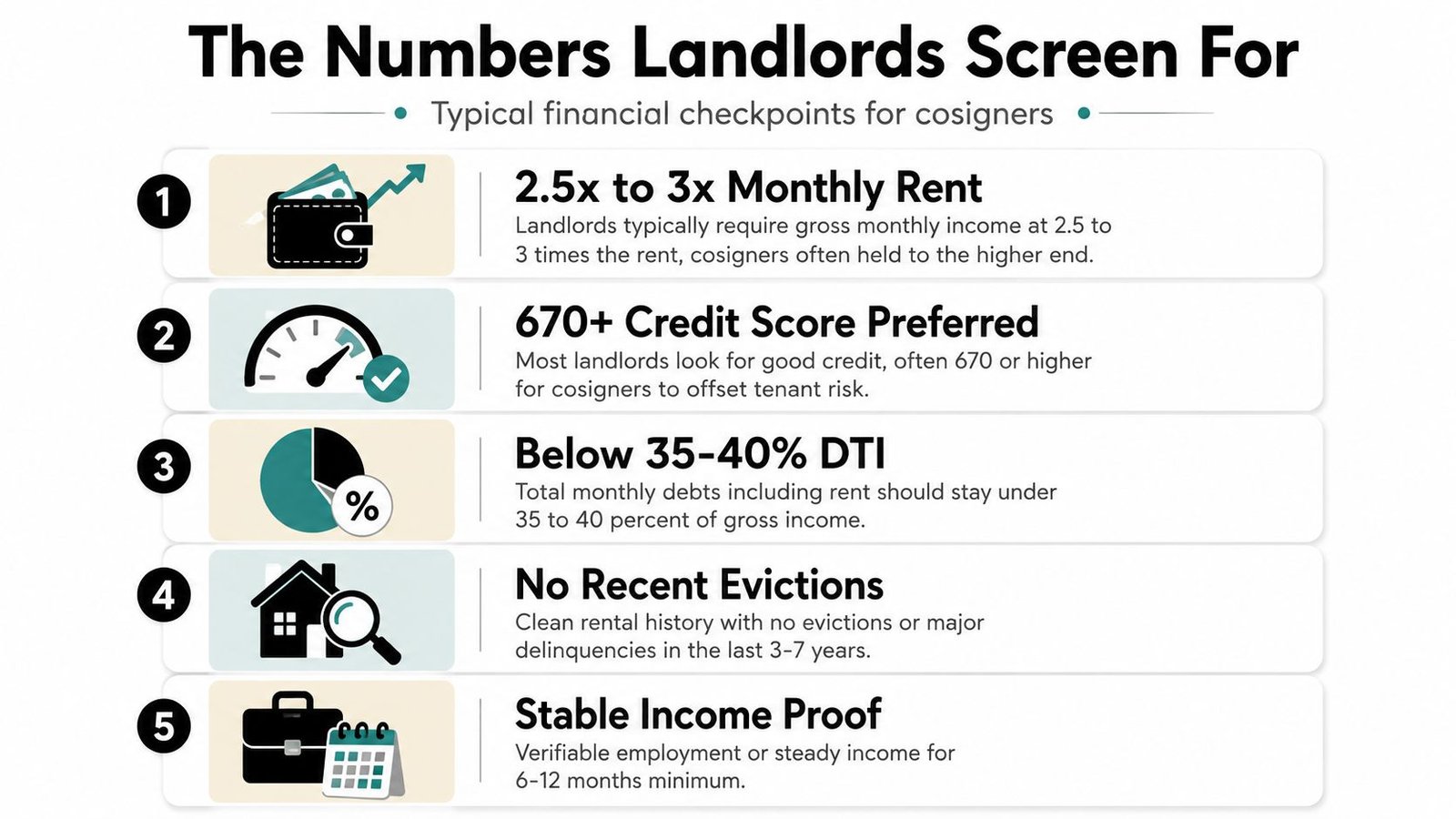
Landlords evaluate a cosigner as a separate financial backstop, not as a decorative addition to the tenant's application. Meeting the income threshold won't necessarily overcome weak credit, excessive debt, or an inability to verify identity.
Income and affordability
Many rental markets use about three times monthly rent as a tenant income benchmark, while cosigners may face a stricter standard of about five to eight times monthly rent, according to cosigner income guidance from The Credit People. For a $2,000 apartment, that stricter range can mean roughly $10,000 to $16,000 in monthly gross income, or about $120,000 to $192,000 annually, depending on the landlord's underwriting rules.
Other landlord guidance describes cosigner expectations around three to four times monthly rent, while particularly strict properties may test annual income at about 40 to 90 times monthly rent, as explained by Redfin's guarantor guidance. These ranges aren't universal. They show why an applicant should ask for the exact written policy instead of relying on a general internet rule.
Credit and debt
Credit standards vary, but published apartment guidance commonly places cosigner targets around 680 to 740 or higher, with premium properties sometimes seeking 700 to 750 or higher. Landlords may also examine debt-to-income ratios and often prefer a result below roughly 36% to 45%, based on Apartments.com's cosigning guidance.
A strong score alone won't solve an affordability problem. The property manager wants evidence that the cosigner could cover the lease while still paying their own mortgage, loans, credit cards, and household expenses.
Identity and legal capacity
The cosigner generally must be at least 18 years old and legally able to enter a contract. Landlords commonly request government-issued identification, a Social Security number or ITIN for screening, and a verifiable address. Residency requirements can be especially strict in markets where collecting against an out-of-state or overseas signer is harder.
For a practical look at how income records are reviewed, these Edinhart Realty tenant screening tips provide useful context on verification. Before signing, review the property's written standards and consider a dedicated cosigner credit check explanation so the screening process doesn't come as a surprise.
Documents and Proof Most Landlords Request
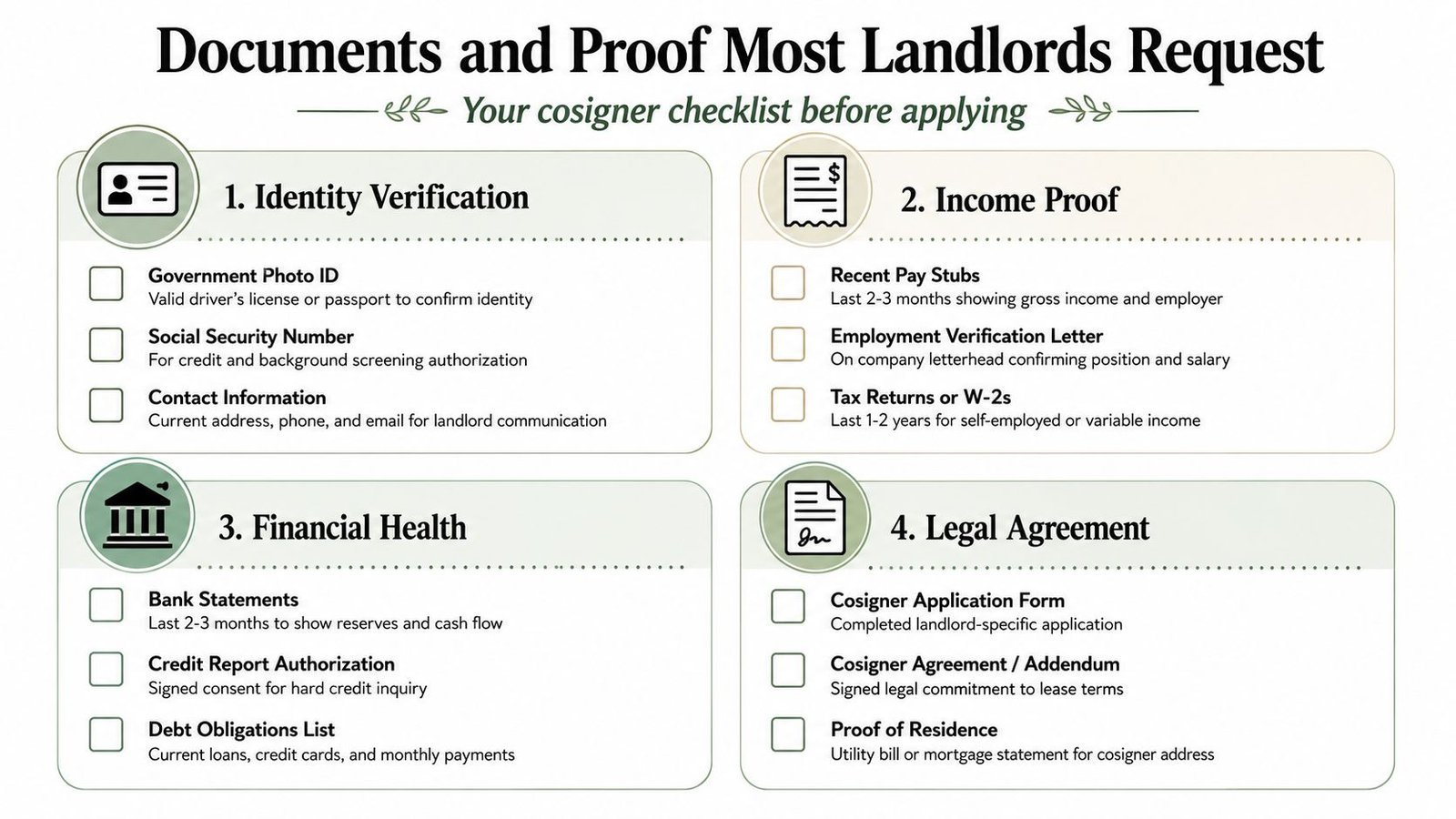
A cosigner can qualify financially and still delay approval by submitting an incomplete file. Property managers often process applications in sequence, so a missing identification page or unclear bank statement can hold up the tenant's move-in.
Start with identity. Prepare a valid government-issued photo ID, the requested SSN or ITIN, proof of age, current address, phone number, and email. The landlord needs to know that the person signing is real, reachable, and legally able to contract.
Build the income file
An employee may provide recent pay stubs, W-2s, an employment verification letter, and tax returns if the landlord requests them. A self-employed cosigner may need personal and business tax returns, 1099 forms, bank statements, recent invoices, or a profit and loss statement instead of ordinary pay stubs.
Bank statements help the landlord see cash flow and available reserves, but they don't replace verifiable income unless the property's policy says they can. Redact unrelated account numbers only if the landlord accepts redaction. Don't alter dates, balances, or transaction descriptions.
Authorize screening
Most landlords require signed permission for a credit and background check. Ask whether the inquiry is hard or soft and how the property stores sensitive documents. A hard inquiry can affect a credit file differently from a soft inquiry, so the cosigner should understand the authorization before signing it.
Proof of residence may include a utility bill, mortgage statement, or current lease. Out-of-state cosigners often need to show that their address is stable and that they can be contacted through ordinary channels. Overseas applicants may face additional verification or may not be accepted under the property's policy.
A professional renters insurance guide from Professional Insurance Advisors, LLC can help separate the cosigner's financial role from the tenant's insurance responsibilities. For a document-by-document preparation list, use this resource on what documents are needed.
Submit clean, readable copies in the landlord's preferred format. Keep the originals secure, respond promptly to verification calls, and ask for confirmation that the file is complete. One missing document can stall an otherwise acceptable application.
Alternatives When a Cosigner Is Not an Option
A tenant who can't find a personal cosigner still has several paths, but each solves the landlord's risk concern differently. The right choice depends on available cash, income stability, relationship preferences, and the property's written policy.
| Alternative | Typical Cost | Best Fit For | Main Drawback |
|---|---|---|---|
| Paid guarantor service | May charge roughly one to two months' rent for a lease-length contract | Students, international renters, and applicants without an eligible personal guarantor | Fee can be substantial and approval isn't automatic |
| Larger security deposit or advance rent | Often one to two additional months of rent | Applicants with stable income but limited credit or rental history | Ties up cash and may be restricted by local law |
| Co-tenant | Shared rent and ordinary tenant costs | Roommates or partners who both want occupancy rights | Creates shared household and lease responsibility |
| Private guaranty letter | Negotiated, often without a standard service fee | Applicants with a financially qualified third party willing to sign a tailored promise | Landlord may reject the format or demand broader liability |
Match the option to the problem
A student with no family support may find a professional guarantor service more practical than asking a distant acquaintance to sign a broad lease obligation. The landlord will still review the service's terms and eligibility, so the tenant should obtain written acceptance before paying a fee.
A tenant with stable employment and a weak credit file might negotiate a larger deposit, if the landlord and local rules permit it. This works best when the problem is limited and the tenant can show consistent income rather than a history of unpaid housing debt.
Adding a co-tenant makes sense only when both people intend to share the home. It isn't a substitute for a cosigner if the second person has the same qualification gap. Both residents may receive rights under the lease, and both can be responsible for the full obligation.
A private guaranty letter can be flexible, but flexibility may weaken enforceability. The landlord should review and approve the exact wording, and the signer should never assume that a short letter limits liability unless the contract clearly says so.
Special Cases Students Self-Employed and International Applicants
Generic rental advice often assumes a salaried applicant with a U.S. credit file. That model doesn't fit everyone, and forcing every applicant into it can produce unnecessary denials.
Students and thin-file renters
Students frequently have limited income, little rental history, or no established credit. A parent or other qualified adult may support the application, but the property may use a guarantor agreement rather than a standard cosigner lease. University enrollment, satisfactory academic progress, evidence of funds, and a housing letter can help the landlord understand the student's circumstances.
International students may encounter a different model altogether. The University of Dundee guarantor scheme illustrates how some student housing programs focus on enrollment, academic status, identification, and proof of address rather than applying a U.S.-style credit and income test to every guarantor.
A thin credit file isn't the same as poor credit. Someone new to the country, under 21, or entering the rental system for the first time may have enough income but not enough history for an automated screen.
Self-employed applicants
Self-employed tenants and cosigners should expect questions about net income, not just gross business revenue. Tax returns, Schedule C or K-1 documents, business statements, invoices, and a current profit and loss statement can show whether income is sustainable after expenses.
Liquidity can help explain a variable income pattern, but savings don't automatically replace earnings. Landlord-facing guidance also discusses liquid savings equal to two to three months' rent and debt-to-income below 40% to 45% as factors some reviewers consider, as described in student document guidance.
International and cross-border files
An international applicant may need visa or status documents, foreign credit records if available, translated bank statements, proof of funds, and an ITIN-based U.S. credit history. Some landlords may request a higher deposit instead of accepting a U.S.-based cosigner, while others may reject foreign documentation if they can't verify it.
For immigration-related legal support resources in Colorado, immigration bail bond information addresses a separate legal process. It shouldn't be confused with rental screening, but applicants dealing with immigration-related documentation should keep each process's requirements distinct.
Real Risks and When to Say No to Cosigning
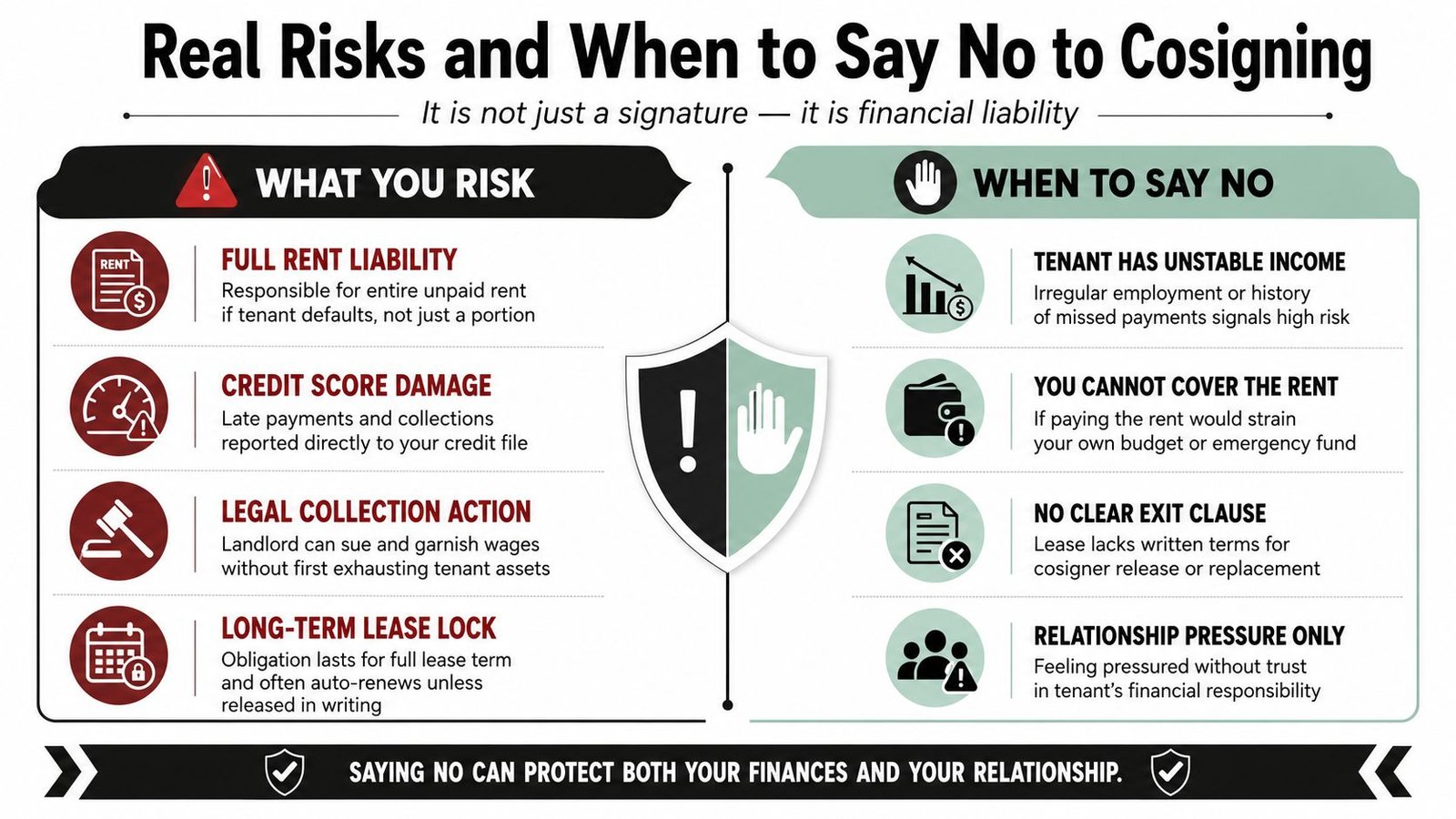
Cosigning is often presented as a simple favor. It isn't. The signer may become responsible for the entire unpaid rent balance, not merely the amount the tenant promised to cover. Depending on the lease, exposure can also include late charges, damage claims, collection costs, and legal expenses.
A sensible cosigning decision starts with the tenant's record, not the family relationship. Open collections, prior evictions, repeated job changes, or broken leases indicate a different risk profile from a recent graduate with a signed employment offer and a short, clearly defined lease.
Practical rule: Don't sign a lease obligation you couldn't cover without damaging your own housing, savings, or credit.
Review the clauses that expand the risk:
- Auto-renewal: The obligation may continue if the lease renews and the cosigner isn't released in writing.
- Late-fee escalation: Extra charges can grow while the tenant tries to catch up.
- Damage provisions: Liability may extend beyond the security deposit if the lease permits additional recovery.
- No release process: Without written conditions for replacement or removal, the cosigner may remain tied to future terms.
A cosigner's own debt-to-income position matters. If absorbing the rent would push their DTI beyond roughly 43%, refusal may be the financially responsible decision, particularly when the tenant has unstable income or prior payment problems. This is the point where personal pressure should yield to a written budget.
Negotiation can preserve the housing opportunity without asking one person to accept unlimited exposure. Consider a smaller unit, a shorter lease term, a permitted larger deposit, or a paid guarantor service. Before deciding, review cosigner responsibilities and compare the actual contract with what the tenant believes they're asking for.
Practical Checklist Before You Sign the Lease
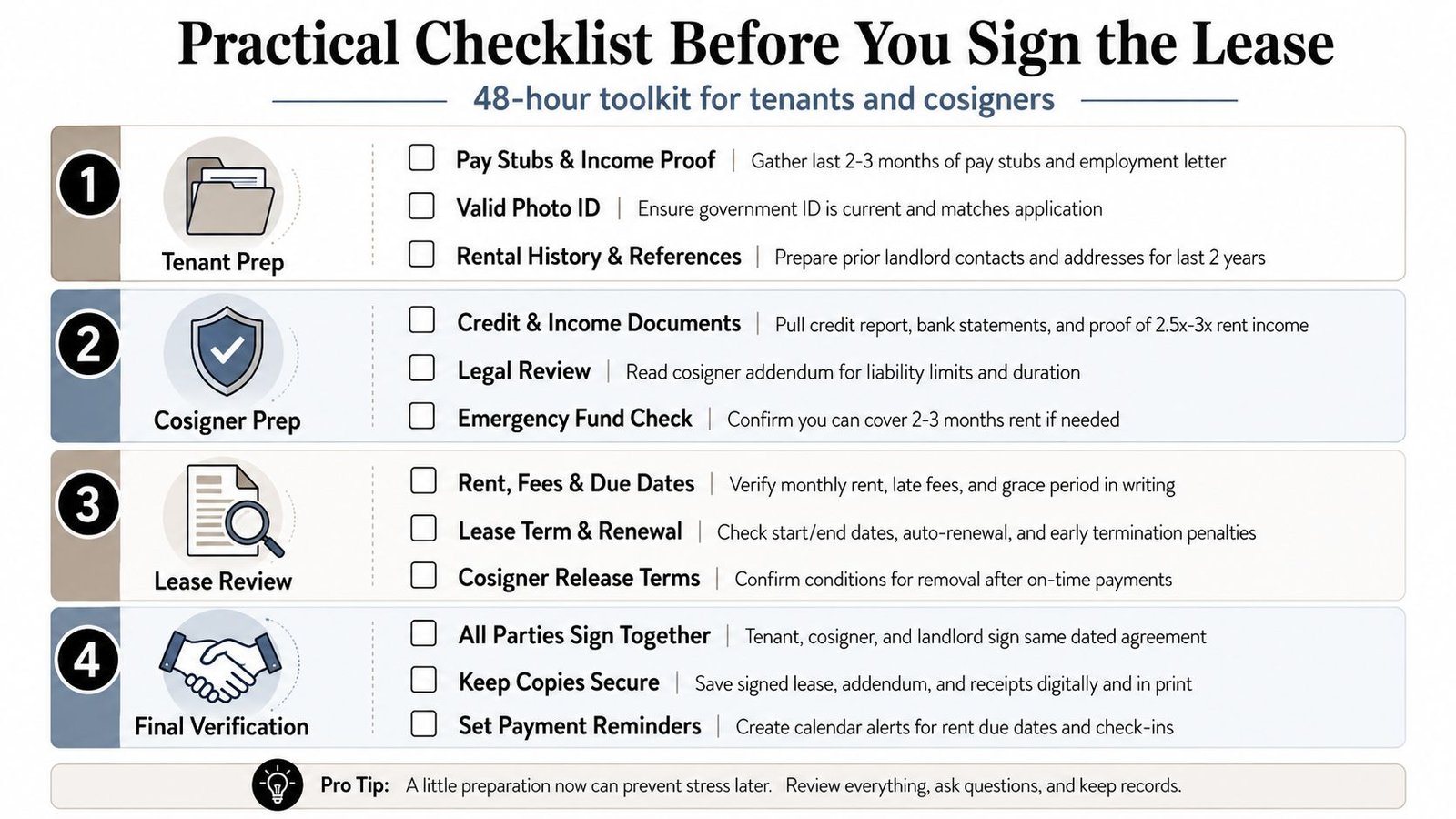
Use the final review as a shared meeting, not a last-minute signature request. The tenant and cosigner should read the same documents, ask the landlord the same questions, and keep proof of every answer.
Tenant preparation
Gather current income documents, identification, rental-history addresses, prior landlord contacts, and references. Make sure names and addresses match across the application. Tell the cosigner about any past eviction, collection, job change, or credit issue before the landlord discovers it.
Cosigner preparation
The cosigner should assemble income proof, authorize the requested credit screening, list existing monthly debts, and calculate whether they could cover the rent temporarily. Don't rely on a verbal promise that the landlord will call only after the tenant misses payments. The signed agreement controls.
Lease review
Read the rent amount, due dates, late-fee structure, grace period, maintenance obligations, early-termination terms, and joint-and-several-liability language. Check whether the cosigner addendum caps liability, applies only to the initial term, or continues through renewals.
Ask for a written release process. If the tenant later qualifies independently, the landlord may require a new screening, replacement agreement, or new lease before removing the cosigner. Don't assume that twelve months of on-time payments automatically ends the obligation unless the lease says so.
Final confirmation
Before keys change hands, confirm that the tenant has the required renters insurance, utilities are arranged, and the deposit receipt is issued. The parties should sign the same dated version of the lease and addendum, then save digital and printed copies.
Document the unit's condition at move-in with dated photos and written notes. Set rent reminders, schedule periodic check-ins, and revisit the cosigner's obligations annually so the backstop doesn't outlive its usefulness.
Bring questions to the landlord in writing and request written answers. For people comparing documentation and cosigner processes across urgent legal situations, Express Bail Bonds offers Colorado surety bail bond applications, electronic contract signing, and guidance on cosigner information and required identification. Visit Express Bail Bonds to review the process and contact the agency before signing any agreement you don't understand.