The call usually comes at the worst time. A son, daughter, spouse, or friend says they were picked up on a probation violation, and the first question out of your mouth is simple. “Can they bond out?”
Sometimes yes. Sometimes not right away. In Colorado, probation violation bail is one of the most stressful corners of the system because a person can be jailed over conduct that never led to a new conviction, and families often have to act fast with very little information.
That urgency is real. Nearly 200,000 people were admitted to prison for probation or parole violations in 2023, including more than 110,000 for technical violations such as missed appointments, curfews, or other supervision-rule breaches according to the Council of State Governments Justice Center key findings. The same findings note that supervision violations accounted for about 42% of prison admissions.
If you're dealing with this in Colorado, the goal is to get clear on three things fast. Whether there is a bond. What hearing is coming next. What facts will help the judge consider release.
An Unexpected Arrest A Guide for When Probation Goes Wrong
The call usually sounds the same. A family member says they were picked up on a probation warrant, they do not know if a bond has been set, and they need help now. In Colorado, that kind of arrest catches families off guard because the original case may have felt finished months ago.
Probation can unravel fast. A missed check-in, an unpaid fee, an incomplete class, a positive test, or a new allegation can put someone back in custody. Once that warrant is active, the practical problem is immediate. Find out where the person is being held, whether the court has set a bond, and when the case will be brought before a judge.
Families often get blindsided because they expect the court to treat a probation matter like a routine new arrest. It usually does not. A probation case starts with a prior conviction and an existing court order. If the judge believes those terms were ignored, release can get harder and the timeline can tighten up quickly.
When a probation warrant is involved, waiting usually costs time and options.
The first step is to gather the information a bondsman or court clerk will ask for right away:
- Full legal name: Exact spelling matters.
- Date of birth: This helps confirm identity in jail records.
- County and jail location: In Colorado, the county often determines how quickly you can confirm status and bond information.
- Case number if available: This makes tracking the warrant and hearing easier.
- Reason for the alleged violation: Even a basic description helps us figure out what release issues may come up.
If you are still sorting out the booking side of the process, this guide on what happens after you get arrested explains what usually happens next in Colorado.
At Express Bail Bonds, the priority in these cases is speed and accuracy. We help families verify the hold, confirm whether a bond is available, and act quickly if release is possible. That matters in Colorado probation cases, where a few hours of good information can make the difference between getting someone home or waiting in custody until the next court date.
How Probation Violation Bail Is Different
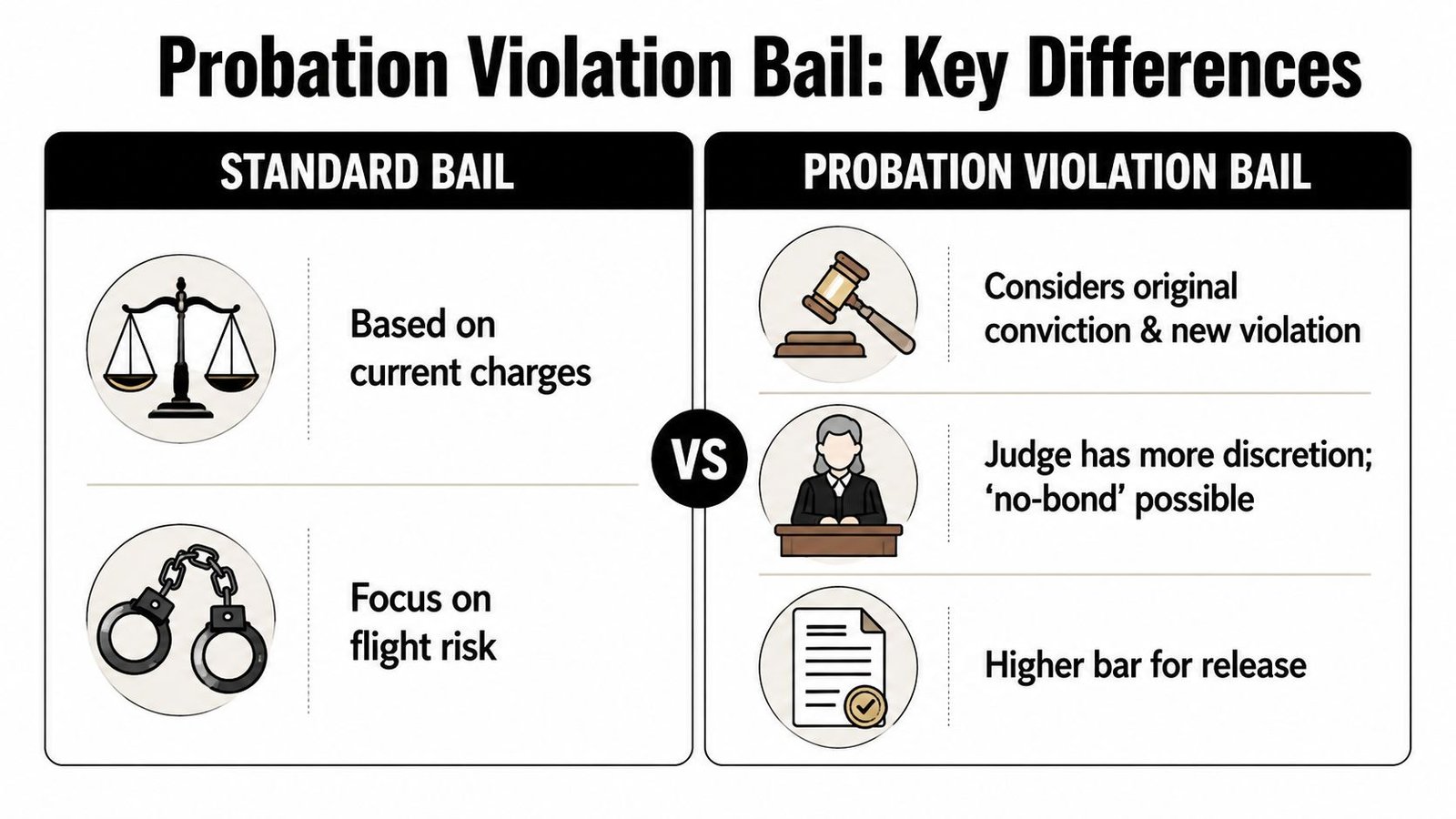
Standard bail asks one main question. Should this person be released while a criminal case is pending?
Probation violation bail asks a tougher one. Should this person be released after the court already gave them a chance and now believes they may have broken the rules of that release?
Why the judge looks at these cases differently
On a first arrest, the court often starts from the current charge and the usual release factors. On a probation violation, the judge is also looking backward. The original conviction matters. The person's supervision history matters. Whether they followed treatment, reporting, testing, and court orders matters.
That's why a probation hold can feel harsher than the family expected.
Procedurally, the burden often shifts toward the defendant after a probation violation warrant is issued. Courts focus heavily on public safety and flight risk, so even technical violations can lead to detention unless the defendant can show stability, compliance, and community ties as described in this overview of probation violation bail decisions.
What usually helps and what usually doesn't
A useful way to think about it is this. Standard bail is often about whether someone will come back to court. Probation violation bail is about whether the court believes supervision can still work.
| Issue | Usually helps | Usually hurts |
|---|---|---|
| Residence | Stable address, verified housing | No clear place to stay |
| Employment | Current job or recent work history | No structure or no documentation |
| Compliance history | Prior reporting and treatment effort | Pattern of missed requirements |
| Violation type | Technical issue with explanation | New criminal allegation |
| Support plan | Family supervision and transportation | No plan for check-ins or treatment |
A lot of families make the mistake of arguing fairness. They say the person “didn't do anything that bad.” That may be emotionally true, but it usually isn't the argument that moves the court.
Practical rule: Judges respond better to a concrete release plan than to frustration about the arrest.
If you need a clean explanation of how regular release decisions work so you can see the contrast, this page on what pretrial release means is useful background.
The Arrest and Revocation Hearing Process
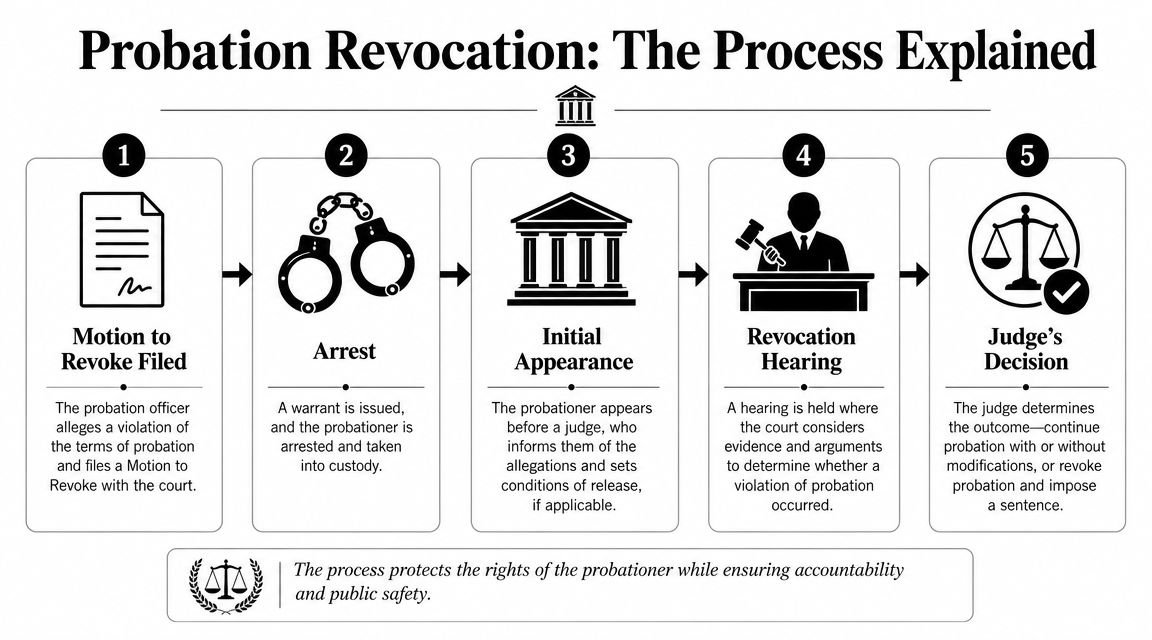
The process usually starts before the arrest. A probation officer or prosecutor alleges a violation, the court issues paperwork, and a warrant follows. By the time the family gets the call from jail, the legal machinery is already moving.
Here is the sequence individuals typically encounter.
What usually happens first
A violation is alleged
This can involve missed reporting, failed testing, incomplete treatment, travel problems, or a new arrest.A motion or warrant is issued
Once that happens, the person can be picked up on the probation matter itself.Booking into jail
The jail enters the case, confirms the hold, and waits for the court process to begin.Initial appearance
The judge reviews the posture of the case and decides whether release is possible, delayed, or denied.
Many families assume this first appearance will resolve everything. It usually won't. It often sets the terms for what comes next.
Why speed matters
People held on probation violations can sit longer than families expect. In some jurisdictions studied by Prison Policy Initiative researchers, the share of jail population held for probation violations ranged from 9.1% to just over 50%, and those cases also stayed longer in jail according to the Prison Policy Initiative probation and parole research.
That's one reason it helps to track the case closely instead of waiting for a phone call. If you're trying to understand where a matter stands once you have a case number, the CasePulse guide to case status offers a practical overview of how to interpret status updates.
A short video can also help if you're trying to explain the flow to another family member before court:
What the revocation hearing is about
The later hearing is where the court decides whether the person violated probation and what the consequence should be. That may include continued probation, modified conditions, or revocation.
Bring these items to the lawyer or have them ready for the court conversation:
- Proof of address: Lease, utility bill, or written family housing confirmation.
- Proof of work: Pay stubs, employer letter, or schedule.
- Treatment records: Attendance slips, program contacts, discharge paperwork, testing history.
- Medical records if relevant: Hospital visit, prescriptions, or documented emergency.
- Transportation plan: Who will drive, supervise, and help with check-ins.
If the person has a public defender or may need one, this explanation of the role of a public defender helps families understand who handles what.
Your Colorado Bond Options and Fees
If the judge allows release, the next issue is practical. How do you get someone out?
In Colorado, families usually face two broad paths. They can pay the full bond directly if the court allows that form of payment, or they can use a surety bond through a licensed bond agency. The right choice depends on the bond type, the amount, and how quickly the family needs to move.
Cash bond compared with surety bond
Cash sounds simple on paper. If the court sets a bond and accepts cash, someone pays the full amount to the court. The problem is obvious. Many families don't have the full amount available on short notice, especially if the arrest happened overnight or while they are also paying for a lawyer, childcare, transportation, and missed work.
A surety bond works differently. The family pays a premium to a bail bond agency, and the agency posts the bond.
Here's the practical comparison in Colorado:
| Bond route | What family pays up front | Main trade-off |
|---|---|---|
| Cash bond | Full bond amount | Ties up a large amount of money |
| Surety bond | Premium to licensed agency | Premium is the cost of the service |
Colorado fee expectations
Colorado's standard premium is 15%, and for bonds over $5,000 some agencies may offer 10% with an approved cosigner, based on the terms described by Express Bail Bonds. That matters in probation cases because release decisions can happen fast, and families often need a realistic option they can complete without standing in line at a jail for hours.
The biggest mistake families make on bond is waiting to “see if they lower it later.” If release is available now, delay often means extra jail time with no real advantage.
What to ask before you commit
Don't focus only on the fee. Ask the questions that affect the actual release process:
- Is this a surety-eligible bond or a no-bond hold?
- Can paperwork be signed remotely?
- What does the cosigner need to provide?
- How fast can the bond be posted at this county jail?
- What happens if the defendant misses court later?
Probation violation bail is often less about finding any money and more about choosing the path that can be completed quickly and correctly.
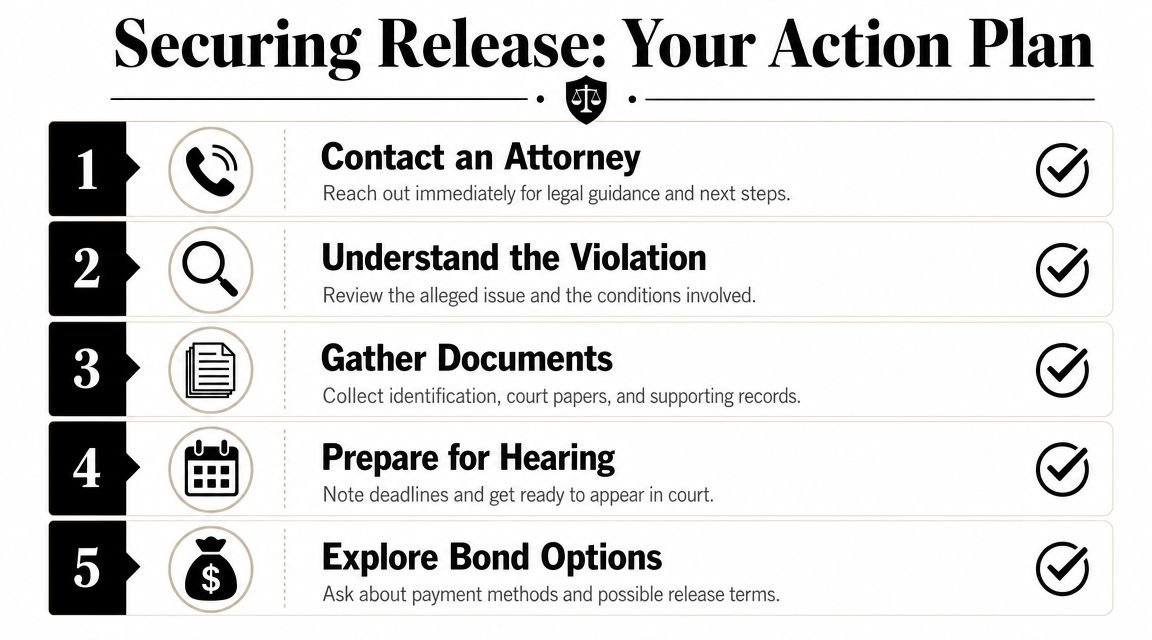
A Step-by-Step Guide to Securing Release
When a loved one is in custody on a probation violation, clarity matters more than speed alone. Fast action is good. Fast action with the wrong information creates delays.
The first moves to make
Call immediately
If you're trying to secure release, contact a Colorado bond professional right away at 720-984-2245. Ask whether the person has a bond, a hold, or a pending advisement. Those are very different situations.Gather the booking details
You'll need the defendant's full name, date of birth, jail location, and, if possible, case number. If there's confusion about the county, verify it before paperwork starts.Find out who will cosign
The best cosigner is usually someone stable, reachable, and financially responsible. The court doesn't choose the cosigner, but the bond company will evaluate who is taking responsibility for the bond contract.
What a strong release file looks like
A probation case improves when the family can show structure. Start collecting:
- Housing proof: Where the person will stay after release.
- Work history: Current employer, shift schedule, or recent employment records.
- Treatment information: Counseling, classes, testing, or rehab participation.
- Family support: Who will help with court dates, reporting, and transportation.
Some Colorado families prefer a local office connection depending on the jail involved. If the case is tied to the west metro area, the Jefferson County and Golden bail bond page is a practical local reference. For south metro cases, the Centennial bail bond page can help you confirm service coverage and local process.
How remote processing helps
A lot of families are out of town, at work, or juggling kids when the arrest happens. Remote paperwork changes the game. Applications, contract documents, and payment steps can often be handled electronically, which saves hours and reduces mistakes caused by rushed in-person visits.
If this is your first time dealing with the process, this walkthrough on how to bail someone out of jail fills in the basics without legal jargon.
Don't wait for every document to be perfect before making the first call. Start the process, then supply the missing pieces in order.
After Release Court Conditions and Next Steps
Getting released is a win, but it isn't the finish line. In many probation cases, release comes with tighter supervision and closer scrutiny than before.
That can mean more frequent reporting, stricter testing, treatment requirements, location restrictions, or other court-ordered conditions. If the person treats release like the crisis is over, they can end up right back in custody.
The hearing standard is lower than most families expect
This is one of the hardest parts to explain to a family. A probation violation hearing isn't a criminal trial, and the state does not have to meet the same burden.
In a probation violation hearing, the state only has to prove the violation by a preponderance of the evidence, meaning it is more likely than not that a violation occurred, as explained in this Colorado probation violation discussion. That lower standard makes these hearings dangerous even when the allegation sounds minor.
What the person should do immediately after release
The first week matters most. Keep it simple and disciplined.
- Follow every written condition: Don't rely on memory.
- Contact counsel right away: Defense preparation starts before the hearing.
- Save proof of compliance: Testing receipts, treatment attendance, work records, and messages.
- Avoid new problems: Even small police contact can change how the judge sees the case.
Why bond compliance matters too
Families also need to understand the bond side. Missing court or violating release terms can create a second layer of trouble involving the bond itself. If you're trying to understand those risks, this explanation of bond forfeiture lays out what can happen when a defendant doesn't appear as required.
A good release plan is boring on purpose. Stable housing, sober routine, clear transportation, and zero surprises give the judge fewer reasons to revoke.
Colorado Probation Violation FAQs and Resources
Families usually need answers fast after a Colorado probation arrest. The right question at the right time can save hours, and sometimes a full day, in getting someone back home.
What's the difference between a technical violation and a new law violation
A technical violation means the person allegedly broke a probation rule. Common examples include missed reporting, missed classes, travel without permission, or failed testing. A new law violation means the person is accused of committing a new offense while already on probation. Judges in Colorado usually treat that second category more seriously because it raises immediate public safety and compliance concerns.
Can someone get bail after more than one probation violation
Yes, sometimes. It gets harder.
Repeated violations often make the court focus on pattern and risk instead of explanation. In those cases, families should spend less energy arguing over fairness and more energy gathering proof that the person can follow rules now. Useful documents include treatment attendance, proof of work, address verification, transportation plans, and anything else that shows stability.
How long does it take to post probation violation bail
There is no single timeline across Colorado counties. Release depends on the jail, the court's order, the bond type, and how quickly the family can provide correct booking and case information.
The delays I see most often are simple but costly. Wrong spelling, missing booking numbers, unsigned indemnitor paperwork, confusion about the bond amount, or waiting until the end of the day to start can all slow release down.
What Colorado resources should families check
Start with official local sources and keep your notes in one place.
- Colorado court locator and dockets: Check the Colorado Judicial Branch website for court locations and public case access.
- County jail inmate search tools: Many Colorado counties provide online custody search pages.
- Defense support: Outside administrative help is useful for legal teams or families needing document support and case organization. Paralegal Assistants can help with document support and case organization.
One more practical point. Keep a written timeline with arrest details, court dates, names, call logs, bond information, and every release condition. In Colorado probation cases, organized families make faster decisions and give the defense lawyer better material to work with.
If your family is dealing with a probation violation arrest in Colorado, Express Bail Bonds is available 24/7 by call or text at 720-984-2245. They've served Colorado detention facilities statewide since 1988 and can handle surety bond paperwork electronically, which helps families move quickly when time matters most.