It's 2 AM. Your loved one has been booked in Colorado, you're several hours away, and nobody in the family can get to a bail bond office or detention center. You need a payment method that works remotely, creates a clear record, and doesn't leave you guessing whether the bond agent received the money.
An electronic bank transfer can solve that problem, but only if you choose the right transfer type and follow the agent's instructions exactly. Speed, settlement, fees, transfer limits, fraud protection, and the possibility of a return all matter when someone's release depends on the payment.
Why Families Choose Electronic Bank Transfers for Bail
A family member in Jefferson County or Centennial may need a cosigner who lives in another state. That person might be at home with children, working an overnight shift, or unable to fly or drive to Colorado. Waiting until morning or arranging an in-person payment can add stress when the paperwork and bond approval are already moving quickly.
Electronic payment removes much of that physical distance. A cosigner can complete documents remotely, contact the bond agency, and send funds through a bank account without spending hours at a detention center. The process still requires identity verification and an approved agreement, but the payment itself can move through a digital channel.

The pressure is practical, not just emotional
Families often face several decisions at once:
- Confirm the location: Determine whether the defendant is held in Jefferson County, Arapahoe County, Denver County, or another Colorado facility.
- Confirm the bond: Ask the agent for the exact bond amount and premium before sending anything.
- Choose the payment rail: ACH may suit a lower-urgency payment, while a wire may be more appropriate when same-day settlement matters.
- Keep proof: Save the confirmation number, receipt, and all messages exchanged with the agency.
If you're dealing with an arrest outside Colorado, the process can differ by state. A practical explanation of bail help for Michigan arrests can help you understand why local rules and bond types matter before you send money.
Colorado families should also understand that a surety bond premium is separate from the full bail amount. The bond agency posts the bond under its agreement with the defendant and cosigner, while the cosigner pays the required premium and accepts the contract obligations.
Practical rule: Never send funds to bank details received from an unverified text message. Call the agency through its official published number and confirm the recipient information verbally.
Before authorizing a payment, review how to pay a bail bondsman so you know what information and documents may be required. Remote payment is convenient, but convenience doesn't replace verification.
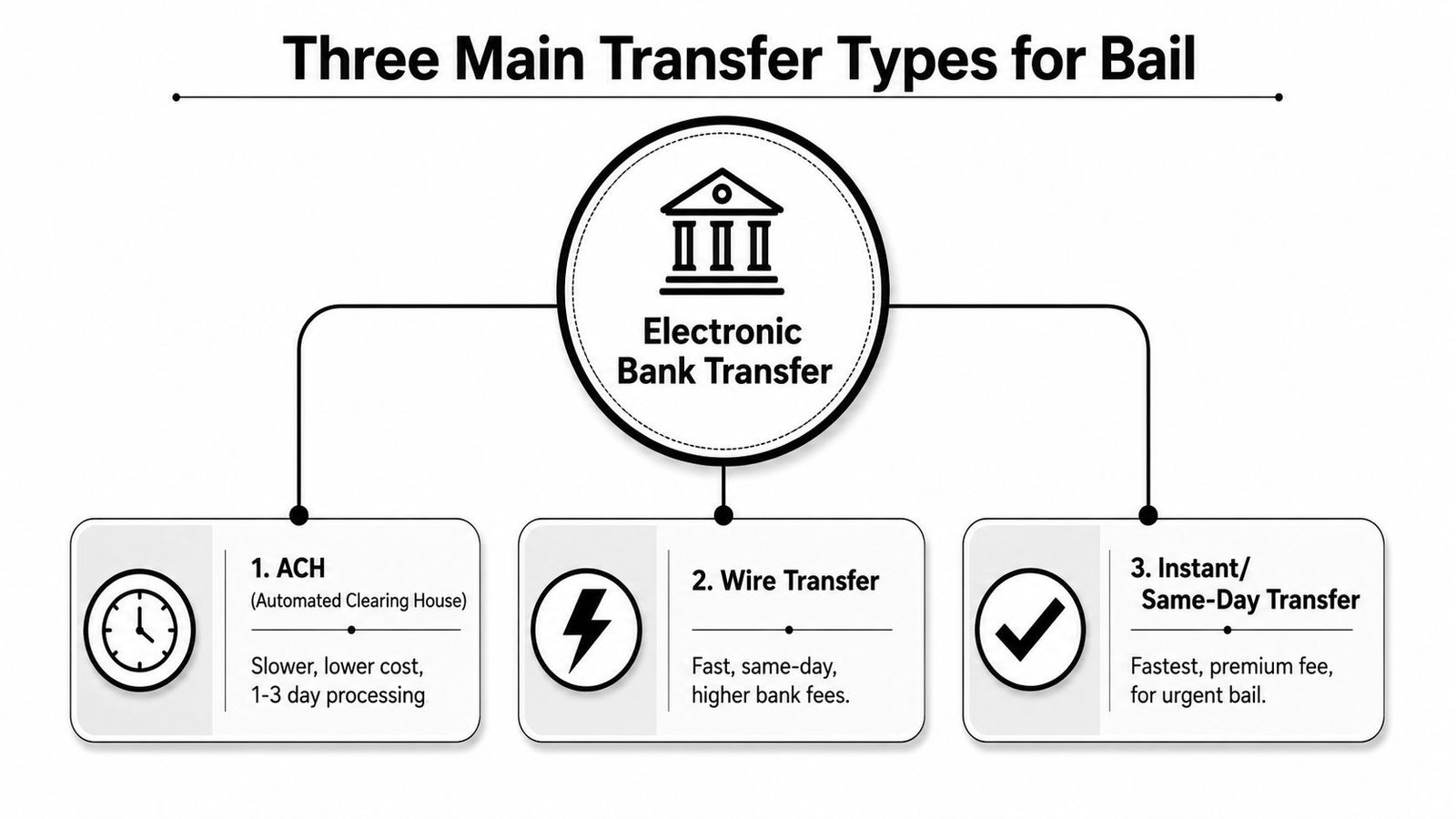
Understanding the Three Main Transfer Types
“Electronic bank transfer” is a broad term. It describes money moving electronically between accounts, but the actual network determines how fast the payment settles, what fees may apply, and whether the payment can be returned.
ACH is the lower-cost digital check
ACH, or Automated Clearing House, is commonly used for account-to-account payments. Think of it as the digital equivalent of a check. The sender authorizes a debit or credit using bank account information, and the payment moves through the ACH network rather than through a card network or a direct wire system.
ACH makes sense when the bond agent has enough time to wait for ordinary processing and the bank account limit accommodates the premium. Same Day ACH can move within hours when the entry meets the applicable processing deadline. Standard ACH commonly settles in 1 to 2 banking days, according to this payment finality comparison.
A wire is a direct bank-to-bank courier
A wire transfer sends payment from one financial institution to another through the banking system. It's the option families usually consider when the payment must settle the same day and the sender can meet the bank's cutoff time.
Wires may carry higher fees than ACH, and a bank may require additional verification. The tradeoff is speed and stronger settlement finality. Once a wire reaches the beneficiary bank, it's typically effectively irrevocable, so the recipient's details must be checked before the sender presses confirm.
EFT is the umbrella category
Electronic Funds Transfer, or EFT, covers a wider range of electronic payments. Depending on the setup, it can include debit card payments, online bill pay, app-based transfers, direct debits, and account transfers.
U.S. law distinguishes electronic fund transfers from paper payments because they're initiated through an electronic terminal, telephone, computer, or magnetic tape to debit or credit a consumer account. Regulation E and the Electronic Fund Transfer Act also establish rules for unauthorized transfers, consumer liability, and error disputes. The consumer rights explanation for electronic fund transfers provides useful legal background.
For bail payments, don't assume every agency accepts every EFT method. Ask which rails the agency accepts, whether the funds must be fully settled before posting, and whether a debit card or app payment has different processing rules. If you're comparing account payment with card payment, review whether bail can be paid with a credit card before choosing.
Comparing Speed and Cost Across Transfer Methods
The right method depends on the release timeline, your bank's rules, and the agency's posting policy. A payment that appears “sent” in your banking app may not yet be available to the recipient, so ask what the agent considers proof of payment.
| Feature | ACH Transfer | Wire Transfer | EFT (Debit/App) |
|---|---|---|---|
| Typical speed | Standard ACH commonly settles in 1 to 2 banking days. Same Day ACH can settle within hours when eligible and submitted on time. | Often settles the same day when submitted before the bank cutoff. | Depends on the card network, bank, app, and payment processor. |
| Cost | Often lower-cost, but your bank or processor may charge a fee. | May include an outgoing or incoming wire fee and possible intermediary charges. | May include card-processing or service fees. |
| Transfer limits | The network cap and your bank's customer limit may differ. | Your bank may impose its own limit or approval process. | Limits vary by provider, account, and security settings. |
| Return or finality | Consumer debits can be returned up to 60 calendar days from settlement under applicable rules. | Typically effectively irrevocable once received by the beneficiary bank. | Dispute and reversal rights depend on the payment method and circumstances. |
| Best bail use | A payment with enough time for ordinary settlement. | An urgent payment when same-day receipt matters. | A convenient option when the agency accepts it and the provider confirms availability. |
Colorado's standard bail bond premium is 15%. For bonds over $5,000, 10% is often available with an approved cosigner, but the agent must confirm the actual premium and contract terms for the specific bond.
A lower fee doesn't make ACH the better choice if the jail release depends on funds arriving that night. A wire may cost more, but that expense can be reasonable when timing is the priority. Conversely, sending a wire without confirming the recipient details creates a serious problem because finality is harder to unwind.
For a deeper look at the payment process and available electronic options, review electronic payment processing. Then ask the bond agent one direct question: “What must you see before you can post the bond?” The answer tells you whether a pending transfer is enough or whether settled funds are required.
Step by Step Checklist for Sending a Bail Payment
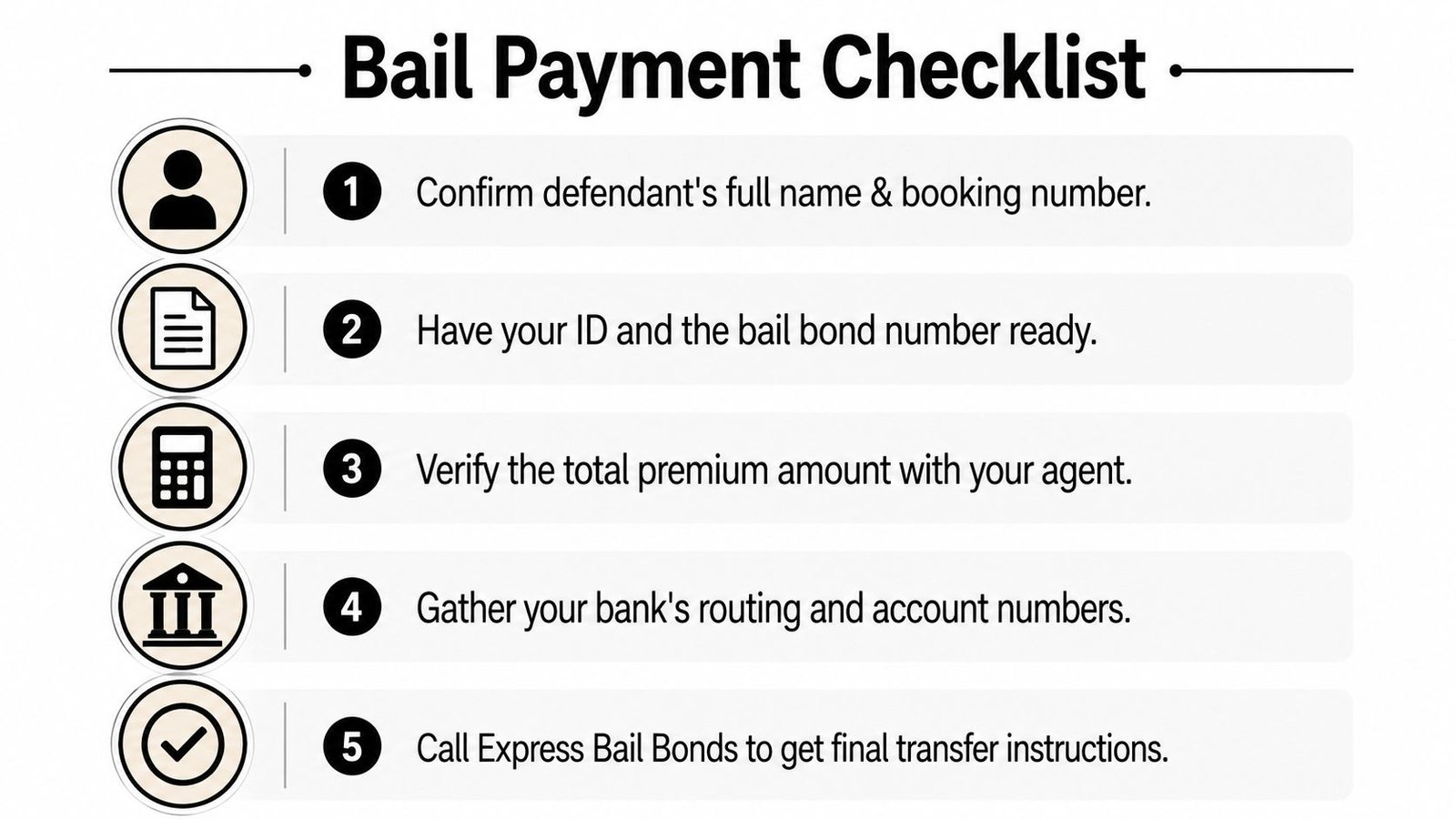
At 2 AM, don't rely on memory. Use a short checklist and keep every confirmation. A missing booking number or one incorrect account digit can delay the release.
Gather the defendant's information
Before contacting the agency, collect:
- Full legal name and date of birth. Confirm spelling exactly as it appears in the booking record.
- Booking number. This helps the agent identify the correct defendant when names are similar.
- Detention facility. Note the county and facility where the defendant is held.
- Your identification. Have the ID requested for the cosigner process.
- Bond details. Ask for the bond number, total bond amount, and premium due.
Don't guess the premium from the bond amount. Ask the agent to confirm the figure before you authorize the transfer.
Complete the agreement remotely
Contact the bond agency at 720-984-2245. The agent can explain the application, cosigner responsibilities, required documents, and the payment channel available for your situation.
Complete the electronic application and contract before sending funds. The written agreement should identify the parties, obligations, payment terms, and any collateral or indemnity requirements that apply.
An accounts-payable process usually depends on authorization, accurate payment details, and confirmation records. That makes this accounts payable workflow overview useful background for understanding why a professional payment process asks for documentation before funds move.
Send only the verified payment
After the agreement is complete, receive the payment instructions directly from the agent. Confirm the routing number, account number, recipient name, transfer type, amount, and any reference or memo required.
Then:
- Call your bank if needed: Ask whether the transfer is ACH or wire and whether the bank requires additional approval.
- Review every digit: Compare the details against the instructions supplied by the agent.
- Save the confirmation: Keep the transaction ID, receipt, date, time, and amount.
- Confirm arrival: Send the confirmation to the agent and ask whether the funds are received and usable for posting.
For remote processing, see how to pay a bail bond online. Electronic contracts and payments can reduce unnecessary travel, but the agent still needs complete and accurate information to move the release forward.
Security Protections and Fraud Risks to Watch
Families sending money under pressure are attractive targets for fraud. The safest approach combines bank security tools with independent verification of the recipient.
Banks commonly use encryption, login controls, transaction monitoring, and two-factor authentication. Turn on transaction alerts, use a private connection, and don't share one-time passcodes with anyone claiming to be an agent, bank employee, or jail official.
Regulation E and the Electronic Fund Transfer Act provide a framework for certain unauthorized consumer transfers and error disputes. That protection doesn't mean every mistaken or deceptive payment will be fully recoverable. Whether you authorized the transaction, how the authorization occurred, and how quickly you report the problem can affect the outcome.
Fraud trends make verification essential
Fraudulent bank transfers, card payments, and cash withdrawals in the Dutch payments system rose 30% in 2025 to about 658,000 cases, while European bank-transfer fraud rose 55% to 129,000 cases and €148 million in value, according to the Dutch central bank's payment-fraud update. These figures reinforce a simple point: urgency is not a reason to skip verification.
Use this process:
- Verify the agency: Check the Colorado Division of Insurance licensing information independently.
- Verify the contact route: Go to the official agency website yourself instead of clicking an unsolicited text link.
- Verify the bank details: Call the published number and read the routing and account details back to the agent.
- Reject pressure tactics: Don't send funds because someone threatens immediate consequences or demands secrecy.
If you suspect an unauthorized payment, contact your bank's fraud department immediately, preserve messages and receipts, and notify the bond agency through a verified channel. These debit card fraud protection tips offer additional guidance for protecting payment credentials and responding quickly.
For the contract itself, review electronic signature requirements and make sure you understand what you're signing before authorizing payment.
Troubleshooting Common Transfer Delays and Errors
A pending status doesn't automatically mean the payment failed. It means the bank or payment network hasn't completed the transaction, and the bond agent may not be able to use the money yet.
If the transfer stays pending
Check the expected settlement window shown by your bank, then call the ACH or wire department rather than relying only on general customer service. Ask whether the payment is held for review, waiting for a cutoff, or rejected for account verification.
Send the transaction confirmation to the bond agent and ask whether the funds have arrived. Don't send a second payment until the first transaction's status is clear, or you could create a duplicate payment.
If the bank details were wrong
An incorrect routing number or account number can cause a return or misdirected payment. Contact your bank immediately, request a trace or recall if available, and tell the bond agent what happened. Wires are especially urgent because recovery becomes difficult after the beneficiary bank receives the funds.
If your daily limit blocks the payment
ACH limits aren't uniform. Banks may set customer-level limits from a few thousand dollars to $25,000 per day, even though the network cap is higher, as explained in this ACH transfer-limit guide. Ask your bank about a temporary increase before initiating the transfer, and confirm whether a branch, phone request, or identity check is required.
Same Day ACH is currently capped at $1 million per payment, and Nacha approved an increase to $10 million effective September 17, 2027, as stated in Nacha's payment-limit announcement. Your personal bank limit may still be much lower.
If a wire misses cutoff
A wire submitted after the bank's cutoff may move to the next business day. Ask the bank whether an expedited option remains available, then coordinate with the bond agent so everyone understands the revised timing.
Best Practices and Next Steps for Remote Bail Payments
Choose the transfer method based on the release deadline, not habit. Use ACH when the agent can wait for settlement, a wire when same-day receipt is necessary, and another EFT method only after the agency confirms it accepts that payment and can apply it promptly.
Verify the defendant's identity, bond amount, recipient details, transfer limit, and bank cutoff before sending. Keep the confirmation number and ask the agent to confirm receipt. If the bank shows “pending,” treat that as an unresolved payment until the recipient confirms usable funds.
Express Bail Bonds has served Colorado since 1988, with statewide coverage that includes Denver, Arapahoe, Jefferson, Douglas, Weld, and El Paso counties. The agency is available 24/7 by call or text at 720-984-2245, which matters when a family member is detained outside ordinary business hours.
For a loved one in Jefferson County, start with the Jefferson County Golden bail bonds service page. For an arrest in Arapahoe County, use the Centennial bail bonds service page. You don't need to solve the payment process alone. A verified agent can tell you which method to use, what documents to complete, and what confirmation is required before posting.
Express Bail Bonds helps Colorado families arrange surety bonds, electronic contracts, and remote payment guidance when someone is detained and time matters. Visit Express Bail Bonds to start an application or get direct help choosing the safest electronic bank transfer for the situation.