
A call from jail usually comes at the worst possible time. Late at night. In the middle of work. While you're trying to get kids fed, answer texts, or make sense of a family argument that got out of control. Then you hear the words no one wants to hear: someone you care about has been arrested for domestic violence.
Your mind goes straight to the same questions I hear all the time. How much is bail? Can they get out tonight? What am I supposed to do first? And just as important, what am I agreeing to if I help?
If you're looking up the domestic violence bail amount in Colorado, you're probably not doing it out of curiosity. You're trying to solve a problem that feels urgent, confusing, and personal. The hard part is that these cases rarely turn on the dollar amount alone. In Colorado, the release process often gets more complicated because of the arrest procedure, court review, and protection order conditions that come with the case.
The Phone Call No One Wants to Get
You pick up the phone and hear stress on the other end. Maybe it's your spouse, your son, your sister, or a close friend. They say they've been booked into jail on a domestic violence related charge. They don't fully understand the charge. You don't understand what jail they're in. Someone mentions bond, but no one can tell you whether bond has even been set yet.
That confusion is normal.
Families often think the first step is finding the money. Sometimes it is. But in a Colorado domestic violence case, the first hurdle is often figuring out whether the person can be released yet, what conditions the court will impose, and what the family needs to do to avoid making things worse.
A lot of callers are trying to solve five problems at once:
- Locate the person: You need to confirm which jail is holding them.
- Find out the charge: A misdemeanor and a felony won't be treated the same way.
- Learn the bond status: In many DV cases, release isn't as simple as paying immediately.
- Understand the restrictions: A no-contact order can change where the person can go after release.
- Protect the future: Arrest records can create long-term issues even before a case is resolved, which is why some families also look into guidance on managing past arrest records once the immediate crisis is under control.
When families panic, they often focus on the fastest answer instead of the right one. In a domestic violence case, the right answer starts with the court's release rules.
The good news is that this process becomes more manageable once you break it into steps. You don't need to know everything at once. You need to know what the court is deciding, what bail means, and what conditions can delay release even after money is arranged.
What Bail Means in a Domestic Violence Case
Bail is a court's release mechanism. It is not a finding of guilt. A simple way to think about it is a security deposit for returning to court. The judge is deciding whether someone can be released while the case is pending, and under what conditions.
That basic idea applies in many criminal cases. Domestic violence cases are different because courts treat them as cases with heightened safety concerns. That changes how release decisions are handled and why the process can feel stricter and less predictable to families.
Bail is the release figure, not the whole story
If the court sets bail, that's the amount attached to release. It doesn't automatically tell you what you personally have to bring in cash. It also doesn't tell you whether the person can go back home, speak to the alleged victim, or possess certain property while the case is pending.
In domestic violence cases, those conditions matter a lot.
Some jurisdictions around the country require courts to consider the least restrictive release option, meaning supervision or recognizance release may be used instead of money bail in some cases, which shows why there isn't one universal domestic violence bail amount for every case or every state, as discussed in this training material on least restrictive release in domestic violence cases.
Why domestic violence cases get more scrutiny
Colorado families often compare a DV arrest to another misdemeanor arrest they saw years ago and expect the same routine. That comparison usually causes more confusion. Domestic violence allegations trigger a closer look at victim safety, living arrangements, and future contact between the parties.
Here are the parts people usually miss:
- The court looks beyond appearance risk. The judge isn't only asking whether the defendant will show up.
- Shared homes create practical problems. A person may be released but still not allowed to return home.
- Court conditions can be the main obstacle. Someone can have money available and still wait on the legal steps needed for release.
Practical rule: In a domestic violence case, think of bail as one part of a release package. The package may also include court orders that control contact, housing, and behavior.
If you want a broader overview of release options, this guide to the different types of bail in Colorado helps explain where surety bonds fit into the system.
How Colorado Courts Set the Bail Amount
A judge doesn't pull a bail number out of thin air. The amount usually reflects a risk assessment. Courts weigh the charge itself, the facts alleged in the police report, the person's record, and the likelihood of future problems if release is granted.
A useful national benchmark comes from the Bureau of Justice Statistics. In its Family Violence Statistics report, defendants charged with family assault had a median bail amount of $35,000 and a mean of $66,000 according to the BJS family violence benchmark. That doesn't set Colorado bail, but it shows why courts have historically treated family assault as a higher-risk category.
The factors judges tend to weigh
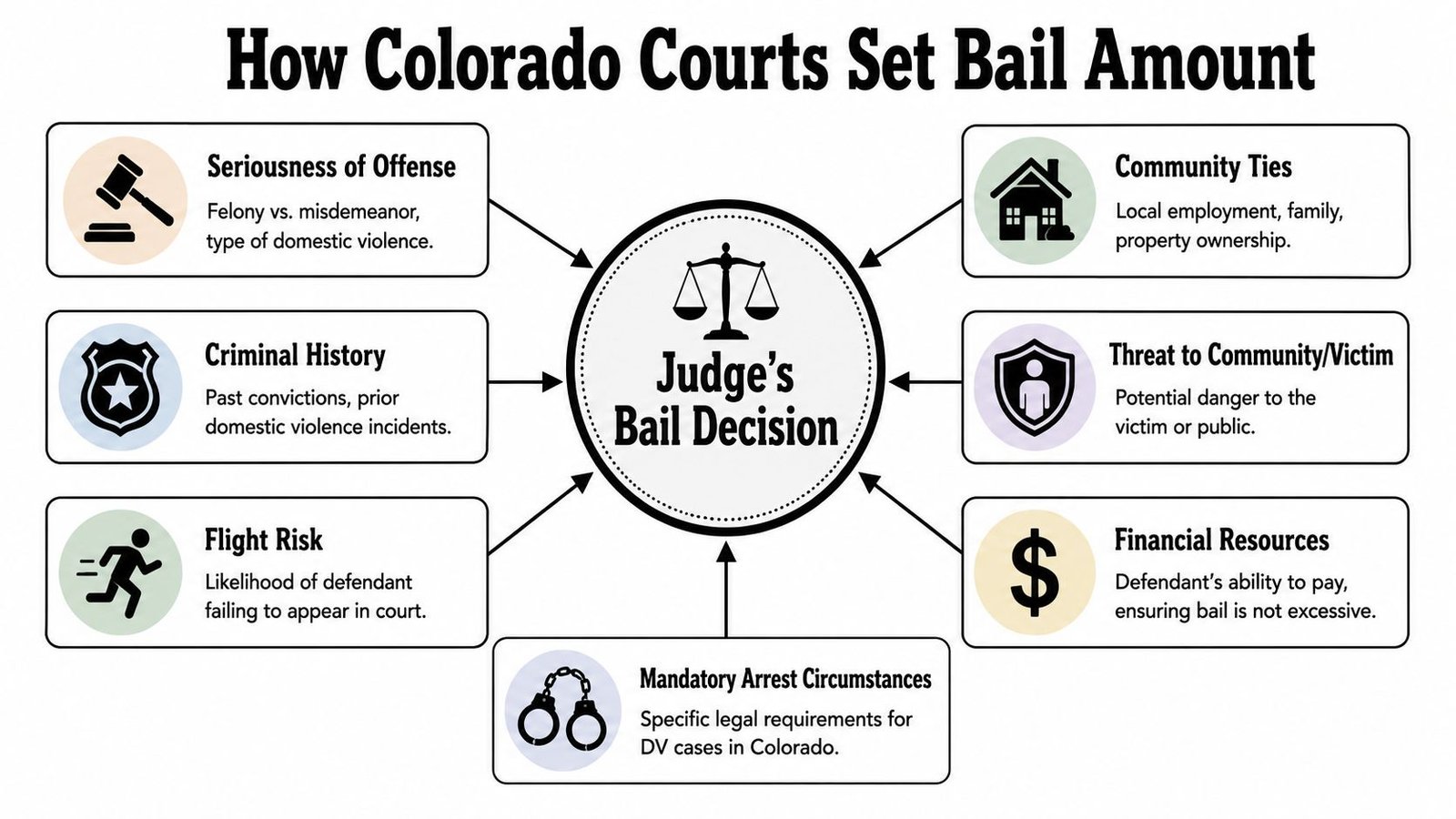
Most families want a number. Judges usually start with a set of concerns.
| Factor | Why it matters |
|---|---|
| Severity of charge | A felony allegation generally creates more concern than a lower-level allegation. |
| Criminal history | Prior convictions or prior violent conduct can push the court toward a higher amount. |
| History of court compliance | Failures to appear can make the judge less comfortable with release. |
| Risk to the alleged victim | Threats, injuries, or prior conflict can lead to stricter terms. |
| Community ties | Stable work, family support, and local residence may help. |
| Available financial resources | Courts consider ability to pay when setting release. |
| Case-specific circumstances | Weapons, existing orders, or surrounding facts can change the analysis. |
Why the same charge can lead to very different outcomes
Two people can face similarly named charges and still receive very different bail outcomes. One may have no prior record, stable housing, and no allegation of violating prior court orders. Another may have a history that makes the court worry about safety or compliance.
That's why broad internet comparisons can mislead families. If you're reading about another state, use it as context, not as a prediction. For example, this explanation of Texas bail bonds explained is helpful for understanding general bail mechanics, but local procedure still controls the definitive answer in Colorado.
A bail hearing is where many of these details come into focus. If you want to understand what happens in that setting, this overview of what happens at a bail hearing can help you prepare for the questions the court may consider.
The Colorado-Specific Process for DV Arrests
Colorado domestic violence cases create confusion because the process doesn't feel like a normal "pay and release" situation. Families often expect to call a bondsman, make a payment, and get immediate release. In many DV arrests, that isn't how it unfolds.
The first issue is procedural. Colorado treats domestic violence allegations with added caution at the start of the case. That means the person often has to go through the first court appearance before the release path becomes clear.
A quick visual can help.
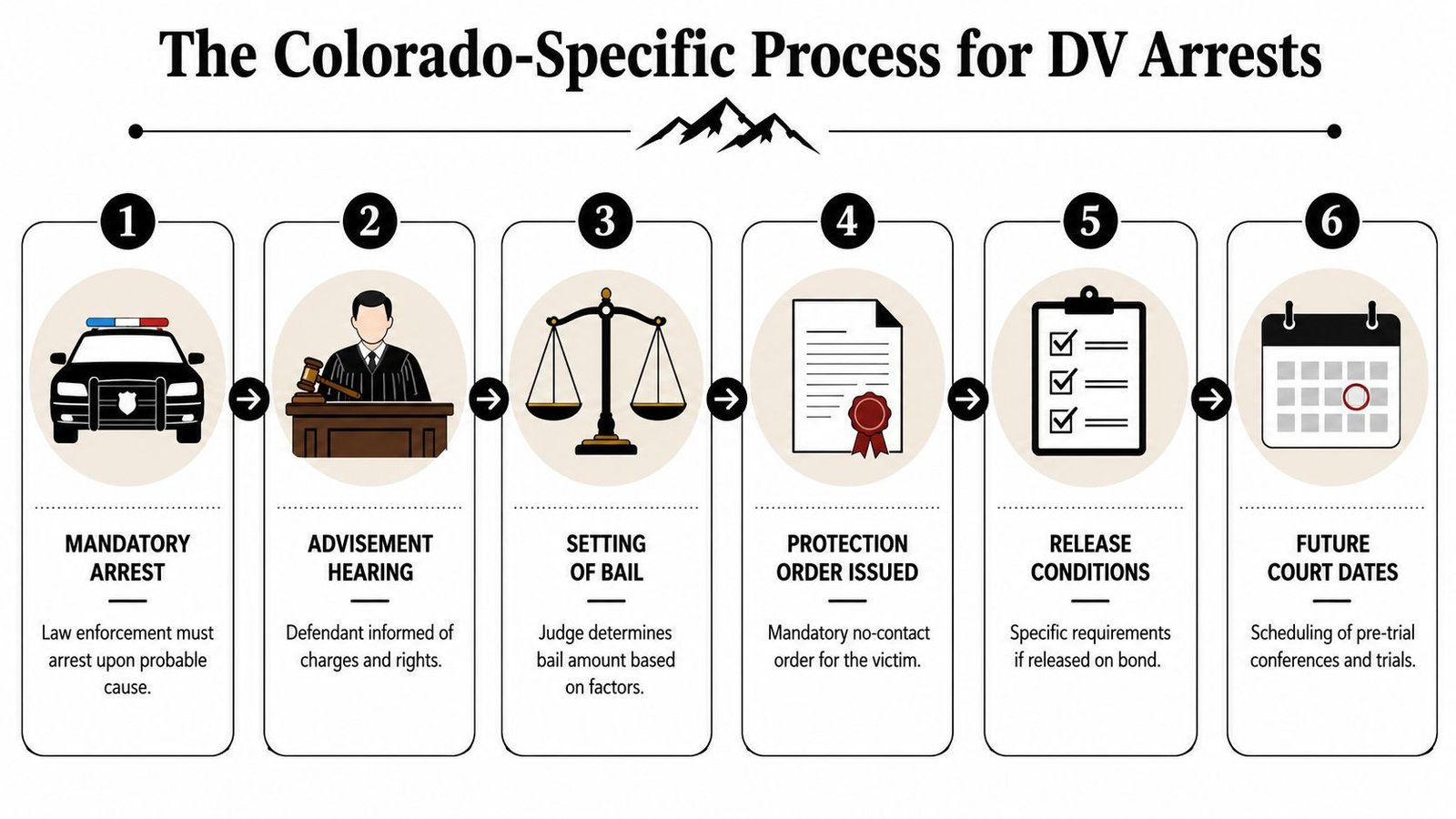
What families usually experience first
The sequence often feels backward to people calling for help. They want to know what it costs before they even know what the court will require.
In practice, the pattern usually looks like this:
- Arrest and booking: Police take the person into custody after the incident.
- Advisement or first appearance: The court informs the defendant of the charges and rights.
- Bail decision: The judge decides the release amount and terms.
- Protection order enters the case: The court imposes conditions that often include no-contact requirements.
- Release processing begins: Only after the legal conditions are clear can the bond process move forward.
Why the protection order matters so much
Families sometimes assume that once bail is posted, the person goes home and life resumes. In a domestic violence case, the court may order the person to stay away from the alleged victim, leave a shared home, avoid indirect contact, or follow other restrictions before release is completed.
That is often the primary bottleneck.
The broader point is supported by court materials showing that in domestic-violence cases, no-contact and protective-order conditions often affect release more than the bail amount itself, because release depends on acknowledging and complying with those conditions, not just posting a bond, as reflected in these court release condition materials.
A posted bond solves only the money piece. It doesn't erase a no-contact order, a move-out requirement, or any other release condition the court attaches to the case.
For a closer look at the legal background behind these cases, this page on domestic violence charges in Colorado gives useful context on how the allegations are treated.
Posting the Bond Cash vs a Bail Bondsman
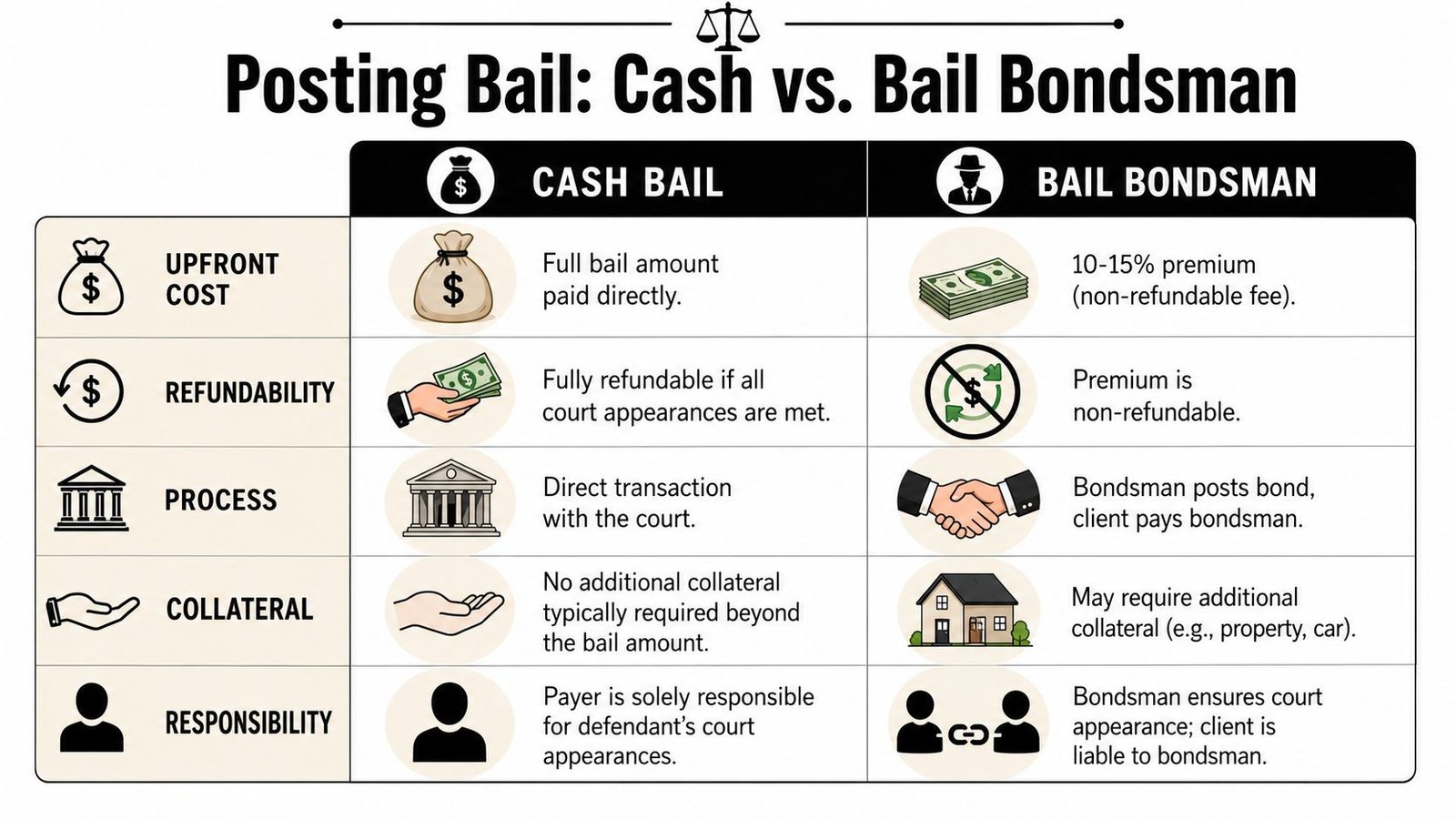
After the court sets bond, many families focus on one question first. "How much do we need right now?" That question matters, but in a Colorado domestic violence case, the better question is often, "Which option gets the financial part handled while we also stay on top of the release rules?"
That is the practical difference here. Paying the bond and completing the release are related, but they are not the same thing.
Paying cash bail
A cash bond means paying the full amount directly to the court or jail, if that facility accepts cash bond on the case. If the defendant appears in court as required and follows the court's rules, the money may be returned later, minus any fees or deductions allowed by the court.
For some families, that route is simple on paper and stressful in real life.
The problem is timing. Coming up with the full amount on short notice can be hard, especially when the arrest has already disrupted work, childcare, transportation, and access to the home. In domestic violence cases, that pressure can feel even heavier because the person may not be able to return to the residence after release, so the family may be solving a housing problem at the same time as a bond problem.
Using a bail bondsman
A surety bond works differently. The family does not post the full bond amount to the jail. A bail bond company posts the bond, and the family pays a nonrefundable premium for that service.
The out-of-pocket cost is usually the premium rather than the full bond amount. As explained in this overview of the domestic violence bond premium structure, that premium is commonly calculated as a percentage of the total bond.
That can make a surety bond more manageable for families who need to act quickly. It can also involve paperwork, a cosigner, and sometimes collateral, depending on the case and the amount.
Side-by-side practical differences
| Option | What you pay up front | Is it refundable | Main issue families face |
|---|---|---|---|
| Cash bail | Full bail amount | May be, depending on court outcome and compliance | Getting the full amount together fast |
| Surety bond | Premium paid to bondsman | No, the premium is the service fee | Completing the application, cosigner review, and any collateral requirements |
A simple way to look at it is this. Cash bond is like paying the full price of a car today. A surety bond is paying a service fee so a licensed company guarantees the amount required for release.
In Colorado DV cases, families often choose based on cash flow, not just the total bond figure. Even then, the money decision solves only one part of the problem. The person still has to be released under the court's conditions, which can affect where they go, who can pick them up, and whether they can return home that night.
If you want a clearer breakdown of how those two options work in practice, this guide to cash bond vs. surety bond explains the differences in plain terms.
Your Next Steps with Express Bail Bonds
When a domestic violence case reaches the bond stage, speed matters, but clarity matters more. You need to know whether the court has set a bond, whether the jail can accept a surety bond on that case, and what release conditions must be in place first.
One option families use in Colorado is Express Bail Bonds, which handles surety bonds statewide and allows applications, contracts, and payments to be completed electronically. For people helping from another city, another county, or even another state, that remote process can remove a lot of unnecessary travel and waiting.
A simple action plan
If you're trying to help someone right now, keep your next steps narrow and practical.
- Confirm where the person is being held. Jail location controls where the bond has to be posted.
- Verify whether bond has been set. In a DV case, timing matters.
- Ask what release conditions apply. Housing and contact restrictions may affect pickup and aftercare.
- Gather cosigner information. The bond process often moves faster when identification and basic details are ready.
- Choose the right local contact. If the case is in the western metro area, the page for Jefferson County bail help in Golden is relevant. If the case is in the south metro area, the page for Centennial bail bond support may be the better fit.
What to have ready before you call
A short checklist can save time:
- Defendant's full name: Even a minor spelling issue can slow down jail lookup.
- Date of birth if available: This helps confirm identity.
- Jail or county information: If known.
- Charge type: Even a rough description helps.
- Your role: Parent, spouse, friend, attorney, or cosigner.
The fastest callers are not always the most organized. The ones who move quickest are the ones who have the right details in front of them.
If you need help understanding cosigner obligations, paperwork, or whether a surety bond is the right route, these bond consulting services are designed for that exact question.
Common Questions About Domestic Violence Bail
Can the alleged victim drop the charges and end the case
In Colorado, the case does not end just because the alleged victim wants it to. The prosecutor decides whether to file charges, continue the case, or ask for changes later.
That catches many families off guard. They assume one phone call can fix everything, then lose time on the issues the court is watching, such as the next hearing date, the protection order, and whether everyone is following release conditions.
Is bail always available right away
Release is not always immediate in a domestic violence case. In Colorado, the bigger delay is often not the dollar amount itself. It is the court process around a mandatory arrest, the setting of bond, and the protective order that usually comes with the case.
A simple way to look at it is this. Bail is only one lock on the door. The other locks can be paperwork, jail processing, and court-ordered restrictions that must be explained and acknowledged before someone walks out.
So if a family member asks, "Can we pay and get them out now?" the honest answer is, "Maybe, but first we need to confirm whether bond has been set and what conditions are attached to release."
What happens if the no-contact order is violated
A no-contact order is a court order, not a suggestion. If it is violated, the court can respond fast. That may mean a new arrest, a revoked bond, or stricter conditions at the next hearing.
This part is especially hard for couples and families because the restriction can apply even when both people want to talk. Until a judge changes the order, the order controls.
For people trying to understand the safety logic behind these rules, it may help to read about safeguarding through Clare's Law. It comes from a different legal system, but it shows why courts treat domestic violence cases with extra caution.
How long does release take after bond is posted
Release time varies from jail to jail. Even after bond is posted, the jail may still need to finish processing, confirm the paperwork, and review the release conditions.
In domestic violence cases, that final step matters more than many families expect. If there is a protection order, housing restriction, or no-contact condition, the person being released may need to receive and sign those instructions before the jail clears them for release. That is why the wait can feel longer than it should, even when the money side is already handled.
If you need help figuring out whether bond has been set, what the release conditions mean, or whether a surety bond is even the right next step, contact Express Bail Bonds. A clear answer early can save hours of confusion and help your family avoid mistakes that complicate the case.