A phone rings late in the evening. A family member has been arrested, the jail has provided a bond amount, and nobody nearby knows whether to pay cash, contact a bondsman, or wait for the court. The pressure grows when the person who needs release is in one Colorado county and the person arranging help is somewhere else.
A county bail bond is more than a statewide legal concept. The court sets the release conditions, but the county jail controls many practical details, including accepted payment methods, posting hours, documentation, and release procedures. This guide explains how the process works in Colorado, why county rules matter, and how a remote electronic process can help families avoid unnecessary travel.
Understanding the Stress of an Arrest
A late-night arrest can turn an ordinary evening into a stream of unanswered questions. A spouse may be calling the jail while a sibling searches for the bond amount, and the defendant may be trying to understand what will happen next from a detention facility phone. The situation feels personal and urgent, but the release process follows a recognizable sequence.
First, the court or authorized official determines whether release is available and what type of bond applies. The paperwork may identify a cash bond, a surety-eligible bond, or a condition that requires additional approval. The jail then processes the release after the required payment, bond document, and agency steps are complete.

Practical rule: Confirm the exact bond type and the county facility's posting instructions before sending money or signing documents.
The first few hours are also a poor time for rushed decisions. Write down the defendant's full name, booking information if available, the county, the bond amount, and any court date or release condition. Families can use this guide on what to do after an arrest to organize the immediate steps without guessing.
Stress can also affect sleep, concentration, and decision-making. While mindfulness can't change the legal process, a structured breathing or grounding practice may help someone stay focused during calls with the jail, court staff, or a licensed bond agent. DeTalks' MBSR programme overview offers background on that type of stress-management approach.
The defendant still has obligations after release. Posting a bond doesn't end the criminal case, and it doesn't replace legal advice. It creates a path out of detention while the case continues under the court's conditions.
What Is a County Bail Bond
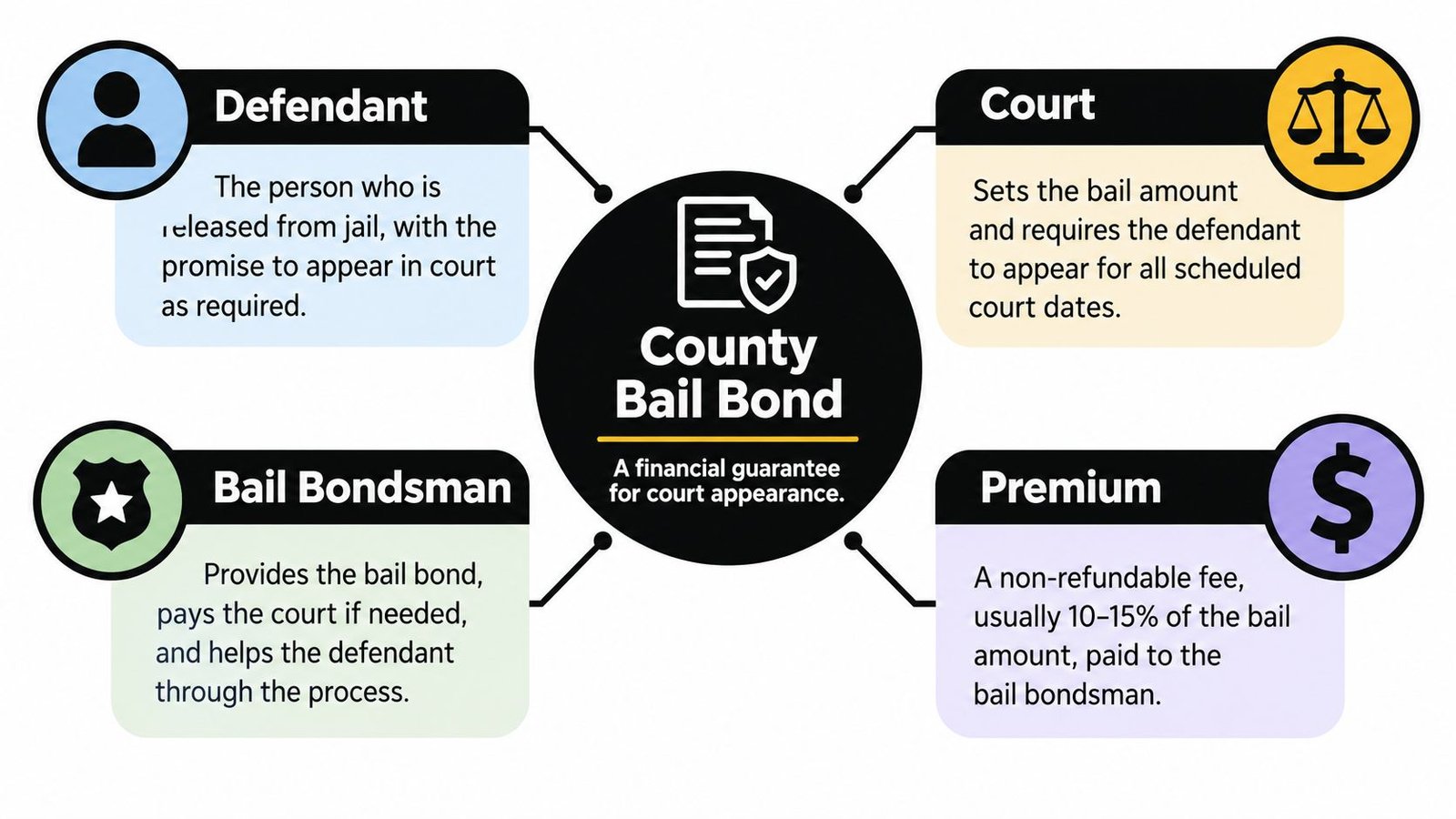
A county bail bond is a financial guarantee connected to a specific court and detention process. The defendant promises to attend required proceedings, while the bond provides financial security if that promise isn't kept. When a licensed surety agent posts the bond, the agent or surety company becomes responsible for the guarantee under the applicable rules.
The idea has older roots than the modern county jail. The Massachusetts Body of Liberties in 1641 gave people accused of non-capital crimes a right to bail, and the Northwest Ordinance of 1787 extended a similar rule by stating that people would receive bail except those charged with capital offenses. The federal Judiciary Act of 1789 also allowed bail in certain capital cases. These historical arrangements generally relied on sureties and recognizance, meaning family members, friends, or employers could pledge to secure a person's appearance instead of paying the entire amount in cash upfront. Historical research on bail at the founding explains how that structure developed.
Modern commercial bonding turns that promise into an organized service. The court sets the obligation, the defendant must follow release conditions, and the bondsman provides a guarantee in exchange for a premium and, where allowed, indemnity or collateral.
Why the county changes the experience
The state establishes the legal framework, but each county facility may publish different instructions. Texas consumer guidance, for example, directs people to local sheriffs, county attorneys, or bail bond boards because county policies can differ and not every county publishes the same information online. Texas Department of Insurance guidance on county bail bond rules illustrates why a county-specific explanation is often more useful than a generic overview.
Colorado facilities show the same practical pattern. Boulder County distinguishes cash and surety bonds and identifies its accepted payment channels, while San Miguel County explains when a bondsman may be used and when certified funds are required. The legal concept is statewide, but the release workflow is local.
For a plain-language explanation of the surety relationship, see what a surety bail bond means. The key point is simple: the bond connects the defendant's promise, the court's conditions, and the surety's financial guarantee.
Cash Bonds vs Surety Bonds Explained
The choice between a cash bond and a surety bond depends first on the court's order. If the bond is marked cash only, a bondsman generally can't substitute a surety bond. If the order permits a surety, the family can compare paying the full amount to the court with paying a premium to a licensed agent.
| Bond type | How it works | Main financial effect |
|---|---|---|
| Cash bond | The payor provides the required amount directly through an approved channel | Funds may be returned after the case closes, subject to applicable court handling and conditions |
| Surety bond | A licensed agent provides the guarantee for the defendant | The family pays a premium, and the agent may require a co-signer or collateral |
Boulder County states that cash bonds may be paid with cash, money order, credit card, or bank checks, while personal checks aren't accepted. It also lists a $10 bond fee per individual bond in its jail guidance. Boulder County's bond definitions and payment information shows why families should check the facility's own instructions rather than rely on assumptions.
San Miguel County provides another useful distinction. Unless the court orders cash only, a bondsman may be hired. A cash bond must be paid with cash or certified funds, and the court returns the bond money to the payor only after the case closes. These rules affect both the amount of money needed immediately and the person who must complete the transaction.
How families can evaluate the options
A cash bond may make sense for someone who can access the full amount and prefers to avoid a commercial premium. The money remains tied up while the case proceeds, and the payor must follow the court's process for its eventual return.
A surety bond reduces the immediate amount paid to the court, but the premium is the agent's charge for assuming the bond obligation. That premium generally isn't returned because the case ends successfully. A co-signer may also have continuing responsibilities under the agreement.
Before choosing, ask three questions:
- Bond classification: Does the court allow a surety bond, or is the order cash only?
- Payment channel: Does the county accept online payment, cards, certified funds, or phone payments?
- Return or premium terms: Who receives any cash-bond refund, and what does the surety agreement require?
This cash bond versus surety bond comparison can help families organize those differences before they commit funds.
Colorado Bail Bond Fees and Cosigners
Colorado places a legal ceiling on a commercial bail bond premium. The premium is capped at the greater of $50 or 15% of the amount of bail furnished, and additional charges are limited to specific categories, including court filing fees, actual collateral storage costs, or premium financing charges. Colorado Revised Statutes section 10-2-707 provides the fee framework.
That ceiling doesn't mean every family's total arrangement will look identical. The bond amount, payment timing, financing terms, collateral, and co-signer approval can affect the agreement. A licensed agent should explain each charge before accepting consideration.
What a co-signer does
A co-signer, sometimes called an indemnitor, enters an agreement supporting the defendant's obligations. The agent may review the co-signer's identity, contact details, relationship to the defendant, financial circumstances, and ability to help maintain communication. The co-signer should understand that signing isn't just a formality.
Colorado rules require written, signed premium or payment arrangements before an agent accepts consideration. They also regulate when collateral or other indemnity may be taken. Colorado's bond security and documentation rules support a practical checklist:
- Read the agreement: Confirm the premium, payment schedule, collateral terms, and responsibilities.
- Request receipts: Keep documentation for every payment and item provided as collateral.
- Clarify communication: Ask how the defendant must report court dates, address changes, or other developments.
- Confirm release conditions: The bond does not cancel the court's requirements.
A co-signer can also help an agent assess the risk of the bond, but approval isn't automatic. Families should never assume that offering collateral guarantees acceptance or changes the court's bond order. For a clearer breakdown of premiums and related expenses, review how much a bail bond costs in Colorado.
How to Secure a Bond Remotely
Travel isn't always realistic. A relative may live outside Colorado, the arrest may happen in a county several hours away, or the co-signer may be working when the detention facility is processing releases. A remote county bail bond process allows the family to complete much of the administrative work electronically while the licensed agent coordinates the posting steps.
Follow the process in order
Contact a licensed agent. Provide the defendant's name, the county, the facility if known, and the bond amount. The agent can help confirm whether the order is surety eligible and identify information the jail requires.
Submit the application. The application usually collects contact details, defendant information, and co-signer information. Accuracy matters because errors can delay document review or create problems when the agent prepares the bond.
Review the agreement. Read the premium arrangement, payment terms, collateral provisions, and co-signer obligations. Don't sign until the financial and compliance terms are clear.
Complete electronic documents and payment. A secure electronic process can let approved parties sign contracts and submit payment without visiting the jail. This overview of electronic documentation explains why digital paperwork can simplify a time-sensitive transaction.
Wait for county processing. The agent submits or coordinates the bond with the detention facility. Release still depends on the jail's internal processing, holds, court conditions, and other legal requirements.
El Paso County says bonds can be posted 24 hours a day and identifies cash, money order, and credit or debit card options under its jail policies. Its guidance also says that, unless the court orders cash only, a bondsman may post the bond, and that a bondsman typically charges 10% to 15% of the total bond while potentially requiring a co-signer and collateral. El Paso County's inmate services guidance demonstrates how county-specific details shape the remote plan.
Larimer County also lists several cash-bond channels, including cash, cashier's check, credit card, online, and phone payment. It states that bond fees, booking fees, and other debts don't need to be paid to secure release on a money bond. Always confirm the current facility rules before relying on a particular payment method.
Frequently Asked Questions
How long does release take after a bond is posted?
There isn't one universal timeline. The agent may complete the bond promptly, but the county jail still must verify the paperwork, check the court order, process the release, and address any separate hold. Ask the agent which step is pending instead of assuming that a signed contract means the person has already left custody.
Does posting bond end the criminal case?
No. Posting a county bail bond only supports release while the case continues. The defendant must attend court, follow every condition, keep the bondsman informed when required, and respond to notices.
Can a co-signer be required?
Yes. A Colorado agent may require a co-signer and collateral depending on the bond's risk. Arapahoe County guidance says a surety bond may be posted through a state-licensed bond agent who may require a co-signer or collateral. Arapahoe County bond information gives a concrete example of how that decision can work locally.
What happens if the defendant misses court?
A missed appearance can expose the defendant and surety to financial consequences and may lead to further court action. The defendant should contact the attorney and bondsman immediately, rather than ignoring the notice or waiting for the problem to resolve itself.
Do county rules stay the same?
Not necessarily. County facilities can differ in payment channels, posting locations, online instructions, and release processing. Confirm the details with the relevant sheriff, detention center, court, or licensed agent.
Getting Help from Express Bail Bonds
A family arranging release needs two kinds of clarity. The first is legal clarity, which comes from the court, defense counsel, and official county information. The second is operational clarity, which covers the bond type, premium, co-signer requirements, documents, payment method, and jail posting procedure.
Colorado's system also sits within a broader policy debate. Congress enacted the Bail Reform Act of 1966 to revise federal bail practices so people wouldn't be needlessly detained because of financial status, followed by the federal Bail Reform Act of 1984. The Manhattan Bail Project reported a failure-to-appear rate of less than 0.7%, a figure discussed in later reform debates about whether large cash demands are always necessary. Harvard Law Review's history of bail at the founding provides context for those developments.
County rules continue to matter even as reform changes the policy environment. The National Conference of State Legislatures reported that states enacted 126 pretrial bills in 2025, including 23 laws focused on the commercial bail bond industry. The same review describes a major county where misdemeanor cash-bond use fell from 86% in 2015 to 14% in 2025, with most misdemeanor cases involving detention of two days or less. NCSL's 2025 pretrial legislation recap shows why families need current, local information rather than an outdated generic explanation.
Express Bail Bonds is a licensed Colorado agency that has served detention facilities statewide since 1988. It handles surety bonds, supports electronic applications, payments, and contract documents, and provides assistance by call or text at 720-984-2245. It doesn't post cash-only bonds, so families should confirm that the court's order permits a surety before beginning the application.
For a Jefferson County arrest, the Jefferson County bail bond service in Golden addresses the local detention setting. Families dealing with an Arapahoe County matter can review the Centennial bail bond information before contacting an agent. These county-specific pages are useful starting points, but the jail and court remain the final authorities on current release requirements.
Express Bail Bonds helps families arrange Colorado surety bonds through a remote process that includes electronic applications, payments, and contracts. Visit Express Bail Bonds to confirm the county requirements, review the next steps, and request help with a county bail bond.