
A late-night call changes the temperature in the whole house. Someone says they've been arrested, the line is bad, you only catch part of the jail name, and now everyone is searching different sites and getting different answers.
That's usually when families start looking for colorado arrest records. They're not being nosy. They're trying to answer immediate questions. Where is the person? What are the charges? Has bail been set? What can be done before morning?
The most useful approach is simple. Confirm where the person is being held, understand what kind of record you're looking at, and move quickly on release options. If you're trying to make sense of the first hours after custody, this practical overview of what happens after you get arrested helps connect the paperwork to the actual process.
Your Guide to Navigating a Colorado Arrest
Most families start in the same place. They hear “I got arrested,” then spend the next hour trying to figure out whether that means a city jail, a county jail, a court hold, or something else entirely.
A Colorado arrest doesn't create just one neat public file. It can create a local booking record, a court case, and in many situations a broader state criminal-history entry tied to fingerprints. That's why two searches can show different things at the same time, and why panic usually makes the search slower.
The first practical move is to stop guessing and start confirming details. Get the person's full legal name, date of birth, where the arrest happened, and any charge information you have. Small mistakes matter. If the name is off or the birth date is wrong, the search can go sideways fast.
What families need in the first hours
When someone has just been arrested, the goal isn't to become an expert in records law. The goal is to answer three questions:
- Where are they right now
- What stage are they in
- What has to happen for release
That's also the moment when rights matter. If your family is trying to understand what police should and shouldn't ask after an arrest, this breakdown of Miranda rights explained by Miles Hansford is worth reading.
Practical rule: Don't rely on screenshots from social media, word-of-mouth, or a broad internet people-search. Use official systems first, then use that information to act.
Once you know where the person is and what record you're looking at, the next steps become much clearer. You can tell whether you're waiting on booking, whether a bond amount exists yet, and whether it's time to contact a bondsman, attorney, or both.
Arrest vs Booking vs Conviction Records Explained
Families often use these terms interchangeably, but they don't mean the same thing. If you mix them up, you can misread the person's status and waste valuable time.
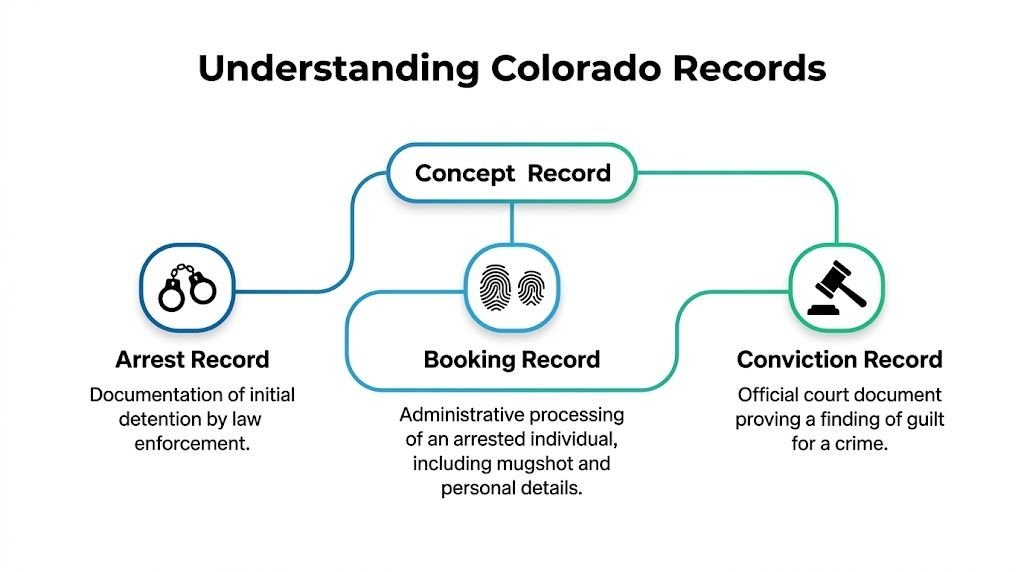
The sequence of events is akin to a timeline. An arrest is the initial event. Booking is intake and processing. A conviction is the final legal outcome, if the case ends with a finding of guilt. Those stages happen at different times and in different systems.
What an arrest record usually means
An arrest record documents that law enforcement detained someone. In Colorado, the practical statewide source is the Colorado Bureau of Investigation's Computerized Criminal History database, which aggregates fingerprint-based arrest data from law enforcement across all 64 counties, according to Colorado arrest records guidance on the statewide CCH system.
That fingerprint point matters. If you're looking for a state-level record, the system is strongest when fingerprints were submitted. A quick local jail lookup and a statewide criminal-history view are not always identical.
What booking tells you
A booking record is the detention side of the process. It usually reflects intake at the jail or detention facility. In such a record, you're more likely to find current custody information, housing location, booking date, and basic charge labels.
For families, booking is often the most urgent record because it answers the practical question of where the person is. It also helps you judge timing. If the person was just booked, release may depend on processing, advisement, or bond setup rather than a lack of cooperation from anyone involved.
If you want a clearer sense of jail processing timelines, this guide on how long booking takes in jail can help set realistic expectations.
What a conviction record is not
A conviction record is court-based. It means the case reached a legal outcome involving guilt. An arrest does not equal a conviction. A booking does not equal a conviction either.
That distinction matters for families because people often see a charge listed online and assume the case is finished. It isn't. The record you're reading may only show the start of the process.
A charge label tells you what law enforcement or prosecutors allege. It doesn't tell you how the case will end.
Here's the simplest way to read the timeline:
| Record type | What it shows | Why you care right now |
|---|---|---|
| Arrest record | Initial detention by law enforcement | Confirms that police action happened |
| Booking record | Jail intake and custody processing | Helps locate the person and check status |
| Conviction record | Final court outcome after the case moves forward | Matters later for long-term consequences |
Where to Search for Colorado Arrest Records
When families search for colorado arrest records, the biggest mistake is starting too wide. If the arrest is recent, the fastest answer usually comes from the local jail or sheriff system, not a broad public-records site.
Use a workflow. Start local for immediate custody. Move to court records for case status. Use the state criminal-history system for the broader official history view when that's the right tool.
Start with the jail or sheriff
If the arrest happened within the last several hours, start with the county jail, sheriff, or detention center. That's the best place to confirm present custody and booking status.
Searches work better when you have:
- Full legal name instead of a nickname
- Date of birth if the jail system allows it
- County or city of arrest so you don't search the wrong facility
Many families bounce between counties because they assume the arresting agency and the holding facility are the same. Sometimes they are. Sometimes they aren't. A city arrest can lead to county detention.
If you need a central starting point, this Colorado jail inmate search guide is useful for narrowing the right facility before you start calling.
Check court records after custody is confirmed
Court records answer a different question. They help you see whether the case has been filed, what court is involved, and whether there are hearing dates or dispositions listed.
Use court records after you've identified the detention facility or at least the county. Otherwise you can spend a lot of time searching the wrong jurisdiction.
A court search is especially helpful when:
- The person has already been released
- You need the case number
- An attorney or cosigner needs to verify the court location
This short video gives a practical overview of how people often approach the search process:
Use the CBI system for official statewide criminal history
Colorado's primary source for official criminal history is the Colorado Bureau of Investigation's Computerized Criminal History database, which aggregates fingerprint-based arrest data from law enforcement agencies across all 64 counties. The official check also emphasizes that an exact name and correct date of birth are required for a reliable search, according to the CBI records check portal.
That “exact” requirement matters more than people expect. A middle-name variation, suffix issue, or wrong birth date can send you down the wrong path. This isn't the kind of system where “close enough” is good enough.
Know what public access does and does not mean
Colorado is described as an open-records state under Colorado law, so many arrest records can be requested by the public through the official criminal-history system. But access has real limits. Sealed records are withheld, and juvenile records are generally not available to the public.
If you can't find a person in a public search, that doesn't automatically mean no record exists. It may mean the record isn't publicly releasable in full.
The state also publishes a long-running arrests dataset that includes annual counts for more than 300 police agencies starting in 2008, and that same reporting notes that arrest trends shift by offense type over time. In 2019, the state reported that three out of five murders, one out of three reported rapes, and 14% of burglaries were cleared by arrest, according to the Colorado annual arrests dataset. That's useful context when you're trying to understand why some kinds of cases generate clearer arrest records than others.
Interpreting Results and Common Pitfalls
A family finds the arrest entry, feels a moment of relief, then gets stuck again because the record raises new questions. Is the person still in jail? Was the case dropped? Why does one site show an arrest while another shows nothing?
That confusion usually comes from reading one record as if it answers every part of the case. It does not. An arrest record, a jail booking, a court case, and a private background report can all update on different timelines.

Why a dismissed case may still appear
Families often assume a dismissal should make the arrest disappear right away. In real cases, record relief usually takes longer than the court outcome.
As of early 2026, the Colorado Bureau of Investigation was facing a backlog of approximately 430,000 cases eligible for automatic record sealing under the Clean Slate Act, according to KRDO's report on the sealing backlog. So an old arrest can still show up even after the legal issue has changed.
The practical question is not just, “Does the arrest appear?” Ask, “What is the current case status, and is the record system caught up yet?” That question gets families to the right office faster.
Sealed, public, and restricted mean different things
“Sealed” does not mean every trace is gone. It usually means the record is no longer available through ordinary public access.
That distinction matters because families sometimes read a missing public result as proof that nothing happened, or read an old result as proof that nothing changed. Both assumptions cause problems. Public databases have limits. Internal government systems, jail systems, court systems, and commercial databases do not always match.
If you are trying to figure out whether the arrest is tied to a separate unresolved issue, such as another case or hold, review this guide on how to check if someone has a warrant before you start calling around. It helps you separate a new arrest from an older legal problem that may affect release.
Common mistake: Treating the first online result as the current answer. Match the arrest entry to the booking status and court status before making decisions about bond, pickup location, or next calls.
Private background reports often lag behind official records
This is one of the most frustrating problems families run into. The court result changes, but a private screening report still shows the arrest or shows it inaccurately.
Private companies often work from copied data, bulk updates, or third-party feeds. Those systems do not always refresh quickly, and they do not always correct old entries cleanly. That can create real-world trouble with housing, employment, or school applications even after the official case outcome improved.
When that happens, work from documents, not memory. Get the official case disposition, compare it line by line to the private report, and dispute the specific error with the screening company using the court paperwork or other official record. That approach is faster and more effective than arguing about what “should” be showing online.
Immediate Next Steps After Finding an Arrest
Once you've confirmed the arrest, the situation becomes less emotional and more procedural. That's good news. Procedure is something you can work with.
The first job is release. Not debate, not internet research, not guessing what the court might do next week. If the person is in custody and bond is possible, your immediate focus should be getting the release process moving.
Your first-hour checklist
Work in this order:
- Confirm the exact facility. Don't assume the arresting agency is where the person is housed.
- Verify the person's full legal name and date of birth. Minor mistakes create major delays.
- Ask whether bond has been set. If not, ask what has to happen before it can be posted.
- Find out if there are any hold issues or restrictions. A bondable case and a releasable person are not always the same thing.
- Get the case or booking information written down. Don't trust yourself to remember it under stress.
What works and what wastes time
What works is one calm point of contact for the family. One person gathers the booking details, one person handles money questions, and one person communicates with the arrested person if calls come through. Too many relatives calling different offices usually creates confusion.
What doesn't work is waiting for perfect information before doing anything. In practice, you often start with partial information and fill in the rest as the jail updates its records.
A bail bondsman can help once bond is available and the case is eligible for a surety bond. One option families use is Express Bail Bonds, which handles Colorado surety bonds and allows applications, payments, and contract documents to be completed electronically. That matters when the cosigner is out of town, at home with kids, or trying to avoid spending hours at a detention facility.
After release, shift to defense and compliance
Getting someone out of jail is not the finish line. It's the point where mistakes can either stop or start.
After release:
- Contact defense counsel quickly so the person gets case-specific legal advice.
- Read every release condition carefully. No-contact orders, court dates, and supervision terms can create new problems if ignored.
- Keep documents organized. Booking papers, bond paperwork, court information, and payment records should stay in one folder.
If the arrest happened in the west metro area, local help for Jefferson County and Golden bail bond situations can be useful once detention location and bond status are confirmed. If the arrest is farther south, information on bail bonds in Centennial can help families line up the right county-specific next step.
Release solves the custody problem. It doesn't solve the court problem. Treat those as two separate jobs.
Colorado County Jail and Court Search Links
When time matters, a short list beats ten browser tabs. The toolkit below gives you a practical starting point for major counties where families often search first.
Use the jail search when the arrest is recent. Use the court search once you need case status, hearings, or disposition details. If you're searching in the Denver metro area and need another county-specific starting point, this Arapahoe County inmate search resource is a helpful addition.
Colorado County Public Record Search Links
| County | Inmate/Jail Search | Court Case Search |
|---|---|---|
| Denver | Denver Sheriff inmate locator or detention information | Colorado Judicial Branch records search or CoCourts |
| Arapahoe | Arapahoe County detention search | Colorado Judicial Branch records search or CoCourts |
| Jefferson | Jefferson County detention services or inmate information | Colorado Judicial Branch records search or CoCourts |
| Adams | Adams County detention information | Colorado Judicial Branch records search or CoCourts |
| Douglas | Douglas County jail information | Colorado Judicial Branch records search or CoCourts |
| El Paso | El Paso County jail records or inmate services | Colorado Judicial Branch records search or CoCourts |
| Weld | Weld County jail division or inmate lookup | Colorado Judicial Branch records search or CoCourts |
| Larimer | Larimer County jail information | Colorado Judicial Branch records search or CoCourts |
| Boulder | Boulder County jail information | Colorado Judicial Branch records search or CoCourts |
How to use this table efficiently
Don't search every county just because you're anxious. Start with the county where the arrest most likely happened, then expand only if the facility can't be confirmed.
If the person was arrested by a city police department, check whether that city books into a county detention center. That one detail saves a lot of dead-end searching.
Frequently Asked Questions About Arrest Records
How long do arrest records stay visible in Colorado
There is no single timeline. What stays visible depends on how the case ended, what database you are checking, and whether the record qualifies for sealing.
In practice, visibility and eligibility are not the same thing. A case can qualify for relief before every public system updates. That gap causes a lot of confusion for families who assume a favorable outcome should disappear from search results right away.
Start with the court disposition. If the outcome supports sealing or dismissal but the record still appears, the next question is whether you are looking at an official source that has not updated yet or a private database that is still carrying old data.
Can an arrest show up even if there was no conviction
Yes. An arrest record and a conviction record are different, so a case can appear in a search even if it never led to a conviction.
That is why families should not stop at the word "arrest." Get the final court disposition and read the outcome closely. If an employer, landlord, or screening company is using a report that leaves out the dismissal or other final result, that missing context matters.
Why would a private background check show something different from the state
Private screening reports are often built from copied or resold data, and those records can be stale, incomplete, or tied to the wrong person.
If the state or court record shows one thing and a private report shows another, rely on the official disposition first. Then dispute the private report using the court documents. That is usually faster than arguing in general terms that the report "must be wrong."
What information do I need to search colorado arrest records accurately
Use the person's exact legal name and full date of birth if you have it. The county of arrest helps narrow the search fast.
A nickname, misspelling, or partial birth date can send you into the wrong jail system or pull up someone else with a similar name. If you are helping a family member, verify the spelling directly from an ID, prior court paperwork, or jail intake information before you keep searching.
What if I can't find the person right away
That usually means booking is still in process, the arrest happened in a different county than you expected, or the person was picked up by one agency and housed by another.
Wait a short time, then check again with the exact name and date of birth. If you still cannot confirm location, call the likely jail directly and ask whether the person has been booked, transferred, or is still waiting to appear in the public system. That call often saves more time than opening five more search tabs.
Is it better to pay the full bond or use a surety bond
It depends on the bond type the court allows, how fast release needs to happen, and whether tying up that much cash will create another problem at home.
A cash bond can make sense if the amount is manageable and the family can post it without missing rent, payroll, or other bills. A surety bond is often the more workable option when the full amount is too high or access to funds will take too long. The goal in the first 24 hours is not just paying something. It is getting the person released in a way the family can sustain.
Should we call a lawyer first or deal with release first
If bond is available and your family member is still in custody, release usually needs attention right away. Time in custody affects work, childcare, medications, and the person's ability to help with their own defense.
The practical approach is to split the job. One person handles bond, jail confirmation, and release timing. Another starts calling defense lawyers and gathering case details. That is usually the fastest way to reduce pressure without losing ground on the legal side.
If you need help turning arrest information into action, Express Bail Bonds can help you move from confusion to a clear release plan. Their team handles Colorado surety bail bonds statewide, including remote paperwork for out-of-town families and cosigners. If you've confirmed the jail, know a bond is available, and need to act quickly, reaching out is the fastest next step.