
Yes, a defendant can usually post their own bail in Colorado, but the court decides whether release will be by cash, surety, property, or personal recognizance, and the amount set determines whether paying directly is realistic. In a Bureau of Justice Statistics study, only about 48% of defendants required to post bail succeeded, and the median bail amount was $9,000.
A call from a county jail can leave a family member trying to make sense of unfamiliar terms while working out what to do next. The key distinction is simple: the legal answer is often yes, but the practical answer depends on the court's order, the money available, and the payment process.
The Moment the Phone Rings at 2 A.M.
Say your brother calls after being arrested in Denver. He's been booked, and you're trying to learn whether he can get out tonight. Someone mentions bail, but you don't yet know whether the judge ordered cash, a surety bond, or release without payment.
That's why “Can you post your own bail?” has two answers. Legally, a defendant can sometimes pay directly if the court permits a cash or property payment. Practically, it may not be possible if the amount is beyond reach, the order requires a different form of security, or the right paperwork and payment method aren't ready.
The money question can be sobering. The Bureau of Justice Statistics study of felony defendants found that about 48% of defendants required to post bail succeeded in doing so. The study reported a median bail amount of $9,000. Those figures show why permission to pay doesn't always mean a person can afford to do so.
Start with the order, not an assumption. The court determines the permitted bond type and amount. A family member or bondsman can't substitute a different arrangement just because it seems easier.
If you're helping someone who's just been arrested, this guide to what to do after an arrest can help you organize the immediate next steps. For a broader overview of criminal defense topics, see Caseledge's criminal defense breakdown. In Colorado, the first useful question is: what kind of release did the court authorize?
The Five Ways a Court Can Let Someone Out
Courts can use different forms of pretrial release. The Bureau of Justice Statistics overview of pretrial release identifies personal recognizance, cash bail, surety bonds, property bonds, and unsecured bonds. Think of these as different ways a court can address the same concern: whether the person will return as required.
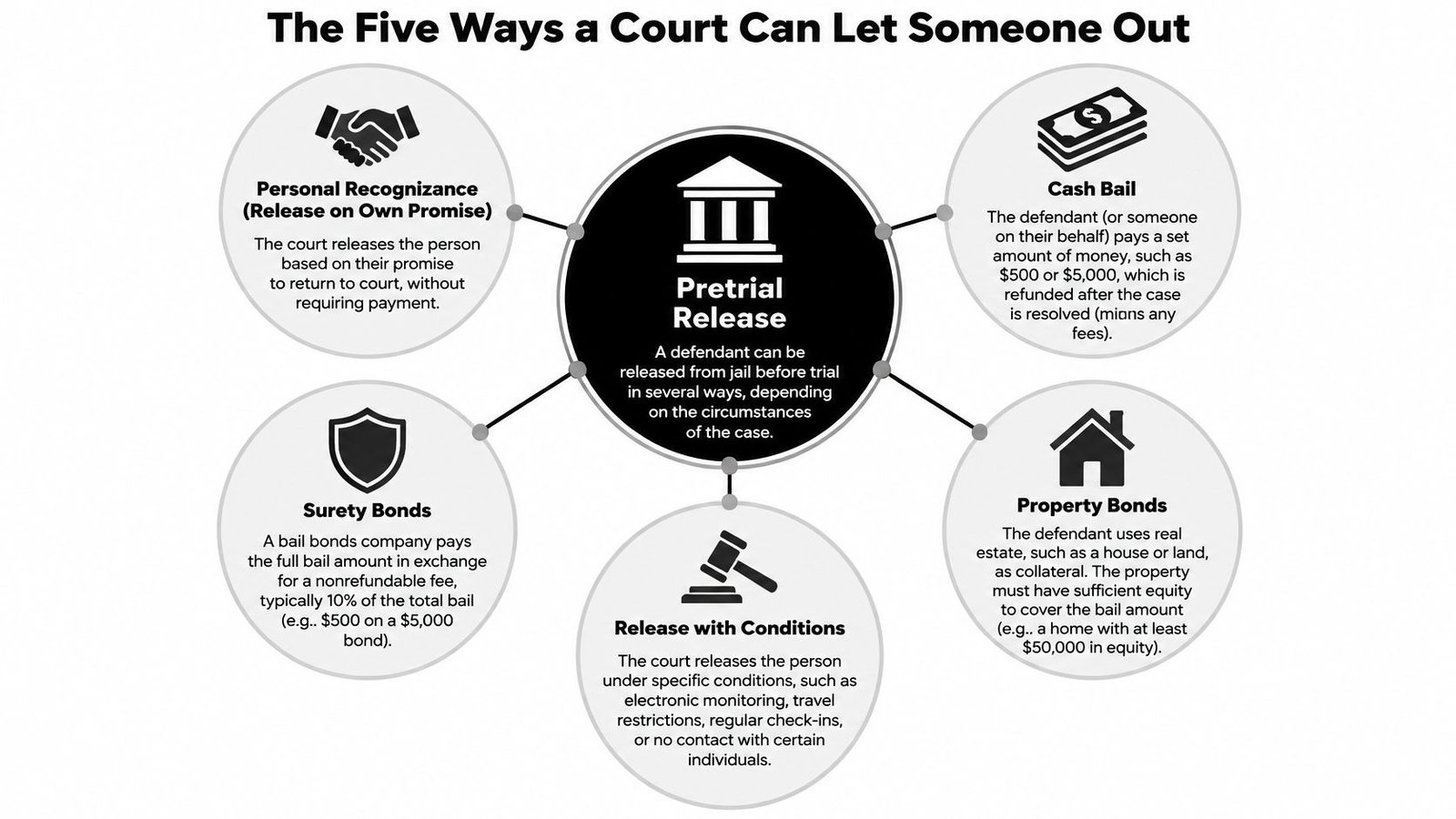
Here's how the options differ in everyday terms:
- Personal recognizance: The person is released on a promise to return, subject to any conditions the court sets. No payment is made up front. Learn more about release on one's own recognizance.
- Cash bail: The full court-ordered amount is paid as security. If the defendant meets the bond obligations, the funds may be returned, though authorized deductions can apply.
- Surety bond: A bondsman guarantees the bond to the court. The defendant or cosigner makes an arrangement with the surety, rather than paying the full face amount directly to the court.
- Property bond: Approved property is used as security instead of cash. The court's rules determine whether a particular property can be accepted.
- Unsecured bond: The court sets a financial obligation, but the defendant doesn't pay it at release. The obligation may become relevant if the person fails to meet the bond requirements.
The court chooses which route is available. A defendant can't decide to use a bondsman in place of a cash-only order, or insist on a no-payment release if the court has imposed financial terms.
That approach has changed over time. The BJS notes that, before 1966, most federal defendants released before trial had to provide a financial bond. The Bail Reform Act of 1966 directed federal courts to favor personal recognizance or unsecured appearance bonds for defendants charged with noncapital offenses unless financial or other conditions were necessary. The Bail Reform Act of 1984 later codified the modern federal release and detention framework. The practical lesson is that posting money is one possible route, not the definition of release.
Cash Bonds Versus Surety Bonds in Plain English
A cash bond and a surety bond can both secure release, but they affect a family's money differently. With a cash bond, the court receives the full ordered amount. With a surety bond, a qualified third party guarantees the bond, subject to the agreement made with the defendant or cosigner.
Colorado's Judicial Branch explains that a cash bond may be paid by the defendant or someone else, while a surety bond involves a bondsman guaranteeing the defendant's appearance. The two aren't interchangeable if the court order specifies one form.
| Factor | Cash Bond | Surety Bond |
|---|---|---|
| What is provided | The full court-ordered amount is paid to the holding county. | A surety guarantees the ordered amount to the court. |
| Cash needed up front | The payer needs access to the full amount. | The arrangement is made with the surety, rather than paying the full amount directly to the court. |
| What happens to funds | Funds may be subject to forfeiture or authorized deductions. Any remainder may be returned after bond liability ends. | The bond agreement governs the costs and any collateral or indemnity obligations. |
| Who bears the risk | The defendant or the person who supplied the money risks losing it if the bond is forfeited. | The defendant and cosigners must meet the agreement's requirements and may face consequences if the bond is forfeited. |
A cash bond can tie up money while the case and bond obligations remain unresolved. Colorado court materials say cash-bond funds may be authorized for court costs, restitution, fines, fees, and surcharges, with any remainder returned after discharge from bond liability. A missed appearance or other breach can also put the posted funds at risk.
A surety bond preserves more of the family's immediate cash, but it isn't the same as a refundable deposit. The surety arrangement has its own terms, and a defendant or cosigner remains responsible for following the bond requirements. Before choosing, consider not just the amount due today, but how long the money may be unavailable and what other obligations the family needs to cover.
For help understanding the difference between a court bond amount and a surety arrangement, review this explanation of surety bond rates and costs. Ask for the terms that apply to the specific bond rather than assuming every case follows the same payment arrangement.
How to Post a Cash Bond in Colorado Step by Step
The first task is to verify the bond order. Don't bring money to a jail based only on what someone heard over the phone. Confirm whether the court ordered cash, surety, property, personal recognizance, or cash-only release, along with the amount and any other release conditions.
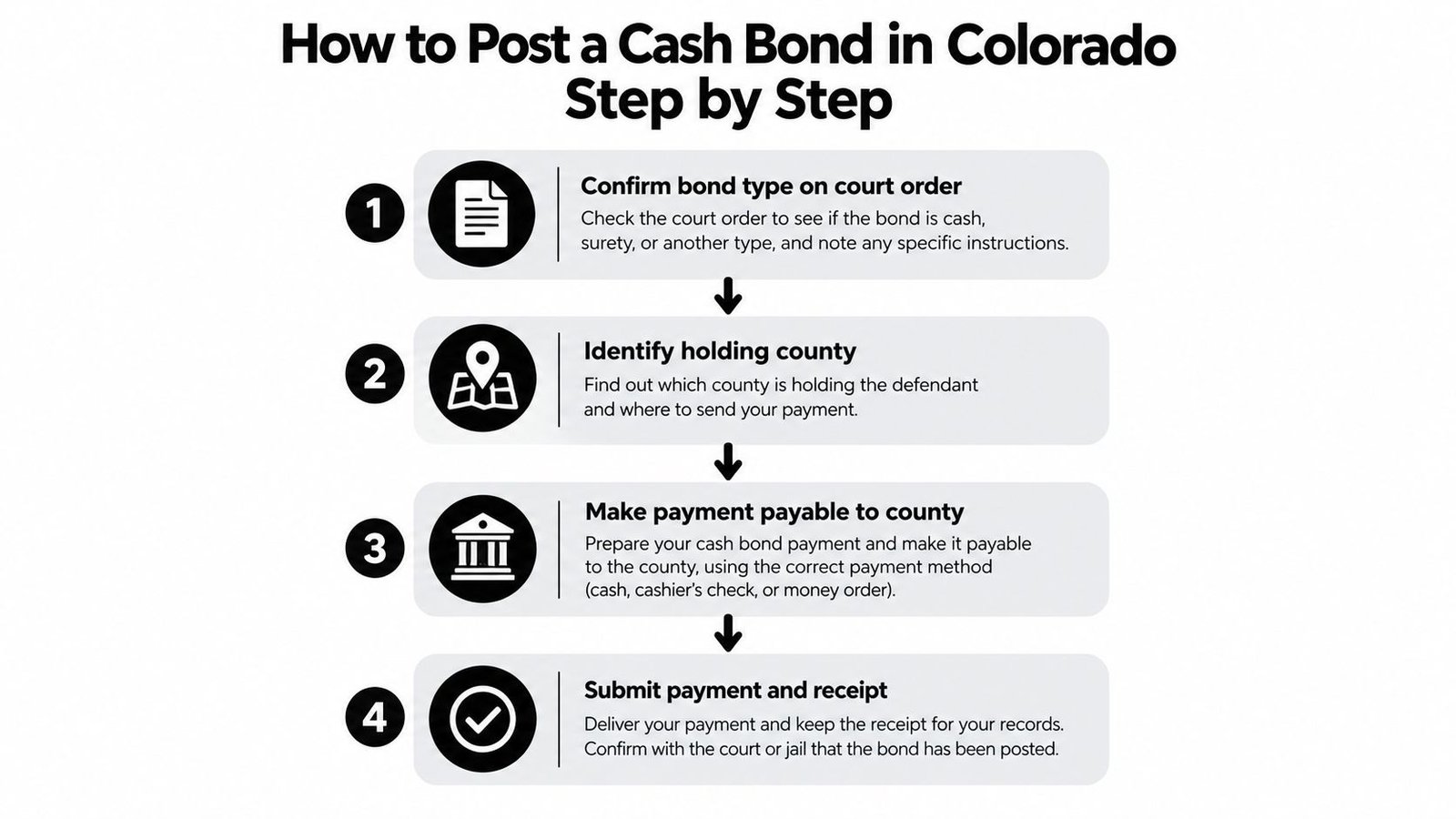
Use this sequence to avoid a preventable trip or payment error:
- Confirm the bond type and amount. Ask the court or the holding facility to verify the current order. A commercial surety arrangement can't replace a court-required cash-only payment.
- Identify the holding county. The defendant may have been arrested in one place and held in another. Find out which county is holding them and where that county accepts bond payments.
- Check the payee and accepted method. Colorado law requires a money bond to be payable to the holding county, not the incarcerated person. The law allows payment by cash, money order, cashier's check, and online credit card. Confirm which options the county facility currently accepts.
- Submit the payment and keep the paperwork. Ask for the bond receipt and the paperwork showing the next scheduled court date. Keep them somewhere accessible and make sure the defendant receives the court-date information.
Colorado legislation establishes processing deadlines, subject to extraordinary circumstances. A defendant granted a cash bond who is physically present in jail must be released as soon as practicable and no later than six hours after the bond is set, once the posting requirements are met. The defendant, surety, or another authorized payer must also be allowed to post within two hours after the sheriff receives the bond information from the court, unless extraordinary circumstances apply. These are processing rules, not a guarantee that every other release requirement has been met. (Colorado's enacted bond legislation sets out these timing requirements.)
For a visual walkthrough of the process, watch this overview:
What Identification and Paperwork the Jail Will Ask For
The payment can be correct and still take longer if the jail can't match it to the right person or order. Before leaving, gather the defendant's full legal name, date of birth, booking or case number if available, and the name of the facility holding them. Confirm spellings carefully, especially if the name has alternate spellings or multiple family members share a name.
Bring a government-issued photo ID and any bond paperwork or payment instructions you have. Requirements can vary by facility, so call ahead to confirm what that jail needs and which payment methods it accepts. If you're paying remotely, ask what identification or verification steps apply before sending funds.
In Colorado, the payer doesn't have to be the defendant. The law allows the defendant, a surety acting for them, or another third party to post a money bond, and payment must be payable to the holding county rather than in the incarcerated person's name. (Colorado's bond-payment provisions also address the bond paperwork a payer should receive.)
Common snags are straightforward but costly in time: going to the wrong county, using the defendant's name as the payee, or arriving with a payment method the facility won't accept. A mismatch between the bond order and the attempted payment can stop the transaction until it's corrected.
Before you travel, confirm three things: the facility, the exact bond type and amount, and the county's accepted payment method. For a preparation list, see what documents may be needed to post bail.
When Posting Your Own Bail Is Actually the Wrong Move
Paying the full cash amount may look like the simplest choice if money is available. But putting all of it into a bond can leave a household short of funds for rent, transportation, legal expenses, or ordinary bills while the case is pending. The right decision isn't always the option with the fewest steps at the start.
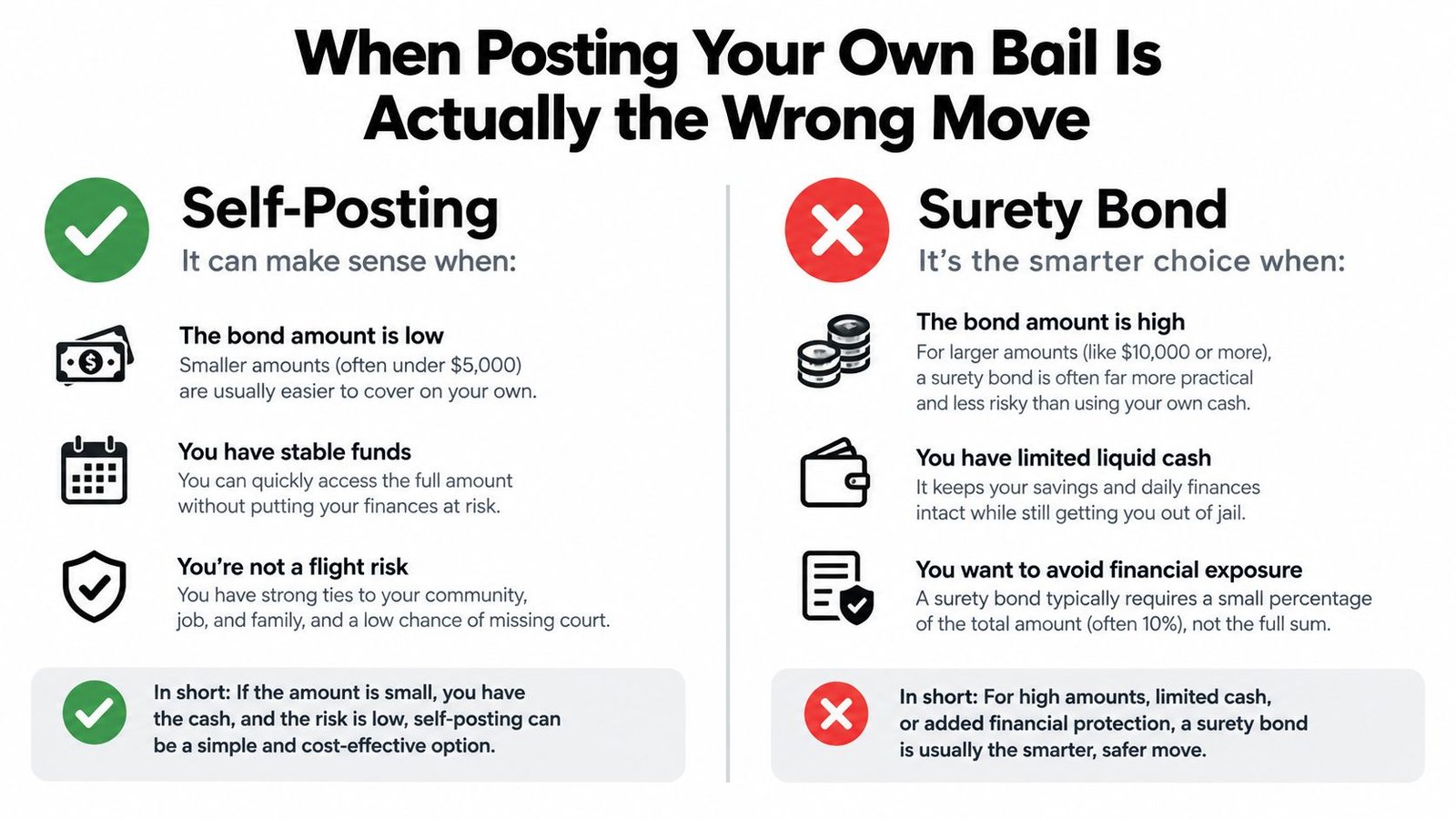
Consider a simple example. A family has enough savings to pay the full bond, but those savings are also the money they rely on for household costs. Paying cash may be possible, yet it could leave them with little flexibility until the bond obligations are resolved. A surety arrangement may preserve more immediate liquidity, although it comes with its own costs and contractual responsibilities.
A surety option may be worth discussing when:
- The full amount would consume available cash. Ask what the household would have left after paying directly, not just whether it can gather the amount.
- You need access to savings during the case. Cash posted with the court isn't available for other expenses while it remains tied to the bond.
- You're unsure how the bond could be applied or returned. Review the court's rules and any surety agreement before deciding. This explanation of whether bail is refundable can help clarify the basic distinction.
- Time and logistics matter. A family member may be coordinating from out of town or managing work and caregiving. Ask the county and any prospective surety what can be completed remotely and what still requires direct action.
Neither path removes the obligation to follow the court's conditions. A surety bond can't guarantee release if the court has ordered cash-only, and self-posting doesn't override other holds or release requirements. Compare the full cash exposure, the surety agreement's terms, and the money the family needs to keep available before choosing.
Colorado-Specific Limits on Self-Posting
Having enough money doesn't mean every release can be completed by paying a bond. The court's order controls, and the defendant may have another hold or condition that must be resolved separately.
The most important distinction is between a cash bond and a cash-only bond order. A cash bond can generally be paid by the defendant or another person, but a cash-only order can't be replaced with a commercial surety arrangement. Colorado's Judicial Branch describes the difference between cash and surety bonds and explains that a court-required cash-only payment must be honored as ordered. (Colorado Judicial Branch bond guidance outlines these bond types.)
Other issues can affect whether payment leads to release. An out-of-county or federal hold, an immigration detainer, a parole or probation hold, or a separate warrant may require action beyond paying the bond for the current case. A protective-order condition or another judicial restriction can also affect what release is permitted. These issues depend on the individual record and the orders in place, so don't assume that one payment resolves every reason someone is being held.
Use this practical check before trying to post:
- Confirm that the bond belongs to the correct case and holding county.
- Ask whether the order allows cash, surety, property, or another release form.
- Confirm whether another jurisdiction or agency has placed a hold.
- Ask the facility what requirements remain after payment.
If the jail says the defendant still can't be released after the bond is addressed, ask which specific hold or condition remains. A bondsman can explain surety options, but can't remove a separate hold or override a judge's order.
A Simple Decision Framework and Your Next Step
If you're deciding what to do now, work through three questions in order. First, what bond type did the court authorize? Second, can the defendant or family pay the full amount without putting essential expenses at risk? Third, is direct payment manageable given the facility's rules, paperwork, and timing?
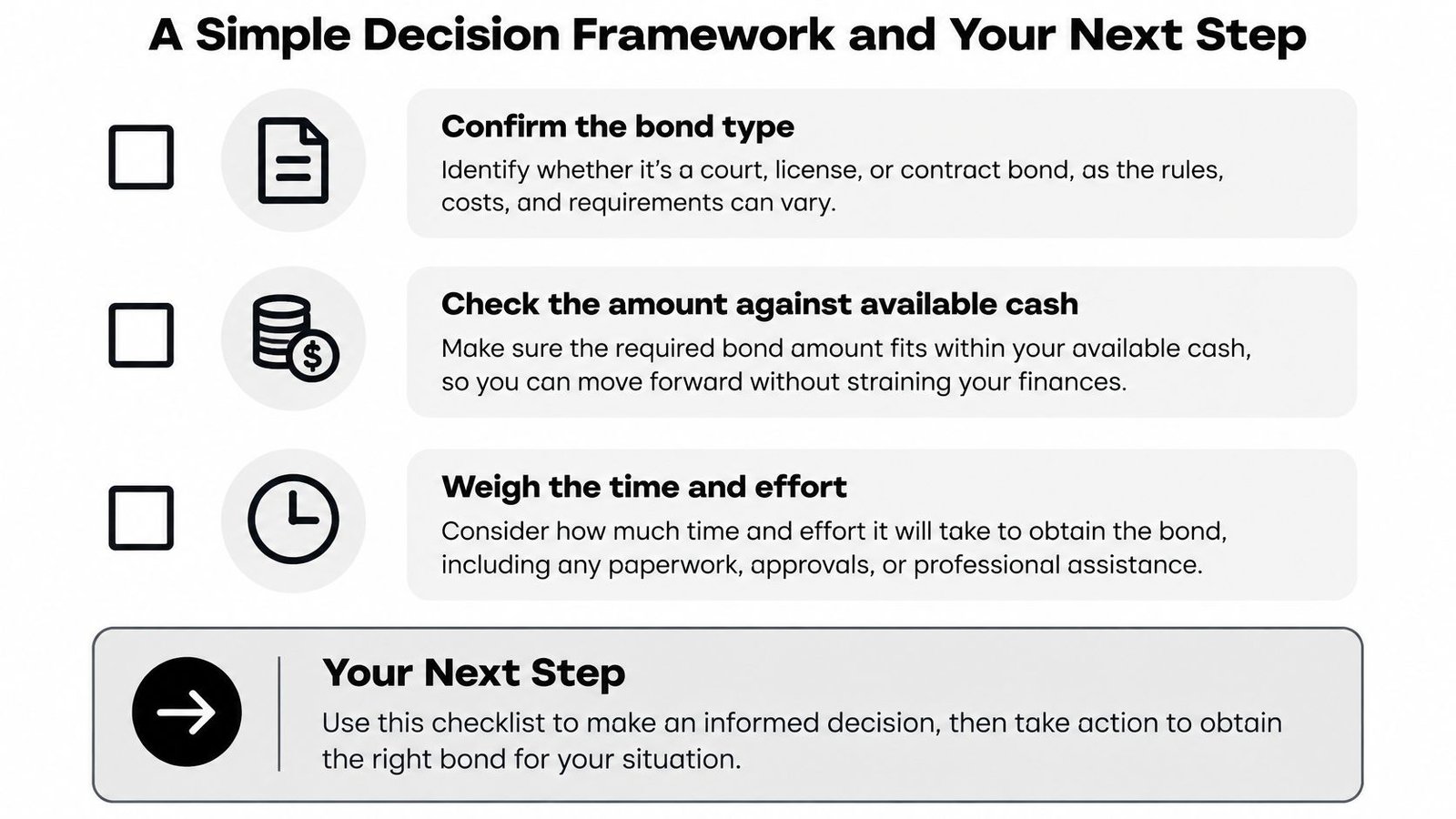
If the order permits a cash bond and the money is available, confirm the holding county's payment instructions and keep the receipt and court-date paperwork. If the amount would strain your finances, or you're uncertain whether a surety option is allowed, get clear information about the order and the available arrangements before committing money. If the order is cash-only, direct payment is required; a commercial surety can't substitute for it.
Express Bail Bonds is one surety option for families who want help with the bond process. The agency serves Colorado detention facilities statewide and offers online application, payment, and contract steps; its Jefferson County information is available for Golden, and its Centennial service information covers that area. Confirm the terms for the specific bond and remember that a surety agency can't post a cash-only bond.
If you're weighing direct payment against a surety bond, contact Express Bail Bonds to discuss the court's bond type, payment process, and next steps. Have the defendant's name, holding facility, and bond information ready so you can get practical guidance for the situation.