
Colorado DUI bond amounts typically run $1,000 to $1,500 for a first offense, but the actual money a family pays depends on whether release is personal recognizance, cash, or surety. Those figures are scheduled benchmarks, not a statewide average or a guaranteed price for getting someone home.
Your phone rings late at night. Someone you love is calling from jail, and you're trying to listen, find a pen, and work out whether you need to move money before morning. The most useful question isn't how much bail costs. It's what kind of bond the court has authorized, in which county, and with what conditions.
Why There Is No Single Number Called Average Bail for DUI
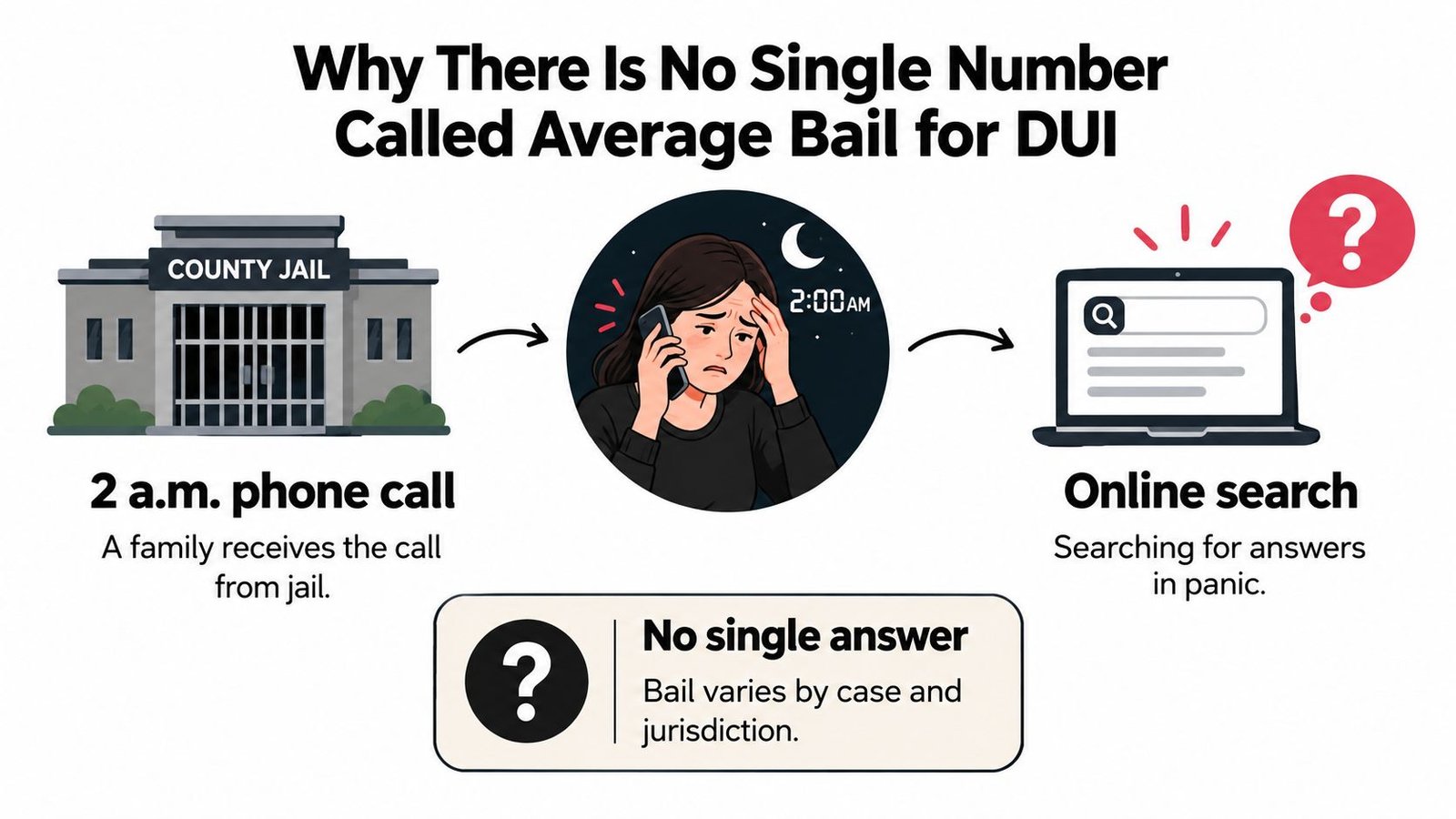
After that arrest call, searching for average bail for DUI feels like the quickest way to get control of the situation. Instead, you find different amounts and explanations that seem to contradict each other. Often, those pages are describing different jurisdictions, different offense histories, or different ways of securing release.
Colorado's official schedules provide a practical first-offense benchmark of $1,000 to $1,500, while the judicial reference materials list an adult reference amount of $1,000 for DUI and $800 for DWAI, rather than a statistical average, as reflected in the Colorado judicial bond schedule materials. A schedule helps identify a starting point. It doesn't tell you everything about a particular defendant's release.
The distinction between a reference amount and an actual release requirement is the reason an online estimate can be technically plausible but practically unhelpful.
Replace the average with a case-specific question
Suppose the jail tells you there's a bond amount on the record. Before reaching for your bank card, ask whether that amount must be deposited, whether a professional surety is permitted, or whether the defendant can sign an unsecured promise to appear.
Those aren't interchangeable answers. A family can misunderstand the cost because someone reads out the dollar amount without explaining the bond type.
Practical rule: Write down the amount, the bond type, and any release conditions together. An amount by itself isn't a usable payment instruction.
You don't need to master court terminology during a frightening phone call. You need enough information to avoid making the wrong financial decision. Ask the jail to explain unfamiliar wording in plain language, and keep the answer beside the defendant's name and facility information.
Treat any average you find online as orientation, not authorization. The court's actual order is what you need to act on.
How Colorado DUI Release Actually Works
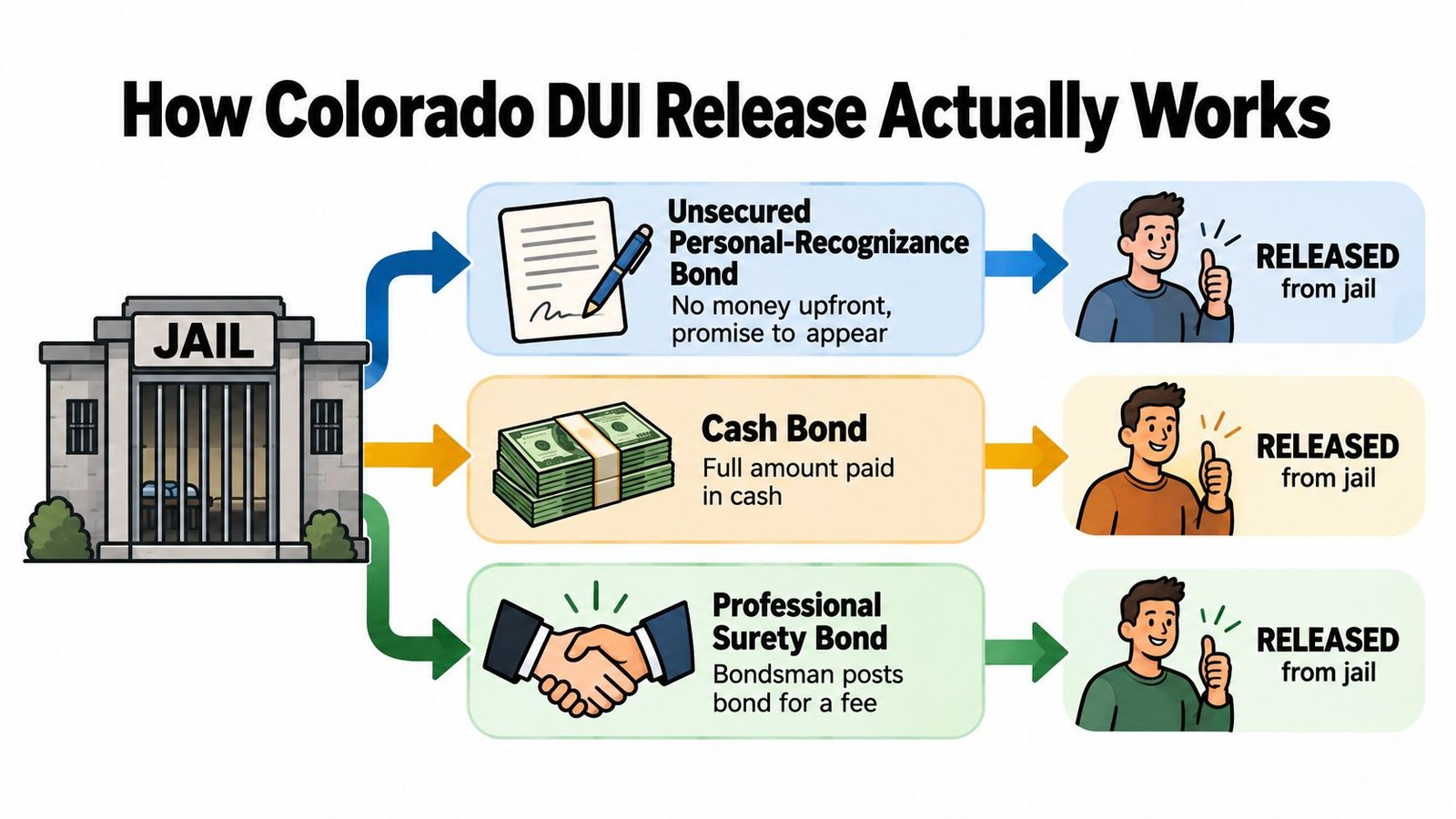
The bond amount and the upfront payment are different things. Colorado law permits unsecured personal-recognizance bonds and secured arrangements, including cash and surety, with the judicial officer selecting the appropriate conditions under Colorado's bond statute.
Think of the printed amount like a storefront price tag with an important qualification underneath it. The number catches your eye, but the payment terms tell you what must happen next. That analogy has limits, because release is a court decision, not a purchase, but it helps explain why reading only the number causes confusion.
These release pathways show the distinction:
Understand what each pathway requires
- Personal recognizance, often called PR: An unsecured bond relies on the defendant's promise to appear and follow the court's conditions rather than an upfront deposit of the stated amount. The Colorado PR bond explanation can help you recognize this terminology.
- Cash bond: The monetary condition is secured by depositing the full required amount. Don't assume a quoted bond amount means a percentage payment is acceptable.
- Professional surety bond: A licensed bondsman arranges the bond for a premium. The surety arrangement supports the court obligation; it doesn't replace the defendant's responsibility to attend court.
The court decides which arrangements are acceptable. Your family's preference matters only within the options the court permits, so don't choose a payment method before checking the order.
For another explanation of the release process, you can watch this video:
If unsecured release is authorized, arranging a commercial bond may be unnecessary. If security is required, compare the permitted options against the cash your household can spare. Keep that decision separate from questions about guilt, penalties, or the eventual outcome of the DUI case.
Factors That Push a DUI Bond Higher or Lower
A first arrest without complicating allegations and an arrest involving prior cases shouldn't be treated as the same financial situation. Colorado judicial officers consider the defendant's circumstances, appearance risk, and community-safety concerns rather than relying on the charge name alone.
Administrative guidelines have listed approximately $1,000 for a first DUI/DUID, $1,500 for a second offense or a deferred sentence within five years, and $5,000 for certain felony categories; those guidelines also identify circumstances that can require closer review, as described in the Colorado administrative bond guidelines. These are category benchmarks, not guaranteed outcomes.
Identify the details that matter
- Prior DUI history: A defendant with a prior conviction may fall outside the uncomplicated first-offense pathway. Ask whether the court has confirmed the relevant history.
- A pending case or probation: Someone already answering another DUI allegation may need judicial review rather than routine scheduled release.
- Alcohol-test allegations: An unusually high BAC or a testing refusal can complicate the release decision. Neither should be converted into an invented automatic surcharge.
- Injury or additional charges: An arrest involving an injury allegation needs a different assessment from a DUI allegation standing alone. Obtain the complete charge list.
- Previous failures to appear: If the court has concerns about attendance, the release decision may address those concerns through security or conditions.
- Financial circumstances and assessed risk: The judicial officer may consider ability to pay and pretrial-risk information. The pretrial-risk assessment explanation helps families understand that part of the process.
For example, a person with no prior DUI and no reported injury may fit a scheduled category. A person with a pending DUI and an injury allegation needs a more individualized answer, even before anyone discusses payment.
These are hypothetical comparisons, not predictions. Don't diagnose the bond from a short phone conversation or assume that every aggravating detail produces a fixed increase. Confirm what the court has ordered.
DUI Bond Amounts Across Colorado Counties
Denver provides a concrete example of why county and bond type matter together. Denver County Court's schedule, effective February 20, 2025, lists a $1,500 personal-recognizance bond for DUI with no prior DUI or DWAI convictions; cases involving a prior conviction have bond set by a judicial officer at first appearance rather than an automatic scheduled amount, according to the Denver County Court bond information.
For the eligible first-offense case, the stated amount generally isn't collected upfront. That's very different from hearing the same amount described as cash-secured.
Typical First-Offense DUI Bond by Colorado County
| County | Typical First-Offense DUI Bond | Common Release Pathway |
|---|---|---|
| Denver | Published first-offense PR benchmark described above | Personal recognizance for the qualifying scheduled category |
| Jefferson County / Golden | Confirm the individual order; no local amount established here | Verify whether PR, cash, or surety is authorized |
| Arapahoe County / Centennial | Confirm the individual order; no local amount established here | Verify the court's permitted arrangement |
| El Paso County / Colorado Springs | Confirm the individual order; no local amount established here | Ask the facility for the exact bond type |
| Rural district example, 9th Judicial District | Scheduled DUI/DWAI benchmark in the judicial materials discussed earlier | Confirm PR eligibility or required security under the applicable order |
The blank numerical comparisons are intentional. Assigning a typical amount or claiming a county usually favors surety without a confirmed local schedule would create false certainty. A statewide reference isn't evidence of a particular county's current practice.
A county comparison should help you ask better questions, not persuade you to pay an amount that hasn't been ordered.
Confirm the county's actual release process
Families arranging help in Golden can consult the Jefferson County bail assistance page. For a Centennial-related arrest, the Centennial bail assistance page offers a local starting point, but you should still confirm the actual detention facility.
Ask whether pretrial services must participate before release and who supplies the conditions. The Colorado pretrial-services guide can help you prepare that conversation.
A higher felony-category amount could become a full cash hurdle if the individual order requires cash. That doesn't make it another county's standard first-offense price, and it shouldn't be compared with Denver's qualifying PR category as though the cases were identical.
What Families Actually Pay a Surety Bondsman
Before signing a surety agreement, separate the premium, any authorized additional charge, and the obligation secured by the bond. Those are different entries, even when they appear on the same paperwork.
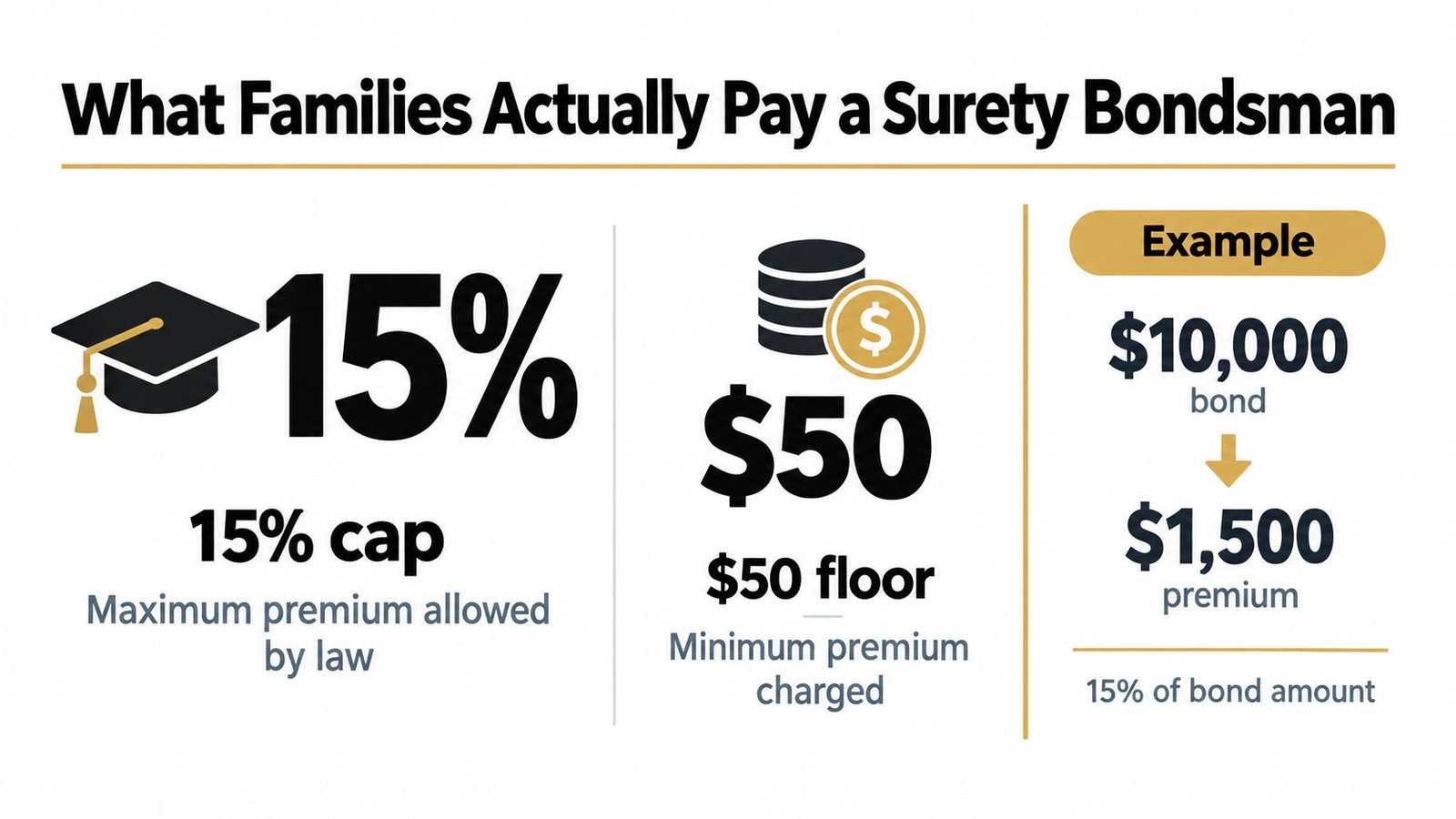
Colorado law caps a professional bail-bond premium at the greater of $50 or 15% of the bail furnished; applying the percentage gives maximum premiums of $150 on a $1,000 bond, $225 on a $1,500 bond, and $750 on a $5,000 bond, before separately authorized charges, under Colorado's bail-bond premium statute. The statute restricts additional charges to authorized court or law-enforcement filing fees, actual secure collateral storage, or premium financing.
This visual summarizes the premium structure:
Read the cap correctly
The statutory rule is a maximum-charge formula, not a command that every agent must charge the maximum. Likewise, the dollar component shouldn't be read as a mandatory minimum price every customer must pay.
A surety calculation applies only when a surety bond is needed and permitted. Don't apply it to Denver's qualifying unsecured release because that order contains a dollar figure.
Before committing, request a written breakdown:
- Premium quote: Ask what the actual charge will be, rather than assuming the legal cap is the quote.
- Additional charges: Have the agent identify each charge and its basis.
- Cosigner terms: Read the responsibilities you're accepting and ask what could create additional financial exposure.
- Collateral terms: Confirm what's required and how the agreement treats it.
The surety-bond rates guide provides another place to review pricing terminology. Compare the written quote with the court's authorized release method, not just with an online percentage calculator.
A lower upfront payment doesn't mean the underlying appearance obligation disappears. Make sure both the defendant and the cosigner understand what they're signing before payment is submitted.
When Money Is Not the Real Barrier to Release
Having the money ready doesn't necessarily mean the defendant is eligible to leave. A court can require supervision or testing, and some circumstances prevent release before judicial advisement.
Colorado's judicial-branch schedule requires monitored abstinence from alcohol and illegal drugs for felony DUI and DUI/DWAI cases involving prior convictions, and bars pre-advisement release when the person is on probation for, or has a pending, DUI/DUID/DWAI charge, under the Colorado judicial bond schedule and pre-advisement procedures. The procedures also use portable-breath-test results when determining supervision and conditions.
Ask what must happen besides payment
A prior conviction and a pending case aren't the same thing. Don't assume every defendant with a prior automatically faces the same pre-advisement restriction; ask which provision applies to this person.
If monitored abstinence is ordered, get the actual instructions. Ask who supervises it, what testing is required, where the defendant must report, and what must be arranged before departure.
Before you transfer money: Ask whether an unresolved court review or release condition would still prevent the defendant from leaving.
Families also hear terms such as SCRAM, urine testing, ignition interlock, or curfew and assume they're universal DUI bond requirements. Don't make that assumption. Ask whether any such requirement appears in the individual order, and have the court or supervising agency explain it.
A bondsman can help with an authorized surety arrangement. A bondsman can't override a court-ordered condition or turn a case awaiting judicial review into immediate release.
The useful measure isn't whether the scheduled amount looks affordable. It's whether every required part of the release decision has been addressed.
First Steps for Families After a Colorado DUI Arrest
Start with the facility, not the payment. You'll make a clearer decision once you know where the defendant is being held and what the current order says.
The Colorado Judicial Branch explains that cash requires the entire bond amount, while a professional surety bond goes through a state-licensed bondsman who may require a cosigner and collateral, in its official explanation of bond types. That distinction should guide your next call.
Use a calm checklist
- Locate the defendant. Confirm the full name and detention facility. Don't assume the city where the arrest occurred tells you where the person is now held.
- Record the exact order. Write down the amount, bond type, and whether judicial review is still required. Ask staff to explain any unfamiliar abbreviation.
- Check conditions before paying. Find out whether supervision, testing, or another requirement must be addressed first.
- Compare permitted payment options. Consider what cash your household can spare, then obtain a written surety quote if that pathway is allowed.
- Prepare documents. Have identification and available defendant information ready. Ask the agent which cosigner documents are needed and whether application and contract paperwork can be completed electronically.
- Plan for departure. Arrange pickup and review the release paperwork with the defendant, including reporting instructions and court information.
Keep notes in one place so another family member doesn't start a separate application or make a conflicting payment. Designate someone to handle the calls and share updates.
The guide to what to do after an arrest can support that preparation. If the family disputes the amount or conditions, speak with a Colorado defense attorney about legal options rather than expecting the bonding agent to change the order.
Your immediate job is manageable: verify, document, compare, and act on the authorized pathway.
Getting the Right Help and Next Steps
The search for average bail for DUI usually starts with a worried family trying to answer a simple question: can we afford to bring this person home? The reliable answer requires more than a schedule.
You now have a better way to evaluate the situation. Match the county's process to the actual order, distinguish payment from conditions, and review any agreement before a cosigner accepts responsibility.
Choose help for the problem you actually have
A jail or court can confirm the recorded release requirements. Pretrial services can explain assigned supervision, and a licensed bail agent can explain an available surety arrangement. A defense attorney is the person to consult about challenging the order or addressing the criminal allegations.
Those roles complement each other. They aren't substitutes, and none should promise that payment alone resolves every obstacle.
Before finishing a call, use this short confirmation list:
- Release eligibility: Is the defendant eligible now, or awaiting judicial action?
- Authorized arrangement: Does the order permit the payment method you're considering?
- Written obligations: Do the defendant and cosigner understand the documents?
- Remaining requirements: Who handles any supervision or testing instructions?
- Next contact: Whom should you call if the recorded status changes?
Out-of-state relatives should also ask about remote paperwork rather than assuming they must travel to the jail. Electronic processing can help with documents, but it doesn't change the court's authority or remove release conditions.
You don't need to solve the entire case tonight. Focus on getting accurate information, avoiding an unnecessary payment, and choosing help that fits the order. That's a more useful approach than chasing a statewide average that doesn't describe your family member's case.
For an authorized DUI surety bond, Express Bail Bonds offers statewide Colorado assistance and electronic applications, payments, and contract documents, including help for families coordinating release remotely. Call or text 720-984-2245, available 24/7, with the defendant's name, facility, and confirmed bond information to discuss fees and next steps; the agency handles surety bonds, not cash-only orders.