
When a judge sets a bail amount, a defendant who can't pay it in cash may stay in jail until the case ends. A surety bond lets a licensed bail company guarantee that amount to the court in exchange for a nonrefundable premium of up to 15% in Colorado.
Few people research bail law before a late-night phone call from a county jail turns an ordinary week upside down. You write down a booking number and a five-figure bail figure, check your bank account, and immediately wonder why do I need a surety bond when the case hasn't even gone to trial.
Sorting out what a bond legally does, what it costs, and what a cosigner risks takes clear numbers rather than guesswork. Once you separate the court's financial guarantee from common myths about bail, deciding your next move becomes far more manageable.
Why Courts Require a Surety Bond and How Big the Gap Is
A court imposes financial bail to create a monetary incentive for a defendant to return for every scheduled hearing, not to punish them before trial. Because no conviction has happened at the bail stage, the dollar figure addresses liquidity and court attendance rather than guilt or innocence. When a judge orders a monetary bond and the accused person can't hand over the full sum in cash, that person remains in custody while the case moves through the docket.
Courts set those conditions after reviewing the alleged offense, prior court attendance history, and community ties, often with help from a pretrial risk assessment. Depending on the charge and the judge's ruling, release usually takes one of four forms.
The Four Main Pretrial Release Paths
Families trying to get a loved one home quickly will run into four distinct mechanisms at the jail or courthouse window. Each one handles cash flow and legal risk differently.
Cash bail requires paying the entire court-ordered sum directly to the court clerk or detention facility. If the defendant attends every hearing through the end of the case, the court generally returns the deposit (minus any applicable court fees or fines), though your cash stays tied up for months.
A surety bond brings in a licensed bail bond company to guarantee the full bail amount to the court. In Colorado, the family pays a nonrefundable premium capped at up to 15% of the bail amount, with a $50 minimum, instead of locking up the entire cash figure upfront.
A property or collateral bond lets a defendant or family pledge real estate equity directly to the court to satisfy the financial condition. Because courts require appraisals, title verification, and recorded liens, property bonds often take far longer to process than a standard release.
Release on recognizance or nonfinancial release requires no upfront payment at all. The defendant signs a written promise to appear and follows court-ordered terms, such as pretrial check-ins or travel restrictions.
The core function of bail: A surety bond doesn't prove innocence or buy a favorable verdict. It simply bridges the gap between what a court demands in cash and what a household can actually reach in a day or two.
What National Detention Data Reveals About the Cash Gap
Many people held before trial are not kept in custody because a judge found them ineligible for release. They stay behind bars because the price tag exceeds what they can assemble.
According to a Bureau of Justice Statistics report on felony defendants in the 75 largest U.S. counties from 1990 to 2004, 38% of defendants remained detained until their cases were resolved. Roughly five out of six detained defendants had bail set by a judge but didn't post the required bond, rather than being denied bail outright.
The same federal dataset shows how steep that affordability wall is. Among felony defendants required to post financial bail during that 1990 to 2004 period, only about 48% succeeded in getting out. Defendants who stayed detained faced a median bail of $15,000 (and a mean of about $58,400), compared with a median of $5,000 (and a mean of about $11,600) for defendants who secured release.
| Group | Median bail | Mean bail | Share |
|---|---|---|---|
| Detained until the case was resolved | $15,000 | About $58,400 | 38% of all defendants |
| Released before the case was resolved | $5,000 | About $11,600 | 62% of all defendants |
| Detained, bail set but not posted | Included in $15,000 detained median | Included in $58,400 detained mean | About 5 out of 6 detained defendants |
| Required to post bail and succeeded | Included in $5,000 released median | Included in $11,600 released mean | About 48% of those required to post bail |
Surety bonds became the primary bridge across that financial divide. In the same Bureau of Justice Statistics felony release analysis covering 1990 through 2004, 62% of felony defendants were released before case resolution, and surety bonds accounted for 33% of all releases, nearly matching release on recognizance at 32%. Between 1990 and 1994, recognizance release represented 41% of releases versus 24% for surety bonds, yet by 2002 and 2004, surety bonds climbed to 42% while recognizance dropped to 23%.
Those historical figures from large U.S. counties clarify why so many families still face the same practical squeeze today. When bail sits at $10,000, $15,000, or higher, very few households have that much liquid savings sitting idle.
Use one straightforward test before you call anyone: confirm whether the judge imposed a monetary bond condition, then check whether you can produce the full cash amount within a day or two without missing rent, payroll, or essential bills. If the answer is no, weighing a surety bond is the practical path to explore.
How a Surety Bond Guarantees the Court's Money
A surety bond works like a co-signed loan: a licensed third party vouches for repayment so the lender moves forward. Under the three-party legal structure outlined in the New Jersey Courts glossary entry on surety bonds, the obligee is the court receiving the financial protection, the principal is the defendant whose appearance is secured, and the surety is the licensed bail company assuming financial responsibility under the bond contract.
That structure is the bond's entire legal job. The court holds a guarantee for the full bail amount, and the defendant goes home while the case proceeds. Whether money bail makes communities safer is a separate policy debate; what the bond itself does is narrower and simpler. It puts a licensed company's money on the line so the court releases someone it would otherwise keep in custody.
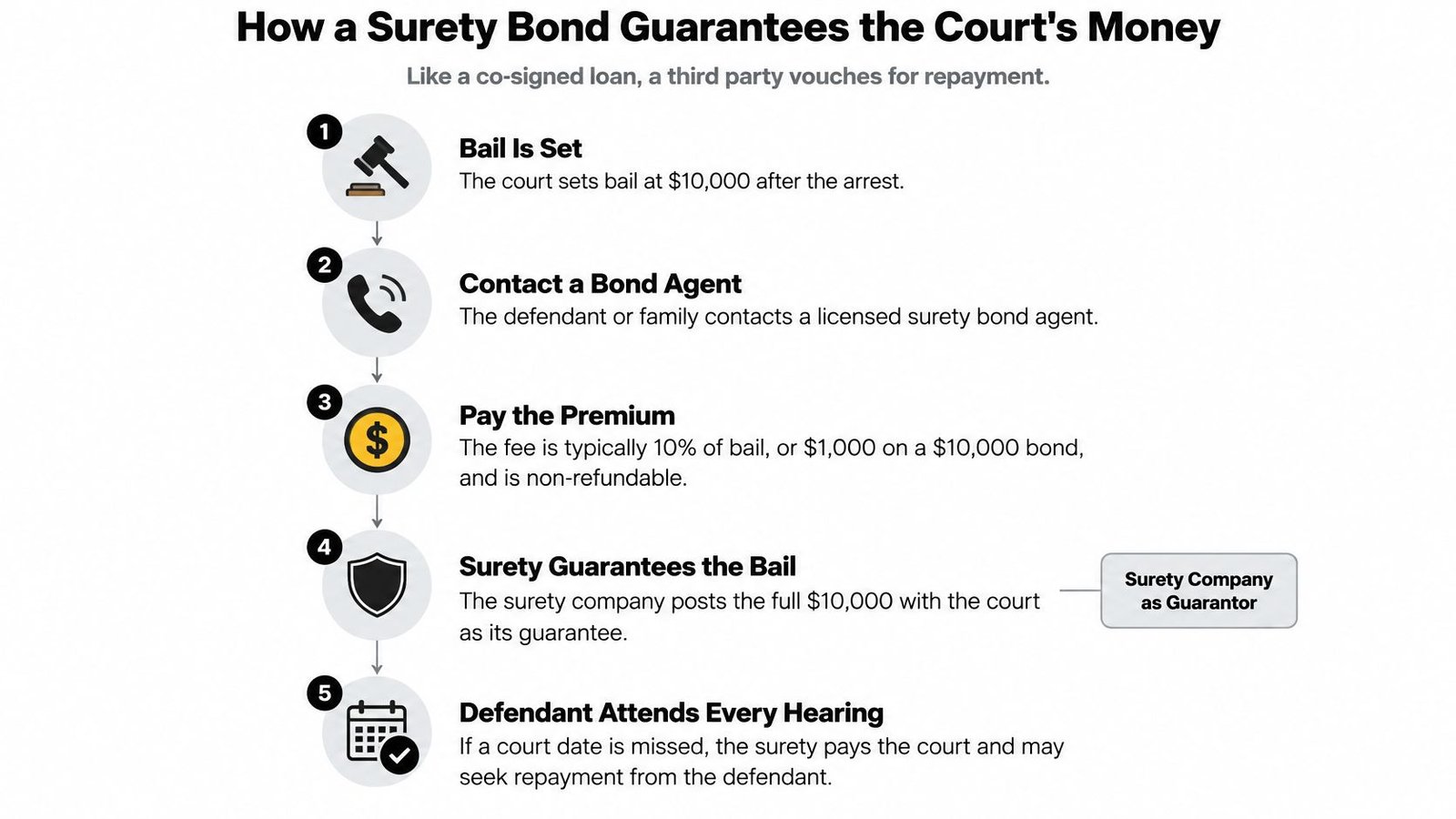
Follow a typical family through their first day after an arrest to see how those roles fit together in practice.
- The judge sets the bail amount. At advisement or through a county bail schedule, the court assigns a monetary figure, say $20,000, along with any pretrial release rules.
- A relative contacts a licensed bond agent. The family member shares the defendant's full name, booking number, facility location, and charges, then fills out an application so the agent can review risk and underwriting details.
- The cosigner pays the premium and signs the contract. Rather than emptying a savings account for the court clerk, the cosigner reviews the written indemnity agreement, pays the regulated fee, and pledges any required collateral. That signature is a legally binding promise that the defendant will show up for every required hearing, and the contract spells out the fees and responsibilities on both sides.
- The licensed agent posts the bond at the jail or clerk's window. The company files its formal financial guarantee for the full bail sum so the court holds enforceable protection if the defendant skips court.
- The detention facility processes release. Once jail staff clear booking paperwork, the defendant returns home subject to every court date and condition on the release order.
Why the Premium Isn't a Refundable Deposit
First-time cosigners often expect the fee they pay a bail company to come back at the end of the case, just like a cash deposit posted directly with a clerk. In most situations it does not.
The premium is payment for a service already performed: the surety underwrote the bond and absorbed the immediate risk of forfeiture the moment it guaranteed the court's money. Because that risk is real, the premium is generally non-refundable except in limited cases where a court orders part of it returned. Families should treat the fee as a cost of release, not a deposit in storage.
Take a $20,000 bail order as a concrete example. Paying cash directly ties up $20,000 until the court closes the case, whereas a surety bond replaces that outlay with a premium that typically runs $2,000 to $3,000 on a bond that size in Colorado. The tradeoff is real savings in liquidity, but underwriting, indemnity promises, and collateral can still apply, especially when bail is very high or the defendant looks like a flight risk.
The cosigner's exposure goes beyond the premium, and this is the part families underestimate. If the defendant misses court, the cosigner becomes legally responsible for the full bail amount. On a $30,000 bond, that means owing the entire $30,000 to the bail company, plus possible additional costs when the bond's terms are not met. The premium buys the guarantee; the signature carries the risk.
For a quick breakdown of how a bail agent coordinates release with the jail and what documents matter most, watch the short overview below.
That cash-flow difference is the everyday reason families ask why do I need a surety bond in the first place. Keeping the rest of those funds liquid instead of parked at the courthouse allows a household to cover rent, keep a car running for work, hire defense counsel, or pay for court-ordered treatment while the case moves forward.
How Much a Surety Bond Costs in Colorado
Colorado law caps a bail bond agent's maximum premium at the greater of $50 or 15% of the full bail amount, so families have a clear statutory ceiling before they sign anything. That cap is set out in Colorado Revised Statutes section 10-23-109. Think of the premium as the price of renting a financial guarantee. The court still has the full bail amount backing the defendant's release, while the family pays an upfront fee instead of tying up the entire bail in cash.
Putting the statutory ceiling next to full cash bail shows how the math scales from small bonds to serious felony orders.
| Bail amount | Maximum Colorado premium | Cash needed without a bond |
|---|---|---|
| $300 | $50 | $300 |
| $2,000 | $300 | $2,000 |
| $5,000 | $750 | $5,000 |
| $10,000 | $1,500 | $10,000 |
| $20,000 | $3,000 | $20,000 |
| $30,000 | $4,500 | $30,000 |
Notice how the $50 minimum applies to small bonds. Fifteen percent of a $300 bail equals $45, so the statute allows a $50 fee on bonds where the percentage would otherwise be lower. On a $10,000 bond, 15% brings the lawful ceiling to $1,500, subject to contract approval.
For a larger bond, the gap between cash bail and a premium can be significant. Express Bail Bonds provides surety bonds to post bail for customers, which means the customer posts a bond instead of paying the full bail amount in cash to the court. For a $20,000 bond in Colorado, the surety bond initial payment may be $2,000 to $3,000, a 10-15% premium. For bonds larger than $5,000, Express Bail Bonds can usually post the bond at a 10% fee with an approved cosigner. Those figures are easier to understand when separated into two questions: what does the court require, and what does the bail company charge to guarantee it?
The answer also depends on approval. A written contract must be signed between the bondsman and the client, outlining the terms of the bail bond, including fees and responsibilities. Approval of a cosigner typically involves a credit and background check. Express Bail Bonds looks for cosigners with stable employment, established residency such as owning a home or having a long-term rental history in the area, and a decent credit score.
Premium Versus Collateral and Refund Rules
Confusion spikes when an agent asks for both a fee and security, such as a lien on property or a pledged asset. Colorado treats those two items as legally separate under Colorado Revised Statutes section 18-13-130. The premium pays for issuing the guarantee. Collateral exists strictly to cover financial losses if the defendant misses court and the bond forfeits.
In certain cases, clients can provide collateral, such as property or valuables, to secure the bond. Collateral may be required in addition to the premium payment and a qualified cosigner, especially for very high bail amounts or when the defendant seems like a high flight risk. Using a bail bondsman typically requires collateral, which can include property or a cash deposit, and a co-signer with a stable income may be needed.
Never sign a bail agreement until the exact premium, any collateral description, and the written procedure for returning collateral after bond exoneration are printed on the contract in front of you.
Fifteen percent is a legal maximum, not a mandatory fee for every agency or bond size. Comparing Colorado surety bond rates and checking the exact dollar figure on the written contract helps prevent surprises at the signing table. Before you hand over a payment method, ask for the itemized fee in writing, check it against the 15% or $50 cap, and confirm in writing how and when any pledged collateral comes back once the court releases the bond.
Who Owes What When a Defendant Misses Court
A cosigner puts their signature on a family member's $30,000 bond so that person can keep working while awaiting trial. Three months later, the defendant panics, skips a mandatory hearing, and disappears. Because a cosigner's signature on a bail bond agreement is a legally binding promise that the defendant will show up for every required hearing, the cosigner on that bond is now legally obligated to pay the entire $30,000 to the bail company, plus potential additional costs if the contract terms aren't met.
Many relatives assume their downside stops at the upfront premium they already paid. It does not. The premium buys the service of posting the bond; it never caps what a cosigner can lose. Seeing every party's legal duty and financial exposure side by side removes that blind spot before anyone picks up a pen.
| Party | Primary duty under the bond | Financial and legal exposure if court is missed |
|---|---|---|
| Defendant (Principal) | Attend every court date and obey all release terms | Arrest warrant, revoked bond, added fees, and possible new charges |
| Cosigner (Indemnitor) | Pay the premium and ensure the defendant appears | Legal liability for the full bail amount, recovery costs, and loss of pledged collateral |
| Bail Company (Surety) | Post the financial guarantee with the court | Forfeiture liability to the court, driving recovery or surrender actions under contract |
How Courts Set Release Conditions and Enforce Forfeiture
Judges don't pluck release terms out of thin air or peg them to a fixed slice of a defendant's paycheck. As documented in the Colorado Commission on Criminal and Juvenile Justice annual report, Colorado's pretrial framework instructs decision-makers to tailor release conditions to individual characteristics, including financial condition, in order to address both court appearance and community safety. That same framework recognizes that a defendant who remains unable to meet a monetary condition after seven days can ask the court for reconsideration.
Those individualized conditions often include mandatory pretrial check-ins, geographic travel limits, sobriety testing, or strict no-contact orders. Violating a release condition can send a defendant back to custody even if they never missed a courtroom date.
When a defendant does skip court, the chain of consequences moves fast. The judge can issue a bench warrant, the court can start forfeiture proceedings against the bond, and the bail company can pursue recovery expenses while seizing any pledged collateral. The cosigner's obligation runs to the bail company, because the company is the party that owes the court. For very high bail amounts or defendants who look like flight risks, that is exactly why companies ask for collateral such as property or valuables on top of the premium.
If you want a plain-English look at how forfeiture timelines unfold after a missed date, review this bond forfeiture guide for families. For the specific contractual steps a bonding company takes when a claim or default occurs, look through our breakdown of the surety bond claim process.
Take three concrete steps the day your loved one is released:
- Build a shared hearing calendar: Enter every court appearance, pretrial services check-in, and attorney meeting into both the defendant's phone and the cosigner's phone with alerts set 48 hours and 24 hours ahead.
- Keep a dedicated paper folder: Store copies of every receipt, the signed indemnity contract, collateral paperwork, and the court's written release order in one place.
- Assign one backup reminder contact: Agree upfront who will confirm transportation to the courthouse the night before each hearing so car trouble or a work shift never turns into a bench warrant.
Remember what a bond can and can't do. It secures temporary freedom while the legal process runs its course, and it never guarantees a dismissal, reduced plea, or acquittal.
When a Bond Is Not the Only Option
Marketing around bail often implies that paying money is the main reason people show up for court or stay out of trouble. Peer-reviewed evidence tells a far more nuanced story, and understanding it keeps families from rushing into a financial obligation when a better legal route exists.
A 2025 criminal justice study published in the American Journal of Criminal Justice examined a Palm Beach County policy that lowered bond amounts and found more pretrial release and shorter jail stays, with no evidence of worse new-crime or failure-to-appear rates. The same article notes a 2025 scoping review concluding that cash bail was mostly ineffective at reducing failure-to-appear or rearrest rates while risking harm to the health and well-being of defendants and their families.
The stakes of staying locked up are steep, too. Research highlighted in that 2025 publication reported that pretrial detention increased the odds of a missed court appearance or rearrest by roughly 50% and raised the odds of a conviction by 36%.
A surety bond solves a cash-flow barrier created by a court order. It doesn't prove that money predicts reliability, and paying a bond doesn't guarantee release if another jurisdiction holds a warrant or detainer.
That brings the question why do I need a surety bond into sharp focus. You need a surety bond when a judge has already imposed a monetary condition you can't pay in cash and no quicker nonfinancial exit is open. You shouldn't treat a commercial bond as the automatic first step without checking whether the court will modify the order.
Questions to Ask Defense Counsel or the Court Early
Timing matters enormously. Speak with a public defender or private criminal defense attorney before the advisement or bond review hearing so they can gather proof of employment, stable housing, or caregiving responsibilities.
- Can we request a bond review or reduction? If the initial bond came off an automated jail schedule, a judge may lower the dollar figure once they hear personal facts about income and ties to the community.
- Is a nonfinancial release on the table? Ask counsel whether the defendant qualifies for supervised pretrial release or personal recognizance, and read up on how a PR bond works in Colorado before the hearing so you understand the obligations involved.
- Does the specific charge restrict nonfinancial options? Certain felony offenses, repeat failure-to-appear histories, or statutory holds limit what a judge can grant without a monetary condition.
- When is the next courtroom date, and what paperwork helps most? Bring pay stubs, a lease or mortgage statement, or a letter from an employer to show the judge a concrete reason the defendant will stay local and appear on time.
Every answer depends on the charge, local county rules, the court calendar, and the individual judge's discretion. Asking those questions early ensures you treat a surety bond as one practical tool in a broader release strategy, never a knee-jerk default.
Check the Bond Terms Before You Sign
When you've confirmed that a monetary condition stays in place and paying full cash isn't realistic, slow down for fifteen minutes and verify the details. You can complete this sequence in one sitting from your kitchen table before committing a single dollar.
- Pull the exact bail figure and release terms from official records. Call the detention facility or check the county court docket directly so you know whether the bond is cash-only, surety-eligible, or subject to additional holds.
- Double-check nonfinancial alternatives with counsel. Confirm with the defendant's attorney whether an upcoming hearing could drop the monetary condition or lower the amount before you pay a nonrefundable fee.
- Verify the bail agent's credentials. Make sure the agency and individual producer are actively licensed, bonded, and insured in Colorado before sharing sensitive financial details or payment information.
- Get the total premium in writing. Ask for an itemized quote and compare it against Colorado's statutory cap so you know the fee is lawful and clear.
- Read the collateral, refund, and termination clauses line by line. Review every provision of your bail bond contract to see what assets are pledged, what happens if court conditions change, and exactly how collateral is released when the case closes.
- Stress-test your cosigner exposure. Ask yourself whether the defendant will answer your calls and show up for every hearing, remembering that you're legally on the hook for the entire bail sum if they don't.
- Lock in every court date immediately. Don't wait for a mailed notice from the clerk; write down the first appearance date and pretrial check-in rules before the defendant even leaves the jail lobby.
What to Expect When Qualifying as a Cosigner
Knowing what an agency looks for speeds up approval and avoids back-and-forth delays. Express Bail Bonds is licensed, bonded, and insured, and we have served every county across Colorado since 1988. When reviewing an application, we look for cosigners with stable employment, established residency such as owning a home or maintaining a long-term rental history in the area, and a decent credit score, with approval typically involving a standard credit and background check.
Because emergencies rarely happen during business hours or in the same zip code, we use secure, electronic contracts that cosigners can review and sign from anywhere in the country. Our agents also help families compile practical details to present a clear picture at a bail hearing, and our team is available 24/7 by call or text at 720-984-2245.
Whether you need statewide Colorado bail bond service, local help with Jefferson County bail bonds in Golden, or fast coordination for Centennial bail bond services, getting accurate figures first puts you back in control. Confirm the exact bail amount and release conditions with the jail or court clerk today so you can move forward with clear numbers.
When a court sets bail higher than your household can pay in cash, working with a licensed agent who lays out every fee, contract duty, and release step upfront takes the guesswork out of a stressful day. Express Bail Bonds offers 24/7 surety bond support across every Colorado county with clear guidance and secure electronic paperwork you can sign from anywhere. Call or text 720-984-2245 or visit Express Bail Bonds to confirm your options and get the release process moving.