Your relative was booked overnight, you're holding a phone with a low battery, and someone has told you to fill out a bail application. Before entering payment information, you need to know which details come from the court, which come from the bail agent, and what still has to happen before release.
A useful bail application example does more than collect a name and a payment. It connects the correct person to the correct court order and a release plan they can follow. Start with the paperwork, not a guessed price.
Sample Application Filled In Field by Field
Say a sister in Denver learns that her brother was booked overnight and, in this hypothetical scenario, the judge has set a bond of $5,000. She should obtain the order before deciding what to pay or which application to complete.
The separate fictional template below uses Maria Elena Ortiz as the defendant. It's a working template, not an official court form. Match identity details to the booking record and copy every case-specific number from the order rather than inventing missing entries.
Under Colorado's bond statute, the court selects the authorized bond and may impose a secured monetary condition only when reasonable and necessary to assure appearance or protect individuals or the community. The full monetary amount must be secured, so a family shouldn't assume a percentage deposited directly with the court will satisfy the order.
Sample bail application fields
| Field | Sample entry | Why it matters |
|---|---|---|
| Defendant full legal name | Maria Elena Ortiz (sample) | Must match the booking record exactly |
| Date of birth | Copy the complete birth date from the booking record | Identifies the correct person in jail records |
| Booking number | Copy the jail-assigned booking identifier | Lets jail staff locate the detained person |
| Facility and county | Denver County Jail, Denver County (sample) | Tells the bondsman where to post the bond |
| Court and case number | Copy the court name and complete case identifier from the order | Ties the bond to the right judicial order |
| Charges | As listed on the court order | Confirms the bond covers the correct case |
| Bond amount | $5,000, hypothetical court-ordered amount | Must be copied from the order, not estimated |
| Bond type | As ordered by the judge, such as surety or personal recognizance | Determines how release is secured |
| Next court date | From the order | Prevents a missed appearance |
| Applicant name, relationship and contact | Sister's full name, working phone and email | Lets the bondsman reach the person who pays |
| Cosigner details | Name, income, residence and credit information | Supports approval before a surety bond is written |
| Payment method and premium | $750 at 15% of $5,000, paid by card or as agreed, illustrative quote | Shows the cost and how it is settled |
Record release conditions alongside the hearing date, including appearance obligations, restrictions on leaving Colorado without permission, and other applicable terms. Keep the applicant and cosigner separate when they're different people, and confirm who may receive notices.
If you're completing a PDF rather than an online intake form, PDFWix's guide to filling out PDF forms online can help with entering and saving the information. Copy this table into a notes file, fill each line from the records, and flag anything you can't verify before calling an agent.
Bond Types and What Each Means for Your Application
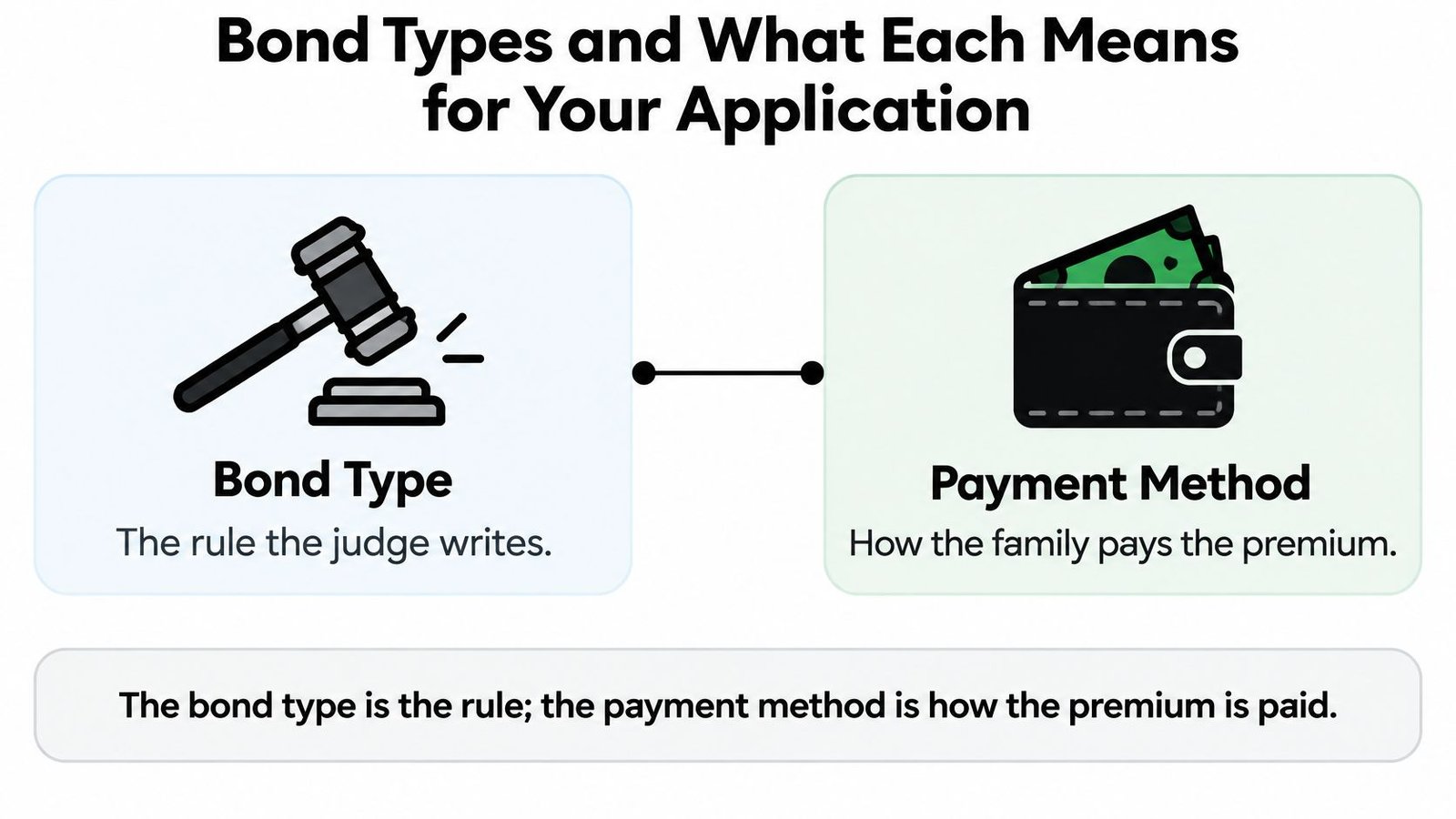
The court's order sets the bond type. A family can choose an available way to pay a premium, but that choice doesn't change what the judge authorized. Think of it as learning the fare before choosing how to pay.
This distinction is especially important when an application asks both for the bond type and for a card or payment arrangement. Those fields answer different questions.
Bond types and what the application records
| Bond type | Who pays what | What the application records | Typical use |
|---|---|---|---|
| Personal recognizance | Nothing posted as security; defendant promises to appear | Order language and release conditions | Lower-risk releases the court sets without money |
| Cash bond | Full bail amount paid to the court or jail | Payor name, amount paid and signed receipt | Releases where the full amount is paid directly |
| Surety bond | Premium paid to the bondsman, plus required collateral; surety writes the full face amount | Surety and cosigner details, premium, collateral and indemnity terms | Bondsman-assisted releases when the family cannot pay the full amount |
| Property bond | Real estate pledged as security for the amount | Property description, ownership and value | Cases where the court accepts property as security |
A surety application involves a contractual commitment, not merely a smaller cash deposit. The cosigner should understand the indemnity agreement before signing, including the financial responsibilities it assigns.
The visual below separates the judicial decision from the family's premium payment.
Use the guide to types of bail bonds to identify the terminology you're seeing, then enter the order's actual wording. Don't select surety just because that's the route your family prefers. We don't post cash-only bonds, so that restriction needs to be identified before proceeding.
Practical rule: If the order requires security, the paperwork must secure the full face amount even when the premium is much smaller.
Documents, Cosigner Details and Mistakes That Stall a Release
Gather the supporting documents before calling. A completed field won't help much if the person reviewing it can't verify the information.
- Applicant identification: Have government-issued photo identification for the person submitting the application.
- Court paperwork: Gather the order or bond paperwork showing the case number, charges, amount and authorized bond type.
- Cosigner evidence: Collect identification, proof of stable income and proof of residence, such as homeownership documentation or a long-term rental history.
- Credit information: Have the information needed for the agent's cosigner review ready, and send sensitive material only through the designated secure process.
- Collateral details: Identify any proposed property or cash deposit and who owns it.
Using a bondsman typically requires collateral, and a cosigner with stable income may be needed. At Express Bail Bonds, we look for stable employment, established residency and a decent credit score. Our document preparation guide helps you organize what to have available.
Separate Agency Paperwork From Court Forms
An agency intake form and an indemnity agreement aren't substitutes for court-facing documents. The Colorado Judicial Branch's bail forms list includes JDF 370, Appearance Bond; JDF 371, Consent of Surety; JDF 375, Surety Request for a Show Cause Hearing; and JDF 231, Waiver of Extradition as a Condition of Bail Bond.
These documents perform different legal functions. A surety consent and an extradition waiver are separate documents, used when the court or bond requires them, not interchangeable attachments that everyone must complete.
Fix These Problems Before Submission
- An amount entered from memory: Replace it with the amount on the actual order.
- Unsupported cosigner information: Gather income and residence documents before presenting the cosigner for approval.
- Unverifiable promises: Don't offer housing, rides or treatment arrangements until the people or programs involved have confirmed them.
- An assumed percentage deposit: Read the security requirement instead of assuming a partial payment to the court is authorized.
- Missing conditions or hearing information: Add the next appearance and every applicable restriction before submitting.
For the release plan, name the proposed residence, identify who can provide transportation, and explain how reporting, work and caregiving will fit together. We can help compile information for presentation at a bail hearing; questions about legal arguments or changing conditions belong with defense counsel.
A lower bond isn't automatically the strongest application. A verifiable plan for housing, court travel and compliance can matter more than a request focused entirely on money. Promise only what the defendant and supporting family can maintain.
Premium Math and What the Bond Costs
On a $5,000 bond, a premium calculated at 15% is $750; Colorado's premium statute caps an insurance producer's premium or commission at the greater of $50 or 15% of bail. At the smaller hypothetical bail amount of $300, that calculation produces $45, so the $50 minimum used in the illustration applies.
That's a statutory ceiling calculation, not a reason to treat every quote as automatically identical. The application should distinguish the court's bond amount from the quoted premium, any authorized separate charge and any collateral.
Premium at 15% by bail amount
| Bail amount | Premium after $50 minimum |
|---|---|
| $300 | $50 |
| $1,000 | $150 |
| $2,000 | $300 |
| $5,000 | $750 |
| $10,000 | $1,500 |
| $20,000 | $3,000 |
The statute generally limits additional posting fees to court or law-enforcement filing charges, actual secure collateral storage, or premium financing. An unexplained processing total deserves clarification before payment.
Get the Agreement and Receipts
Under Colorado's professional cash-bail agent documentation requirements, the payment arrangement and schedule must be written, signed and dated before payment is accepted, with the defendant's or indemnitor's signature. Each premium payment must receive a signed and dated receipt stating the amount paid.
The bond document also identifies the collateral amount and type, together with the conditions for returning it. Collateral is separate from the premium, so don't accept a combined total without knowing which money is payment and which property or money is security.
Ask for an itemized calculation, not just an amount to charge to your card.
Use the bond pricing explanation to prepare your questions. Before paying, request the premium calculation in writing and check the arithmetic against the table.
Step-by-Step Process from First Call to Release
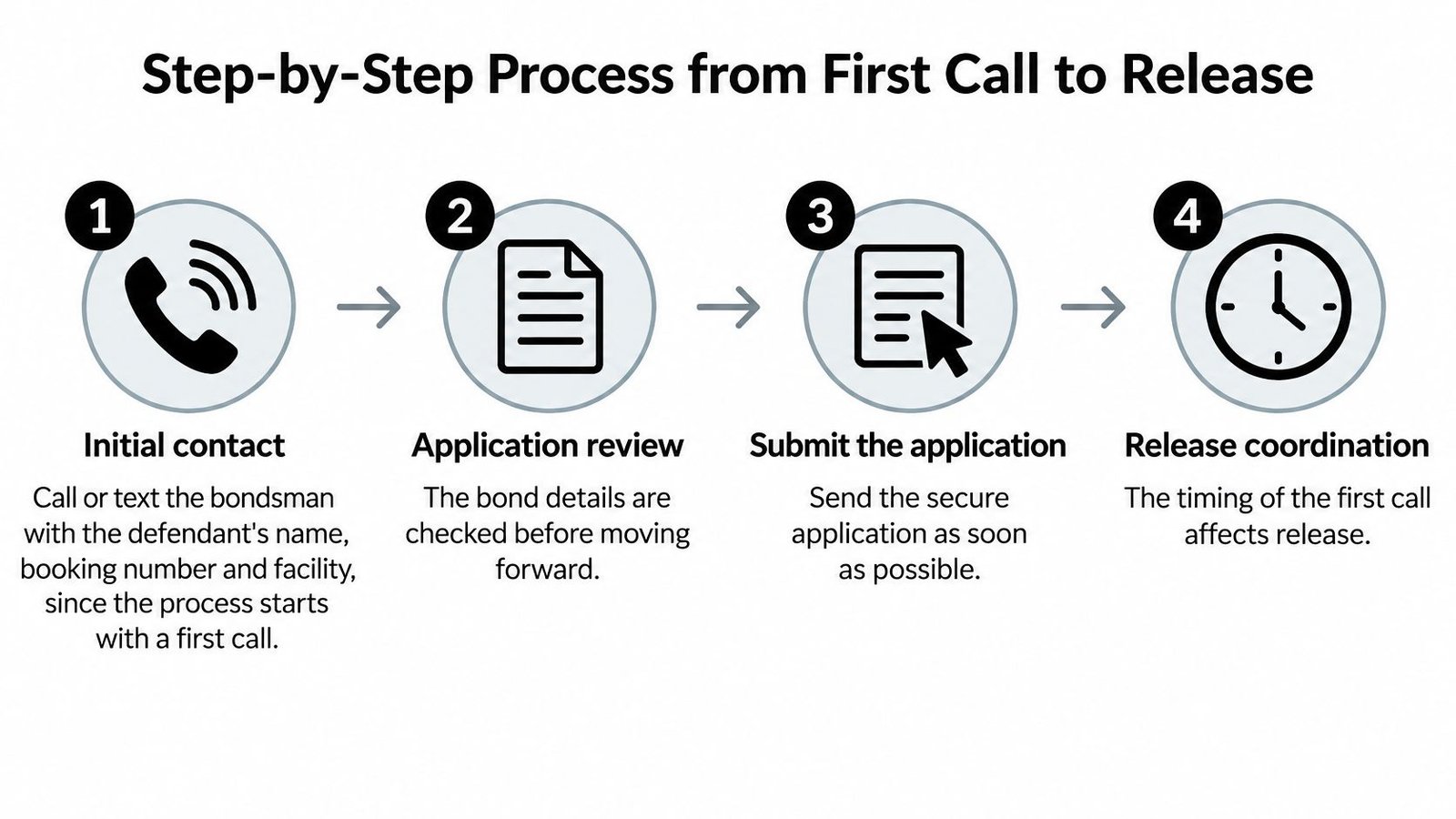
The core transaction has three stages: initial contact, paperwork and posting. For a family coordinating remotely, separating payment and jail processing makes the handoffs easier to track.
Make initial contact. Call or text the bondsman with the defendant's legal name, booking number and facility. These details let the agent locate the right detention record before discussing the transaction.
Complete the application. Enter the court-order details into the secure online form, keeping applicant and cosigner information separate. Our electronic process works from a phone or computer, including for family members in another state.
Sign and arrange payment. Review the premium, payment schedule, bail bond agreement and contract documents before signing. Keep the signed receipt and your completed copies together.
Have the bond posted. The bondsman posts the bond with the court and relevant detention facility. Ask for confirmation of posting rather than assuming submission of your application means posting is complete.
Coordinate jail release. Confirm that the facility has received the bond and that the defendant is physically present for processing. Follow the jail's instructions about pickup and any remaining compliance steps.
This process graphic shows the main coordination points.
Understand Which Clock Applies
Colorado's release statute requires release within six hours after a personal-recognizance bond is set and the defendant returns to jail, or after a cash bond is set, the defendant returns and the jail receives notice that the bond is ready to post, unless extraordinary circumstances exist. It also prohibits withholding release for unpaid booking, bond-processing, pretrial-supervision or electronic-monitoring fees.
Those statutory triggers shouldn't be confused with a universal deadline measured from your first call. Individuals can typically expect release within two to six hours after posting, but the time of day, the court's processing speed and the nature of the charges can affect that expectation.
Court approval doesn't mean immediate physical release. Staff still need to validate documents, complete facility procedures and resolve applicable release requirements. Our jail release process guide helps families understand those separate steps.
Save the posting confirmation, the facility contact, pickup instructions and the next hearing information. If release appears stalled, ask which specific step remains outstanding rather than submitting duplicate applications or making another payment without clarification.
What Happens After Release and Getting Collateral Back
Once your relative is out, preserve the paperwork before attention shifts to getting home and returning to work. Keep the signed payment schedule, bond document and every signed and dated receipt in a secure folder the payor can access.
Read the collateral provisions carefully. Identify what was pledged, who owns it and what must happen before it can be returned. If the return conditions aren't clear, ask the agent to explain them in writing rather than relying on a verbal assumption.
Keep a Working Compliance Record
- Court appearances: Put every court date from the order on a shared calendar and confirm that the defendant knows where to appear.
- Release conditions: Track travel restrictions, no-contact terms, monitoring and reporting appointments exactly as ordered.
- Contact changes: Call the bondsman before an address, employment or phone change so the bond record remains accurate.
- Collateral follow-up: Keep the written return conditions with the ownership documents and payment records.
A violation can lead to a new warrant and bond forfeiture. If a ride falls through or a condition becomes difficult to follow, contact defense counsel promptly rather than treating the problem as permission to ignore the order.
Release starts an obligation to comply; it doesn't end the case.
For questions about the difference between a payment and returnable security, use the guide to getting bail money back. Don't assume that release itself triggers collateral return or that the premium and collateral follow the same rules.
The agent can explain the agreement and paperwork. The court order remains the final authority on release conditions, and any requested change needs to go through the appropriate court process.
Submit Your Application and Start the Bail Process Today
Start the inquiry now rather than waiting until every question feels settled. An early call lets a licensed bondsman identify missing information while you gather the documents; it doesn't replace checking the order or guarantee release.
Remote coordination lets a family member organize the paperwork without traveling to the detention facility.

Our licensed bondsmen are available 24/7 by call or text at 720-984-2245, or by email, and begin the release process when a customer calls. The fully electronic process lets out-of-state relatives complete the application from a phone or computer without flying to Colorado.
Choose the Relevant Starting Point
- Statewide help: Start an online inquiry through the Express Bail Bonds website.
- Golden and Jefferson County: Use the Jefferson County bail bond page for local coordination.
- Centennial: Use the Centennial bail bond page when arranging help in that area.
Have the court order, booking number, cosigner information and written premium calculation available for the conversation. If something is missing, identify it clearly instead of filling the gap with a guess.
You can also watch the accompanying video before completing your paperwork.
Call to begin the inquiry, then work through the document checklist with the agent before submitting the completed application.
Express Bail Bonds offers secure electronic applications, payment and contract paperwork, with licensed agents available around the clock to guide Colorado surety-bond coordination. Visit Express Bail Bonds with your court order and booking information ready, and start an application that matches the order and supports a workable release plan.