
It's late, your phone just rang, and someone you care about is sitting in a Colorado jail while a booking officer mentions an amount you didn't expect. You search for a bail schedule because you need one clear number, fast. That number exists, but it's only the starting point. The county where the person is held, the exact charge class, the bond type, and any hold on another case can change what you pay and how soon release happens.
Scheduled Bail Amounts by Colorado Charge Class
| Charge class or offense | Scheduled amount | Note |
|---|---|---|
| Class 2 felony | $50,000 | Statewide schedule amount; local schedule sets bond type |
| Class 3 felony | $20,000 | Statewide schedule amount |
| Class 4 felony | $10,000 | Some sources list $25,000; confirm against your county schedule |
| Class 5 felony | $5,000 | Statewide schedule amount |
| Class 6 felony | $2,000 | Statewide schedule amount |
| First-offense DUI (Denver County Court) | $1,500 personal-recognizance bond | Cited statute; bond type is personal recognizance, not cash or surety |
Find the charge class on the charging document, booking sheet, or summons, then match it to the row above. Treat that figure as a starting point the court can modify, not as a final price you've locked in. A judge who reviews the case later can raise it, lower it, or change the conditions attached to release.
Why the Bond Type Matters as Much as the Amount
The Denver DUI row shows why you shouldn't read only the dollar figure. A $1,500 personal-recognizance bond doesn't work like $1,500 in cash or a $1,500 surety bond. With personal recognizance, the court releases the person on a signed promise to appear, so there's no premium to pay an agent for that bond. With cash or surety, money changes hands before release.
If you're looking at a DUI case specifically, our guide to DUI bail amounts in Colorado walks through how those charges are handled. The key habit is simple. Always note two things together, the amount and the bond type, because either one alone can mislead you.
Practical rule: Write down the amount and the bond type from the same row. A number without its bond type isn't a complete answer.
A Quick Word on the Class 4 Figure
Pay extra attention to the Class 4 felony row. The statewide schedule lists $10,000, but another Colorado court order lists $25,000 for that class. That gap isn't a typo you should guess your way through. It means counties and court orders don't always align, and the schedule your specific court applies is the one that controls your case.
Say your brother is booked on a Class 4 felony and a family member finds $10,000 online. If the jail is working from an order that sets $25,000, you could arrange the wrong amount and lose hours. Confirm the figure with the jail or the county schedule before you move money. The sections that follow show you how to find that county schedule and when a scheduled amount stops deciding release altogether.
How Bail Schedules Work and Why Counties Use Them
Think of a bail schedule like the sticker price on a car. It's set in advance so the process can move quickly, and the final terms get settled later. Nobody at booking has time for a full hearing on every case at 2 a.m., so the schedule gives staff a preset number to work from.
The image below shows the moment most families first meet that number, across a counter, before any judge has seen the file.
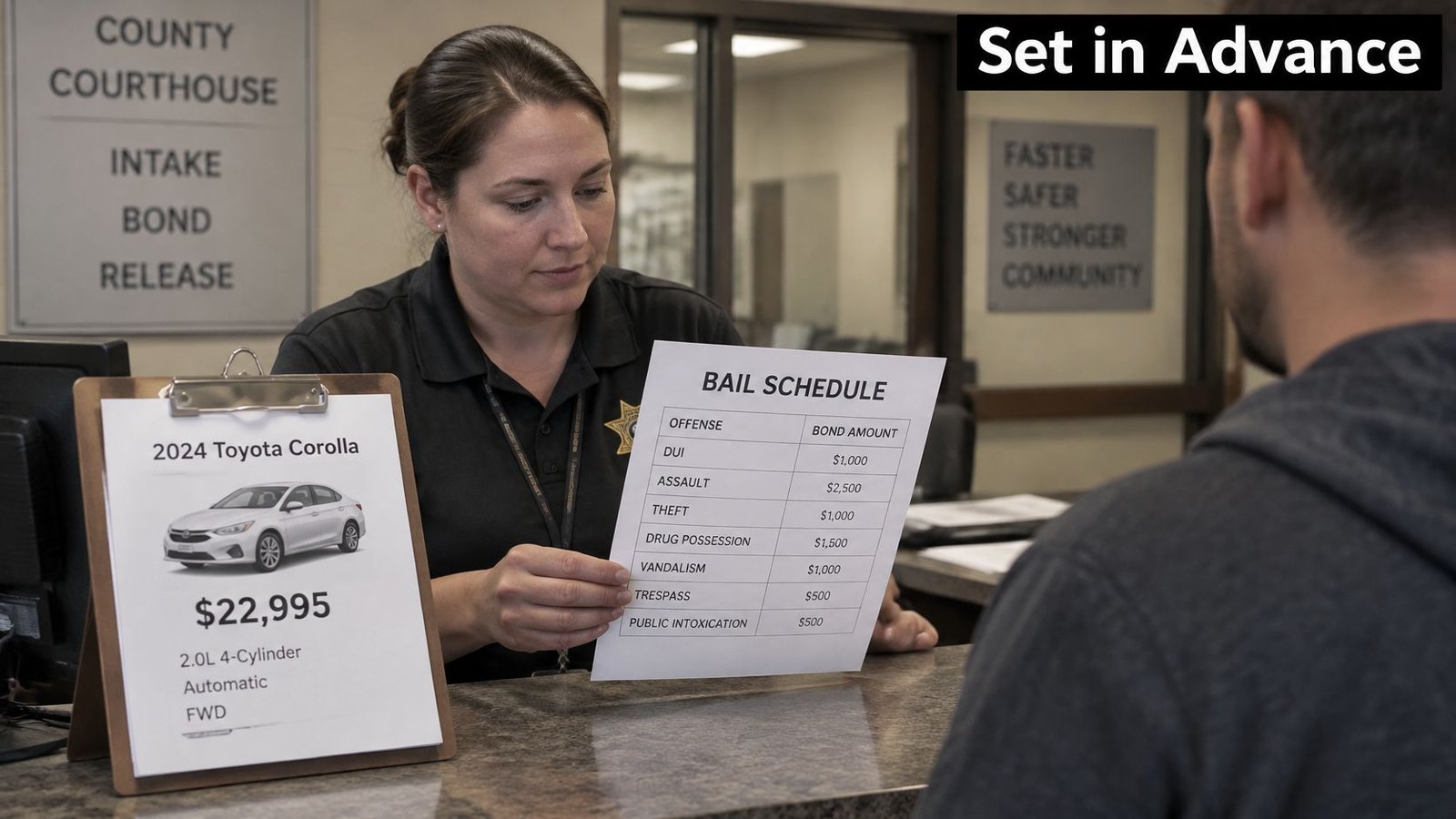
A bail schedule is a preset list that assigns a recommended monetary amount to an alleged offense, based mainly on the charge and its seriousness rather than a fully individualized hearing at the initial stage, as the Bureau of Justice Statistics pretrial release overview describes. One major empirical estimate found that approximately 64% of U.S. counties use bail schedules, while other jurisdictions use more individualized approaches instead. So schedules are common, but they're not universal, and they're not a national price list.
What the Schedule Does and Doesn't Do
The schedule's job is speed and consistency. Two people booked on the same charge in the same county get the same starting amount, and booking staff can process release without waiting for a judge in eligible cases. That's useful when courts are closed.
What it doesn't do is weigh the individual. A judge reviewing the case later can modify conditions based on public-safety concerns, flight risk, and criminal history. Our overview of Colorado bail laws explains how that judicial review fits into the wider rules. Amounts also differ substantially between jurisdictions for similar offenses, so the schedule in the Colorado county where the case is filed is the only one that matters to you.
The short video below walks through that difference between a starting amount and a judge's final decision.
There's a trade-off built into this system. Uniform amounts are predictable, but a high preset figure can keep someone in jail because they can't pay, even before a judge has looked at their circumstances. That's why it's best to treat the schedule as an entry point into the release process, not a verdict on the person or the case.
Finding Your County's Bail Schedule Step by Step
A bail schedule is a standardized pre-arraignment decision rule that assigns a preset bond amount and bond type to an alleged offense, allowing release processing without waiting for an individualized judicial hearing in eligible cases, as shown in the Colorado Judicial Branch bond schedule order. That order sets amounts by offense class, while separate local schedules specify whether the amount is a personal-recognizance, cash, or surety bond.
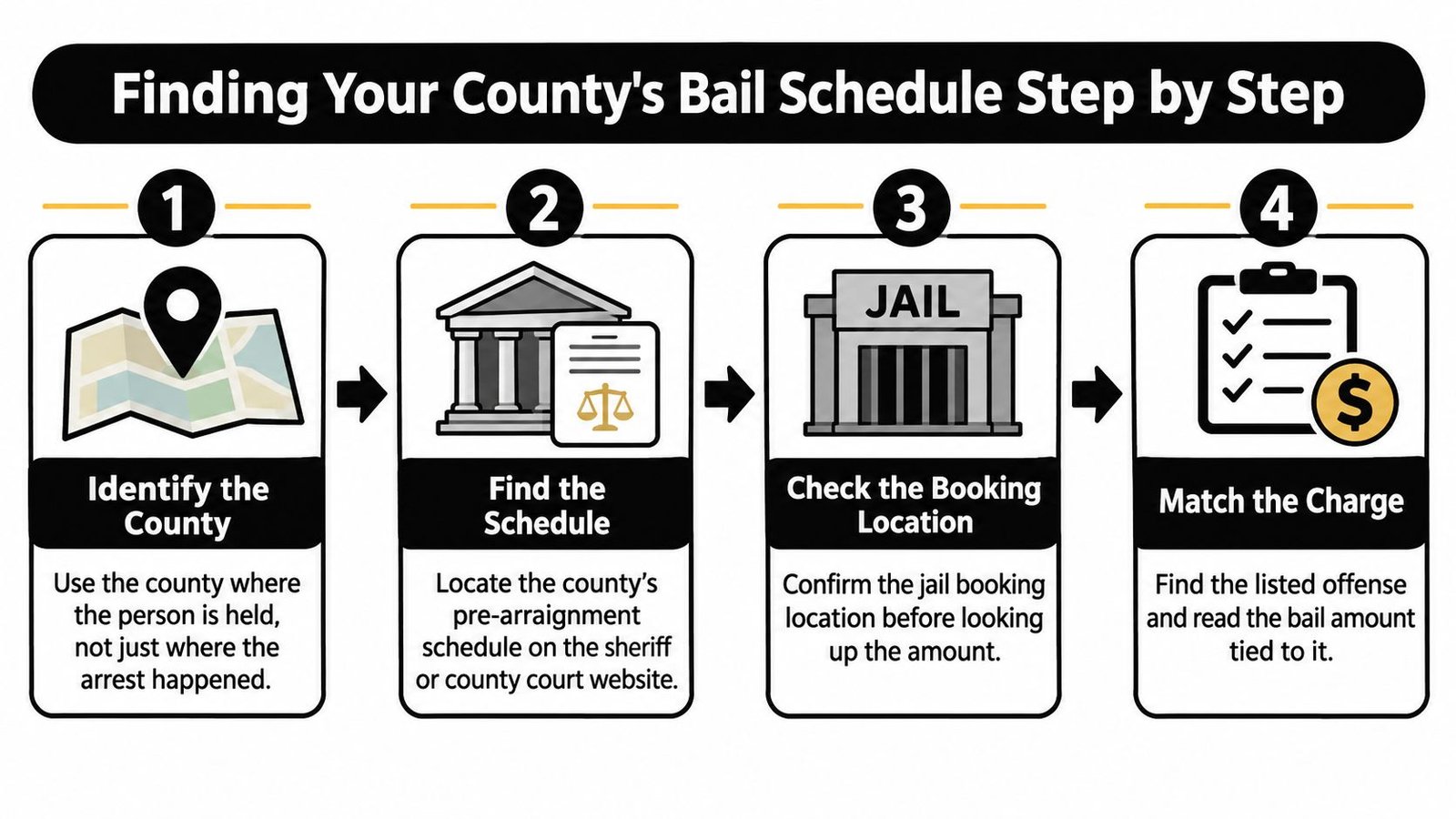
- Identify the county where the person is held. The jail booking location may differ from where the arrest happened, especially after a transfer. Use the holding county, because that's the schedule the jail staff are working from.
- Find that county's pre-arraignment schedule. Look on the sheriff or county court website. Denver County Court, for example, publishes offense-specific amounts rather than only class-based ones.
- Pull the exact charge and its class or statute. Get it from the arrest report, booking sheet, or summons, not from what someone remembers hearing. One class level can change the amount by thousands.
- Match the class or statute to the schedule row. Note the bond type listed beside the amount. Personal recognizance, cash, and surety each lead to a different next step.
- Check the exceptions before assuming a surety bond is available. Some charges can't be released through the schedule at all. The next section covers those, so don't arrange money until you've read it.
- Ask the jail about warrants and court dates. Confirm whether a warrant or upcoming court date is attached to the case. Our list of Colorado county jail phone numbers helps you reach the right facility quickly.
Why County and Class Must Match Exactly
Colorado guidance distinguishes scheduled release from individualized judicial review, and current guidance states that this framework is not itself a bond schedule and requires consideration of available pretrial risk information. In plain terms, the schedule converts a charging classification into a release pathway, but it isn't the final bond decision. If your county or class is wrong, everything downstream is wrong too.
Verify the exact county, charge classification, and warrant status before you rely on any dollar amount you've found online.
We provide free bail information and guidance if you get stuck matching a charge to a schedule. Before you go further, write down three things on one line, the matched row, the county, and the bond type. You'll need all three for every decision that follows.
When the Scheduled Amount Does Not Decide Release
Here's the assumption that trips up most families. A published dollar amount does not guarantee release. The Colorado Judicial Branch 2025 bond guidelines state that the sheriff may not release an individual until a judicial officer has set bond, except where a specific rule or order provides otherwise, and those guidelines expressly say they are "not a bond schedule."
| Case type | What changes | What to do |
|---|---|---|
| Felony arrest | Release waits until a waiver of extradition is signed | Complete and sign the waiver, then arrange bond |
| Designated domestic-violence offense | The schedule cannot be used for release | Wait for a judge to set bond |
| Alcohol-related traffic offense | Appearance before a judge, or cash or surety bond | Ask the court about the appearance date and bond options |
| First-degree murder | May be ineligible for ordinary bond when proof is evident or presumption is great | Expect a judge's decision |
| Other listed offenses | Hearing within 96 hours of arrest; judge must find proof evident and significant public peril | Expect a judicial hearing |
| Eligible person with local pretrial program | Program evaluation advises on bond eligibility and conditions | Ask whether a pretrial program applies |
Reading the Exceptions in Plain Language
For first-degree murder, the guidelines identify it as a category that may be ineligible for ordinary bond when the proof is evident or the presumption is great. For other listed offenses, a hearing must occur within 96 hours of arrest, with reasonable notice, and the judicial officer must find both that the proof is evident and that releasing the accused would place the public in significant peril. No schedule row overrides that process.
Lower-level cases have their own gates. A person arrested for a felony can't be released until the required waiver of extradition is completed and signed. A designated domestic-violence offense can't be released through the schedule at all, so you're waiting on a judge. Alcohol-related traffic offenses require either an appearance before a judge or the posting of a cash or surety bond.
There's also a constructive option in the table. A local pretrial-services program may evaluate an eligible person and advise the court whether they're bond-eligible and what conditions fit. Our explainer on pretrial risk assessment in Colorado covers how courts weigh that information. It turns a simple pay-and-release transaction into a supervised release path for some people.
We provide guidance to help clients understand the legal aspects of bail, and we can post bonds for the vast majority of criminal charges. Still, confirm your charge against each row above before arranging any money. Paying toward a bond that isn't yet available helps no one.
Premiums, Cosigners and Release Time
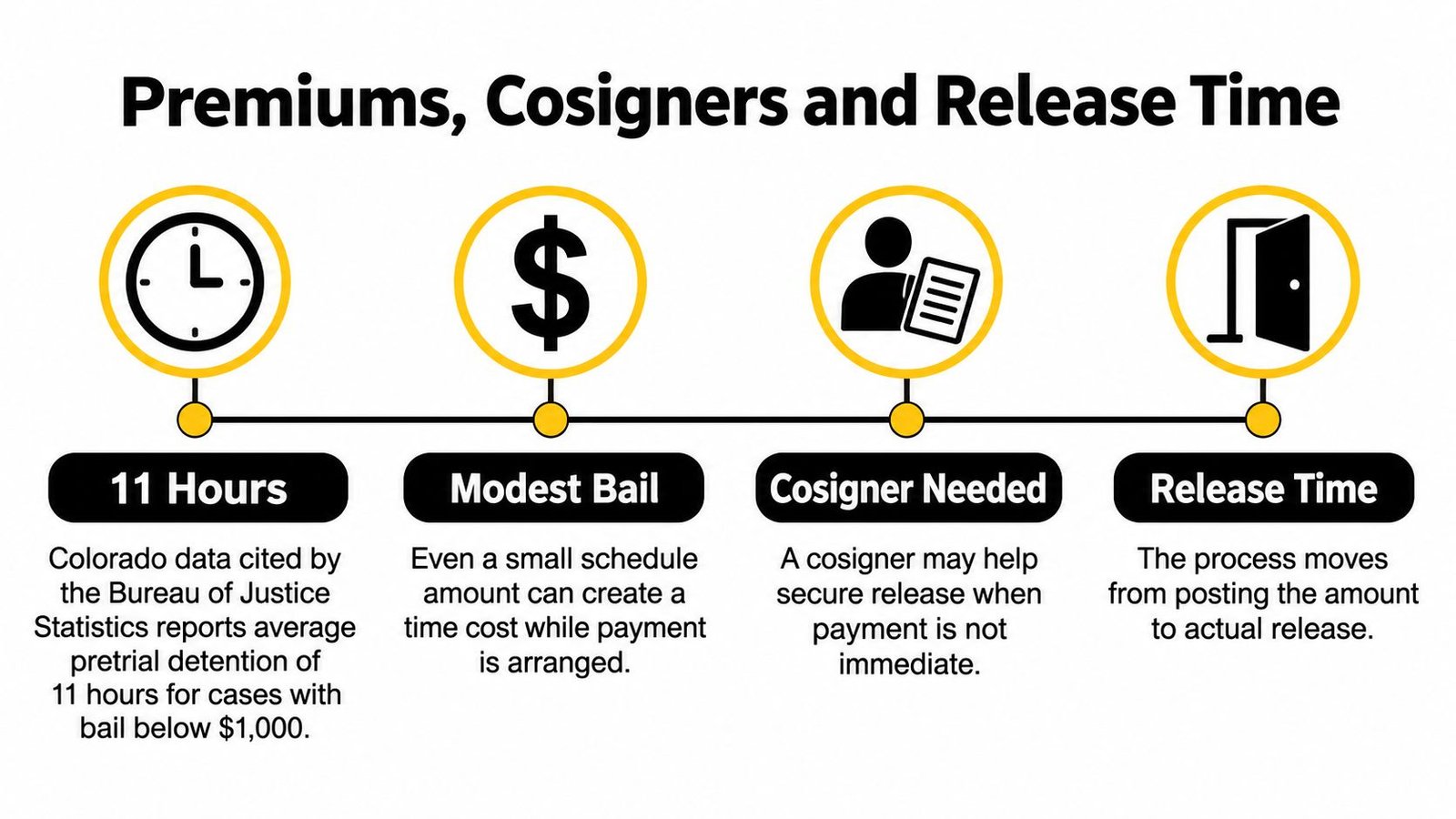
The cost of a bail schedule is often measured in time, not just money. The Bureau of Justice Statistics material on Colorado pretrial release reports that average pretrial detention is 11 hours for cases with bail below $1,000. Even a modest amount creates a same-day logistics problem involving booking, eligibility checks, paperwork, payment, and jail processing.
Premium Versus Face Amount
The schedule sets the face amount, which is the full figure the court requires. A surety bond works differently. You pay a premium to a licensed bail agent, the agent posts the face amount with the court, and that premium is generally non-refundable because it's the fee for the agent's guarantee. Confirm the exact percentage in writing before you pay anything, and our breakdown of surety bond rates in Colorado explains how that math works.
| Route | What you pay | What is needed |
|---|---|---|
| Cash payment to the court | Full scheduled amount | Funds to post with the court |
| Surety bond through a licensed agent | Non-refundable premium to the agent; agent posts the face amount | Licensed agent, defendant details, charge information |
| Surety bond with a cosigner | Same premium; cosigner is responsible for the full amount | Cosigner with stable employment, residency and credit |
Cash ties up the full amount until the case resolves, which most families can't spare. A surety bond lowers the upfront outlay to the premium, but that premium doesn't come back. Adding a cosigner doesn't change the premium itself. It changes who stands behind the bond if the defendant misses court.
What a Cosigner Needs to Show
We look for cosigners with stable employment, established residency such as owning a home or having a long-term rental history in the area, and a decent credit score. The cosigner is promising that the defendant will appear, and accepts responsibility for the full amount if they don't. That's a serious signature, so nobody should cosign under pressure without understanding it.
If you're cosigning from out of state, prepare these before you call:
- Identification: A valid government-issued ID you can send electronically.
- Employment details: Employer name, how long you've worked there, and income information.
- Proof of residence: A mortgage statement, lease, or utility bill showing your address and how long you've lived there.
- Credit information: Be ready for the agent to discuss your credit history and current obligations.
Having those ready can save an hour of back-and-forth while someone waits in a holding cell. Ask which steps you can complete electronically, since paperwork and payment often don't require you to be in Colorado.
Where Release Time Actually Goes
Securing a bail bond takes three steps on our end, initial contact, completing paperwork with details about the detained person and the charges, and the bondsman posting bail with the court. After that, the jail still has to process the release. Individuals can typically expect to be released within two to six hours after the bail is posted, and the time of day, the specific court's processing speed, and the nature of the charges can affect this timeframe.
A fast bond does not guarantee immediate physical release, because jail verification and unrelated holds may remain.
That last point matters most. If the person has a hold from another case, a probation matter, or another county, posting your bond clears only your case. The jail won't release them until the other hold is resolved. Always ask the jail directly, "Are there any other holds?" before you pay.
Modern systems increasingly track release, detention, failure-to-appear, and violation outcomes rather than treating the scheduled dollar figure as the central metric. For your family, the practical version is simpler. Confirm a surety bond is allowed for the charge, confirm there are no other holds, then compare premiums. In that order.
Confirm Your Amount Before You Call
A short checklist makes your first call far more productive. When calling us, it helps to have these four items ready:
- Defendant's full name: Exactly as it appears on the booking record, including any middle name.
- Date of birth: Jails use this to separate people with similar names.
- The jail where they're held: The facility and county, not just the city of arrest.
- The scheduled bail amount: Confirmed against the county schedule, with the bond type noted beside it.
On that call, the agent should explain fees, court requirements, and next steps before you commit to anything. Ask how any holds the jail reported would affect timing, and ask what happens right after release, including check-ins and court dates. If an agent can't answer those questions plainly, that's information too.
We're available 24/7 by call or text at 720-984-2245, and you can book a bail bonds appointment online through our booking page at Express Bail Bonds online booking. For local context, see our pages for bail bonds in Jefferson County and Golden and bail bonds in Centennial.
Your next step is concrete. Write down the four pieces of information above, confirm the scheduled amount against the county schedule one more time, then call, text, or book online. Five minutes of checking now can save hours of waiting later.
If you've matched your charge to the bail schedule and confirmed a surety bond is available, we can explain the premium, paperwork, and likely release timing for your county before you pay anything. Visit Express Bail Bonds to book online or reach a licensed agent any time, day or night.