A late-night call from a Denver or Jefferson County detention center can leave a family searching for “surety bond direct” before anyone has explained what the phrase means. You may be hoping to apply online, pay remotely, avoid a trip to the jail, and get someone released without a confusing chain of paperwork. Those are reasonable goals, but application speed, bond issuance, and court acceptance are separate steps.
The choice between going directly to a surety and using a licensed Colorado bail agent can affect how those steps unfold. It can also affect how you handle cosigners, collateral, fees, signatures, and local detention-facility procedures. This guide breaks down the differences in plain language, so you can make a practical decision under pressure. For a general overview of the process, see how to get a bond.
When You Need a Bail Bond Fast in Colorado
The phone rings after midnight. A relative has been arrested, the person calling from the detention center doesn't know the exact release requirements, and the family member holding the phone is several hours away. A search for surety bond direct often starts with one simple question: “Can we handle this online right now?”

Online processing can remove unnecessary travel and make it easier for an out-of-state cosigner to participate. But an online application isn't automatically an electronic bond, and an issued bond still has to be accepted and filed by the appropriate jail or court. The fastest path is usually the one that fits the specific bond, the cosigner's situation, and the facility's procedures.
What families are usually trying to solve
Most families aren't comparing insurance distribution models. They're trying to answer practical questions:
- How much will the premium be? Colorado pricing has statutory limits, but the final arrangement can depend on the bond amount, risk review, cosigner, and permitted charges.
- Can everyone sign remotely? Electronic documents can make remote processing possible, although special requirements may still apply.
- Who files the bond? The surety or agent must complete the filing in a form the relevant authority accepts.
- Will collateral be required? A surety may ask for additional security when the financial profile or obligation presents more risk.
- What happens after release? The defendant still has to follow every court condition and appear as required.
A direct online quote may look appealing because it appears to shorten the process. Yet a family that needs help identifying the correct jail procedure, arranging an approved cosigner, or resolving a filing issue may save time with a licensed Colorado agent.
Practical rule: Ask three separate questions: How quickly can we apply? How quickly can the bond be issued? How will the jail or court accept it?
Colorado families may be able to complete much of the surety process remotely, including applications, payments, and contract documents. That can be especially useful when relatives live outside the area or can't reach a detention facility easily. Still, remote convenience doesn't remove the need to verify the bond's legal and administrative acceptance.
The useful next step isn't choosing the word “direct.” It's finding out which party will review the application, prepare the instrument, collect required signatures, and submit the bond to the correct Colorado facility.
What Surety Bond Direct Really Means
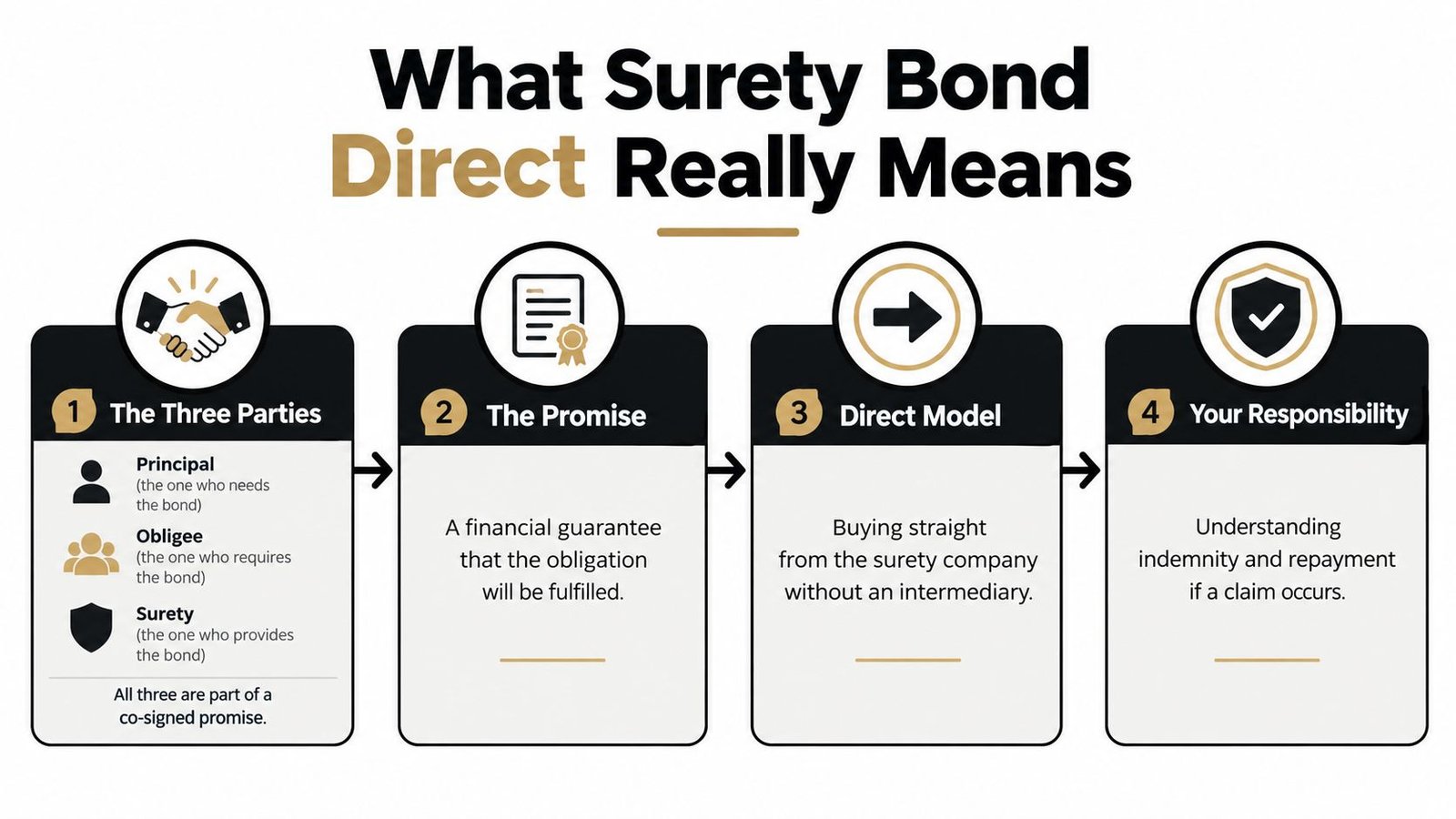
A surety bond is a structured promise among three parties. The principal is the person or business responsible for the obligation. The obligee is the court, government office, or other party requiring the bond. The surety is the company that guarantees the obligation under the bond's terms.
For bail, the defendant is generally the principal, while the court or authorized government entity is the obligee. The surety provides a guarantee rather than handing over cash. That guarantee carries conditions, including the defendant's duty to appear and follow release requirements. Learn how a surety bond works for bail in Colorado.
The co-signed promise analogy
A surety works like a financially qualified third party standing behind a promise. That backing gives the obligee added confidence that the obligation has support. The person arranging the bond, often with a cosigner or indemnitor, still carries responsibility if the defendant fails to meet the bond's conditions.
The word direct describes how the bond is obtained. A direct purchase generally means the customer applies to the surety company without an intermediary. An agent-assisted route places a licensed producer or bail agent between the customer and surety. The agent may gather information, explain requirements, prepare documents, and coordinate filing.
Direct describes the channel, not the entire process. It does not remove underwriting, indemnity agreements, court rules, or filing requirements. Online forms can make application faster, but application speed is only the first checkpoint. The surety must still review the risk and issue the bond, and the jail or court must accept it before release can proceed. A direct option therefore is not automatically paperless or the cheapest overall choice.
Why surety bonds are established tools
Surety bonds serve more than one type of obligation. The Congressional Research Service overview of the SBA Surety Bond Guarantee Program describes the U.S. Small Business Administration program as an important milestone in the modern surety market. The program has operated since 1971. In FY2024, the SBA guaranteed 11,092 bid and final surety bonds tied to a total contract value of $9.21 billion, the program's highest contract value in 25 years.
That example involves contracting rather than bail, but the structure is similar. A surety bond is a three-party agreement supporting performance or payment responsibilities. In bail, the obligation concerns release and court appearance instead of construction work. The central idea remains a third-party guarantee with defined duties for the defendant, the person arranging the bond, and the surety.
Direct vs Agent Assisted Bonds Compared
The direct and agent-assisted routes can both be useful. The better choice depends on whether your situation is routine or requires someone to interpret local procedures and coordinate several moving parts.
A direct channel may work well when the bond is straightforward, the applicant understands the obligations, and the surety's online workflow can handle the file. An agent-assisted bond may be more practical when the family has questions about a cosigner, collateral, county filing, payment arrangements, or a defendant located far from home.
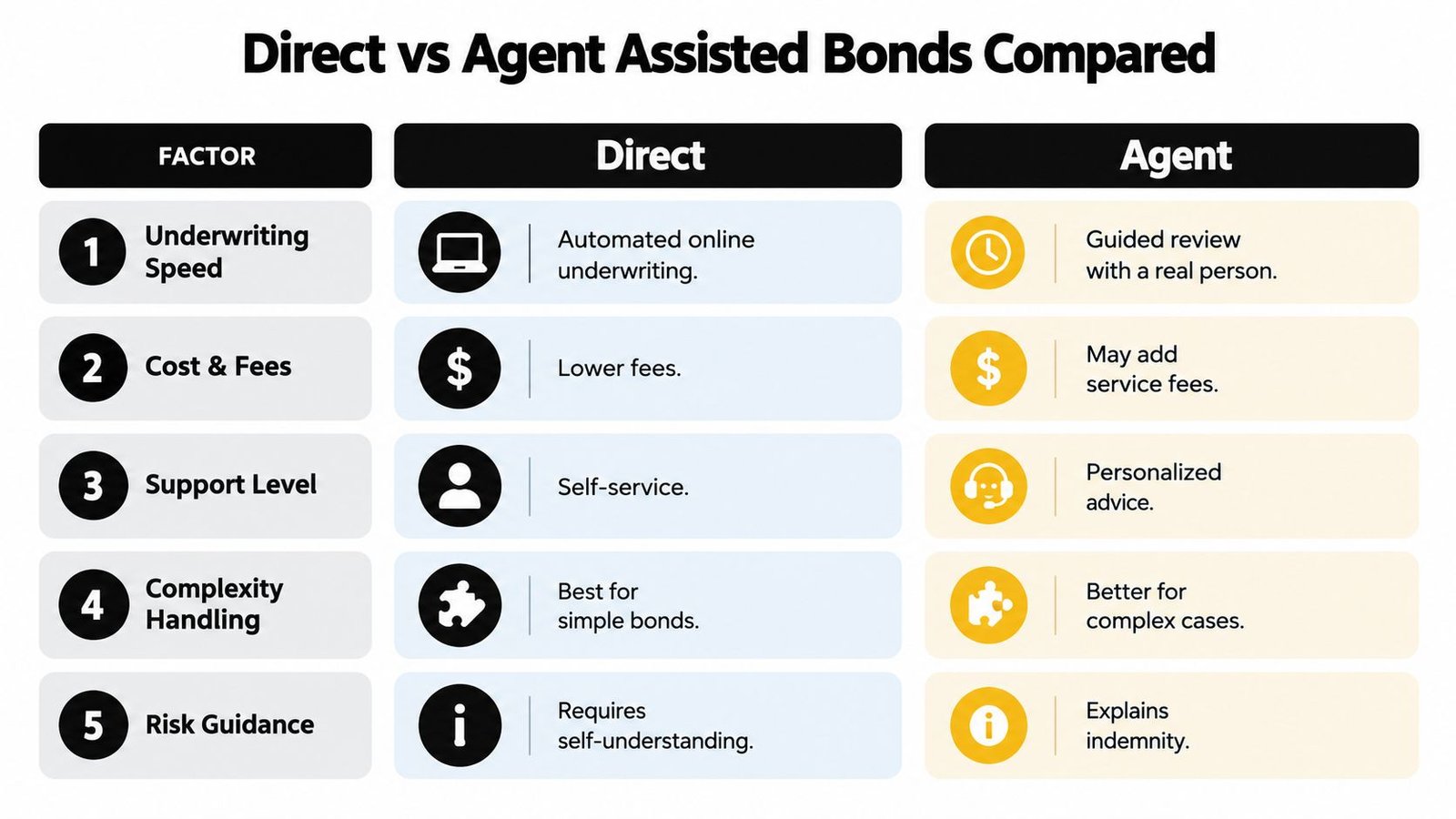
Direct and agent-assisted options at a glance
| Feature | Surety Bond Direct | Licensed Bail Agent |
|---|---|---|
| Underwriting speed | Online intake may be quick for standard applications | Guided review can identify missing information before submission |
| Cost and fees | May reduce intermediary friction, but isn't automatically the lowest total cost | The agent explains the premium and permitted additional charges |
| Support level | Primarily self-service | Personal help with forms, signatures, cosigners, and questions |
| Complexity handling | Often better suited to simple, standard bonds | Often more useful when collateral, unusual facts, or multiple parties are involved |
| Acceptance | Still depends on the court or detention facility | The agent can coordinate submission according to local procedures |
The biggest misunderstanding is treating an online quote as proof that the bond will be accepted immediately. The quote answers a pricing or eligibility question. It doesn't necessarily confirm that the final instrument is ready, that every signature is complete, or that the receiving authority has approved the filing format.
Where local help has value
A licensed agent can explain who needs to sign, whether a cosigner is likely to be requested, and what documents may be needed. That guidance matters when one family member is in Colorado, another is in another state, and the defendant is being held at a facility with its own intake process.
Families also compare bail decisions to other urgent financial choices. If you're trying to understand how deductibles and out-of-pocket responsibility work in another context, understanding Colorado auto deductibles offers a useful comparison. The broader lesson is similar: the headline amount doesn't tell you every responsibility attached to the transaction.
A Colorado bail bond agent can serve as the practical coordinator between the family, surety, defendant, and facility. That doesn't guarantee instant release, but it can reduce avoidable mistakes when the file needs human review.
How Much a Surety Bond Costs in Colorado
A family may receive a quick online quote and still need to answer three separate questions: How fast can the application be submitted? How fast can the surety issue the bond? How fast will the jail or court accept it? The quoted price addresses cost, not necessarily signatures, underwriting, or filing approval.
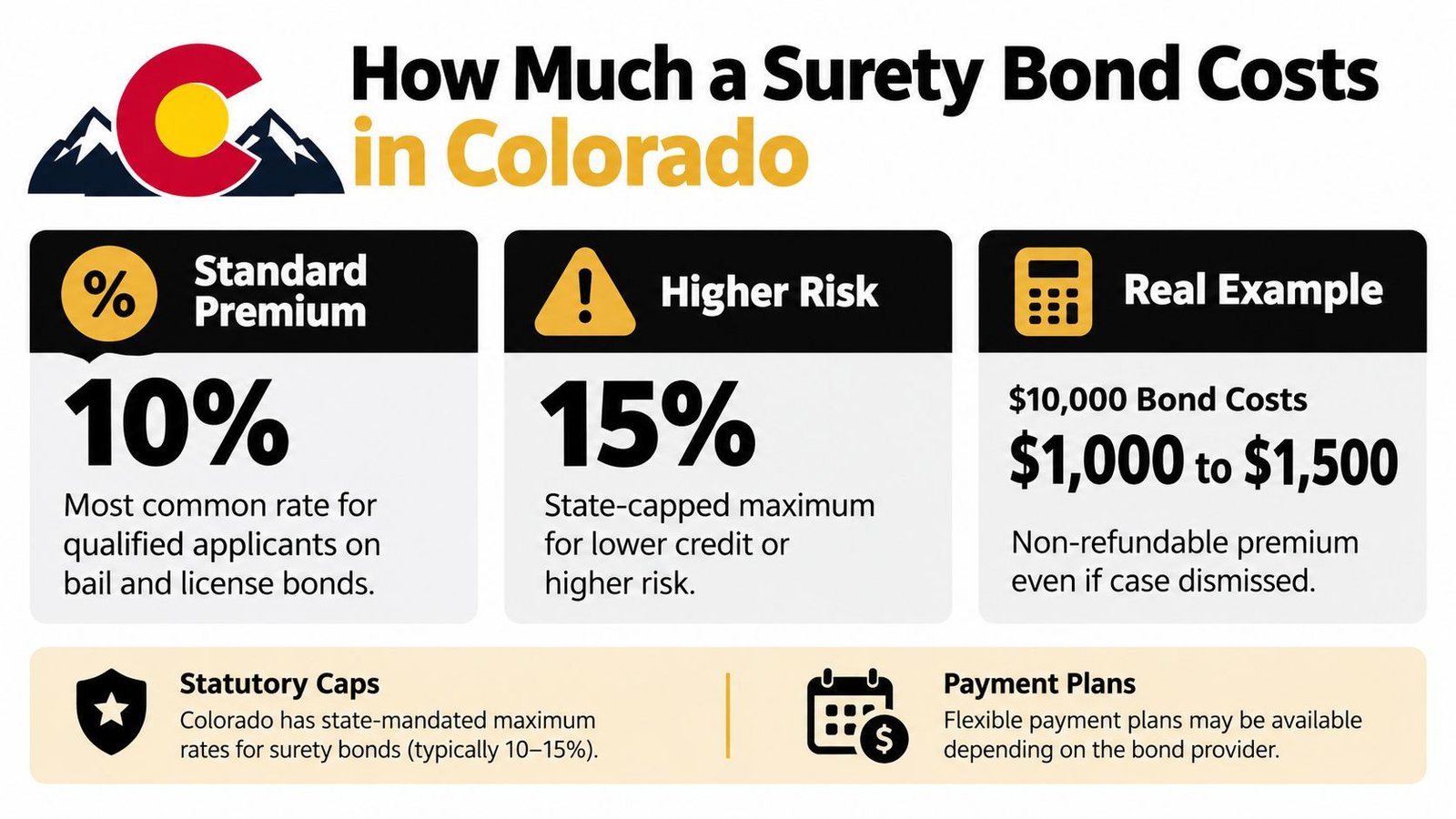
Colorado bail premiums are generally stated as a percentage of the bail amount, rather than as a loan fee. County guidance explains that a surety bond may be posted through a state-licensed bond agent, who may request a cosigner or collateral and typically charges 10% to 15% of the total bond amount. The Arapahoe County bond information page describes that process.
Colorado law also sets a ceiling. A bail bond producer's premium or commission is capped at the greater of $50 or 15% of the amount of bail furnished. Other charges are limited to categories such as court or law-enforcement filing fees, actual collateral storage costs, or premium financing, as described in Colorado Revised Statutes section 24-13-125.
How the percentage changes the math
A Colorado bail guide describes a standard premium of 15%. Bonds of $5,000 or more may be written at 10% when an approved cosigner is available. The difference is easier to see in examples:
- $10,000 bond: At 10%, the premium is $1,000. At 15%, it is $1,500, according to Colorado bail bond payment guidance.
- $25,000 bond: At 10%, the premium is $2,500, using the same calculation.
The premium pays for arranging the surety's guarantee. It is separate from the full bail amount and is not automatically returned if the case is dismissed. Before signing, request a written breakdown of the premium, permitted additional charges, payment terms, and each indemnitor's responsibilities. Surety bond premium information provides further detail on the calculation.
When collateral enters the discussion
Many surety bonds are issued without collateral. A surety may request it when the principal's finances, the obligation's term, or the risk profile does not support standard approval. Liquid forms commonly include cash, an irrevocable letter of credit, or marketable securities. Real estate is usually less suitable because converting it can take longer and may increase the surety's loss exposure, according to surety underwriting collateral guidance.
Why Online Does Not Always Mean Paperless
An online application is a method for collecting information. An electronic bond is the legally usable instrument itself, accepted by the authority that requires it. Those aren't interchangeable.
A digital intake system may allow uploads, electronic signatures, underwriting workflows, and data pulls from credit or registry sources. Yet the final bond may still need a paper copy, a particular filing format, or confirmation from the jail or court. Recent coverage of surety procedures in India describes this same distinction, noting that digital intake can be available while electronic surety instruments remain less broadly operational and paper copies remain common in practice. The discussion of electronic surety bond guidelines is useful background, although Colorado acceptance depends on local rules and the receiving authority.
Separate the three speeds
Application speed is how quickly you submit information and documents. Online forms can make this step efficient.
Issuance speed is how quickly the surety approves the risk, prepares the bond, and obtains required signatures or payment. A complicated judicial or probate-style obligation may require more underwriting than a standard bond.
Acceptance speed is how quickly the jail or court verifies and files the bond. This step may control release even when the application and issuance are complete.
The family's real finish line isn't “application submitted.” It's “the authorized facility has accepted the bond and processed release.”
Online distribution also doesn't guarantee a lower total cost. One market report claims online quote platforms can be 15% to 25% cheaper than direct broker quotes, but that claim is presented in the industry reporting on online surety distribution, not as a universal Colorado rule. The same reporting distinguishes speed and service tradeoffs, which is why a quote should be compared with the actual premium, permitted fees, support, cosigner requirements, and acceptance process.
For an out-of-state cosigner, remote signatures may remove a major travel burden. They won't necessarily remove identity verification, collateral delivery, notarization, or facility-specific requirements.
How to Post a Surety Bond Remotely with Express Bail Bonds
A family may be spread across Colorado or out of state when a defendant needs release. A remote surety bond can reduce travel by moving much of the application and document work online. The process still starts with confirming the defendant's location, bail amount, and any court conditions that apply beyond the bond.
A practical remote sequence
- Call or text 720-984-2245. Provide the defendant's full name, booking information if available, detention facility, and bail amount. Accurate details help the agent identify the proper filing route.
- Complete the electronic application. The applicant and proposed cosigner submit information for underwriting and contract preparation.
- Review the premium and conditions. Ask how the premium is calculated, whether a cosigner is required, whether collateral could be requested, and which additional charges are permitted.
- Make the agreed payment and sign electronically. Family members in different locations may complete their portions without visiting multiple detention centers.
- Provide cosigner or collateral information if requested. A cosigner's financial profile can affect approval. Collateral may be requested when the surety will not accept the risk on an unsecured basis.
- Wait for posting and facility processing. The agent submits the bond under the receiving jail or court's procedures. Release then depends on that facility's review and processing.
These steps have separate completion points. An application may be submitted quickly, while underwriting, signatures, or payment take longer. After issuance, the jail or court still must receive and process the bond. Online intake therefore changes how documents are exchanged, not who controls acceptance.
Colorado bond information commonly describes surety bonds as being posted through a state-licensed bond agent, with a cosigner or collateral sometimes required. The typical premium is 10% to 15% of the bond amount, subject to the applicable rules and agreement.
Before starting, review the online surety bond purchase process and prepare the defendant's booking details, facility information, and contact information for every signer. Express Bail Bonds handles surety solutions, electronic applications, payments, and contract documents, and does not post cash-only bonds. Procedures can differ among Denver, Arapahoe, Jefferson, Douglas, Weld, El Paso, and other county facilities, so confirm the exact location before submitting documents.
Choosing the Right Path and Taking the Next Step
A direct online route may fit a straightforward bond when you understand the paperwork, have the required funds, and don't need help coordinating multiple people. It can be less suitable when the defendant's situation requires a cosigner, collateral, unusual documentation, or clarification about what the court or jail will accept.
Use this quick decision filter:
- Choose direct intake when: the bond is standard, the surety's process is clear, all required parties can respond promptly, and you understand the indemnity obligations.
- Consider an agent when: the family is unsure which facility handles the filing, a cosigner lives elsewhere, collateral may be involved, or the application has unusual facts.
- Ask before paying: whether the rate is 10% or 15%, whether an approved cosigner could affect eligibility for the lower rate on a bond of $5,000 or more, what extra charges are allowed, and whether the bond will be electronically accepted or require another filing step.
- Confirm the release condition: a bond may secure release, but the defendant must still follow court orders and appear as required.
The central lesson is simple. Surety bond direct describes the purchase channel, not a promise of instant release, paperless completion, or the lowest price. The application may be online, the bond may be issued after underwriting, and the facility may still control final acceptance.
For families dealing with a Jefferson County or Golden booking, the Jefferson County and Golden bail bond resource can help you focus on local information. If the arrest occurred in Arapahoe County, the Centennial bail bonds resource provides another starting point. Statewide coverage matters because the correct filing location and local procedures can change the practical timeline.
Contact Express Bail Bonds by call or text at 720-984-2245 and ask for a direct explanation of the premium, cosigner requirements, collateral questions, electronic signatures, and posting steps for the specific facility. Having those answers before signing can prevent a rushed decision based only on an attractive online quote.
Express Bail Bonds provides Colorado surety bond intake with remote electronic processing, payment, and contract support, helping families compare a direct path with agent-assisted guidance. Visit Express Bail Bonds now or call or text 720-984-2245 to begin the application and confirm what the court or detention facility requires.