
Yes. In Colorado, an out-of-state cosigner can qualify if they're verifiable, reachable, and financially approved, and the bond is still posted by a Colorado-licensed agent. If you're sitting in another state after getting that late-night call that someone you love was arrested in Colorado, the good news is that you usually don't have to get on a plane just to help.
That's the part most families need to hear first. The part that comes right after is where confusion starts. People hear “out of state” and assume the answer depends on where the family member lives. In most real cases, the bigger issue is whether the bail agency can confirm who you are, where you live, how to reach you, and whether you can legally take on the financial responsibility.
For many Colorado families, the process now happens from home. Documents can be sent electronically. Identity can be checked remotely. In some situations, notarization can also be handled remotely where allowed. What used to require local, in-person paperwork has shifted toward secure document handling and remote underwriting, which is why same-day interstate cosigning is now common in many markets.
The harder truth is that cosigning isn't just a favor. It's a financial commitment tied to someone else's court compliance. If the defendant misses court or disappears, the cosigner's risk doesn't shrink just because they signed from another state.
Introduction to Out of State Cosigning for Colorado Bail
At 11 p.m., your son is sitting in the Jefferson County Jail, and the person with the steady job, the clear ID, and the willingness to help lives in Texas. The first question is simple. Can that person cosign from another state for a Colorado bond?
In many cases, yes.
For Colorado families, the bigger issue is usually how fast the bail company can confirm that the out-of-state cosigner is real, reachable, and able to take on the obligation. Residence matters less than proof. A cosigner in Phoenix who can send clear documents, answer verification calls, and complete forms quickly may be easier to approve than someone local who cannot verify basic details.
That practical difference is why many families use a remote out-of-state bail bond process instead of rushing to Colorado in person. The workflow is often straightforward. The agency sends documents electronically, the cosigner signs them online, and identity details are checked against the information provided. If notarization is needed, it may be handled remotely where state law allows.
A good way to picture it is like opening a serious financial account from home. The company is not focused on your ZIP code by itself. It is focused on whether your name, address, contact information, income, and identification all match up well enough to rely on the agreement.
One point gets missed in a lot of short FAQ answers. Out-of-state cosigning is not only a paperwork question. It is also a risk question. If the defendant misses court, the person who signed may still be responsible for the bond obligation even though they never set foot in Colorado. Distance does not erase liability.
Colorado also keeps one part of the process local. The bond still has to be posted through a Colorado-licensed bail agent. So the real-world setup often looks like this: the defendant is in a Colorado jail, the agent is licensed in Colorado, and the cosigner completes the approval steps from another state through secure remote paperwork.
Families who move fastest usually do the same few things early. They gather a government ID, confirm their current address, keep their phone close, and get ready to show proof of income or assets if asked. Those steps can save hours when release timing matters most.
Understanding What a Bail Cosigner Actually Does
A lot of people think a cosigner is just the emergency contact on the file. That's not what this role is.
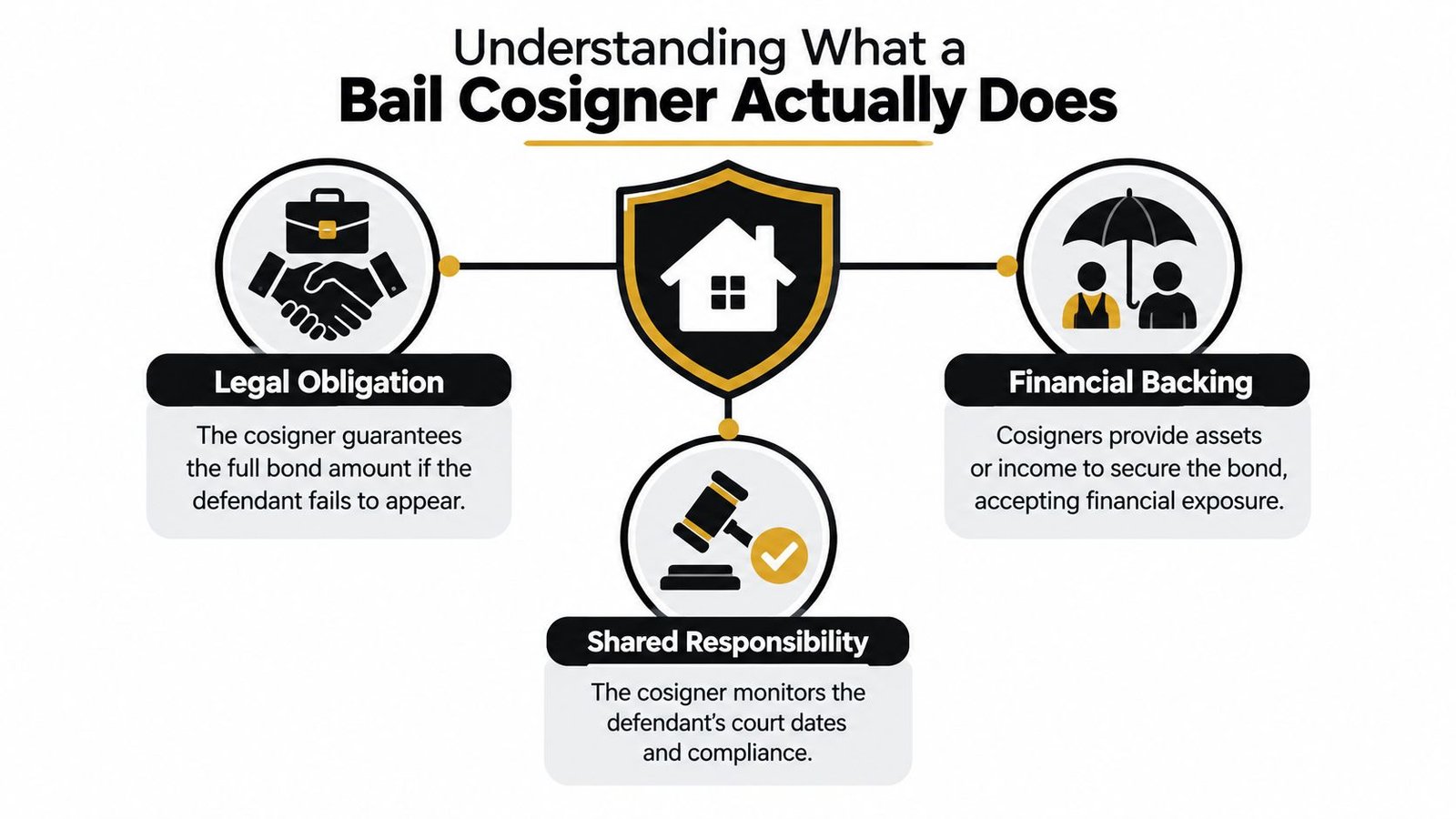
A bail cosigner is closer to a person who backs a serious financial contract. You're not only helping someone get released. You're signing paperwork that can make you responsible if that person doesn't follow the court's rules.
The cosigner signs a real financial obligation
In Colorado, the state's public guide says a bail bond co-signer is financially responsible for the full value of the bond, may be required to provide collateral or other security, and is usually required to be at least 18 years old to enter a contract (Colorado public guide to bail bonds).
That means if your nephew is released and then fails to appear, the risk can come back to you. If collateral was pledged, that collateral may be at stake. The same Colorado guide also states that the co-signer can be responsible for the bond amount and reasonable recovery costs if the defendant is not found.
The cosigner is also part of the compliance picture
Families often get surprised. Cosigning isn't ceremonial. In practice, the agency is looking at whether you're someone who can help keep the defendant connected to the process, aware of court dates, and reachable if problems start.
One academic and industry source goes a step further and argues that cosigned bail agreements function as a way to enroll family members as third-party social control agents (discussion of family liability in bail). That language is more academic than most families need, but the basic point is useful. When you cosign, people expect you to stay involved.
You're not promising that you “hope” the person goes to court. You're signing because you believe they will, and because you're willing to carry consequences if they don't.
Why agencies check cosigners so closely
Once you see the role clearly, the screening makes more sense. Agencies aren't just checking whether you know the defendant. They're checking whether you can legally sign, whether your identity is real, and whether you can cover the risk if the case goes sideways.
That's also why out-of-state cosigners can qualify. The important part isn't geography by itself. The important part is whether the agency can document and rely on the person behind the signature.
How Colorado Evaluates an Out of State Cosigner
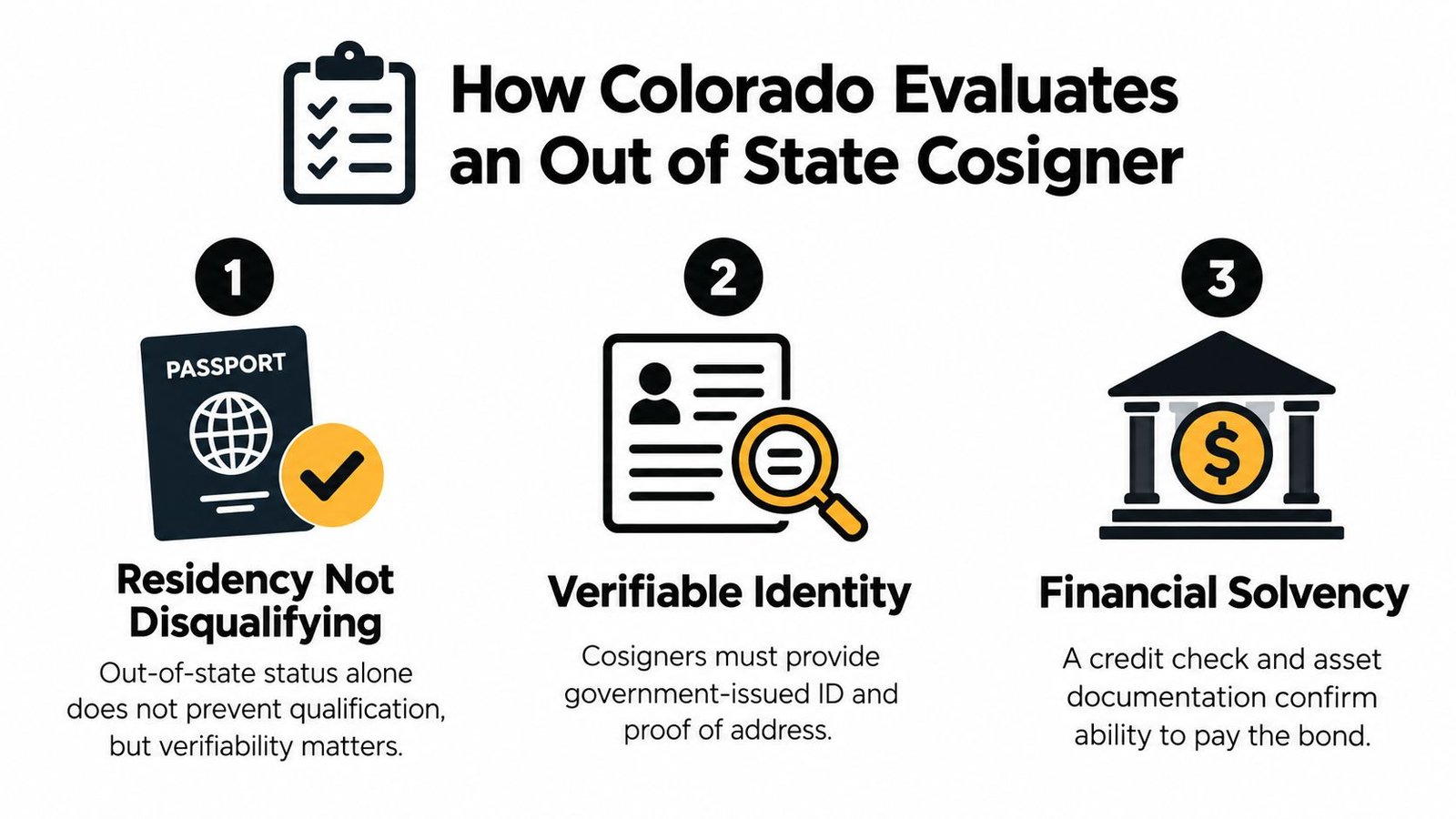
A lot of families expect the first question to be, "Do you live in Colorado?" In practice, the more important question is, "Can the agency verify who you are, where you live, and whether you can carry the financial risk if something goes wrong?"
That distinction matters. A sister in Arizona with clear documents, a steady job, and a working phone line may be easier to approve than a local signer with patchy records or hard-to-confirm information. Colorado agencies care less about mileage and more about proof.
As explained earlier in these Colorado bail cosigner requirements, an out-of-state cosigner can be approved. The review just tends to be stricter because the signer is not available for in-person paperwork or quick local follow-up.
What approval usually turns on
For an out-of-state applicant, the agency is often looking for documents that can be checked quickly and match each other cleanly. Small mismatches slow things down. An ID with an old address, a utility bill in someone else's name, or pay stubs that do not match the legal name on the application can all trigger follow-up questions.
Proof of residence usually needs to show your current address and your name. Common examples include a recent utility bill, lease, mortgage statement, bank statement, or a government mail piece. A shipping label or a screenshot of an online profile usually will not carry much weight because it does not prove stable residence very well.
Financial review is often more practical than families expect. The agency may ask for recent pay stubs, bank statements, tax documents, or proof of another asset that could back the bond. If the bond is large, weak credit or limited income can lead to a request for collateral, even if the signer is a close family member.
An independent bail guide makes the same general point. Out-of-state cosigners are often reviewed more closely and may need added proof of income, residence, credit authorization, or collateral because the bond still has to be written through a licensed agent in the arrest state (interstate cosigner rules and documentation).
What can raise concern during review
Distance by itself usually is not the problem. Friction is the problem.
Agencies tend to slow down or decline a file when the signer cannot be reached consistently, sends blurry documents, has an address that cannot be matched, or seems unclear about the financial promise being made. That last point matters more than many FAQ pages admit. A cosigner is not just helping with paperwork. A cosigner may be agreeing to pay bond losses, fees, and recovery-related costs if the defendant misses court and cannot be brought back promptly.
A smart way to prepare before the call
If you are trying to help someone from another state, gather your paperwork before anyone starts texting document requests back and forth. That usually means:
- a valid photo ID with your legal name
- one recent document that proves your current address
- income documents, or account records if assets will be used instead
- a phone number and email you check
- details on whether you own property, have savings, or could provide collateral if asked
That preparation helps in two ways. It speeds up the decision, and it shows the agency that your information can be verified remotely without guesswork.
How Remote Cosigning Works With Electronic Signatures
Your brother is in a Colorado jail. You are sitting at your kitchen table in Arizona, phone in hand, wondering how you are supposed to sign bail paperwork from hundreds of miles away before the day ends.
That situation is common now. In many Colorado bail cases, the cosigner does not need to walk into an office. What matters is whether the agent can confirm who you are, get signed documents back in a usable form, and complete any notarization step the file requires under Colorado procedures. Residence is only one piece of the puzzle. Verifiable identity and reliable follow-through usually matter more during the remote process.
What the remote workflow usually looks like
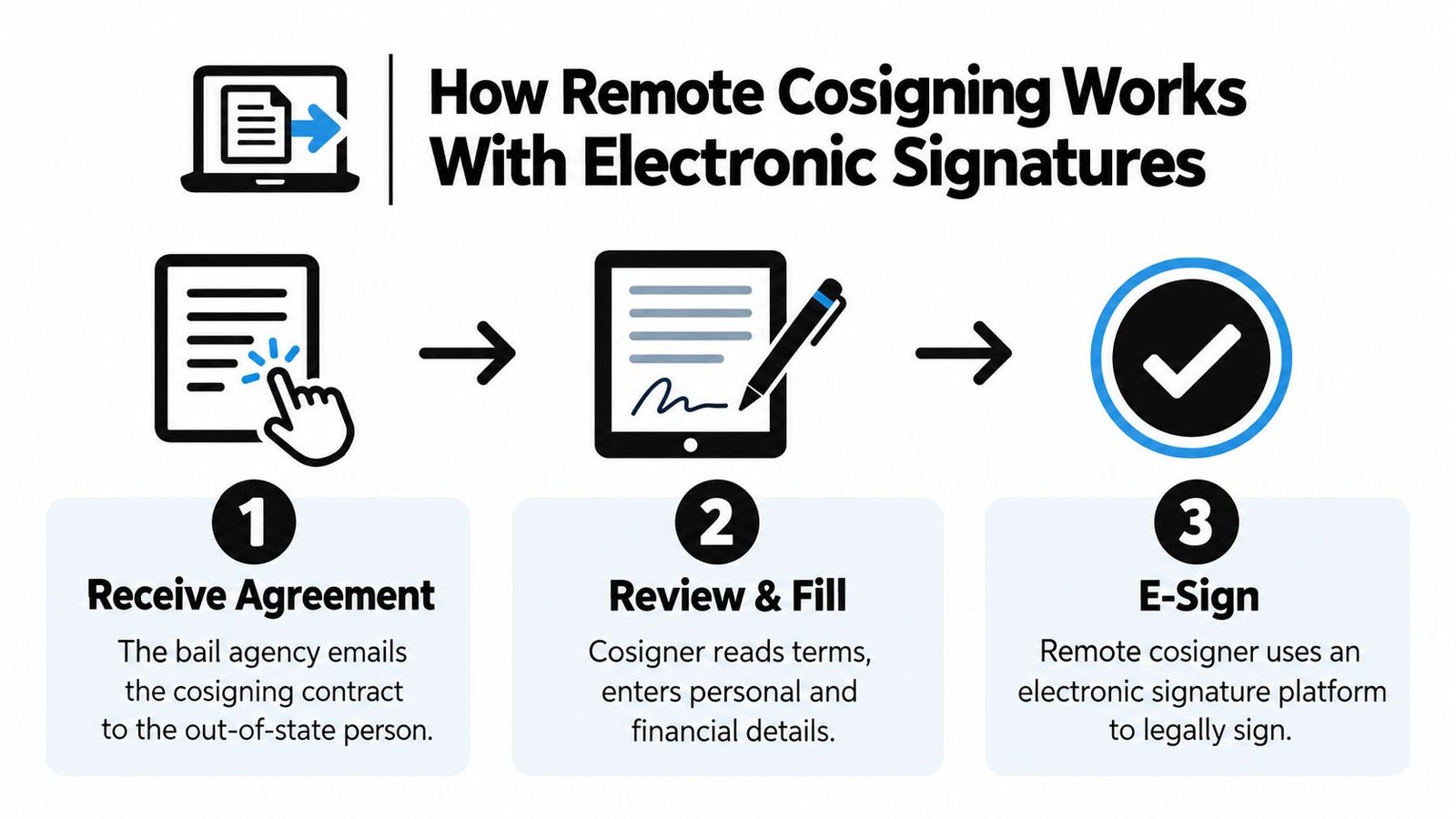
A remote cosign works a lot like closing any serious contract from a distance. The paperwork may arrive by text or email, but the obligation is real and the identity checks still have to be done carefully.
Here is the usual sequence:
You speak with the agency by phone or text.
The agent collects the defendant's name, jail location, case details, and your basic information as the proposed cosigner.Your identity is verified remotely.
You may be asked for a photo ID, a selfie, proof of address, and sometimes a live phone or video check so the signer can be matched to the documents.The contract packet is sent electronically.
This often includes the indemnity agreement, payment terms, collateral terms if any apply, and instructions for any document that must be notarized.You review and sign the forms.
Some documents can be signed electronically. Some may require a notarial act, which can be handled remotely if the transaction allows it and the notary follows Colorado rules for remote notarization and identity proofing.The licensed Colorado agent finalizes the bond.
Your signature starts the obligation. The bond itself is still posted through the Colorado side of the transaction.
What families often misunderstand about "electronic"
Electronic does not mean informal. It just means the paperwork moves through a screen instead of across a desk.
A good way to picture it is mailing a cashier's check versus handing it over in person. The delivery method changes. The financial promise does not. If you sign as a cosigner from another state, you are still agreeing to back the bond under the contract terms, including losses tied to a missed court date if the defendant does not comply.
If you want to see the paperwork side in plain English, electronic signature requirements for bail documents lays out the kinds of steps remote signers are usually asked to complete.
Where delays usually happen
The slow part is rarely the signature box itself. The slow part is proof.
Blurry ID photos, an address that does not match the supporting document, missed calls from the agent, or unsigned pages can stall the file fast. Remote notarization can also add a step because the notary has to confirm identity in a way the law accepts, not just in a way that feels convenient.
That is why families should have a quiet place, good lighting, and all documents ready before opening the packet. Five extra minutes of preparation can save hours of back-and-forth.
One Colorado agency families may hear about is Express Bail Bonds. The useful point here is practical, not promotional. Some agencies now handle applications, payments, and contract documents electronically, which makes it possible for an out-of-state parent, spouse, or sibling to complete the process without driving across state lines.
Risks and Responsibilities Every Out of State Cosigner Should Know
This is the part many FAQ pages soften too much. They answer the eligibility question, but they don't spend enough time on the liability.
If you cosign from another state, your distance doesn't reduce what you owe under the contract. The risk follows the signature, not your address.
The main risks are financial and practical
A missed court date can trigger problems quickly. The cosigner may face liability tied to the bond obligation, may lose collateral if collateral was pledged, and may also face reasonable recovery costs if the defendant isn't found. Distance can make all of that harder because you may not know right away that the defendant is slipping out of contact.
That's one reason agencies may look carefully at nonlocal cosigners. If you live several states away, you may have less day-to-day influence over the person you're trying to help.
Distance can weaken your real-world control
A local parent might be able to drive someone to court, verify where they're staying, or step in fast when they stop answering calls. An out-of-state aunt or friend may not have those tools.
That doesn't mean you can't cosign. It means you should be honest about your actual ability to stay involved.
- Know the person's habits: If they've missed deadlines, ignored court papers, or disappeared before, take that seriously.
- Ask where they'll stay after release: A stable plan matters.
- Make sure you can reach them directly: Don't rely only on one relative passing messages.
- Understand the contract before signing: If anything is unclear, stop and ask.
If you want a plain-English outside resource on understanding cosigner obligations, that guide does a good job explaining the day-to-day reality families often overlook.
Signing because you love someone is understandable. Signing without a realistic plan for keeping them engaged with court is where families get hurt.
Colorado families should also review cosigner responsibilities in more detail before agreeing to take on the role. The biggest mistake isn't living out of state. It's treating the signature like a simple favor instead of a live financial obligation.
Alternatives When an Out of State Cosigner Is Not Approved
Sometimes the answer is yes in theory, but no in your specific case. Maybe the documents aren't strong enough. Maybe the proposed cosigner doesn't want the liability. Maybe the agency wants a different structure before it will move forward.
That doesn't always end the release effort. It usually means the family needs to switch to a different path.
Practical options families consider
Some families find a Colorado-based signer who is easier to verify and easier to reach locally. Others use collateral to strengthen the file. In some cases, payment arrangements or a different underwriting structure can help, depending on the bond and the agency's rules.
Express Bail Bonds states that Colorado's standard premium is 15%, and for bonds over $5,000 they often secure 10% with an approved cosigner (Colorado bail bond services and pricing information). They don't post cash-only bonds, so families dealing with a cash-only order need to ask the court or detention facility about that separate process.
Options When Out of State Cosigner Is Not Available
| Option | Best When | Key Consideration |
|---|---|---|
| Local Colorado cosigner | A trusted in-state person is available | Local presence may simplify verification and communication |
| Collateral-backed bond | The family has property or other assets to support the file | Collateral can be at risk if the defendant fails to appear |
| Payment plan with approved structure | The family can manage the premium over time | Approval still depends on underwriting and documentation |
| Cash bond through the court or jail | The court requires cash or the family chooses that route | This is separate from a surety bond and may require local handling |
How to choose between them
The best option usually depends on three things:
- Speed: Which path can be documented today?
- Risk tolerance: Who is willing to carry the liability?
- Control: Which arrangement gives the family the best chance of keeping the defendant on track?
If your first out-of-state cosigner isn't approved, don't assume the whole case is stuck. It may just mean the agency needs a different signer, stronger collateral, or a cleaner documentation package.
Next Steps to Secure Bail With an Out of State Cosigner
Your brother is in a Colorado jail. You are sitting in Texas, Florida, or Kansas with your phone in one hand and a dozen questions in your head. The good news is that distance does not automatically stop the bond process. What matters now is speed, clear communication, and understanding what you are agreeing to before you sign.
Start by treating the first half hour like a handoff, not a research project. One person in the family should text or email the bail agent the defendant's full name, date of birth, and the jail location as soon as possible. Then ask one simple question: what do you need from the cosigner first, and how should it be sent?
Once the agent replies, send the requested items in one batch if you can. Clear phone photos usually work better than blurry scans. After you send them, do not assume they came through. Call or text to confirm receipt so the file does not sit untouched in an inbox.
If the agency is ready to move ahead, the next practical step is completing the online Colorado bail bond application. That usually starts the remote workflow families use. The agent reviews the submission, sends the agreement for electronic signature, explains whether notarization can be handled remotely, and checks that the signer's identity and contact information can be verified.
This part confuses a lot of families, so here is the plain-English version. Remote cosigning works a lot like closing an account from out of state. The agency still has to confirm that the signer is a real person, that the signature is valid, and that the signer understands the financial promise behind the bond.
A practical timeline looks like this:
- Within the first 15 minutes: Send the defendant's basic booking details and the best callback number for the cosigner.
- Within 30 minutes: Return any forms the agent marked as first priority and ask whether anything is missing.
- Before signing: Read the indemnity agreement closely. That is the contract that says the cosigner may owe money if the defendant misses court or breaks bond conditions.
- Right after signing: Confirm the agent received every page, including any notarized pages if required.
- After release: Keep your phone on and stay in contact. A cosigner's job does not end when the person walks out of jail.
That last point is the one families often miss. An out-of-state cosigner is not just helping someone get released. The cosigner is taking on financial liability. If the defendant disappears, misses court, or creates a bond problem, the agency may look to the cosigner for payment under the contract.
If you need direct help, call or text 720-984-2245 any time. Express Bail Bonds can explain the remote paperwork process, what can be signed electronically, and what an out-of-state cosigner should expect before agreeing to the bond.