You get the call late at night. A family member has been booked, everyone wants an immediate release, and the detention center needs paperwork before anything moves. In that moment, contract documents aren't a formality. A missing booking number, an unclear signature, or an incomplete cosigner file can keep the bond from being posted even after the money is ready.
The fastest path is organized paperwork. Know which documents matter, prepare accurate information, and use a signing process that creates a clear record from application through submission. Colorado families can also contact Express Bail Bonds for statewide surety bond assistance and guidance through the contract process.
Understanding Bail Bond Contract Documents
When someone is arrested, the bail bond contract documents create the legal structure that allows a surety agency to post a bond. They identify the defendant, the person or people guaranteeing the obligation, the agency providing the surety service, the bond amount, payment terms, and responsibilities connected to court appearances.
These papers are more than a promise that the defendant will return to court. The surety agreement allocates financial risk. If the defendant misses court and the bond is forfeited, the signer may become responsible under the agreement for the resulting obligation. That's why a cosigner should read every term before signing, especially provisions involving indemnity, collateral, payment obligations, and notice requirements.
The paperwork controls the release
A typical packet may include an application, an indemnity agreement, the surety bond, payment authorization, identification records, and any jurisdiction-specific forms. The agency uses these documents to confirm that the defendant's information is correct and that the person signing has authority and financial capacity to support the bond.
Errors create operational problems quickly. If the defendant's name differs between the booking record and the application, the agent may need to stop and verify the discrepancy. If a signature is missing, the packet may be returned instead of sent to the detention facility.
Practical rule: Treat every field as a release requirement, not as optional administration.
Electronic contract documents are now a recognized part of modern contracting. The 2000 Electronic Signatures in Global and National Commerce Act, known as ESIGN, gave qualifying electronic signatures and records the same legal standing as handwritten signatures when the parties choose electronic transactions, as explained by ConsensusDocs' overview of electronic signatures on contracts.
If you're preparing templates or reviewing agreement language before an emergency, an AI Contract Writer can help organize general contract language. It doesn't replace a licensed bail agent or legal advice, but it can make document preparation more structured before the actual agency forms are issued.
The key point is simple. The bond cannot move efficiently until the documents show who is involved, what obligation is being guaranteed, and whether every required signature and supporting record is present.
Typical Forms and Required Information
The core paperwork is familiar across Colorado, although the exact packet can vary with the charge, court, detention facility, bond conditions, and agency requirements. Start with the bail bond application. It normally identifies the defendant and gives the agency the information needed to locate the booking record and assess the proposed arrangement.
Expect to provide the defendant's full legal name, date of birth, booking number, current detention center, charges, court information when available, and contact details. The application may also request information about the person arranging the bond and the proposed cosigner.
The main documents in the packet
The indemnity agreement is the document that protects the surety agency if the defendant fails to meet the bond obligation. The indemnitor or cosigner accepts responsibility under the agreement and may need to provide information demonstrating identity, residence, and financial capacity.
The surety bond document connects the agency's promise to the court with the defendant's release. It identifies the bond amount and the parties involved. Supporting documents may include identification, address verification, payment records, collateral paperwork, and proof of income or employment.
Colorado law caps a bail bond premium at the greater of $50 or 15% of the amount of bail furnished, according to the statutory explanation provided by Express Bail Bonds' Colorado cosigner requirements resource. The paperwork must therefore state the exact bail amount and premium terms accurately before the agreement is finalized.
| Bond Amount | Maximum Premium, 15% | Required Documentation Level |
|---|---|---|
| $1,000 | $150 | Defendant identification and booking details, application, signed agreement, and payment information |
| $5,000 | $750 | Core bond packet plus cosigner identity, residence, and financial documentation when requested |
| $10,000 | $1,500 | Core bond packet plus stronger verification of authority, residence, income, and solvency |
The table illustrates the calculation, not a guarantee that every case will require identical documents. A $10,000 bond, for example, has a maximum premium of $1,500 under the 15% ceiling. The agency still must confirm the actual court-ordered bond and any applicable agreement terms.
Don't send random screenshots or partial forms and assume the agent can assemble the rest. Use the documents needed for a bail bond checklist to gather the information in one place. If a cosigner's identity, address, or financial information is unclear, approval can pause while the agency verifies it.
For people handling sensitive identity paperwork, it's also useful to understand how consent-based identity records are organized. A resource covering a Digital Footprint Check for employers offers context on consent forms and verification records, although bail agencies should rely on their own approved procedures and documents.
The Role of Signatures and Cosigners
The person who signs a bail bond contract isn't helping with a payment. The signer may be accepting a financial obligation tied to the defendant's compliance with the court process. If the defendant misses a required appearance, the agreement can expose the indemnitor to financial responsibility connected to forfeiture, recovery, or other contract terms.
That risk explains why agencies don't accept an unidentified person with an electronic signature and no supporting evidence. The signer must be connected to a real identity, a verifiable address, and a credible ability to meet the agreement's obligations.
What the cosigner must establish
A cosigner should be prepared to provide:
- Government-issued identification: The name on the ID should match the name used on the application and signature record.
- Address verification: A lease, utility bill, official correspondence, or another accepted record can help confirm where the cosigner lives.
- Income or solvency evidence: The agency may request proof of employment, income, assets, or another basis for evaluating financial responsibility.
- Reliable contact information: The agency needs a dependable way to communicate notices, court information, and follow-up requirements.
The supporting file isn't designed to embarrass or burden the family. It answers a practical question: who is legally standing behind this bond, and can the agency verify that person? A missing document can force an otherwise prepared application into manual review.
Conditional pricing needs written confirmation
Colorado guidance commonly treats the premium as a non-refundable fee for the surety service. Industry information also states that bonds of $5,000 or more may sometimes be written at 10% when an approved cosigner is in place, as described by Express Bail Bonds' explanation of bail bond costs. That lower rate is conditional. It isn't automatic because the bond reaches a particular amount.
Don't calculate the premium yourself and send payment before the agency confirms the rate and approval. The contract should show the bond amount, premium, payment arrangement, cosigner status, and any collateral terms. Read the cosigner responsibilities before signing so you understand what you're accepting.
A scripted font also isn't enough. A typed name, cursive-looking font, or image pasted into a document may not establish the signer's intent and identity. Use the agency's approved electronic signing system, complete every required authentication step, and save the executed copy.
Electronic Completion and Legal Validity
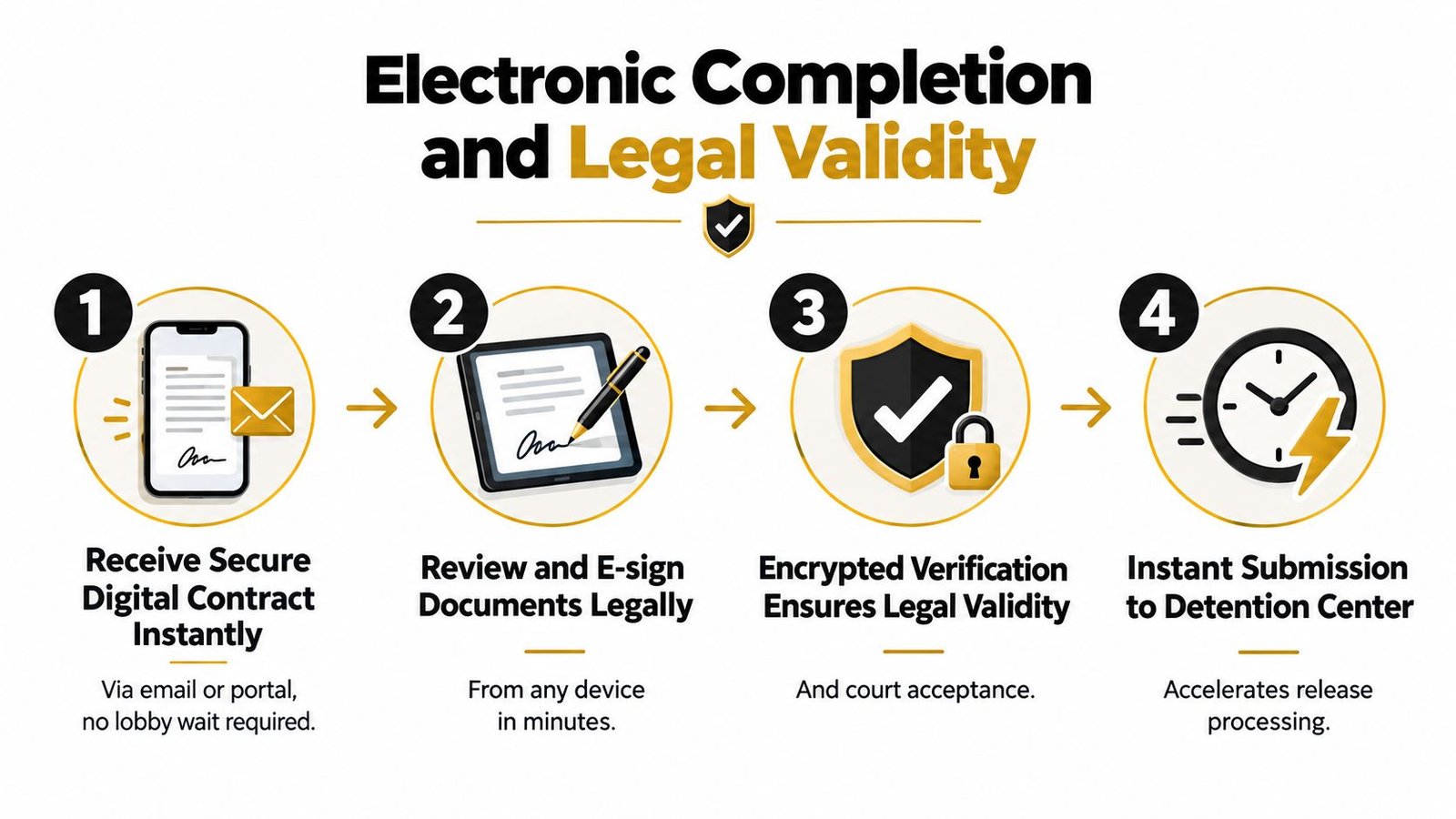
Electronic completion solves the most immediate operational problem in a bail case: distance. A relative in another state can receive the application, review the agreement, provide documents, sign, and make payment without traveling to the detention center. The agency can then assemble the completed packet and submit it through the required release process.
Colorado bail agencies may process applications, payments, and contract documents online before posting the bond, as described in Express Bail Bonds' online contract-signing process. That workflow matters because the detention center doesn't need a family member's physical presence to begin reviewing a complete bond packet.
Four elements support enforceability
Under U.S. electronic-signature law, a defensible electronic contract workflow should capture four core elements:
- Intent to sign: The signer takes a clear action showing an intention to execute the document.
- Consent to electronic business: The signer agrees to conduct the transaction electronically.
- Connection to the record: The signature can be associated with the specific version of the contract that was signed.
- Retention and reproduction: The completed record remains stored in a form that entitled parties can accurately access and reproduce.
The ESIGN Act and UETA overview from DocuSign explains these operational requirements. A valid signature isn't enough if the agency can't show which document was signed, when the event occurred, or how the final record was preserved.
The signer should also receive required disclosures, including the option to receive a non-electronic version, the ability to withdraw electronic consent, and information about the hardware or software needed to access the record. Purdue Global Law School's discussion of e-signature requirements explains why access, disclosure, and reproducibility belong in the workflow before signature capture.
The signature is only one part of the evidence. The audit trail, identity check, consent record, and final readable contract complete the process.
For identity-related questions, educational material on how to verify online dating profiles shows why digital identity signals matter in remote interactions. Bail agencies should still use their own approved verification controls, not informal online checks.
A Colorado electronic waiver form can support a remote process when the agency requires it. Keep the final executed documents and any confirmation messages. If a problem arises, the agent needs the complete record, not only a screenshot of the signature.
The video below provides additional context on electronic document workflows.
Common Pitfalls and How to Avoid Them
A common assumption is that an electronic signature automatically makes a contract acceptable. It doesn't. A valid e-signature and a defensible document process are related but different. The agency still needs reliable identity verification, authorized-signatory checks, consent evidence, an accurate final record, and consistent information across the packet.
Mistakes that stop a release
- Inconsistent names: Don't use a nickname on one form and a legal name on another. Match the booking record and identification exactly.
- Wrong detention center: Confirm where the defendant is held before submitting documents. A complete packet sent to the wrong facility still creates delay.
- Missing pages: Review the final file, not only the signature page. Attachments, collateral terms, and payment provisions may be part of the agreement.
- Scripted-font signatures: A cursive typeface isn't automatically an electronic signature. Follow the approved signing workflow and complete its identity and consent steps.
- Unclear court obligations: Read the appearance requirements and explain them to the defendant. A release isn't the end of the responsibility.
Sensitive contract documents should be protected during transmission and storage. Texas government guidance recognizes electronically or digitally signed contracts as binding when the signer has authority, distinguishes a scripted font from a legal electronic signature, and advises encryption for sensitive electronic records. That principle applies directly to bail paperwork, where identity and financial information should not be sent casually.
Don't treat collateral language as fine print to ignore. If the defendant misses court, the consequences can reach the indemnitor under the agreement. Review the agency's explanation of what bond forfeiture means before signing, and ask direct questions about notices, court dates, collateral, and payment obligations.
Preparing Documents to Speed Up Release
The best time to gather information is before the agent sends the contract link. You don't need to guess which forms the court will require, but you should have the basic records ready so the application doesn't stall while relatives search through email, wallets, and old paperwork.
Build the file before calling
Use this checklist:
- Defendant details: Full legal name, date of birth, booking number, charges if known, and the detention center.
- Cosigner identification: Government-issued photo ID showing the full legal name and address.
- Residence proof: A utility bill, lease, official letter, or another document the agency accepts.
- Financial information: Proof of income, employment, or other evidence of financial responsibility if requested.
- Contact records: Current phone number, email address, references, and emergency contact information.
Keep the documents legible. Blurry photos, cropped IDs, expired records, and mismatched names cause avoidable follow-up. Send files through the agency's secure upload or contract system instead of scattering sensitive records across unrelated text messages.
Out-of-state relatives should tell the agent immediately that they need remote signing. Electronic workflows can let them review the contract, complete identity checks, sign, and pay without traveling. Use the agency's jail release forms page to identify the paperwork that may be needed, then confirm the exact requirements with the agent handling the bond.
For a local response, families in Jefferson County can review Jefferson County and Golden bail bond assistance. Families in Arapahoe County can find Centennial bail bond services. Give the agent the booking information first, keep your phone available, and don't sign until you understand the financial and court-related obligations.
Express Bail Bonds helps Colorado families complete applications, identity uploads, payments, and bail bond contract documents electronically, with agents available to explain fees and next steps. Visit Express Bail Bonds now to start the paperwork and get direct guidance on moving the release process forward.