
You accepted a curfew, electronic monitoring, travel limits, or a no-contact order because getting home mattered more than arguing about every restriction at the jail. Then your work schedule changed, your child's school event landed during curfew, or the person listed in the order is also your spouse and co-signer. The condition that seemed manageable on release now threatens your job, housing, family, or ability to follow treatment.
Colorado courts can modify bond conditions. The practical question isn't whether you dislike a restriction. It's whether you can show that the requested change is supported by facts, still protects court appearance and public safety, and is narrower than the condition currently imposed. This guide explains how to get bail conditions lifted in Colorado with the evidence and courtroom preparation that make a request credible.
Why Bail Conditions Can Feel Impossible to Live With
A defendant I'll call Marcus accepted GPS monitoring and a strict evening curfew after his arrest in Jefferson County. He wanted out quickly so he could keep working and help his family. A few weeks later, his construction employer assigned him to job sites outside his usual area, and the commute made the curfew nearly impossible to meet. Every late return created another monitoring concern, even though he had attended court and followed the other terms.
That kind of pressure builds fast. A parent may be unable to attend a child's school program. A spouse named in a no-contact order may have to leave the shared home. A medical appointment, treatment program, or shift change can collide with a residence requirement or travel restriction. These conditions affect daily life, but frustration alone won't persuade a judge.

Restrictions aren't permanent
Colorado law gives the court a mechanism to change bond conditions. Colorado Revised Statutes § 16-4-109 allows the district attorney or defendant to ask the court to increase or decrease financial conditions, add or release security, or alter another bond condition. The request must be tied to the facts of the case, not presented as a general complaint about inconvenience.
That distinction matters. A judge may be willing to adjust a curfew to accommodate verified employment, but less willing to remove monitoring without an alternative that addresses the court's concerns. A no-contact order may require a carefully limited exception rather than a complete cancellation, particularly where safety or witness integrity remains contested.
Practical rule: Never treat a requested modification as approved until the court enters it. Follow the current order exactly while your attorney pursues the change.
For a plain-language overview of check-ins, curfews, no-contact orders, testing, and travel limits, review Colorado conditions of bond. Requesting a modification isn't an admission of guilt or disrespect. It's a formal effort to make release workable while preserving the protections the court considers necessary.
Legal Grounds for Lifting or Modifying Bail Conditions
The strongest Colorado motions answer one question: What has changed, and why does the existing condition now go farther than necessary? Colorado law permits a defendant to seek changes to bond conditions, while CRS § 16-4-105 also recognizes that release can be revoked or conditions changed if a competent court finds probable cause that the defendant committed a felony while released. That makes clean compliance and credible documentation essential.
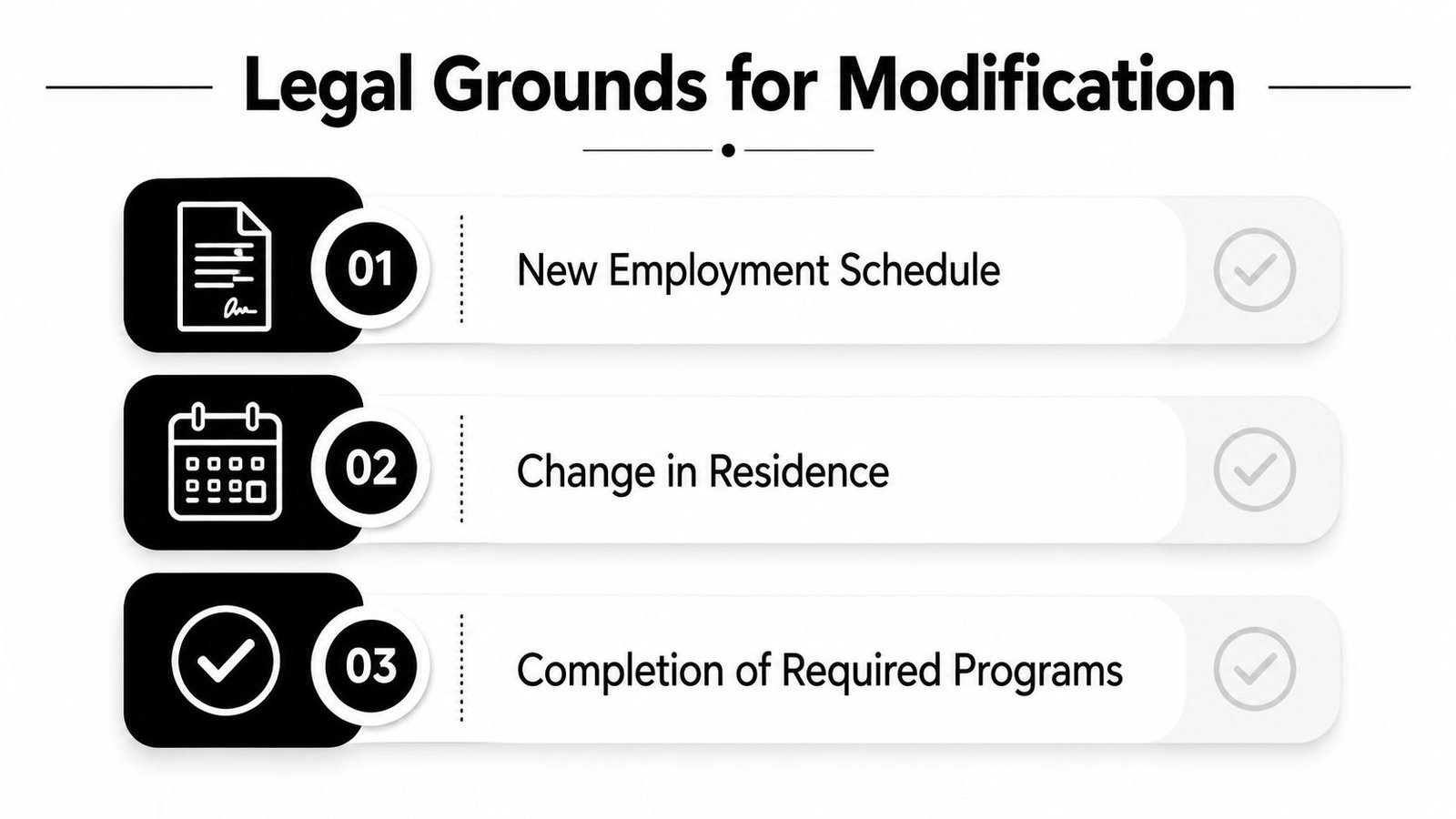
Changed circumstances
A new job schedule is a common example. A construction worker may need to travel to job sites that weren't part of the original release plan. An employer letter should identify the schedule, work locations, expected start times, and why the requested adjustment is necessary. A vague statement that “work is difficult” is weak. A dated letter from a supervisor is useful evidence.
A residence change can also support modification. The defendant may need to move closer to work, live with a safer sponsor, or leave a location that no longer provides stable housing. Explain the address, who lives there, and how the move affects the existing condition.
Conditions that are broader than the risk
The defense should connect each condition to the risk it was meant to manage. If the court is concerned about court appearance, a narrowly adjusted travel condition and a firm reporting plan may address that concern. If the concern involves contact with a particular person, a request limited to written communication about childcare may be more persuasive than demanding unrestricted contact.
Family hardship matters when it's specific and documented. A parent who can't care for minor children because of a residence restriction should provide custody information, school schedules, and a proposed arrangement that protects everyone involved.
Compliance and completed obligations
A history of following check-ins, testing, monitoring, and court dates gives the judge a reason to consider a less restrictive plan. Completion or enrollment in an approved program can also support a targeted request, especially when the proposed change reflects progress rather than avoidance.
Keep the supporting packet organized:
- Employment proof: Employer letter, schedule, pay documentation, and travel details.
- Residence proof: Lease, address confirmation, household information, and transportation plan.
- Program records: Enrollment, attendance, completion, or treatment documentation.
- Compliance records: Check-in history, test results, monitoring reports, and court attendance.
If a prior case or public record creates a separate employment or housing problem, ContentRemoval.com court record help may be a useful resource to review. For supervision questions, Colorado pretrial services information can help you identify the agency and reporting requirements involved.
The defendant carries the practical burden of showing that the requested change serves justice without creating an unmanaged risk. Don't ask the judge to trust a promise when a document can prove the point.
Filing a Motion to Change Your Bail Conditions
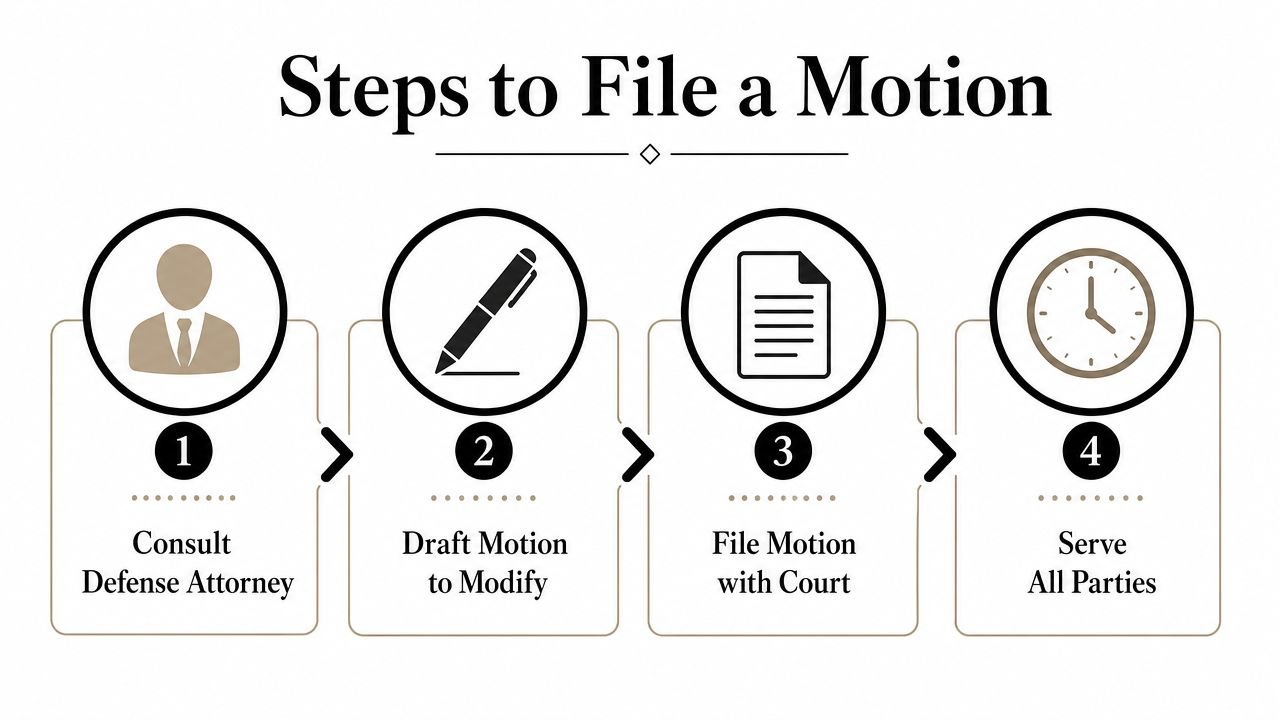
Start with the defense attorney handling the criminal case. The attorney should review the release order, identify the exact condition at issue, and draft a Motion to Modify Bail Conditions for the court where the case is pending. Don't rely on an informal call to the clerk or an unfiled letter. A court needs a specific request, a factual explanation, and a proposed order.
Build the motion around one requested result
The motion should state:
- The existing condition: Quote or accurately identify the curfew, monitoring, travel, residence, testing, weapons, driving, or contact restriction.
- The requested change: Say precisely what should be removed, narrowed, or replaced.
- The factual basis: Explain the changed circumstance, hardship, compliance history, or other reason.
- The safeguards: Offer a workable alternative, such as adjusted reporting, a defined travel window, or limited communication.
- The exhibits: Attach employer letters, medical records, treatment documents, residence proof, or compliance records.
- The proposed order: Give the judge a clean document that states the approved modification.
Colorado's bond modification form identifies conditions that may be targeted, including no alcohol, no drugs, drug testing, no weapons, driving without a valid license, substance-abuse monitoring, electronic alcohol monitoring, and electronic home monitoring. A no-contact order may require a separate letter or motion, so the attorney should check the applicable court's requirements before filing.
File and serve correctly
The motion is submitted to the clerk in the county where the case is pending. Your attorney should confirm local filing procedures, any applicable fee, the hearing process, and service requirements for the district attorney's office and other parties. The prosecutor needs a fair opportunity to review the request, raise safety concerns, and decide whether to oppose or negotiate it.
Colorado procedures vary by court and case posture. Don't assume a hearing will occur on a particular schedule. Ask counsel to confirm the filing date, hearing date, courtroom or remote appearance instructions, and whether the judge expects a proposed order or additional exhibits.
The request is only pending until the judge signs an order. Until then, the original conditions control. Do not change your curfew, stop testing, contact a protected person, leave the approved residence, or disable monitoring because the motion has been filed.
For context on the financial side of release, see how bail can be reduced. The financial bond and non-financial conditions are related, but a reduction in money doesn't automatically remove a curfew, monitoring requirement, or no-contact order.
Preparing for and Attending the Modification Hearing
A modification hearing is a focused risk-and-hardship review. The judge usually wants to know what condition is causing the problem, what evidence supports that claim, whether the defendant has complied, and why the proposed alternative protects the case as well as the existing order.
Bring a clean, indexed packet through counsel. Useful materials may include a current employer verification, work calendar, medical documentation, treatment enrollment, residence information, school or childcare records, and reliable character letters. Cosigners should attend when possible, particularly if they can explain the supervision plan, transportation, housing, or financial responsibility attached to the bond.

What the judge evaluates
The judge may weigh:
- Public safety: Whether the change creates a new danger or removes a necessary safeguard.
- Appearance risk: Whether the defendant has attended court and has a reliable plan for future dates.
- Investigation integrity: Whether contact, travel, or residence changes could affect witnesses or evidence.
- Actual hardship: Whether the condition causes a documented employment, medical, housing, or family problem.
- Available alternatives: Whether a narrower restriction can manage the same concern.
The prosecutor may oppose the request, ask for additional safeguards, or agree to a negotiated adjustment. Your attorney should be ready to answer objections with evidence, not emotion. If the request concerns a spouse or family member, explain the proposed boundaries clearly and avoid minimizing any allegation or safety concern.
How to present yourself
Arrive early, dress neatly, silence your phone, and address the judge respectfully. Don't interrupt the prosecutor or argue with the protected person, co-signer, officer, or anyone else in the courtroom. Answer only questions you understand, and let your attorney make legal arguments.
A construction worker might ask to travel for verified job assignments while keeping check-ins and monitoring. A parent might request a curfew adjustment for childcare, supported by school schedules and a transportation plan. Those requests are stronger when they solve a defined problem without asking the court to abandon every safeguard.
Use court hearing preparation guidance to organize documents, clothing, arrival plans, and courtroom expectations before the hearing. Preparation won't guarantee approval, but disorganization can give the judge a reason to reject an otherwise reasonable request.
Practical Tips and Common Mistakes to Avoid
A good legal ground can fail because the request was poorly prepared. The court sees the release order, the compliance record, the prosecutor's objection, and the proposed alternative. Your job is to make the reasonable path obvious.
What improves the request
Ask for the smallest change that solves the documented problem. If work requires a later return, request an adjusted curfew tied to the work schedule. If contact is necessary for childcare, request a narrow communication method and topic rather than unrestricted contact. Judges are more likely to consider a precise solution than a broad demand to eliminate supervision.
Choose timing carefully. File after you can document the change, not while you're still gathering facts. A supervisor's letter, confirmed medical schedule, treatment record, or residence documentation gives the motion a foundation.
Coordinate with the bail bondsman before making changes to your routine. A bondsman can explain the financial and contract implications of missed obligations, but only the court and defense attorney can address the legal modification. Express Bail Bonds, for example, handles surety bond applications and electronic documents for Colorado families, while the defense lawyer manages the court motion.
Mistakes that damage credibility
- Filing without proof: A personal statement rarely carries the same weight as a dated employer, medical, treatment, or residence record.
- Requesting everything at once: Removing every restriction can look like an effort to escape supervision rather than solve a specific hardship.
- Breaking the order while waiting: The original conditions remain enforceable until written court approval arrives.
- Missing check-ins: A missed appointment can undermine the compliance history that supports modification.
- Posting reckless social media content: Public posts can contradict claims about sobriety, residence, employment, or contact.
- Ignoring a new arrest or violation: Tell your attorney immediately. Concealing it makes the credibility problem worse.
- Leaving the co-signer out: A co-signer may have critical information about housing, transportation, monitoring, or family responsibilities.
Review what a Colorado bail bond violation can mean before taking any action that could be interpreted as noncompliance. Don't test the boundaries of a condition. Ask counsel for written clarification and pursue a formal change.
Next Steps and Getting Professional Support
Start with a condition-by-condition review of your release order. Identify the restriction that creates the clearest, provable hardship. Then gather the evidence, propose a narrower alternative, and have your criminal defense attorney file the motion and proposed order with the correct court.
If the judge denies the request, ask your attorney why. The next option may be a renewed motion after circumstances change, a better-supported request, or a review or appeal route available under the posture of your case. Don't refile the same unsupported request and expect a different result.
Bail modification is realistic when the evidence shows a defined problem and a responsible solution. Keep following the current order, attend every required appointment and hearing, and let your attorney handle the legal argument while your co-signer and bond provider help maintain a stable release plan.
If restrictive conditions are interfering with your release plan, visit Express Bail Bonds to review surety bond support and electronic processing options with a Colorado agent. You can also reach the team about local resources in Jefferson County and Golden or Centennial and Arapahoe County while your defense attorney handles the modification request.