At 2 a.m., a family member calls from a Denver jail and asks the question nobody wants to answer under pressure: who can qualify as a cosigner for a Colorado bail bond? The answer isn't “a relative with a driver's license.” The right cosigner is a financially responsible indemnitor who understands the risk, can document their finances, and is prepared to act if the defendant misses court.
Colorado families often focus on paperwork first. That's understandable, but the contract matters more than the checklist. A cosigner may accept responsibility for the full bond amount, recovery expenses, and other losses if the defendant fails to appear. Out-of-state relatives can often participate through electronic signing, so helping from another state doesn't necessarily require a flight to Denver.
What This Guide Covers
A Colorado bail bond cosigner is the person who gives the surety company confidence that its financial exposure can be recovered if the defendant doesn't meet the court's requirements. That means the bondsman looks beyond the relationship. A parent, sibling, spouse, friend, employer, or family friend may be considered, but the agency still needs to verify identity, residence, income, credit, and willingness to accept the contract.
This guide focuses on the questions I hear from families after arrests in Denver, Aurora, Pueblo, and surrounding Colorado communities:
- What makes someone an acceptable cosigner?
- Which documents will the bondsman request?
- How does the application and signing process work?
- Can an out-of-state supporter sign electronically?
- What does the indemnity agreement make the cosigner responsible for?
- What alternatives exist when nobody qualifies or wants to sign?
The underwriting logic is familiar across credit markets. Cosigners are most common when the primary applicant has limited credit or income history. In private student lending, more than 90% of undergraduate and 75% of graduate private student loans originated since 2015 included a cosigner, according to the overview of private student loans in the United States). Bail underwriting follows the same basic principle, although the obligation is tied to court appearance rather than loan repayment.
By the end, you should know whether you're a realistic candidate, what paperwork to gather, and what questions to ask before signing. Don't sign because everyone is tired and worried. Sign only after you understand the exposure.
Who Counts as a Cosigner Under Colorado Law
On a Colorado bail bond, the financially responsible signer is generally called the indemnitor. The indemnitor promises to protect the surety company from losses connected to the bond. If the defendant flees or fails to appear, the indemnitor can become responsible for the bond amount and contractually permitted expenses.
That role is different from a character reference. A character reference may describe the defendant as reliable, employed, or connected to the community. That person isn't automatically agreeing to pay anything. A cosigner's signature, by contrast, activates a financial agreement. Friendship and trust may explain why someone volunteers, but they don't limit the legal obligation.
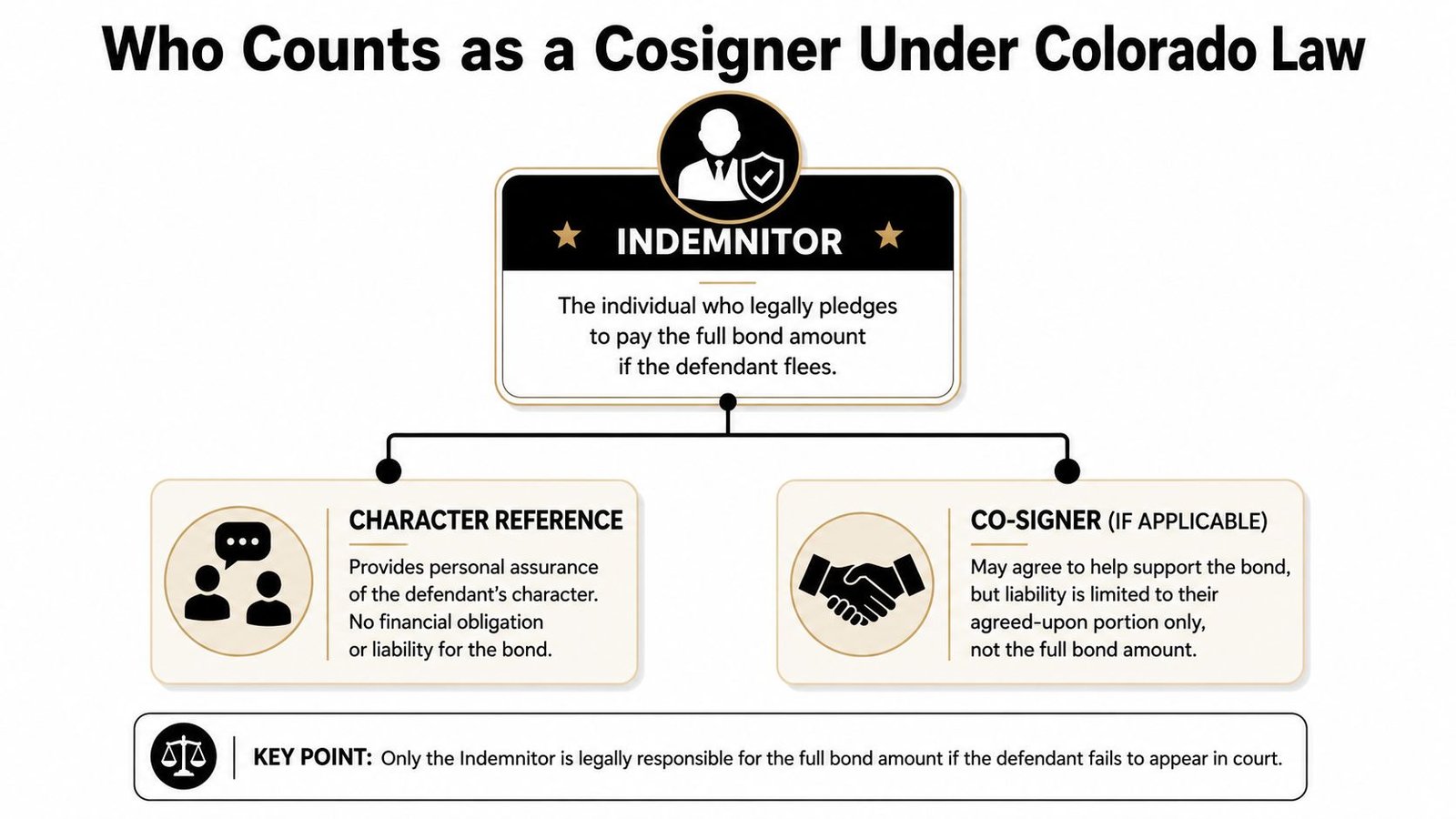
Colorado doesn't create one universal statutory checklist that every surety company must use for approving an indemnitor. Each surety agency applies its own underwriting standards, which is why one agency may accept a particular applicant while another asks for collateral or an additional signer.
Practical eligibility categories
A bondsman will commonly look for an adult who can verify identity and financial responsibility. In practice, acceptable applicants often include:
- U.S. citizens or lawful residents: The agency needs reliable identity documentation and a practical way to communicate with the signer.
- Colorado residents or out-of-state supporters: Living outside Colorado isn't automatically disqualifying, but the agency may request additional verification and electronic documentation.
- People with verifiable income: Pay records, tax documents, or other proof helps establish the ability to respond if the bond creates a loss.
- Applicants with acceptable credit: Credit doesn't tell the whole story, but open bankruptcy proceedings, major unpaid obligations, or recent charge-offs can weaken an application.
A family member who says, “I know he'll come to court,” may be helpful, but that statement isn't a substitute for indemnity. Before signing, read the Colorado bail bond cosigner information and ask whether you're signing as the indemnitor, providing collateral, or doing both.
The Core Cosigner Requirements in Colorado
A Colorado bondsman is deciding whether the signer can cover a loss if the defendant fails to meet the bond terms. The paperwork supports that decision. It is not busywork, and an approved cosigner can affect the premium, with some Colorado bonds commonly moving from 15% to 10% when the agency approves the signer.
Start with identity and contact information. The cosigner needs a valid government-issued photo ID, such as a driver's license, state identification card, or passport. The agency also verifies a current residence. A Colorado address helps, but an out-of-state signer may qualify by documenting the address and remaining easy to reach. Electronic signing can let a supporter complete the paperwork without flying to Denver, if the agency accepts that process.
Income records show whether the signer can respond if the bond creates a financial obligation. Agencies may review pay stubs, tax returns, benefit statements, or comparable documents. The premium is only the upfront cost. A forfeiture can range from $5,000 into the hundreds of thousands, so larger bonds demand stronger financial support.
Credit is one part of underwriting, not the entire decision. Open bankruptcies and recent major charge-offs can weaken an application. The agency may also request bank records, vehicle information, real estate details, or collateral. Review the agency's cosigner credit check before applying, so you know which financial issues require an explanation.
| Requirement | What the Bondsman Checks |
|---|---|
| Government-issued photo ID | Identity, validity, and consistency with the application |
| Verifiable residence | Current address and ability to locate or contact the signer |
| Income documentation | Employment, recurring income, and ability to absorb financial exposure |
| Credit history | Bankruptcy status, major charge-offs, and payment reliability |
| Collateral, when requested | Real estate equity, vehicles, or other assets supporting the indemnity |
When underwriting gets stricter
A bond above $25,000 or a defendant with a prior forfeiture can lead to higher income expectations or collateral requirements. That reflects the agency's risk assessment, not a personal judgment. Surety underwriting may use collateral and financial statements to offset weaker credit, while larger obligations can require shared risk through coinsurance or reinsurance, as described in the Federal Acquisition Regulation surety framework.
The indemnification contract controls the signer's financial exposure. Read it before signing, especially the provisions covering forfeiture, recovery costs, collateral, and the defendant's court obligations. If you want a comparison with lease guarantors, with VerticalRent's landlord advice provides context on income, credit, and payment responsibility. Gather records first, then ask the bondsman to explain every obligation in plain language.
How the Cosigning Process Works Step by Step
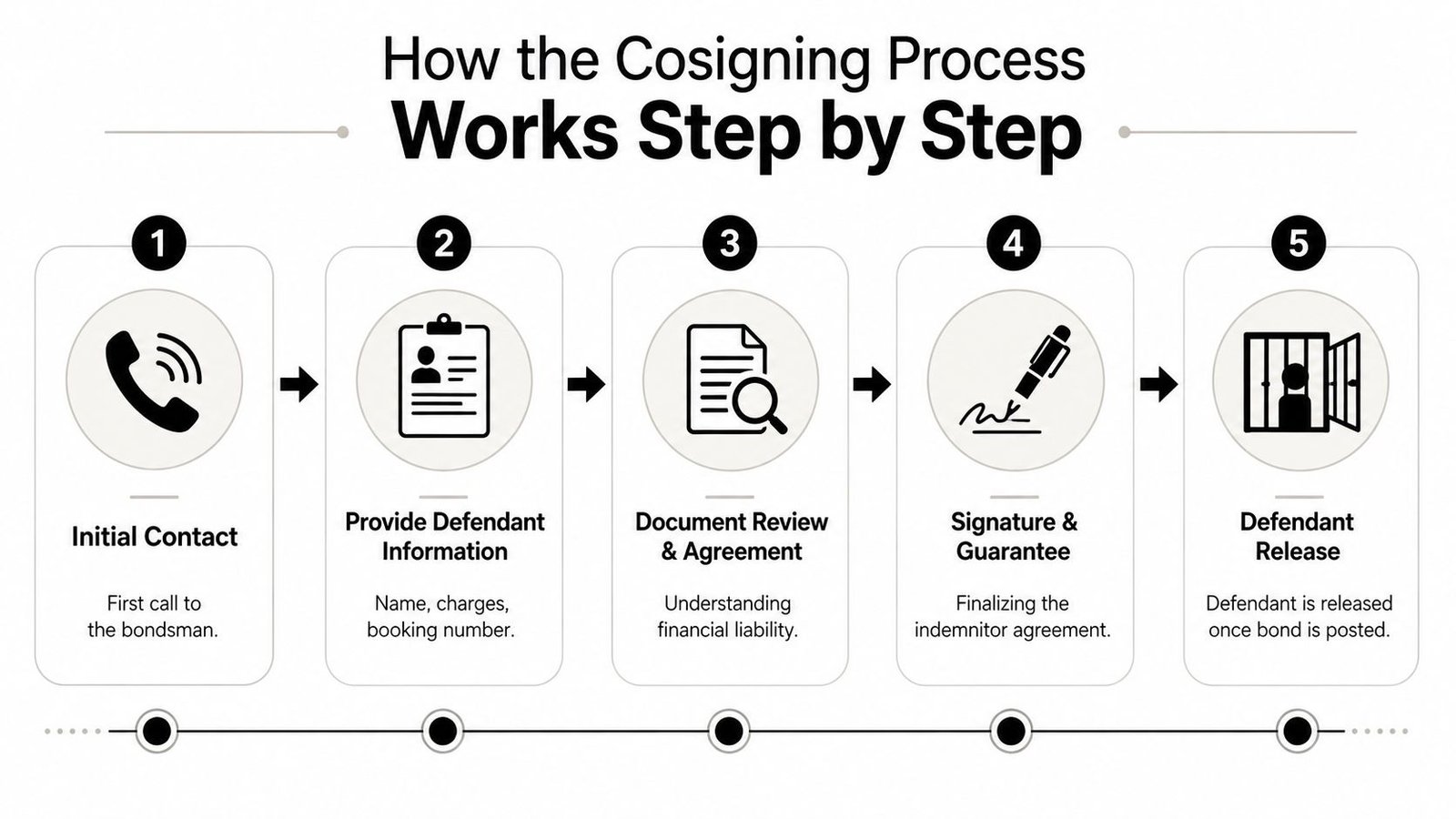
The process starts with a phone call, not a signature. Give the bondsman the defendant's full name, date of birth, booking information if available, arresting agency, charges, and bond amount. Accurate information prevents delays and lets the agent identify the court and jail requirements.
The application and document review
The cosigner completes an application and submits identification, residence information, income records, and any other documents the agency requests. Be honest about debts, employment changes, previous bond obligations, and available assets. A missing document is usually easier to fix than a contradiction discovered after approval.
The agent then explains the premium, payment arrangements, collateral terms, and indemnity agreement. Colorado's commonly described standard premium is 15% of the bond amount, while some Colorado guidance states that bonds of $5,000 or more may be written at 10% when an approved cosigner is available. The Colorado bail premium guidance describes those figures and the role an approved cosigner can play in pricing.
Payment plans may be available, but don't assume approval is automatic. The agency will set terms based on the application and the contract. Ask when each payment is due, whether collateral is required, and what happens if a payment is late.
Signing and release
Read the indemnity agreement clause by clause. Confirm who is liable, what expenses can be charged, how collateral is handled, and what notice obligations apply. In-person signing may be available, but remote family members can often complete documents through a secure platform such as DocuSign. The online contract signing process can allow an out-of-state cosigner to participate without flying to Denver.
After the documents and required payment are complete, the agency posts the surety bond with the appropriate detention facility. Release timing depends on the jail, court authorization, processing workload, and whether additional holds exist. Once released, the defendant must attend every court date and follow all conditions. The cosigner should maintain current contact information and respond promptly to the bondsman.
Legal Risks and Financial Responsibilities
Cosigning a bail bond is not a casual favor. It's a financial guarantee tied to the defendant's appearance. If the defendant misses court and the bond is forfeited, the indemnitor may face responsibility for the full bond amount, not merely the premium paid to obtain release.
The contract may also expose the cosigner to recovery expenses. In Colorado, a bail bond cosigner is typically treated as an indemnitor who may be financially responsible for the bond and reasonable apprehension or recovery costs if the defendant is later located, according to this Colorado bail bond liability explanation.
Practical rule: Never sign until you know exactly how the agency defines forfeiture, recovery costs, collateral, and notice.
A missed appearance can start a chain of events involving court action, agency notices, efforts to locate the defendant, collateral claims, and collection activity. Depending on the agreement and the circumstances, the agency may pursue a civil judgment. That can create serious pressure on personal finances, including possible collection against wages or assets. Credit problems can follow when an unpaid obligation reaches collection or judgment.
What happens to the premium
The premium pays for the surety service and is generally not treated like a refundable deposit. Whether any amount can be returned depends on the contract, the bond's status, and applicable circumstances. Ask that question before signing, not after the defendant's case changes.
A cosigner also shouldn't assume they can withdraw whenever they want. Release may require the agency's written approval, replacement security, surrender of the bond, or another event defined by the agreement. Review the agency's process for removing a cosigner from a bail bond before you commit.
If the defendant is unreliable, evasive, using substances, threatening to leave Colorado, or refusing to discuss court dates, treat those as warning signs. Your relationship matters, but it doesn't cap your liability. Decide whether you could withstand the financial loss before you sign.
Tips for Out-of-State Cosigners and Common Pitfalls
Living in Texas, California, Kansas, or another state doesn't automatically prevent you from helping with a Colorado bond. The agency still needs to verify your identity, address, income, and financial reliability. Remote participation makes the process more convenient, but it doesn't make the obligation less real.
Prepare for electronic signing
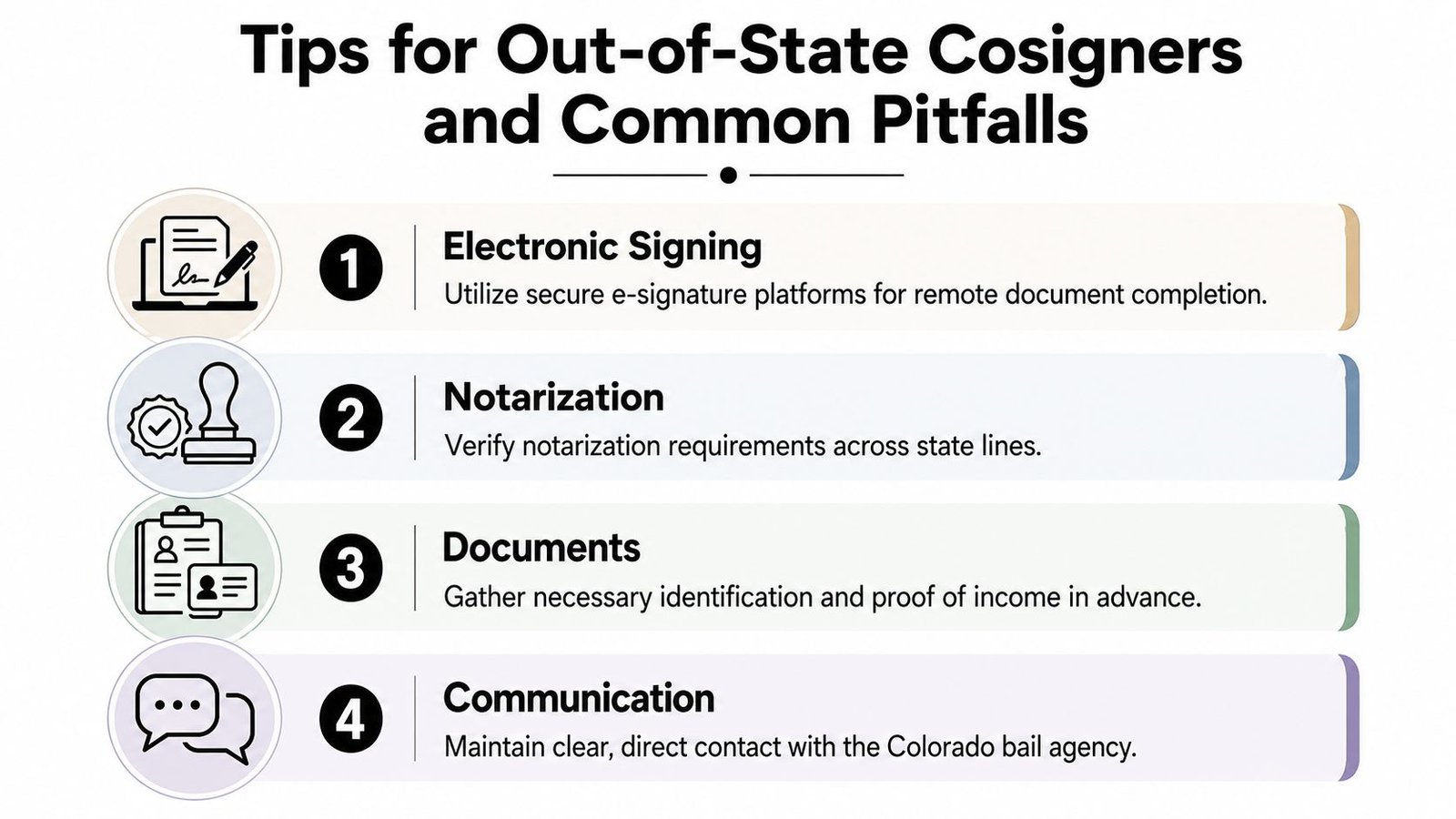
Ask the agency which documents can be emailed and which require an original, notarized, or witnessed signature. A secure electronic-signature platform may handle the indemnity agreement, but state-specific notarization rules can differ. Don't photograph a signature page casually and assume it satisfies every requirement.
Have clear scans or photos ready for your government ID, proof of address, pay records, tax documents, and any collateral paperwork. Use the agency's secure upload method rather than sending sensitive information through an unverified contact.
Read jurisdiction and notice clauses
Out-of-state cosigners often overlook provisions concerning Colorado law, venue, communication, and consent to jurisdiction. Those clauses can affect where disputes are handled and how notices are delivered. Ask the agent to explain any provision you don't understand, and consult a Colorado attorney if the language creates serious concern.
Common mistakes include:
- Signing for convenience: A remote signature carries the same contractual weight as an in-person signature.
- Losing contact with the defendant: The cosigner should know where the defendant lives and how to reach them.
- Ignoring court reminders: Confirm hearing dates and encourage the defendant to communicate with counsel.
- Waiting after a warning sign: Call the bondsman immediately if the defendant disappears, changes jobs without explanation, discusses leaving, or stops responding.
The out-of-state bail bond process can help supporters understand the practical steps before sending documents. Keep copies of every signed agreement, receipt, disclosure, and message. If the agency calls about a missed court date or location concern, respond immediately.
Alternatives When a Cosigner Is Not Available
No qualifying cosigner doesn't always end the release discussion, but it usually changes the path. The defendant, family, and attorney need to match the option to the court's order, available funds, property, and urgency.
Cash bail means paying the court or detention authority the required amount directly. A property bond may use real estate equity, subject to court approval and documentation. Both options can require more time, paperwork, and available resources than a standard surety bond.
An attorney can ask the court to consider release on personal recognizance, an unsecured bond, or another less restrictive arrangement under Colorado Rule of Criminal Procedure 431. The judge controls that decision. A lawyer may also help address conditions, holds, or facts that make a secured bond unnecessary.
Some larger Colorado counties, including Denver and El Paso, use monitored pretrial release programs. Availability depends on the court and the defendant's circumstances. Some agencies may offer payment arrangements for self-pay defendants, but approval remains an underwriting decision.
A public defender cannot serve as the defendant's cosigner. If nobody can meet the agency's requirements, contact defense counsel and the court promptly instead of waiting for a rejected application to solve itself.
Frequently Asked Questions About Cosigner Requirements
Can an approved cosigner lower the premium?
Colorado commonly uses a 15% premium. A bond of $5,000 or more may qualify for 10% with an approved cosigner, but the agency must approve the signer and confirm the contract before applying that rate. Ask for the premium and all fees in writing before signing. As noted earlier, the lower rate depends on approval and contract terms.
Can I remove myself after the bond is posted?
Not automatically. The indemnification agreement remains in effect unless the agency approves a change. Ask whether replacement security, surrender, collateral changes, or written release is required. The defendant's release does not erase your liability.
What happens if the defendant misses court?
The court may pursue forfeiture. The bondsman may contact you, locate the defendant, seek recovery, and enforce the contract. Respond immediately. Delay can make recovery harder and increase your financial exposure.
Can a spouse or ex-spouse cosign?
Yes, either may be considered. Marriage or a past relationship does not guarantee approval. The agency reviews identity, income, residence, credit, and your willingness to accept liability.
Is there a fixed minimum income?
No single statewide income threshold applies to every agency. Many agencies look for income roughly two to three times the premium, with stronger proof or collateral for higher-risk bonds.
Can bad credit disqualify me?
Yes. Open bankruptcy, recent major charge-offs, unstable income, or heavy existing obligations can lead to rejection or a collateral request. Explain financial problems before submitting documents.
Do I need to live in Colorado?
No. An out-of-state cosigner may qualify if the agency can verify identity, residence, finances, and communication. Electronic signing may let you complete the process without flying to Denver, but the contract still creates full legal responsibility.
What documents should I gather?
Prepare a government-issued photo ID, proof of residence, recent income records, tax documents when applicable, and information about assets or collateral. The bondsman may request additional records after reviewing the application.
Does a character letter make me a cosigner?
No. A character letter supports the defendant's background. It does not create the financial guarantee created by an indemnification agreement.
If you need help reviewing Colorado cosigner requirements, Express Bail Bonds provides statewide surety-bond guidance, electronic contract processing, and support for out-of-state signers. Visit Express Bail Bonds with the defendant's booking information and your identification ready, or contact the agency before signing to confirm the premium, paperwork, and liability.