
Your phone rings late. It's a shaky voice, a bad connection, and a sentence nobody wants to hear: “I got arrested in Breckenridge. Can you help me?”
That moment scrambles people. You're trying to figure out where they are, whether they're safe, what the bond is, and whether you need to drive into the mountains tonight or whether this can be handled from home. Most families lose time right there. They call the wrong number, they don't have the booking name exactly right, or they assume they need cash in hand before anything can happen.
You don't need to know everything at once. You need the next right move, then the one after that.
A Practical Guide to the Breckenridge Colorado Jail
Those looking for the Breckenridge Colorado jail usually aren't doing it casually. They're standing in a kitchen with a charger cord in one hand and a notebook in the other, trying to sort out a problem fast.
The first thing to understand is that panic makes people skip details that matter. A nickname instead of a full legal name. A guess about the date of birth. Confusion about whether the person is in Summit County or was stopped somewhere nearby and transported elsewhere. Those small mistakes slow everything down.

A better approach is simple. Confirm the jail. Confirm the charge information. Confirm whether bail has been set. Then decide whether the release can be handled through cash, a surety bond, or a personal recognizance release if the court allows it.
What matters in the first hour
Write down these basics before you start calling around:
- Full legal name: Use the exact name shown on ID if you know it.
- Date of birth: This helps separate your person from anyone with a similar name.
- Arrest location: Breckenridge, Frisco, Silverthorne, Dillon, or somewhere else in Summit County.
- Callback number: If the jail, court, or an agent returns your call, you don't want that missed.
- Medical or work concerns: If there's medication, childcare, or a job issue, note it early.
Practical rule: Fast release starts with accurate information, not frantic calling.
If your family member is in Summit County, a local overview like the Summit County Breckenridge jail page can help you get oriented quickly before you start making decisions.
The goal is speed without mistakes
Some people waste half a day trying to solve everything in the wrong order. They focus on visits before they confirm bond. They ask about court dates before they know if the person is still in booking. They drive to the jail without checking whether there's anything they can do in person.
The right sequence is cleaner. Find them. Verify status. Learn the bond type. Act on the release option that fits the case. That's how you turn a chaotic night into a manageable process.
Summit County Jail Location and Inmate Search
If your loved one was arrested in Breckenridge, the facility you're usually dealing with is the Summit County Jail inside the Summit County Justice Center at 501 North Park Avenue in Breckenridge. It serves as the county's primary incarceration site and is described as a 95-bed adult detention facility that holds between 2,000 and 2,500 inmates annually, which points to heavy short-term and pre-trial use rather than long-term housing, according to the Summit County Jail facility overview.
That matters because turnover is high. People are often booked, processed, and moved through the system quickly. If you wait too long to verify details, you can end up working with stale information.
How to search for someone in custody
Start with the basics. Don't overcomplicate it.
Gather the exact legal name
Use the person's full first and last name. If there's a middle name or suffix, keep it handy.Add the date of birth
This is one of the fastest ways to avoid confusion when names are common.Check the jail roster or custody lookup
Use a dedicated tool like this Colorado inmate locator tool to narrow down where the person is being held.Review the booking details carefully
A booking record may show the charges, custody status, and whether a bond amount appears.Call to confirm if the listing is unclear
Online systems can lag. If anything looks incomplete, call the detention facility directly and verify the status.
What you're looking for in the record
A booking entry usually answers the questions families care about most:
| What to check | Why it matters |
|---|---|
| Booking status | Tells you whether the person is still being processed or fully housed |
| Charges listed | Helps you understand how serious the case may be |
| Bond information | Shows whether release may be possible right away |
| Hold or restriction notes | Can signal delays or limits on immediate release |
If the person was only recently arrested, “not found” doesn't always mean they aren't there. It often means booking isn't finished yet.
Common search mistakes
Families lose time when they do one of these:
- Using a nickname: “Mike” instead of “Michael” can fail.
- Misspelling the last name: Even one letter off can throw off results.
- Searching too early: Booking can take time.
- Assuming Breckenridge police means a city jail: In practice, county detention is usually the issue you're solving.
When you call, keep your questions tight. Ask whether the person is in custody, whether bond has been set, and whether there are any release holds. That gets you farther than telling the whole story.
Jail Procedures Communication and Visitation Rules
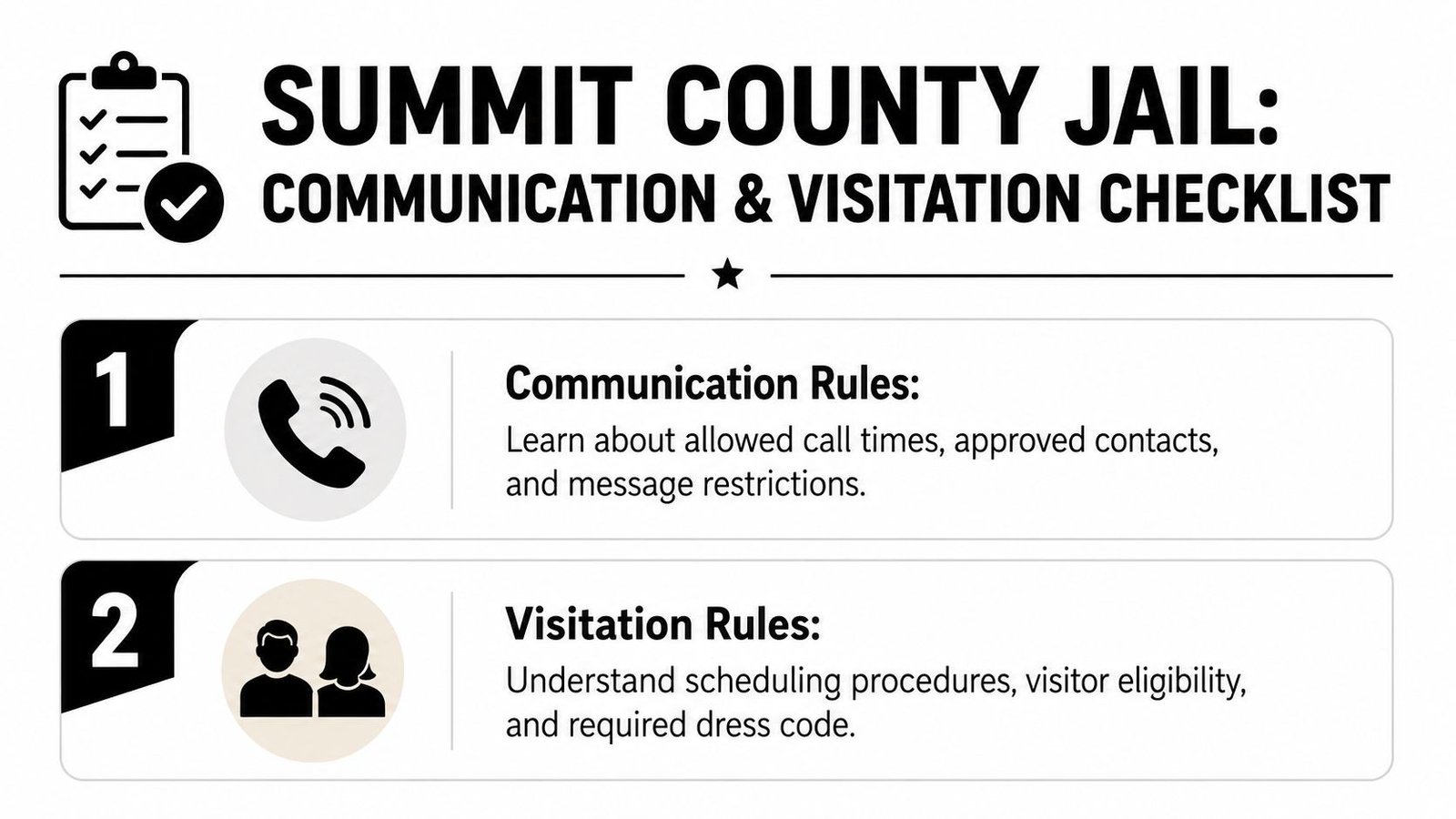
Once you know your person is in custody, the next pressure point is contact. Families want to know, “Can they call me?” “Can I send money or mail?” “Can I visit tonight?”
The short answer is maybe, but jail rules control every part of that. The fastest way to help is to follow the facility's process exactly. When people improvise, mail gets rejected, visits get denied, and calls get missed.
Inmate phone calls
Most jail calls work on the jail's phone system, not the inmate's personal phone. That means you usually need to be ready to answer unfamiliar numbers and follow the prompts if the call is collect or routed through a provider.
Keep these points in mind:
- Calls are outgoing: Inmates generally call out. You usually can't call directly into a housing unit and ask to be connected.
- Call windows vary: Access depends on housing schedules, classification, and jail operations.
- Monitoring is common: Don't discuss facts of the case unless the person's lawyer has advised it's safe to do so.
- Missed calls matter: If you send unknown callers to voicemail automatically, you may miss the first contact.
Best advice: Use the first phone call to gather facts, not emotions. Get the booking name, charges if known, and whether bond has been mentioned.
Mail and property rules
Mail sounds simple, but families often make avoidable mistakes with it. Every jail has rules about envelope format, content, and contraband. If you want the message to reach the inmate, keep it plain and compliant.
A safe approach looks like this:
- Write clearly: Use the inmate's full legal name and identifying information if required.
- Keep contents basic: Plain letters are usually safer than anything decorative.
- Avoid restricted items: Extra paper, stickers, cash, or unexpected enclosures often trigger rejection.
- Ask before sending property: Clothing, medication, and personal items usually require approval or won't be accepted at all.
If the person needs essentials, don't assume you can drop them off at the front desk. Always check first.
For a broader overview of what families usually run into, this guide on visiting someone in jail is a helpful starting point.
Visitation and what usually goes wrong
Visitation rules change more often than people expect. Some facilities require advance scheduling. Others limit who can visit based on housing status, classification, or disciplinary restrictions.
Before you drive over, confirm:
- Whether visits are in-person or remote
- Whether appointments are required
- What ID is accepted
- Dress expectations
- Who is allowed to attend
Here's what usually gets visits denied:
| Problem | Why it stops the visit |
|---|---|
| Late arrival | Many facilities cancel the visit instead of shortening it |
| Name mismatch | The approved visitor list may require exact matching |
| Improper ID | Staff won't waive identification rules |
| Dress code issue | Visitors may be turned away at check-in |
If your main goal is release, don't let visitation become the focus too early. Contact matters, but getting bond information handled usually does more to help than planning a visit.
How the Bail and Bond Process Works in Summit County
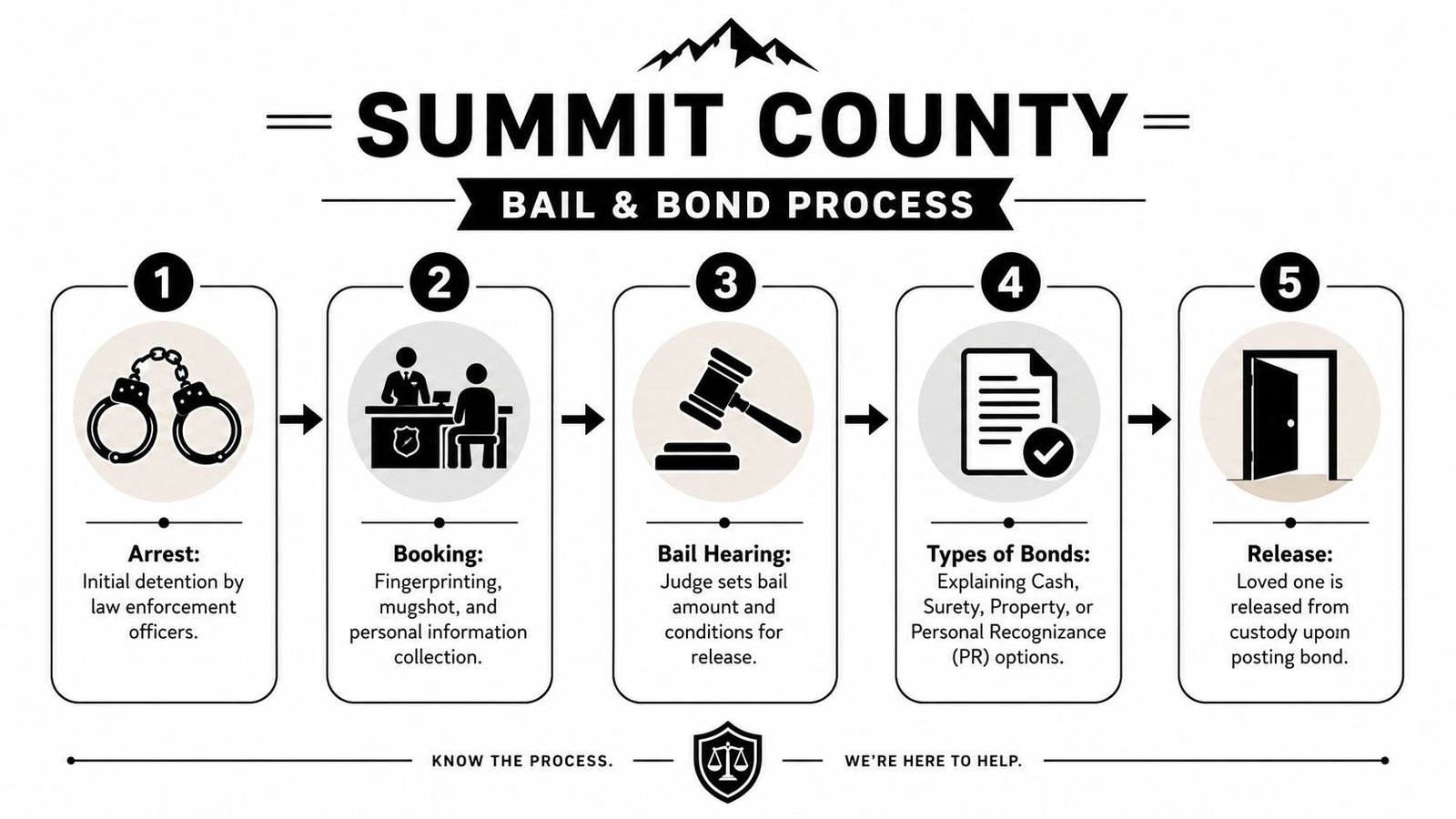
Bail confuses people because they treat it like a fine. It isn't a fine. Think of it more like a security deposit to the court. The court sets conditions for release and wants a financial incentive strong enough to make the defendant come back.
In Summit County, jail operations can move relatively smoothly. The Summit County Detention Facility is listed as a 93-bed adult detention center with an average daily population of 30 inmates, which equals about 32.3% capacity utilization, according to Summit County detention services. In practice, a lower daily population can help administrative processing move more efficiently than in a heavily overcrowded jail.
The main bond types
Here's the plain-English version of what you may run into.
| Bond type | What it means | Main trade-off |
|---|---|---|
| Cash bond | The full amount is paid directly to the court or jail | Ties up a large amount of money |
| Surety bond | A licensed bail bond company posts the bond | You pay a premium for the service |
| PR bond | Release on a promise to appear | Not available in every case |
| Cash-only bond | The court requires cash and won't accept a surety bond | Least flexible option for families |
Why families choose one option over another
A cash bond can make sense if the amount is manageable and you're prepared to part with that money until the case resolves. The problem is simple. Many families don't have that amount ready, and even if they do, they may need it for rent, legal fees, childcare, or travel.
A surety bond exists for that reason. A bondsman guarantees the amount to the court, and the family pays the premium and completes the required paperwork. If speed and affordability both matter, this is usually the practical route.
A PR bond is the easiest financially because no up-front bond payment may be required, but it depends entirely on the court and the facts of the case. You can't force it.
Courts set the release terms. Families choose the most workable option within those terms.
The timeline people should expect
The process usually follows this order:
- Arrest and booking
- Custody entry and charge review
- Bond amount or release condition set
- Bond posted if eligible
- Jail release after internal processing
The biggest mistake families make here is assuming posting bond means the door opens immediately. It doesn't. The jail still has release procedures, identity checks, and paperwork to finish.
If you want a deeper explanation of the surety side, this overview of what a surety bail bond is breaks down the mechanics without legal jargon.
What works and what doesn't
What works:
- Calling with complete information
- Asking whether the bond is surety-eligible
- Getting documents signed quickly
- Using remote processing when the cosigner is out of town
What doesn't:
- Arguing with jail staff about the charge
- Showing up with partial cash and no plan
- Waiting until morning because you assume nothing happens overnight
- Confusing a cash-only bond with a standard bond
If the bond is standard and not cash-only, speed comes from preparation. The less back-and-forth required, the faster the posting side can move.
How to Post Bail with Express Bail Bonds
When a family wants the least stressful path, the biggest advantage is remote processing. You don't need to sit in a detention center lobby for hours just to get paperwork started. A modern bail process can be handled by phone, text, email, and online signatures, which matters a lot when the cosigner lives outside Summit County or outside Colorado.
Colorado families who need statewide help often start with Express Bail Bonds, especially when they want one point of contact and an online process instead of a string of separate office visits.
What the first call should accomplish
A useful first call is short and factual. You want to establish four things:
- Who is in custody
- Where they are being held
- What the bond amount and bond type are
- Who will cosign if needed
From there, the paperwork can move. The company information provided by the publisher states that Colorado's standard premium is 15%, and for bonds over $5,000 they often secure 10% with an approved cosigner. It also states that the agency does not post cash-only bonds and focuses on surety bonds handled through electronic applications, payments, and contract documents.
That distinction matters. If the court says cash-only, a surety company can't convert it into a standard bond just because the family prefers that route.
How remote posting helps out-of-town families
Many people save time here.
A cosigner in another city can complete the application, review the agreement, provide identification, and handle payment electronically rather than driving into Breckenridge. That's especially useful during weather issues, late-night arrests, or situations where several family members are trying to coordinate from different states.
Here's the practical sequence:
- Call or text the agent
- Submit the defendant's booking details
- Complete the online application
- Review and sign the indemnity paperwork
- Make payment electronically
- Wait for bond posting and jail release processing
If you need a direct online option, the pay bail bond online page is built for that exact situation.
A short overview can also help if this is your first time dealing with the process:
The real trade-offs
No bond option is perfect. The practical question is which drawback you can live with.
A cash bond avoids a bond premium, but it may require a large amount of money up front. A surety bond preserves liquidity and can move quickly, but the premium is the cost of using that service. A cash-only bond removes the surety option completely, which is why families need to confirm bond type before making assumptions.
If the arrest happened outside Summit County, the same remote approach can still matter. People comparing nearby service areas often look at Jefferson County bail bond help in Golden or bail bonds in Centennial when they're dealing with different Colorado jails but want a similar process.
Breckenridge Jail and Bail Bond FAQs
The same questions come up every night, and they usually come fast. Here are the answers families need most.
How long does release take after bail is posted
There isn't one universal release time. After bond is posted, the jail still has to complete its own release process. That can include internal approval steps, identity checks, records work, and shift-based delays.
What helps is clean paperwork and fast response from the cosigner. What slows things down is incomplete information, bond-type confusion, or waiting to start the process until everyone in the family agrees.
Don't promise the defendant an exact pickup time unless the jail gives one directly.
What happens if someone misses court
This is serious for both the defendant and the cosigner. A missed court date can lead to a warrant, bond problems, and extra pressure to get the case back on track quickly.
If there's a surety bond involved, the cosigner may also face financial consequences under the bond agreement. The best move is immediate action, not delay. Call the lawyer, call the bondsman, and find out what needs to happen next.
Do you get bail money back
It depends on the type of bond.
With a cash bond, the money posted directly to the court may be returned according to court rules and any applicable deductions once the case is resolved. With a surety bond, the premium paid to the bail bond company is the fee for the service and is generally not refundable.
That's one reason families need to understand the difference before they pay anyone anything.
What does cash-only bond mean
It means the court requires cash and will not accept a surety bond for release. Families sometimes hear the word “bond” and assume a bondsman can handle it. Not in a cash-only situation.
If the bond is cash-only, your next step is to confirm the exact amount and the payment process with the jail or court. Don't assume there's flexibility if the order doesn't allow it.
Can an out-of-state relative help
Yes, in many standard surety situations, an out-of-state relative can often help as a cosigner if the bond company approves it and the documents can be completed remotely. The key is speed, valid identification, and clear communication.
Should you visit first or work on release first
If the goal is to get the person out, work on release first. Visiting can provide reassurance, but it usually doesn't solve the legal or financial issue that keeps the person in custody.
Your Next Steps for a Quick Release
If someone you care about is sitting in the Breckenridge Colorado jail, the path forward is straightforward even if it doesn't feel that way right now.
First, confirm where they are and whether they've been fully booked. Second, verify the bond amount and the bond type. Third, act on the release option that fits the case, especially if the cosigner is out of town and needs a remote process.
Keep your focus narrow. Don't spend the night chasing side issues. Don't assume every bond can be handled the same way. And don't wait for “normal business hours” if a release can start sooner.
The fastest outcomes usually come from accurate information, quick signatures, and a clear understanding of whether the bond is cash, surety, PR, or cash-only. When families stay organized, the whole situation gets more manageable.
If you need immediate help from a licensed Colorado bail bond agency, contact Express Bail Bonds right away so an experienced agent can help you sort out what happens next.
If you need a fast, calm answer right now, contact Express Bail Bonds. They serve Colorado statewide, handle many bonds remotely, and can walk you through the next step any time of day or night.