You get a call late at night. A family member says they're in Pittsburgh, they mention 15222, and the line goes quiet before you understand what happened. At that point, you don't need a tourism guide. You need a working map of the area, what kind of neighborhood it is, what systems shape daily life there, and what practical problems show up fast when someone is dealing with an arrest, release delay, or mental health crisis.
That's why this guide matters. The 15222 ZIP code sits in downtown Pittsburgh, in a part of the city where business activity, dense housing, government functions, and fast-moving daily traffic all overlap. If you're helping from across town or from another state, those details aren't trivia. They affect how quickly you can verify location, contact the right office, judge the environment your loved one is in, and make smart decisions under pressure.
An Essential Guide to Pittsburghs 15222 ZIP Code
A lot of families first encounter the 15222 ZIP code the hard way. Someone gets stopped downtown after work. Someone has a mental health episode near a commercial corridor. Someone visiting Pittsburgh ends up in a legal situation and suddenly a ZIP code becomes the first clue you have.
That's the value of knowing this area. 15222 isn't just a mailing label. It's part of Pittsburgh's Central Business area, and that tells you a lot about how the environment works. It's urban, busy, highly mixed in its daily use, and shaped by both residential living and downtown employment patterns. The verified location profile also places it in Allegheny County and ties it to the Pittsburgh Unified School District, which helps confirm you're looking at the correct district footprint for services and public systems through Data Commons' 15222 profile.
Why families need location context fast
When people panic, they often search the wrong thing first. They look up a person's name, an old address, or a vague neighborhood nickname. Start with the ZIP code instead. If the paperwork, booking information, or phone call mentions 15222, you're dealing with downtown Pittsburgh conditions, not a quiet outer residential pocket.
Practical rule: In a legal emergency, confirm the ZIP code, county, and neighborhood before you start calling agencies. That prevents wasted time and bad assumptions.
What makes this guide different
Most writeups about this area stay stuck on apartments, property values, and lifestyle branding. That's not enough if your family needs answers tonight. You need to understand the area as a functioning system: dense streets, mixed-use buildings, institutional presence, and the reality that emergencies move differently downtown than they do in suburban neighborhoods.
This guide takes that approach. It connects the 15222 ZIP code to real decision-making, especially when safety, legal access, or support services matter more than marketing language.
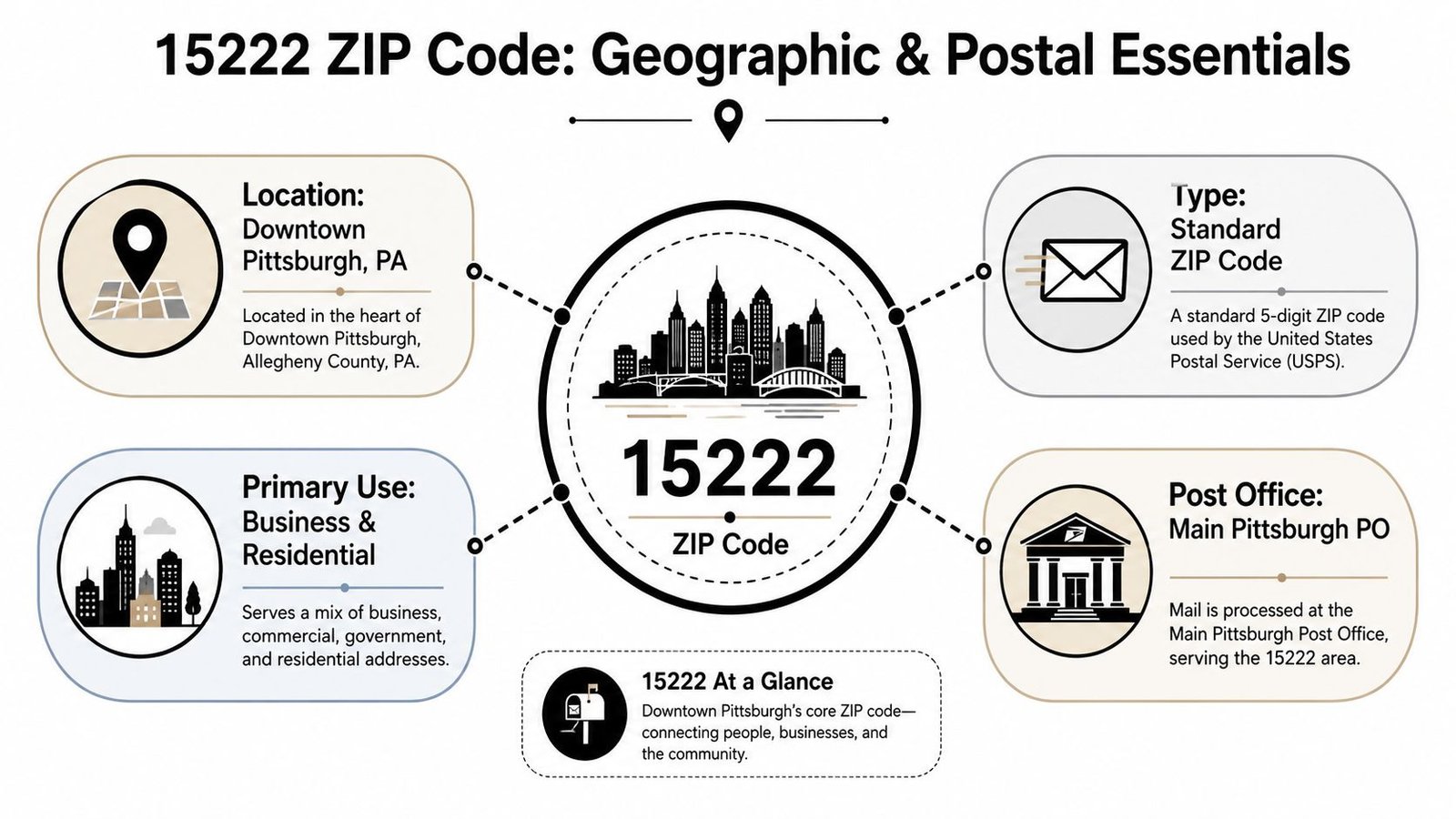
15222 at a Glance Geographic and Postal Information
If you need to verify the area quickly, use this short checklist. It helps you confirm you're working with the right place before you make calls or search for local records.
Quick reference checklist
- City: Pittsburgh, Pennsylvania
- County: Allegheny County
- Neighborhood context: Downtown Pittsburgh, including the Central Business area
- ZIP code: 15222
- Primary use: Mixed business and residential activity
- Postal identity: Standard Pittsburgh ZIP serving a dense urban core
The physical footprint is compact. The 15222 ZIP code covers about 0.9 square miles and has a population density of 6,463.2 people per square mile, according to Census Reporter's 15222 profile. That matters because a dense downtown ZIP usually means more foot traffic, more public-facing activity, more apartment living, and more overlap between workday crowds and overnight residential needs.
Why this geographic footprint matters
A compact downtown ZIP changes how families should think. Distances may look short on a map, but access can still feel complicated because downtown areas involve government buildings, parking limits, one-way streets, commercial towers, and security procedures. If someone says they were arrested or detained “near downtown,” 15222 narrows that picture sharply.
Use that to your advantage:
- Match the ZIP to official paperwork. If the address on a citation, release form, or contact record says 15222, treat downtown Pittsburgh as your operational area.
- Assume mixed-use conditions. Office buildings, apartments, nightlife, and institutional buildings can all sit close together.
- Plan for process, not distance. A short drive doesn't always mean a fast errand in a central business district.
If you want to see how another ZIP-focused legal resource is structured for emergency use, this 80231 ZIP code guide is a useful comparison.
| Key point | Why it matters in an emergency |
|---|---|
| Dense urban footprint | Services may be nearby, but access can still be procedural and time-sensitive |
| Downtown setting | Legal, medical, and administrative needs often intersect in the same area |
| Allegheny County location | County systems matter for detention, court, and release steps |
Demographics and Economic Profile
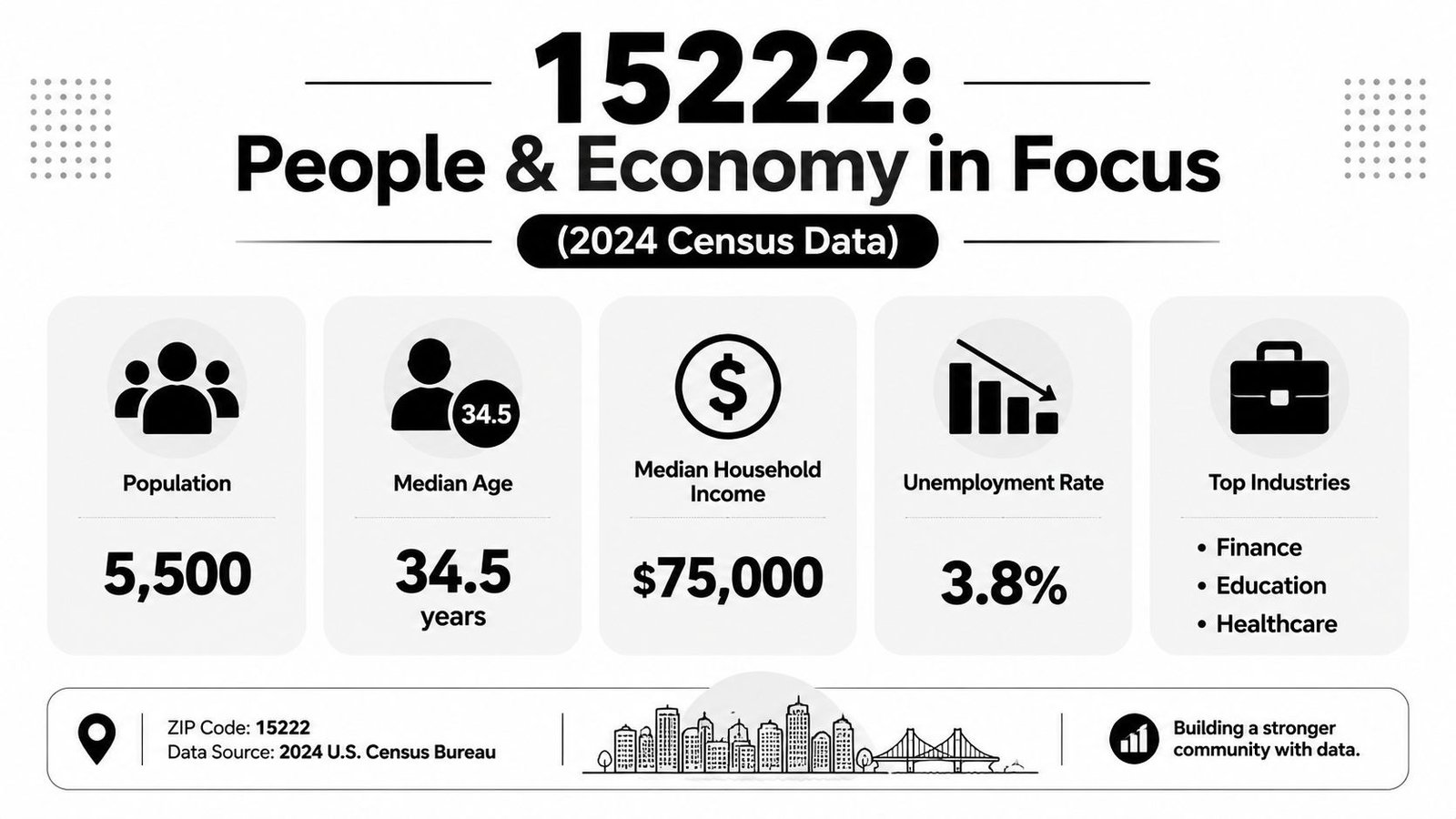
If you get a late-night call tied to a downtown Pittsburgh address, demographic context helps you make faster decisions. In 15222, you are often dealing with younger adults, smaller households, and uneven financial capacity behind a polished address.
The population profile supports that reading. Analysts cited earlier report that 15222 has a relatively young median age and income figures that are spread widely across residents. That combination fits a downtown ZIP with professionals, renters, service workers, and people who may look financially secure from the outside but have limited cash or local backup during a legal emergency.
What the income split means
The key point is the gap between median household income and average household income. That usually signals a ZIP where some residents earn far more than the middle of the pack, pulling the average upward while many others live on much less.
A separate local profile for 15222 income and per-capita earnings reinforces the same pattern. This is downtown Pittsburgh. Some residents have strong salaries, but household stability varies, and that is the detail families miss when they are trying to arrange bond, transportation, childcare, or document pickup on short notice.
What families should do with that information
Do not assume one clean story about who lives here. Ask direct questions right away.
Find out whether your loved one lives alone, who can enter the residence, who can bring ID or medication, and whether anyone nearby can help with payment, rides, or court reminders. In reality, emergency support remains thin for many people in high-visibility downtown ZIPs, even when the building looks expensive or the job title sounds solid.
This matters more in 15222 than in a more conventional residential area. A person may have a good income and no nearby family. Another may have modest earnings and stronger day-to-day support. For legal and bail planning, the second situation is often easier to manage.
If you want a comparison point for how ZIP-level community patterns affect emergency planning, review this legal resource on ZIP-based local support factors in 32225.
Bottom line on community character
A younger downtown population usually means apartment living, changing work schedules, newer social networks, and fewer relatives close by. That can slow everything down after an arrest or detention call.
Friends may know where the person goes out, not where they keep documents. Coworkers may know their shift, not their medical needs. Family members may live outside the city and underestimate how hard it is to solve a same-day problem downtown.
Treat 15222 as a place where appearances can mislead you. Verify support, cash access, transportation, and contact information early. That is how you avoid losing hours when time matters most.
Real Estate and Housing Market Trends for 2026
The housing picture in 15222 is expensive, urban, and easy to misread if you only look at one number. The cleanest verified housing figure available is this: the median individual house value is $609,600, and the same source reports a median household income of $114,167 for the ZIP, which it notes is higher than the Pittsburgh city average of $65,742, according to Simplemaps' 15222 profile.
That tells you the area carries real estate value well above what many people expect from a downtown ZIP. It also tells you something more practical. A person can live in a high-value area without being financially comfortable day to day. Downtown housing often includes condos, apartment towers, rented units in premium buildings, and residents whose monthly obligations are high even when their address looks affluent.
Don't confuse expensive housing with stability
Families make this mistake all the time. They hear a downtown address and assume structure, savings, and easy problem-solving. That's sloppy thinking. In places like 15222, a polished residential building may contain long-term owners, short-term renters, working professionals, students, and residents stretching to afford the location.
That's why legal and safety planning should focus on actual logistics:
- Who has access to the residence
- Whether someone can retrieve identification or medication
- Whether building access requires management approval or key fob entry
- Whether the person lives alone
What the 2026 outlook suggests
For 2026, the practical trend line is straightforward even without inventing forecasts. High-value downtown housing usually means pressure, turnover, and uneven resident stability. If someone in 15222 is dealing with a legal emergency, the housing market doesn't just shape rent or ownership costs. It affects whether their belongings are secure, whether someone can enter the unit, and whether missed work quickly becomes a housing problem.
If you're comparing similar ZIP-based snapshots in other regions, this 32809 ZIP code guide shows how local housing context can influence emergency planning.
Crime and Public Safety Overview
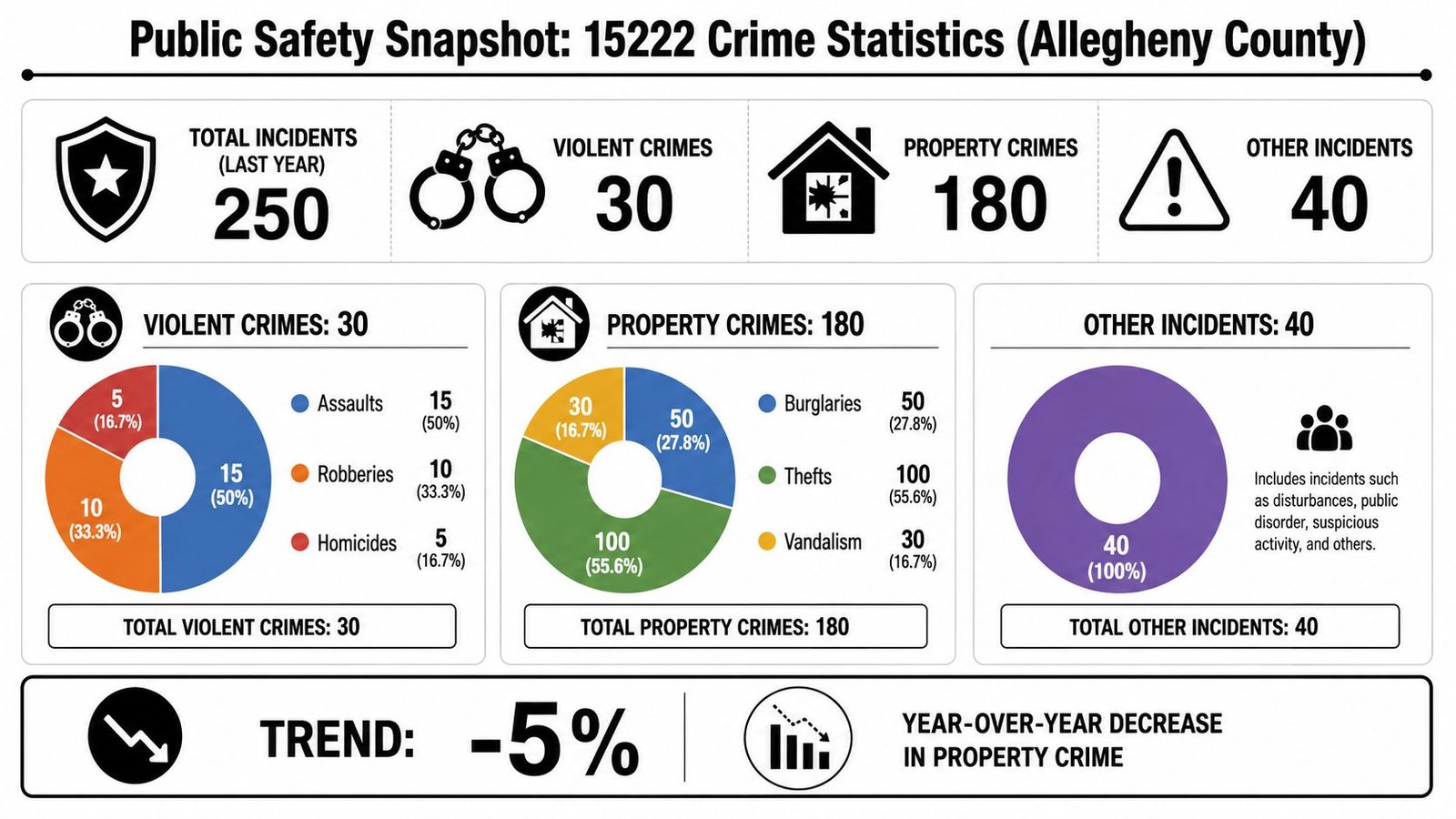
Families usually ask the safety question too broadly. They want to know whether 15222 is safe. That's not the right question. The useful question is whether you understand the kind of safety environment that comes with a dense downtown district.
The answer is this: 15222 should be treated as an active urban core, not a quiet neighborhood. That means more pedestrian movement, more commercial traffic, more late-night transitions, and more situations where minor disputes, intoxication issues, or public-order problems can escalate fast. The verified location data already shows why. This ZIP is dense, compact, and tied to downtown activity rather than a single residential pattern.
How to read public safety in a downtown ZIP
Don't overreact to the setting, but don't romanticize it either. A central business district creates specific risks:
- Crowd-based confusion: Witnesses often see part of an event, not the full chain.
- Building access issues: Secure lobbies and controlled entry can complicate pickups and property retrieval.
- Transit transitions: People moving between work, nightlife, and housing can be more exposed when tired, stressed, or impaired.
- Police visibility: Downtown zones often have faster law-enforcement contact because incidents happen in public view.
Those conditions matter if someone is arrested, cited, or having a mental health crisis. The issue may not be a long criminal history. It may be one bad hour in a visible place.
What concerned relatives should do
If your loved one is in 15222 and you're worried about immediate safety, stay disciplined.
- Confirm the exact location and time of the incident.
- Ask whether it happened near housing, work, nightlife, or a public street.
- Find out whether there were medical or behavioral health concerns involved.
- Document who last had direct contact.
Public safety in a downtown ZIP depends heavily on timing, visibility, and surrounding activity. The same block can feel routine at noon and chaotic late at night.
If you need a practical checklist for the first hours after an arrest, this guide on what to do when arrested is worth reviewing.
The right mindset
Treat 15222 as a place where context matters more than labels. “Downtown” doesn't automatically mean danger, and it doesn't mean calm either. It means more variables. Families who handle that reality well usually move faster because they stop guessing and start verifying.
Navigating Legal and Bail Procedures in Allegheny County
Most online guides fail people on this point. They talk about neighborhood trends and skip the one thing families need at midnight: how to move through the legal process when someone is being held.
That gap is especially serious here. Verified guidance notes that existing content about 15222 focuses on real estate while missing local bail bond accessibility during emergencies, and it also points to a 12% increase in pretrial detention durations in Allegheny County during the 2024 to 2025 period. That means delays matter more, not less. If you wait passively, your family member may stay in custody longer than necessary.
Start with the process, not panic.
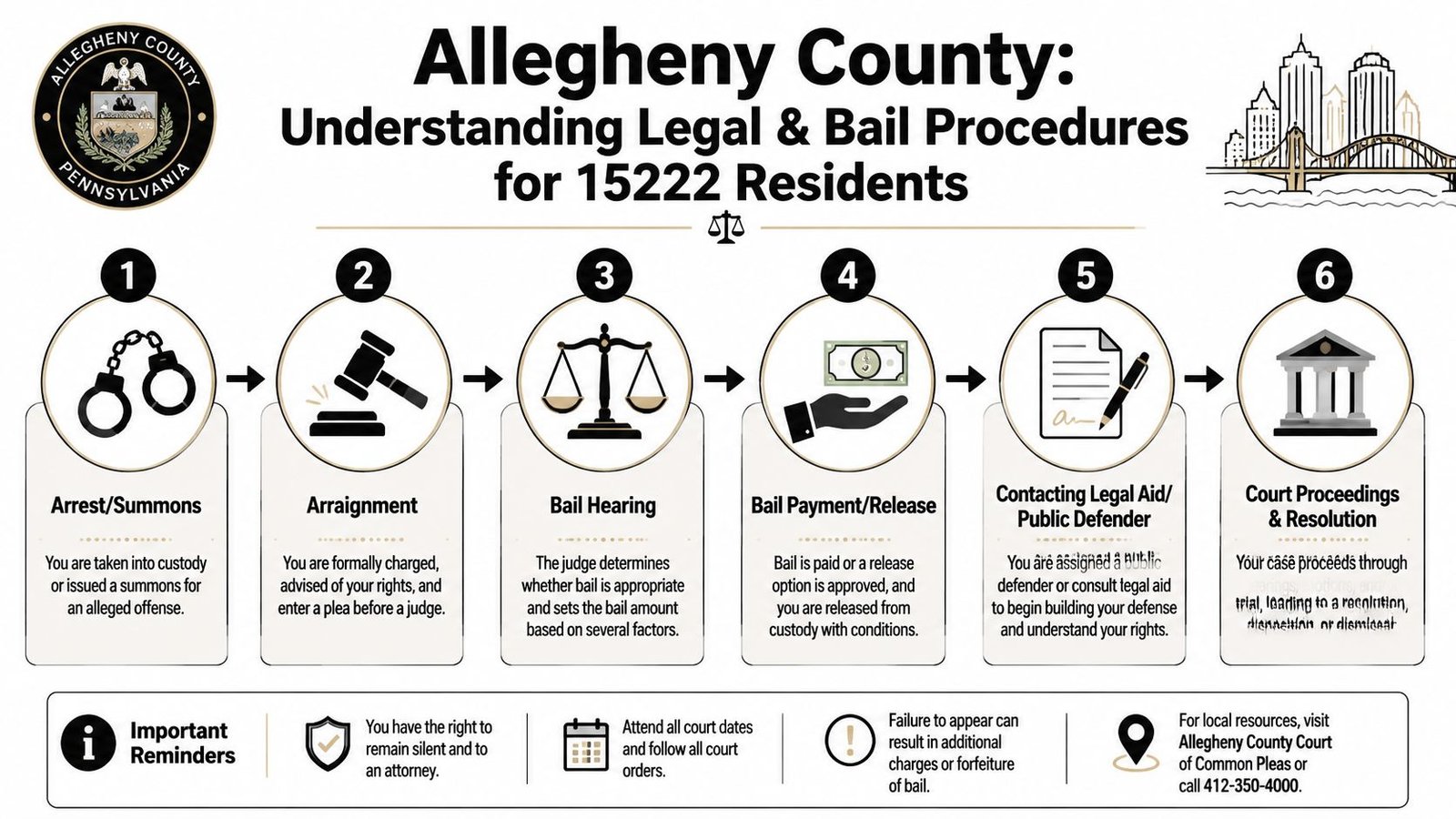
First moves that actually help
If someone connected to the 15222 ZIP code has been arrested or detained in Allegheny County, do these things in order:
- Confirm where the person is being held. Don't rely on secondhand guesses from friends.
- Get the full legal name and date of birth exactly right. One wrong digit or misspelled surname wastes time.
- Ask whether bail has been set, denied, or is still pending.
- Find out whether there are mental health concerns, medication needs, or safety issues that should be flagged immediately.
- Keep written notes of every call, time, and name.
A lot of families skip step four. That's a mistake. Behavioral health issues can shape both immediate safety and later release planning.
How the local process usually feels to families
The process feels disorganized because different parts move at different speeds. Booking, court scheduling, release conditions, and third-party communication don't line up neatly. That's normal, but it's still frustrating.
This explainer is a useful general primer on understanding the bail bond process in simplified terms.
Here's a quick visual overview before you start making calls:
What to ask when bail becomes the issue
Don't ask vague questions like “How do we get them out?” Ask specific ones.
- Has a bond amount been set, or is there another release condition?
- Is the bond cash-only or is a surety option available?
- What identification or paperwork will a family member or cosigner need?
- Can any part of the process be handled electronically or remotely?
- What court date or reporting condition applies after release?
Immediate priority: The goal is not just release. The goal is accurate release with no missed condition, no paperwork error, and no misunderstanding about the next court step.
Why families lose time
They usually lose time in one of three ways.
First, they call multiple people without confirming who has current information. Second, they assume downtown access means a faster process. It often doesn't. Third, they focus on payment before they understand the release terms.
If the person has work obligations, children, medication needs, or housing vulnerability, every hour matters. That's why calm, disciplined information gathering beats frantic action.
Mental health concerns can't be treated as secondary
In a legal emergency tied to 15222, mental health concerns should be addressed early, not as an afterthought. A person may need crisis support, evaluation, medication coordination, or family advocacy that runs alongside the legal process. If the arrest followed erratic behavior, panic, substance use, or obvious emotional distress, say that clearly when contacting the relevant offices or professionals. Don't sanitize the problem.
That kind of honesty protects the person. It also helps the family ask the right next question: “What support does this person need immediately if release happens today?”
Key Local Institutions Schools and Employers
The 15222 ZIP code is shaped by institutions more than by suburban-style neighborhood patterns. That's the correct way to read it. If you're trying to understand why the area feels fast, formal, and sometimes difficult to move through during a crisis, look at the systems around it.
One verified anchor is clear. The area is served by the Pittsburgh Unified School District, and it sits in or near the Central Business neighborhood context identified in the local data. That alone tells you this ZIP is part of a civic and administrative core, not just a residential enclave.
What defines the area day to day
Three types of institutions usually matter most in a ZIP like 15222:
Public systems
School district coverage, county administration, and court-related functions shape how families interact with the area when a problem starts.Commercial employers
Downtown Pittsburgh is known for office activity, service jobs, and professional work. That means many people in 15222 are there because of employment, not deep neighborhood roots.Support services
In a dense urban district, help often exists, but it may be fragmented. A family may need to coordinate across employers, building managers, legal offices, healthcare contacts, and transportation options.
Why this matters during a legal crisis
A lot of problems after an arrest have nothing to do with guilt or innocence. They're institutional problems. Someone misses a shift. A badge or key card is left behind. A child pickup plan falls apart. A building front desk won't release property to the wrong person. A manager wants documentation. Those are downtown problems, and families need to prepare for them quickly.
Use this framework:
| Institution type | Family question to ask |
|---|---|
| Employer | Does someone need to report an absence or protect the person's job status? |
| Housing or building management | Who can access the unit or retrieve essentials? |
| School-related contact | Is there any dependent-care issue tied to the district or school schedule? |
The fastest way to stabilize a legal emergency is often to secure the person's routine. Work, housing access, and dependent care can unravel before the court process does.
If you know those three areas are covered, the rest becomes easier to manage.
Frequently Asked Questions About 15222
Is the 15222 ZIP code mainly residential or mainly commercial
It's both, but families should think of it as a downtown mixed-use ZIP. That means the area combines residential living with strong business and institutional activity. In practical terms, you're dealing with apartments, office buildings, public-facing streets, and service systems layered close together.
Why does this ZIP code matter so much in a legal emergency
Because place shapes process. A downtown ZIP changes access, communication, transportation, and the speed at which problems become public. If a loved one is tied to 15222, you need to think in terms of county systems, dense streets, and mixed-use buildings rather than a simple neighborhood block.
Does the area's healthcare shortage designation affect families during the bail process
Yes. The 15222 ZIP code's designation as a Health Professional Shortage Area and a Medically Underserved Area can affect emergency mental health support for defendants and families during the bail process. That matters because generic legal guides often ignore the care side of the crisis. In real life, families may need evaluation, crisis intervention, medication continuity, or short-notice counseling support at the same time they're handling release questions.
The right response is practical:
- Ask early whether there are active mental health concerns.
- Document medications, providers, or recent episodes.
- Tell the relevant legal or detention contact if the person may need urgent behavioral health attention.
- Plan for post-release support before the person walks out.
What's the biggest mistake families make
They chase fragments of information. One friend says the person is downtown. Another says they're already being released. A third says it's “just a misunderstanding.” That confusion wastes time. Work from verified names, locations, and conditions only.
How should I verify local details without getting lost
Use a simple standard. Confirm the person, the place, and the process.
- Person: Full legal name and date of birth
- Place: Correct facility or official location tied to the incident
- Process: Current legal status, release terms, and next required appearance
Should I assume release will be quick in a downtown area
No. Dense urban settings can create the opposite effect. There may be more institutional access nearby, but there can also be more handoffs, more waiting points, and more confusion if paperwork isn't clear. Stay organized and expect delays unless someone confirms otherwise.
If you're helping a loved one through a fast-moving situation, keep your communication tight, write everything down, and address mental health concerns directly when they exist. That's how families avoid preventable mistakes.
If you need a fast, professional model for how bail support should work, contact Express Bail Bonds. They've served Colorado detention facilities since 1988 and offer efficient electronic processing for families who need clear answers under pressure. If your situation is in Colorado, their local resources for Jefferson County and Golden and Centennial bail bonds are strong places to start.