
You hear a hard knock, see officers at the door, and suddenly everyone in the house is asking the same question, what exactly are they allowed to search? That question matters because the answer can change depending on the type of search warrant involved, and the difference can affect a home, a phone, a car, or even location data stored somewhere else.
For families and first-time defendants, the word “warrant” can sound simple when it isn't. A warrant to enter a house is not the same thing as a warrant to copy a phone, pull location history, or gather data from a provider, and understanding that difference can help you ask better questions, protect your rights, and make smarter decisions about what happens next. If you're trying to sort through the basics, this bail overview can help connect arrest, release, and the practical steps that follow.
Why the Type of Search Warrant Matters
A warrant on paper can look official and still tell you very different things depending on what kind it is. One warrant may let officers enter a house and look for physical evidence, while another may focus on digital records, a vehicle, or a defined set of location data. The label shapes what officers may enter, seize, copy, or examine.
That distinction matters most in the real moment families face, the moment officers are standing at the door and nobody knows whether they can search the bedroom, take a phone, or open a laptop. A premises warrant is about a place. A digital warrant can be about data. A geofence warrant can be about devices in a zone, even when the person under investigation hasn't been named yet.
Practical rule: ask what the warrant actually authorizes, not just what it's called.
In Colorado cases, that difference also affects what a defense lawyer may review later and what a judge may scrutinize. A warrant's category can determine whether investigators were allowed to search only a home, or whether they could also review accounts, cloud records, or location history tied to a device. Courts care about those boundaries because they determine the scope of lawful police conduct under the Fourth Amendment and related procedural rules, which you can see reflected in the federal standard discussed in what to do when arrested.
The practical takeaway is simple. If you only hear “they had a warrant,” you still don't know enough. You need to know what kind.
The Constitutional Standard Behind Every Warrant
Every lawful search warrant starts with the same constitutional baseline, probable cause supported by an oath or affirmation, and a description that is specific enough to tell officers what place to search and what items to seize. The Fourth Amendment does not let police use a warrant like a blank check.
A simple way to think about it is a permission slip with boxes that have to be filled in. The judge has to know who is asking, what facts support the request, where the search will happen, and what evidence officers are looking for. If the form is vague, the search starts to look like a general rummage, and the Constitution is designed to prevent that.
The Supreme Court describes probable cause as a fair probability that evidence will be found in a particular place. That is not certainty, and it doesn't require police to prove the case before the search happens. It does require a real factual basis, sworn to before a neutral judicial officer.
Why particularity keeps searches narrow
Particularity is the rule that keeps a warrant from becoming an open invitation. If officers ask to search “everything,” the warrant is too broad. If they identify a house, a device, a category of records, or items tied to a specific offense, the judge can measure whether the search stays inside those lines.
Federal Rule of Criminal Procedure 41 adds a procedural layer for federal warrants. It recognizes the magistrate's role, requires the warrant to identify the property or person to be searched and seized, and generally requires execution within a set time window. Federal procedure also requires a return and inventory after the search, which means the paperwork keeps going after the officers leave.
A valid warrant is not just about permission, it's about limits.
That's the language families should keep in mind when they review paperwork or speak with counsel. The question isn't only whether a judge signed something, it's whether the document was detailed enough to stay within constitutional bounds. If you're comparing warrants to the arrest process itself, this guide on court papers being served helps explain why paperwork details matter so much.
Core Warrant Types from Premises to Vehicles
The most familiar types of search warrants are the ones people picture from TV, but the legal categories are more specific than the dramatized version. A premises warrant lets officers search a home, apartment, office, or other described location. A person warrant focuses on a named individual. A vehicle warrant covers a particular car, truck, or other movable place tied to the investigation.
A no-knock warrant is different because it authorizes entry without the usual advance notice. Courts treat that as a serious step because it raises officer-safety and privacy concerns at the same time. A telephonic or remotely authorized warrant may allow fast judicial review when time matters, while still requiring a judge's approval. Each one is narrower than the casual phrase “they had a warrant” suggests.
Common Search Warrant Categories at a Glance
| Warrant Type | What It Authorizes | Key Restriction |
|---|---|---|
| Premises warrant | Search of a described home, building, or place | Limited to the location and listed items |
| Person warrant | Search or seizure of a named person | Focuses on the individual, not a general area |
| Vehicle warrant | Search of a specific vehicle | Tied to the described vehicle and evidence |
| No-knock warrant | Entry without prior announcement | Requires heightened justification |
| Telephonic warrant | Judicial approval through remote means | Still needs probable cause and specificity |
A person warrant and a premises warrant are not interchangeable. If police have authority to search a house, that doesn't automatically mean they can search a person standing nearby, and a warrant for a person doesn't magically authorize a sweep of the whole home. That distinction is one reason defense lawyers often start by reading the face of the warrant before examining what officers did.
If you want a plain-English explanation of how people sometimes verify warrant status, this resource on checking if someone has a warrant can help frame the difference between existence and scope.
Digital, Anticipatory, and Geofence Warranties
Modern search practice reaches far beyond a front door. A digital-device warrant may cover phones, laptops, cloud accounts, or other electronic storage, but it has to be framed with more technical care because a device can contain an enormous amount of personal information. The warrant should identify the device or account, the offense-related evidence sought, and the protocols that limit review to responsive data.
The Supreme Court's 2014 decision in Riley v. California reinforced why phones deserve special treatment. The Court recognized that a modern phone holds a massive amount of personal information, which makes it materially different from physical items found on a person during arrest. That's why a phone seizure is not the same thing as permission to look through every file, app, photo, and message inside it.
Three modern warrant forms readers confuse most often
An anticipatory warrant is based on a future event, like delivery of contraband, and can't be executed until the trigger happens. A geofence warrant asks a provider for information about devices in a certain place during a certain time, which means the search may start before investigators know who the suspect is. A digital warrant, by contrast, is usually aimed at a known device, account, or data source.
That shift matters because the privacy impact is different. A geofence request can sweep in bystanders, workers, residents, and passersby before investigators narrow the list. A digital warrant can be narrower, but only if the affidavit and warrant are written that way. For readers dealing with data-heavy cases, a technical workflow resource like legal transcripts to e-discovery workflow shows how structured data review works in a legal setting, even though a warrant search is a separate question.
Geofence practice also expanded quickly in actual practice. Google reportedly received approximately 9,000 geofence requests in 2019, and by 2021 more than 25% of all warrants Google received in the United States concerned geofence data. In another historical measure, geofence warrants issued to Google increased by more than 1,500% from 2017 to 2018 and by more than 500% from 2018 to 2019 (source). Those numbers show why digital search issues now sit at the center of warrant practice.
If your case involves electronic evidence, this page about electronic signature court documents can help explain how modern legal paperwork often moves electronically too.
How a Warrant Is Executed From Knock to Inventory
Once a judge signs a warrant, the process still isn't finished. Under federal Rule 41, most warrants must be executed within a specified period, generally no more than 10 days, and they're usually carried out during daytime unless a judge authorizes another time for good cause (federal rule summary). That timing rule exists to keep searches controlled and predictable.
The usual sequence is straightforward. Officers arrive. They announce themselves unless a no-knock or similar exception applies. They enter and search only the authorized areas. Then they make an inventory of what was taken and later file the return required by court procedure.
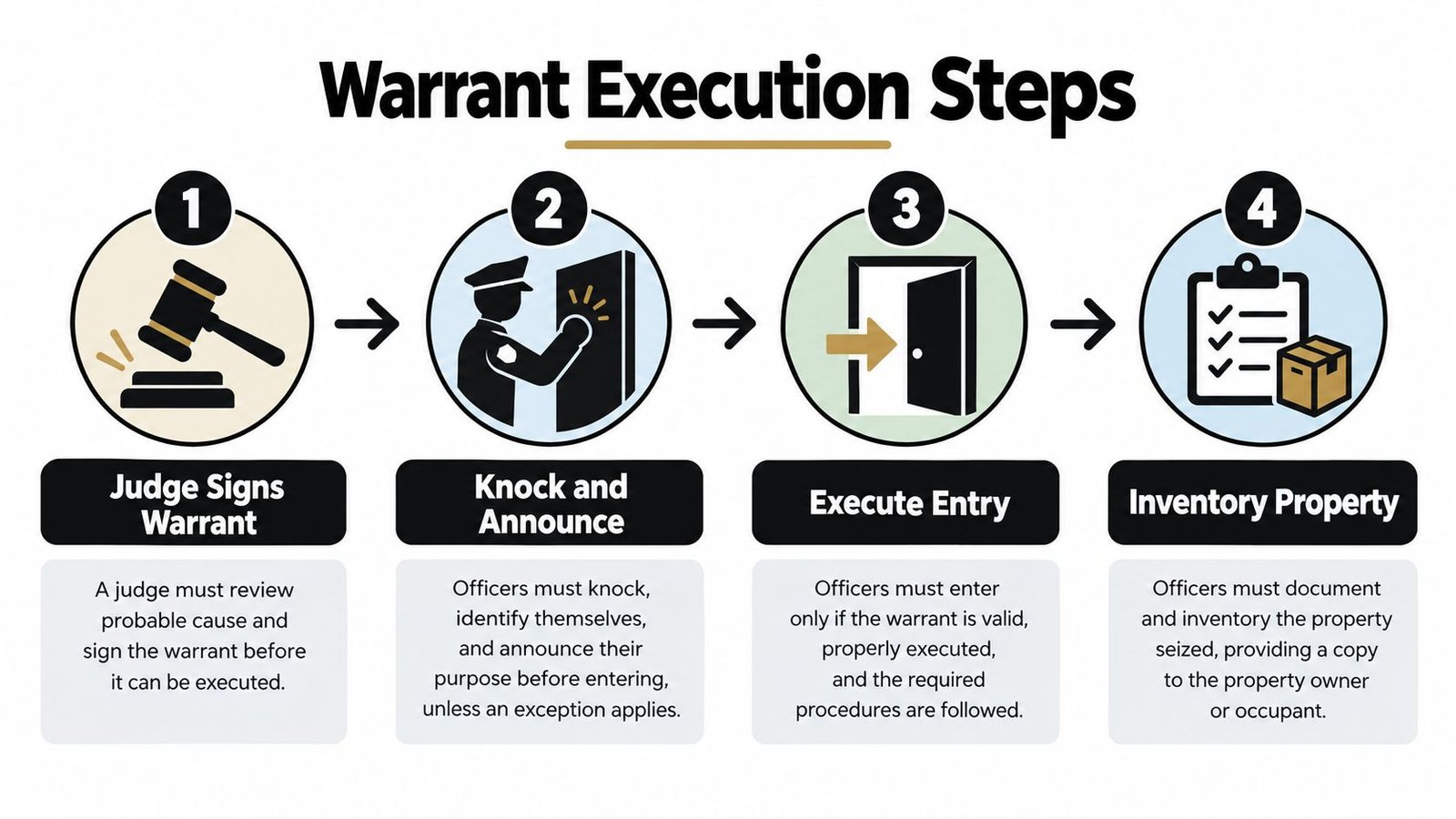
A local federal procedure in one district requires the warrant return, warrant copy, and inventory to be electronically filed within 60 days after execution, with sealed filings remaining sealed when the warrant application was sealed (district procedure). That matters because families often think the search is over when officers leave, but the legal paperwork continues.
For people trying to understand how cars fit into the picture, this explainer on when police can search your car is a useful side reference. A vehicle search can raise different issues from a home search, especially when the warrant's language is narrow.
Colorado-Specific Rules on Warrants and Location Data
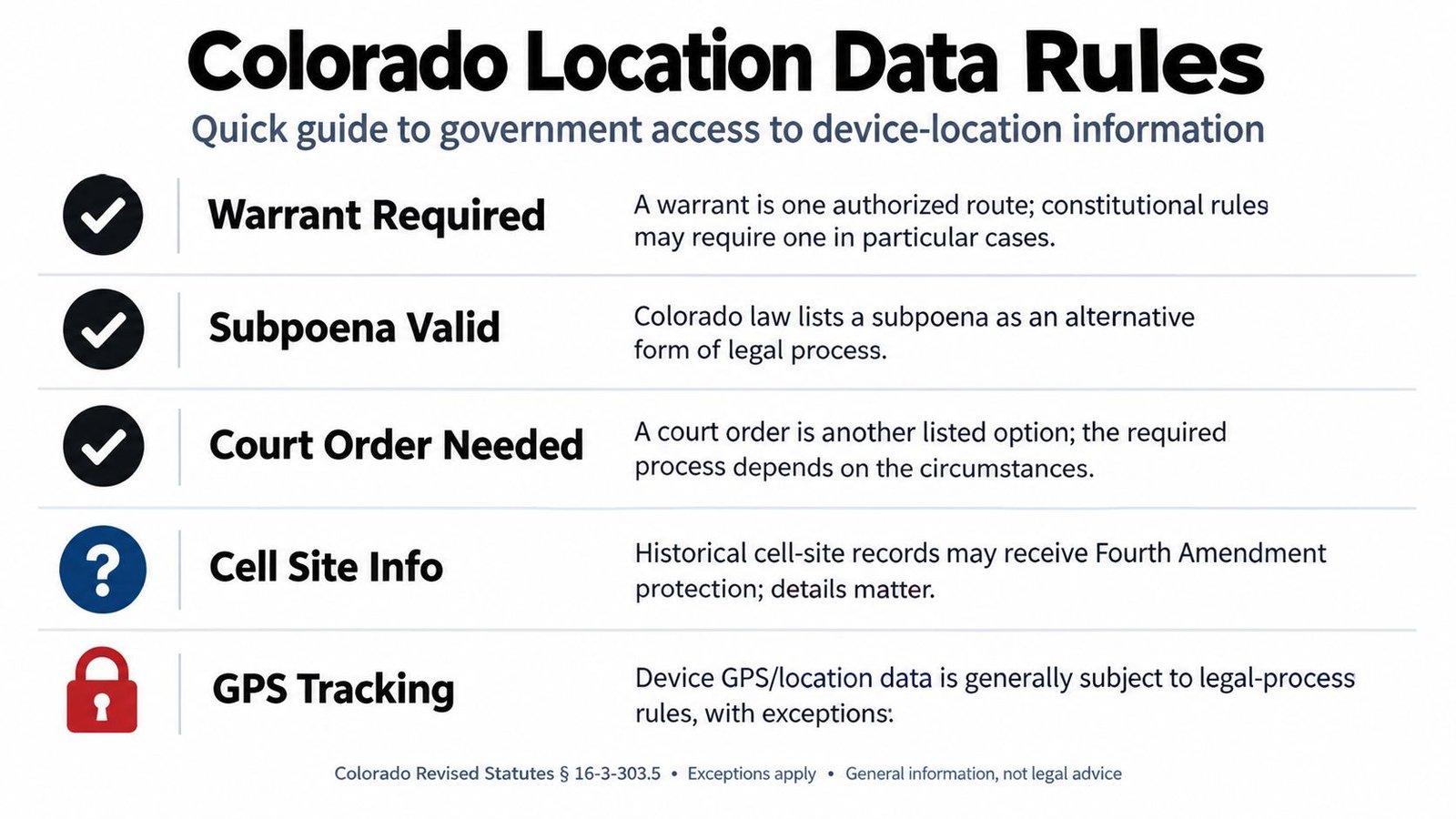
Colorado law adds an important wrinkle that families miss all the time. The state generally requires a warrant, subpoena, or court order before a government entity obtains electronic-device location information, and evidence derived from that information may be inadmissible unless the required documents are disclosed to the opposing party (Colorado statute summary). That means a warrant to seize a phone is not the same thing as authorization to gather location history from it or from a provider.
Colorado also permits electronic transmission of warrant applications, affidavits, oaths, and signatures, which can speed up judicial review. That efficiency helps in urgent investigations, but it also makes the supporting paperwork even more important because the scope has to be clear enough for a judge to review quickly and accurately.
Questions families should ask in Colorado cases
- What was requested? Ask whether police sought a device search, location data, or both.
- What document authorized it? Look for a warrant, subpoena, or court order.
- What time period was covered? Location requests should not be treated as unlimited in time.
- Was the data tied to a device, account, or place? The target matters as much as the label.
- Was the disclosure complete? Colorado law makes disclosure relevant to admissibility in some circumstances.
If the paper says “search warrant,” that doesn't automatically answer whether location records were also authorized.
That distinction becomes even more important in geofence cases, because reverse searches can sweep in people who were nearby at the time. Colorado's framework makes the practical question unavoidable: what exactly did investigators ask for, and what did the judge approve?
A privacy and confidentiality resource like protecting privileged client matters can also help readers think about why careful handling of sensitive information matters once records are in play.
A Practical Checklist for Families and Defendants
When a warrant shows up in a Colorado case, the fastest way to get oriented is to stop focusing on the label alone and start asking precise questions. Was it a warrant for a home, a person, a vehicle, a phone, or location data? Did officers stay inside the listed place, or did they reach into something broader, like cloud records or app data? Those details often matter more than the headline.
The paperwork should tell you what device, account, address, or person is named. It should also tell you whether the search involved electronic data, whether a date range was built into the request, and whether the government used a warrant, subpoena, or court order. If the case involves a phone or location records, ask whether the search was limited by protocol or whether officers could examine everything.
A short checklist to keep handy
- Identify the warrant type. Premises, digital, geofence, anticipatory, person, or vehicle.
- Read the target carefully. Look for the exact address, device, account, or name.
- Check for location data. Historical cell-site, app location, and geofence requests need special attention.
- Look for limits. Date ranges, categories of data, and search protocols should be visible.
- Ask about disclosure. In Colorado, the way location information was obtained can affect admissibility.
Families also tend to learn about the warrant during the same stressful window when arrest, booking, and release decisions are happening. That's when a clear path to bail support can matter just as much as understanding the search itself, because the practical problem is often immediate freedom, not just later courtroom strategy.

If you're dealing with an arrest in Colorado, Express Bail Bonds can help you move from confusion to action with fast statewide support, clear guidance, and a process built for urgent situations. Visit Express Bail Bonds for help, or go directly to the Jefferson County Golden page or the Centennial page if that's where you need support right now.