A process server knocks at your Colorado home while your family is preparing dinner. Your spouse answers, signs for an envelope, and brings it inside. The first page shows a court name and case number. Beneath it, a complaint or petition explains what someone is asking the court to do, while a summons tells you how and when to respond.
Shock is normal. So are confusion and urgency. But court papers served at your home don't automatically mean anyone has been arrested, and they don't determine whether someone is released from jail. Service, response, arrest, and bail are related parts of the legal system, but each involves different documents, deadlines, and professionals.
This guide explains what formal service means, how Colorado delivery and proof-of-service procedures work, and what to do after papers arrive. It also separates three issues families often mix together: being notified isn't the same as being arrested, responding isn't the same as resolving a case, and posting bail is separate from answering a lawsuit.
When Court Papers Reach Your Door
The envelope may look ordinary, but its contents deserve immediate attention. In a realistic Denver delivery, a process server hands papers to the person who answers, or leaves them through a legally permitted method. A spouse might sign for a summons even though the spouse isn't the named defendant. Whether that delivery is legally effective depends on the governing rule and the facts recorded in the proof of service, not only on who held the envelope.
Inside, look for the front-page caption, which identifies the parties and court; the court address; and the case number, which the clerk uses to locate the matter. You may also find a summons listing a first court date or a deadline for filing a response. The remaining pages could include a complaint, petition, subpoena, protection order, or another document that changes what action is required.
First response: Keep every page together, note how and when the papers arrived, and don't throw away the envelope.
Service creates notice of a legal proceeding. It doesn't itself place someone in custody. If the papers concern a civil lawsuit, the immediate issue may be an answer deadline. If someone has separately been arrested, the jail's booking and release documents address custody and bond, while the criminal summons or charging papers address the court case.
A person can therefore face two parallel concerns. They may need a Colorado attorney to evaluate the lawsuit or criminal case, and a licensed bonding professional may need to address release if a judge has set bond. For families dealing with a possible surrender or court appearance, planning before turning yourself in is a separate conversation from deciding how to answer served papers.
Understanding Service of Process
Service of process is the formal, court-approved delivery of documents that tells a person a legal case has started. The recipient generally receives their own copy of the papers, and the person who delivers them must create proof that the delivery occurred. Colorado guidance explains that papers must be delivered in the correct way, each adult or organization named in a case must be served separately, and an affidavit of service must be filed afterward (Colorado guidance on delivering legal papers).
The rule protects notice. A court shouldn't impose a binding order or enter a default judgment against someone who wasn't properly notified under the applicable procedure. Think of service as the court's receipt confirmation for a legal package. The complaint describes the dispute, but service gives the court a documented basis to treat the recipient as someone who had an opportunity to respond.
Who receives the papers
The named defendant usually receives service in a civil case. A minor or protected person may require service on a legally recognized representative, such as a guardian ad litem when applicable. A business may be served through its registered agent or another person authorized under the governing rule.
The document itself helps identify the legal track:
- Summons and complaint: A lawsuit has started, and the defendant must determine how to answer.
- Petition: Someone is asking the court to begin or change a proceeding, often in a family or protection-related matter.
- Subpoena: The recipient may be required to provide testimony, records, or both.
- Protection order: The papers may impose immediate restrictions or set a hearing.
- Criminal summons: The document may require an appearance, but it isn't automatically an arrest warrant.
Civil matters generally follow the Colorado Rules of Civil Procedure, while criminal matters follow corresponding criminal procedure rules. A person who receives papers should identify the document first, because the required response depends on what was served and which court issued it.
If you want to understand how an arrest-related court order differs from other legal documents, review this plain-language explanation of what a bench warrant means. The delivery method is the next critical question.
Common Ways Papers Are Served
Colorado service isn't one universal handoff. The acceptable method depends on the document, the parties, and the rule that governs the case. Courts focus on whether the chosen procedure was legally authorized and reasonably calculated to give the correct person actual notice.
Comparing the main methods
Personal service usually means a process server or sheriff hands the documents directly to the named individual. It creates a clear delivery event, but the server still needs to record identifying details and file the required return.
Substituted service can involve leaving papers with a responsible adult at the defendant's home or workplace, followed by a mailed copy. The exact conditions matter. A court may require additional steps to protect due process, so an informal handoff to a roommate or coworker isn't automatically enough.
Certified mail with a return receipt creates a mailing record. This method is used in some civil and small-claims matters, but the sender must follow the applicable rule regarding the address, documents, and receipt.
Service by publication is generally reserved for situations where the defendant's location can't be found after a diligent search. Publication isn't a convenient substitute for personal delivery. Courts may require proof of the search and additional notice procedures.
| Method | Who Delivers | Where Delivery Happens | Key Requirement |
|---|---|---|---|
| Personal service | Process server or sheriff | Directly to the named person | Authorized delivery and documented return |
| Substituted service | Authorized server | Home or workplace through a responsible adult | Required follow-up steps must be completed |
| Certified mail | Clerk, party, or authorized sender | Legally permitted mailing address | Receipt and mailing records must satisfy the rule |
| Publication | Authorized publication outlet | Public notice through an approved publication | Diligent search and court-approved procedure |
The method shown on the proof-of-service form matters because that's what the court evaluates. Pennsylvania rules, for example, illustrate how jurisdiction-specific procedures can differ, allowing certain non-original papers to be delivered by hand, mailed, or left at an attorney's address (Pennsylvania service rules). Colorado parties shouldn't assume another state's process applies.
A separate issue is whether someone has an active warrant. That question calls for a reliable records check, not a conclusion based on a delivered envelope. Families can review guidance on checking whether someone has a warrant while seeking legal advice.
How Proof of Service Works
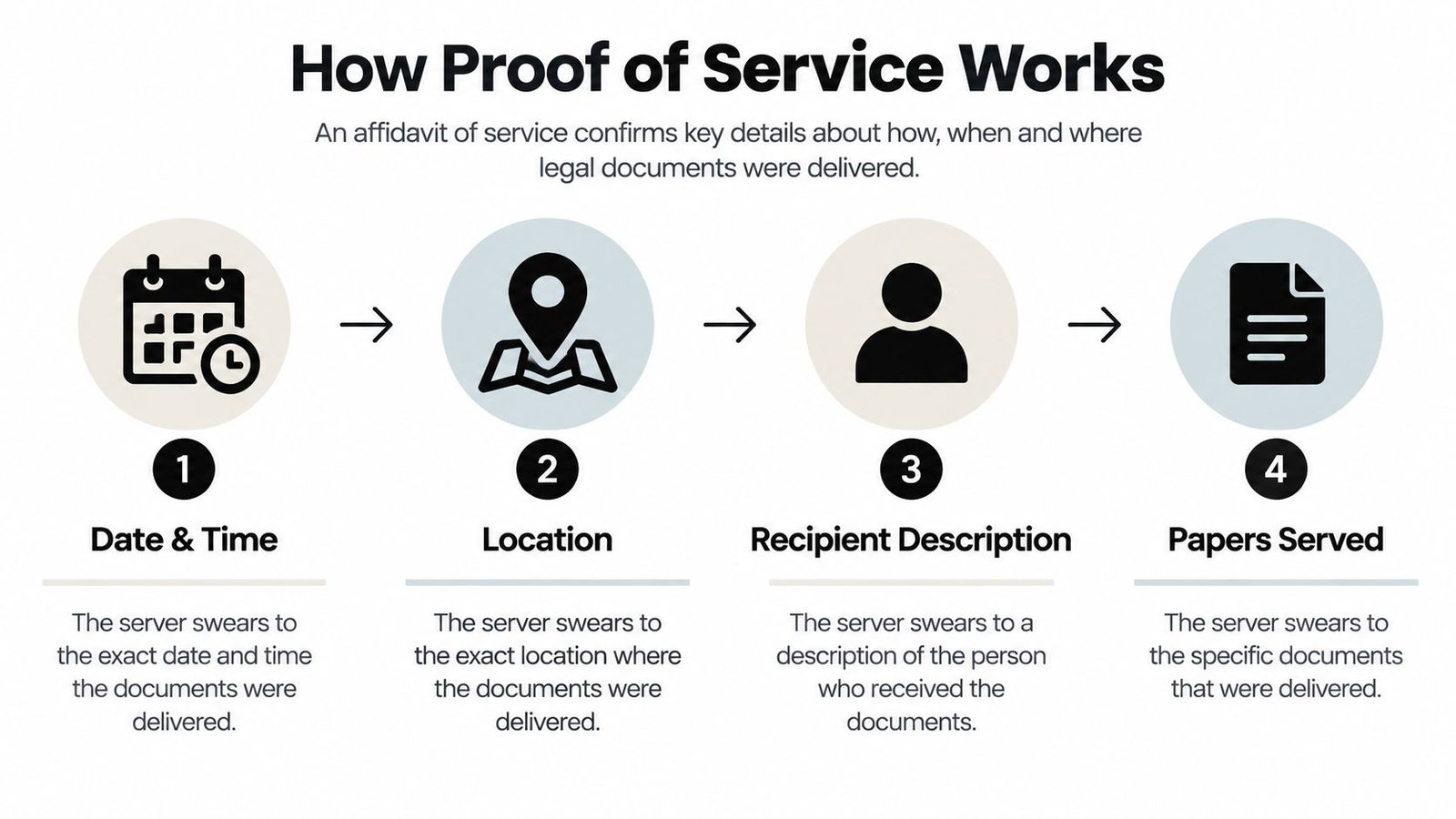
The papers in your hands tell you what the case is about. The proof of service tells the court what happened when those papers were delivered. An affidavit of service or return typically records the date, time, location, documents delivered, and facts showing how the recipient was identified.
For personal or substituted service, the server signs the affidavit and swears that the described events occurred. Depending on the filing procedure, the signature may need notarization. Mail service uses a different record, usually a certificate of mailing and certified-mail return receipt, showing where the documents went and what happened to the delivery.
The record is separate from the complaint
The proof document is filed with the court separately from the complaint, petition, or summons. The recipient's choice to read the papers, answer them, ignore them, or refuse to sign doesn't rewrite the server's record. Signing may acknowledge receipt, but it generally isn't an admission that the allegations are true or that the recipient agrees with the case.
Colorado's procedure includes requirements for filing the return, including under Colorado Rule of Civil Procedure 4(j). If the proof is incomplete or defective, a party may challenge service or the court may require correction. Whether a defect invalidates service depends on the rule and facts, so a licensed Colorado attorney should review the filed return rather than relying on appearances.
The same discipline helps in other discovery-heavy matters. Someone dealing with a personal injury lawsuit may benefit from understanding the broader personal injury discovery process, because service is only the notice event, while later requests for information create different obligations.
A filed proof of service acts as the procedural gateway for the case. It gives the court a record supporting notice, but it doesn't decide whether the claim is valid or whether the defendant will win.
If a person fails to appear after receiving a required notice, the consequences can be serious. Families can review what happens after missing court while contacting counsel promptly.
Deadlines and Legal Consequences
Service often starts a response clock. The exact deadline depends on the document, the court, the delivery method, and the applicable rule. In a Colorado civil case, a defendant generally has 21 days to file an answer after personal service under Colorado Rule of Civil Procedure 12(a), with adjustments possible for out-of-state delivery and additional time in some publication or mail situations. Confirm the date with the summons and a Colorado attorney, because the calculation can depend on details that aren't obvious from the envelope.
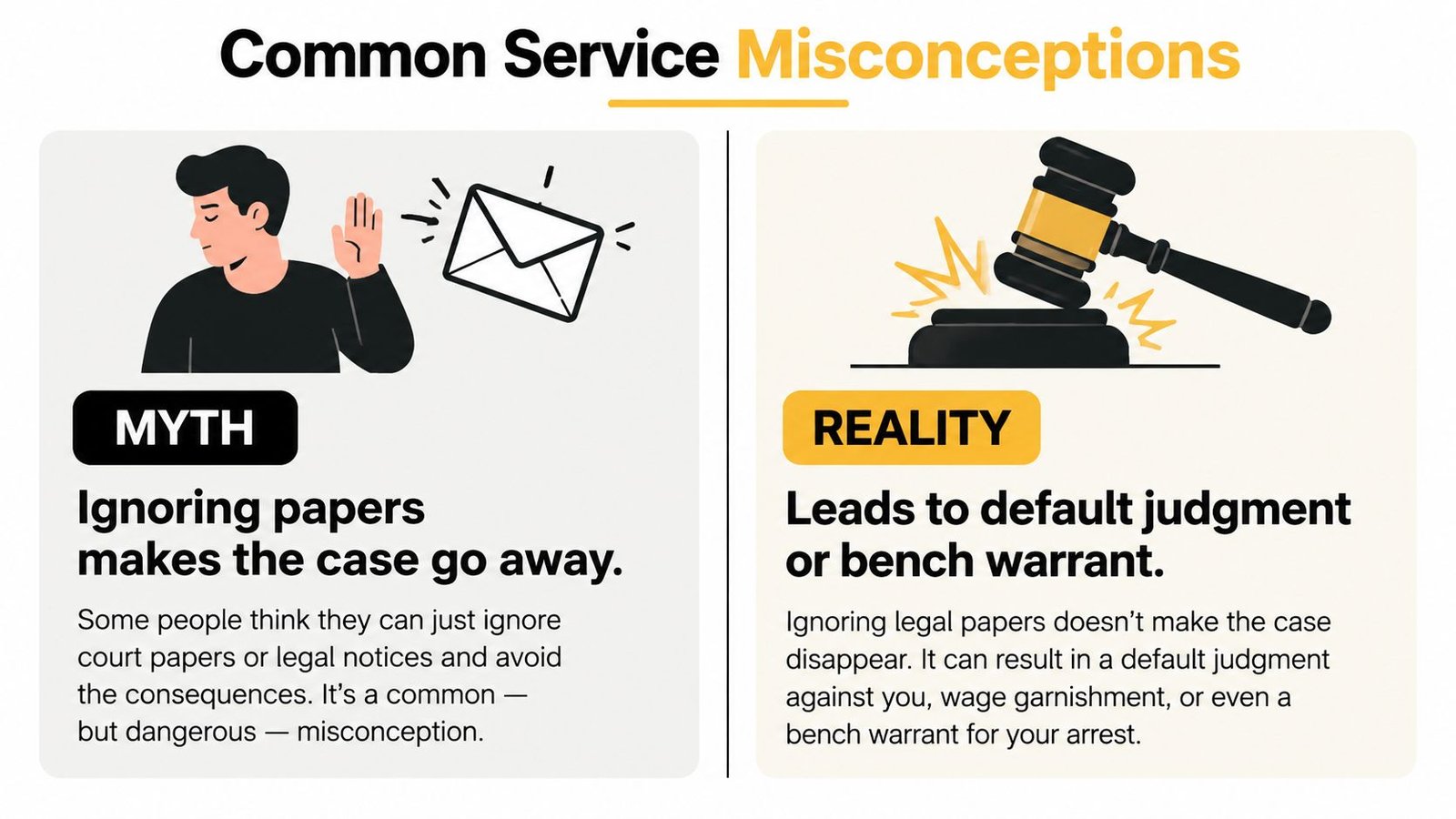
A missed civil deadline can allow the other side to seek a clerk's entry of default or a default judgment. It can also affect the ability to raise certain defenses. Ignoring papers doesn't pause the case, and a person who believes service was defective should raise that issue through the proper court process rather than remaining silent.
| Service Method | Typical Deadline to Respond | Key Consequence if Missed |
|---|---|---|
| Personal service | Often 21 days in a Colorado civil case under CRCP 12(a) | Default-related action may become available |
| Out-of-state delivery | May receive an adjustment under the applicable rule | A response can still be due without a personal reminder |
| Mail service | May include additional time under the governing procedure | Failure to respond can affect defenses or default risk |
| Publication | May carry additional court-ordered time | The case may continue after the publication period |
Civil service and criminal custody are different
A civil summons and complaint don't themselves arrest the recipient or set bail. In a criminal matter, an arrest warrant, booking paperwork, release conditions, and a criminal summons perform different functions. The appearance or arraignment date on a criminal summons controls attendance, while custody and bond questions arise through the criminal court and jail process.
Federal civil cases demonstrate why timing is foundational. Under the Federal Rules of Civil Procedure, a defendant usually must be served within 90 days after the complaint is filed (Federal Rule of Civil Procedure 4). A federal summons must be served with the complaint, and the plaintiff must supply the necessary copies to the person serving them. These are procedural requirements, not optional administrative preferences.
A person who fails to appear for a criminal proceeding may face a bench warrant. A bond amount is set through the criminal court process, such as booking or a first appearance, not by a process server handing over civil papers. Questions about response deadlines belong with a Colorado attorney, while release questions belong with a licensed bonding professional.
Common Service Misconceptions
A served envelope creates uncertainty, and uncertainty often produces bad assumptions. The most dangerous is the belief that ignoring papers makes the case disappear. A civil court may proceed toward default, and a criminal court may respond to nonappearance with a bench warrant when the required appearance is missed.
What the delivery does and doesn't mean
A text message, email, or social-media message isn't automatically valid service. Some courts can authorize alternative methods in particular circumstances, but a casual message or envelope tossed near a door doesn't automatically satisfy Colorado procedure. The court looks for an approved method and documented proof.
A summons isn't an arrest warrant. A summons usually gives notice of a case or requires an appearance. A warrant is a judicial order with different legal consequences, including possible arrest for probable cause or failure to appear. The process server doesn't create a warrant by delivering civil papers.
Refusing to sign usually doesn't end the event. A server may be able to complete service without the recipient's signature if the governing rule permits the method. Signing generally confirms receipt, not agreement with the allegations.
Talking to the server doesn't resolve the lawsuit. A process server delivers documents. They aren't the person who decides the case, changes a court date, or accepts an answer on the judge's behalf.
Arrest and booking paperwork controls the immediate release track. Service of process controls notice and, often, the response track. If the papers appear invalid, address the concern quickly with a licensed Colorado attorney. Don't treat uncertainty as permission to do nothing.
What to Do After Service in Colorado
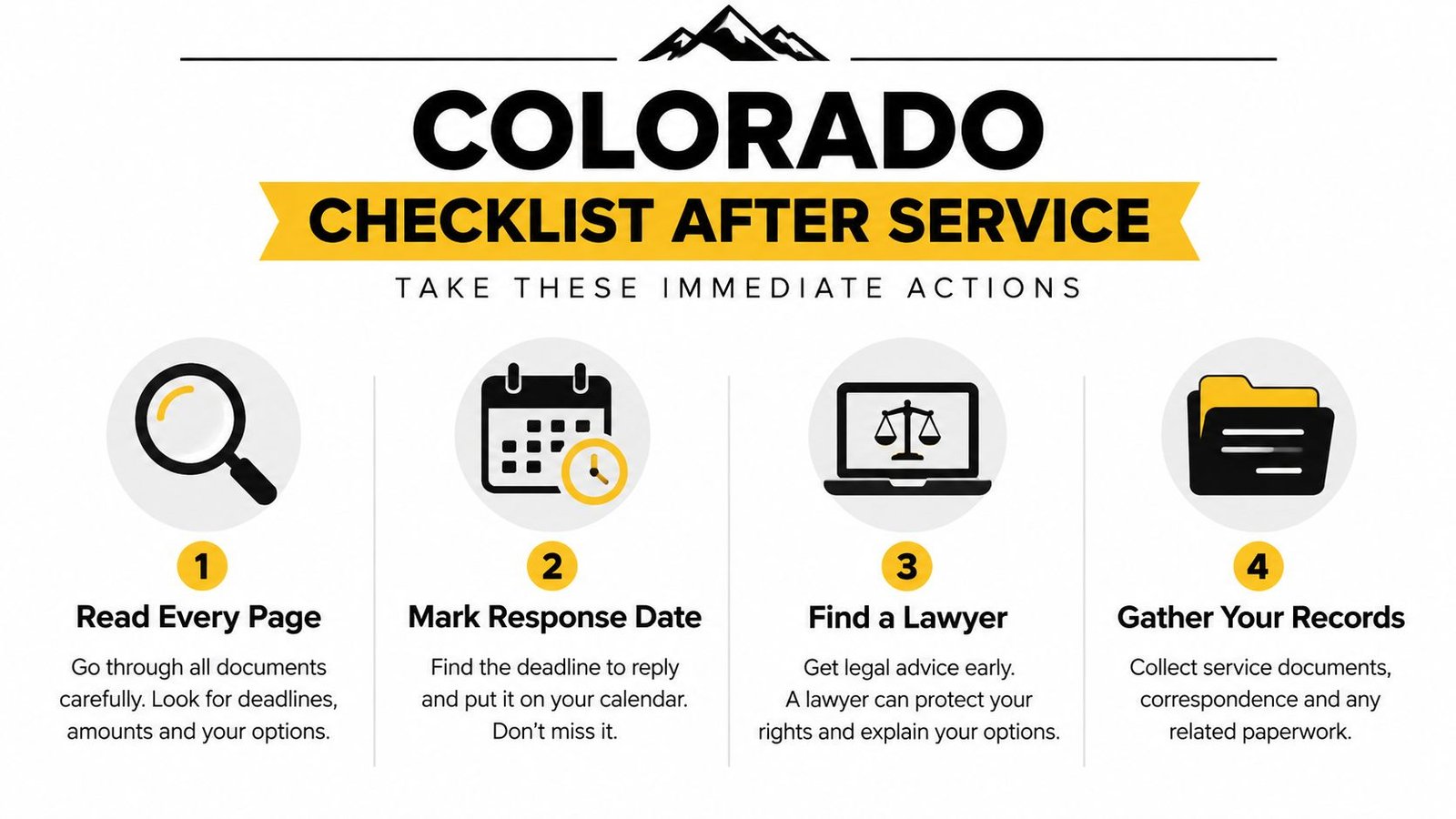
Start with the packet, not the story surrounding it. Read every page, including attachments and instructions that seem routine. Mark the response date or appearance date shown on the summons, identify the issuing court, and write down the case number where you can find it quickly.
Don't sign or return anything you haven't read. Preserve the originals, keep the envelope, and make a complete copy or scan for your attorney. Note who received the papers, where the delivery occurred, and when it happened. Those details can help counsel evaluate the proof of service.
A practical first-days checklist
- Read every page: Separate the summons, complaint, petition, subpoena, and attachments so you know what was served.
- Calendar the deadline: Record the response or appearance date and set reminders before it arrives.
- Call a licensed Colorado attorney: Ask counsel to evaluate service, deadlines, defenses, and the appropriate filing.
- Gather records: Collect contracts, messages, notices, medical records, financial documents, or other materials connected to the case.
- Contact the court for procedure: Colorado Judicial Branch self-help centers, the local clerk's office, and county law libraries may help you locate forms and procedural information. Court staff can explain filing mechanics, but they can't represent you or give legal advice.
Keep two tracks separate. A complaint or petition may require a legal response. Release paperwork, by contrast, concerns custody conditions and bond, and it doesn't replace an answer or motion. If an arrest is involved, the person or family should address release with the appropriate bonding professional after confirming the court's requirements.
Taking the Next Legal Step
The safest sequence is short: read the papers, calendar the deadline, consult a Colorado attorney, and respond before the required date. Organized action gives counsel time to check whether service was proper, identify the correct filing, and protect against default or an avoidable failure to appear.
Don't ask a bail agent to interpret allegations, prepare pleadings, negotiate a plea, or decide whether a motion should be filed. Those tasks belong to legal counsel. Release questions follow a different track, including whether a bond has been set, what conditions apply, and what paperwork the jail will accept.
For practical preparation before appearing, use this guide to prepare for a court hearing. If release is the immediate issue, Express Bail Bonds provides Colorado surety-bond support, including electronic applications, payments, and contract documents, with coordination for posting at detention facilities. That service doesn't replace an attorney's advice about the case itself.
Quick, informed steps protect both your legal rights and your freedom. Treat court papers served as a deadline signal, then get the right professional involved for each part of the process.
If someone needs release assistance after an arrest, visit Express Bail Bonds to review the surety-bond process and contact the agency for help with bond paperwork. Families in Jefferson County can also find local information through Jefferson County and Golden bail bond services, while those in Arapahoe County can use the Centennial bail bonds resource.