
At 2 a.m., a sister is pacing her kitchen after a bondsman tells her that her brother is being released from jail on OR. She understands that he may not need a cash bond, but she still doesn't know whether he can leave now, whether she owes money, or what he has to do next. The word “released” sounds final, yet the criminal case is still active.
OR means own recognizance. In plain English, the court lets a defendant leave without posting money because the defendant signs a written promise to appear for every required court date and follow every release condition. OR changes where the person waits for court. It doesn't erase the charge, end the case, or guarantee that the jail door will open immediately.
The difference between an OR order and an actual walk-out causes many of the calls families make. The judge may grant release, while the jail still has to receive the order, check records, return property, verify identity, and clear any other hold. Those steps can take time, especially outside ordinary staffing hours.
The Moment You Hear Released on OR
The first question is usually financial: “Do we still need a bondsman?” If the court has ordered release on own recognizance and no separate bond or hold remains, the defendant generally doesn't need a surety bond for that release. No premium is posted to satisfy an OR order.
The second question is more important: “What does my brother have to do?” He must appear in court, follow the written conditions, keep his contact information current, and comply with any supervision or treatment requirements. A missed appearance can lead to a warrant and a new detention decision.
Practical rule: Treat the OR paperwork as a set of binding instructions, not as a free pass.
The phrase “released from jail on OR” describes the release method, not the outcome of the criminal case. A person can leave the facility on OR and still face arraignment, hearings, negotiations, trial, sentencing, or dismissal later. The court is allowing the person to remain in the community while the case continues.
That distinction matters because jail release is a large and recurring movement through the justice system. Local jails released an estimated 7,215,958 people in 2022, compared with 10,203,728 in 2019, a decline of about 29%, according to Prison Policy Initiative's analysis of jail releases. The same analysis describes local jails as the main short-stay setting for people awaiting trial or serving short sentences.
A judge's OR decision may happen quickly, but the physical release follows a separate administrative path. Families should ask two different questions: Has the judge ordered OR? And Has the jail completed its release processing? Those answers may not arrive at the same time.
What OR Release Actually Means
A judge says, “Release on your own recognizance,” and a family member may assume the jail door will open immediately. In Colorado, those are two separate events. Own recognizance release means the defendant signs a promise to return to court and follow the written release conditions. The court allows community release without requiring a cash deposit or commercial bond premium.
The judge may review the defendant's address, community ties, employment, prior court attendance, outstanding warrants, and the seriousness of the charge. A working parent with a stable home and a history of appearing in court might receive OR release. The signed promise becomes the foundation of the release decision.
A personal recognizance bond is closely related. An unsecured bond works differently: the court sets a dollar amount, but the defendant does not pay it upfront. If the defendant fails to appear, the court may pursue that amount under the bond terms.
A cash bond requires money to be posted through the approved process, often by the defendant or a family member. A surety bond uses a licensed bonding company when the court requires a financial guarantee that the family cannot or does not want to post directly.
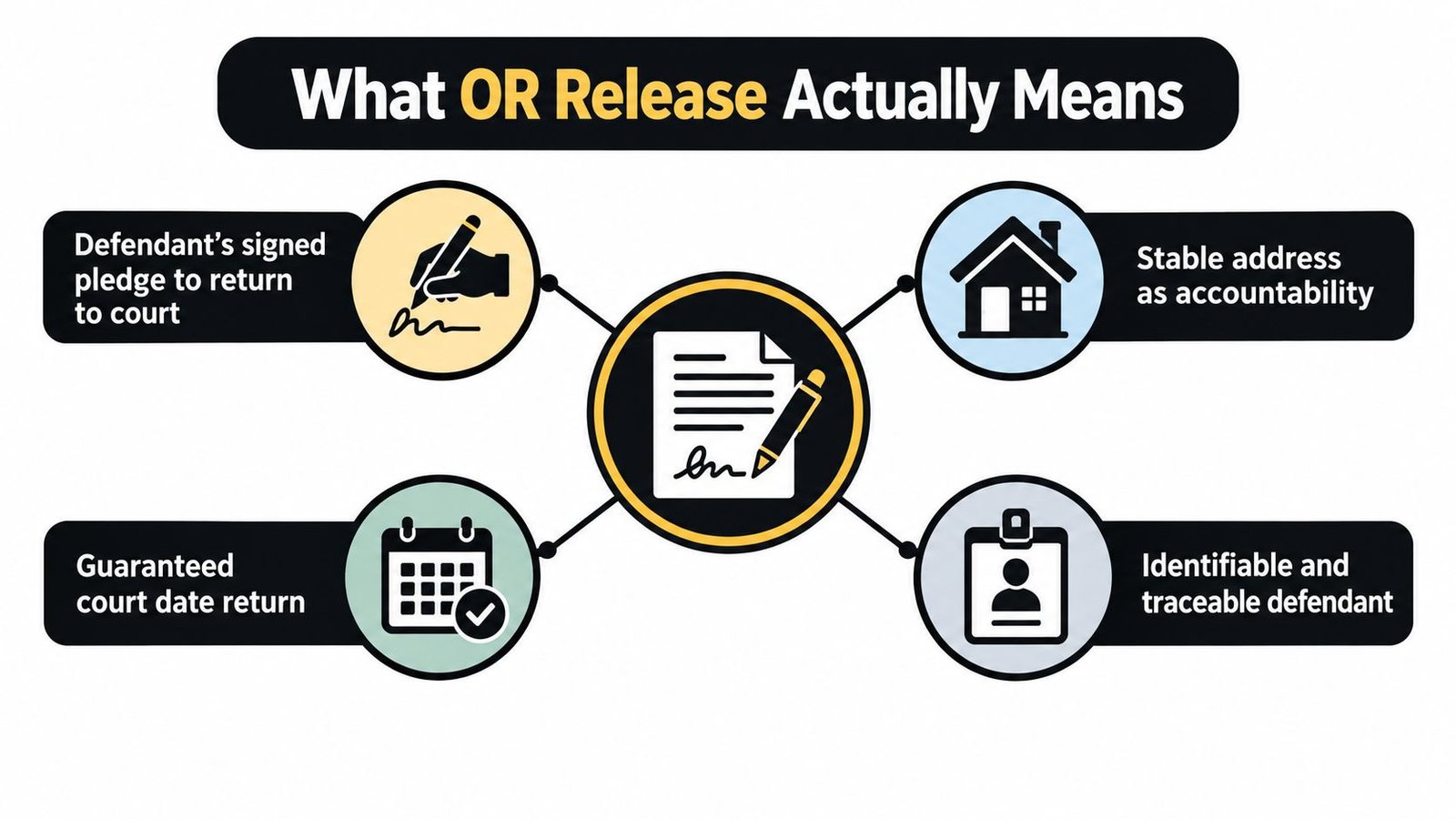
The practical dividing line is financial exposure. OR places the main responsibility on the defendant's promise and compliance. A secured arrangement adds money or collateral, creating another layer of accountability.
Families wanting a plain-language explanation can review the Cherokee Bail Bonds recognizance process and Colorado information about release on own recognizance.
Federal data shows that release without financial conditions is a common federal practice. In fiscal years 2011 through 2018, 32% of defendants whose cases were disposed were released before trial, and 76% of those released had no financial conditions, according to the Bureau of Justice Statistics report on federal pretrial release. The report also found that 22% were released at their initial appearance and another 10% at a later hearing.
OR may avoid a premium or cash deposit, but it is still a binding court arrangement. Before leaving, the defendant needs to understand the order, including court dates, prohibited contact, testing, travel limits, and check-in instructions.
How OR Release Compares to Surety Bonds
OR and a surety bond solve the same immediate problem, keeping a defendant out of jail while the case proceeds, but they place responsibility in different hands. OR relies primarily on the defendant's promise. A surety bond adds a financial guarantor and a contract with a licensed bondsman.
Cost and financial exposure
OR generally has no upfront bond premium. The defendant may still have court-ordered obligations, such as monitoring or program requirements, but the release itself doesn't require a commercial bond payment.
A surety bond normally involves a premium paid to the bondsman and may require collateral or an approved cosigner. In Colorado, state law caps a commercial bail bond premium at the greater of $50 or 15% of the bail amount, and restricts unrelated additional bond fees except for narrow categories such as court filing fees, collateral storage, or premium financing. Families should ask for the written financial terms before signing.
Risk and accountability
With OR, the defendant personally faces the consequences of missing court or violating conditions. The court may issue a warrant, rescind OR, and impose a secured bond or detention.
With a surety bond, the bonding company guarantees the bond under its agreement with the court. The defendant and cosigner still remain responsible for court compliance, and the contract may permit the bondsman to demand surrender if the defendant stops cooperating or violates the agreement.
Conditions and daily obligations
Both release types can include appearance requirements, no-contact orders, travel restrictions, testing, treatment, or pretrial supervision. OR doesn't mean “no rules.” It means the court chose a nonfinancial release structure.
Surety arrangements can add practical communication duties, such as answering monitoring calls and keeping the bondsman informed about address or court changes. Those duties arise from the bond contract, while court conditions arise from the judge's order.
| Factor | OR Release | Surety Bond |
|---|---|---|
| Upfront release cost | Usually no bond payment | Premium and possible collateral or cosigner |
| Main guarantee | Defendant's signed promise | Bonding company guarantee |
| Financial exposure | Defendant may face financial consequences after nonappearance | Defendant and cosigner remain bound by the contract |
| Monitoring | Court or pretrial services may supervise | Court supervision plus possible bondsman contact |
| Best fit | Defendant with reliable ties and manageable risk | Case requiring a secured financial guarantee |
Lower-risk, first-time nonviolent defendants with strong local ties may receive OR. A higher bond, weak ties to the area, a prior failure to appear, or an unresolved hold may make a surety bond more realistic. These aren't competing products so much as different rungs on the same pretrial-release ladder.
Who Qualifies for Release on Recognizance
A magistrate doesn't decide OR based on one favorable fact. The court weighs whether the defendant is likely to return, whether release can protect specific people, and whether the proposed conditions address the risks presented by the case.
Community connection
A local home, family responsibilities, steady work, and a reachable phone number can help show that the defendant has reasons to remain available. A first-time misdemeanor defendant who lives with family, works locally, and has no warrants presents a different picture from someone who has no confirmed residence.
The court may also examine whether the person can receive notices and report to pretrial services. A stable address isn't a guarantee, but it gives the court a practical way to communicate and supervise.
Charge and history
The nature of the accusation matters. A minor allegation may support OR in one case, while violence, alleged threats, weapons, domestic violence, or serious felony allegations may lead to stricter conditions or detention.
A prior failure to appear can weigh heavily. So can an active warrant, pending case, or cases in multiple counties. A defendant charged in several jurisdictions may face separate holds even if one judge is willing to grant OR.
Safety and flight concerns
The judge may consider danger to an alleged victim, witnesses, household members, or the public. Domestic violence allegations can produce no-contact conditions or a financial bond even when the defendant has a job and family nearby. Alleged gang affiliation, immigration-related concerns, or other facts affecting flight or safety can independently change the decision.
Colorado families can use a plain-language guide to what is release on recognizance while remembering that only the court's order controls the individual case. A related explanation of pretrial risk assessment can help families understand why a judge asks questions that seem unrelated to the ability to pay.
Consider two defendants. The first has a single misdemeanor charge, a verified local address, a steady employer, and no missed court dates. The second has an active warrant, a pending case in another county, and an allegation involving a protected victim. The first may receive OR with conditions. The second may require a secured bond or remain detained while the court resolves the hold and safety issues.
Eligibility is never a promise. The judge can impose conditions, request more information, or change the release decision when new facts appear.
What Happens Between the Order and the Door
A judge's OR ruling starts the release process. It doesn't finish it. The jail must receive an authenticated order, match it to the correct inmate, confirm that no other legal reason requires continued detention, and complete its own out-processing.
The usual sequence looks like this:
- The judge grants OR. The court records the decision and lists conditions, such as reporting, no contact, testing, or a travel restriction.
- The clerk sends the paperwork. Jail staff can't release someone based only on a family member's report or a verbal courtroom announcement.
- Release staff verify the record. They check identity, booking information, fingerprints, charges, warrants, detainers, and other holds.
- Staff complete discharge tasks. The facility closes files, returns personal property, collects facility-issued items, and records the release transaction.
- The defendant receives instructions and leaves. Pretrial services may receive notice, and the defendant may need to confirm an address, phone number, or reporting requirement.
Correctional standards describe formal out-processing that includes identity verification, file closure, fingerprinting, property return, recovery of facility-issued clothing or bedding, and wants-and-warrants checks. The ICE admission and release standard provides a detailed example of why an order and a walk-out aren't the same event.
Some facilities publish service targets. One sheriff's policy requires releases within four hours after receiving documentation, while another jail procedure allows up to eight hours after bond payment. A Colorado example is Weld County, which says a sheriff must release a defendant within six hours after notice that a cash or personal recognizance bond is ready, absent extraordinary circumstances, according to Arapahoe County bond information and related Colorado jail guidance.
Watch this overview while planning transportation and pickup:
Timing varies widely. Some facilities complete release in a few hours, while others take 12 to 24 hours or longer, depending on staffing, missing paperwork, holds, and workflow, as explained in this guide to delays after bond is posted. Families who need to understand the difference between a posted release and an actual discharge can also review posted bail but not released.
Two Real-World Release Scenarios
The fastest way to understand OR is to follow two people through the same checkpoints. These examples are illustrative. The exact result depends on the court, the charge, the record, the jail, and the written order.
| Step in Process | Scenario A: First-Time DUI | Scenario B: Repeat DV Charge |
|---|---|---|
| Bond hearing | Judge considers OR with conditions | Judge reviews safety concerns and prior history |
| Jail processing | Staff enter the order and verify no holds | Release is paused while new information is reviewed |
| Conditions | Court date, no alcohol use, possible monitoring | No-contact order, supervision, or secured release |
| Physical outcome | Defendant leaves after processing | OR is withdrawn or replaced before the walk-out |
| Family response | Arrange transportation and preserve paperwork | Contact counsel and prepare for a new bond decision |
Scenario A
A 28-year-old defendant appears for a morning hearing on a first DUI charge. The defendant has a verified Colorado address, answers the judge's questions clearly, and has no known warrant or prior failure to appear. The judge grants OR with conditions that include attending court and avoiding alcohol monitoring violations.
The jail still has to receive the order, enter it, verify identity and holds, return property, and provide release instructions. Once those tasks finish, the defendant leaves with the court date and conditions in hand. A family member picks the person up later that day, but the case itself remains open.
The important point isn't the hour of departure. It's that the court's decision and the facility's workflow are separate checkpoints.
Scenario B
A defendant facing a repeat domestic violence charge receives preliminary consideration for OR. Before the release process finishes, the alleged victim communicates safety concerns to the prosecutor. The court reviews the new information and may revoke or modify the proposed release, impose no-contact terms, require a surety bond, or order continued detention under applicable law.
The family may believe the person is “already released” because someone mentioned OR in court. That assumption can lead to a missed pickup, unnecessary travel, or confusion with the jail. Until the facility confirms that the final order is active and no hold remains, the defendant hasn't completed release.
In the first scenario, compliance begins at the jail exit. In the second, the release decision changes before the exit. Families should keep the court, attorney, and jail informed rather than relying on an early verbal update.
Next Steps for Defendants and Families
OR release works best when everyone treats the order like a deadline-driven checklist. The defendant should read every condition before leaving and ask the court, attorney, or pretrial officer to explain anything unclear.
Start with these actions:
- Report promptly: Contact pretrial services within 24 hours if the order requires it. Keep proof of the call, visit, or online submission.
- Calendar every date: Put court appearances, check-ins, testing, treatment, and reporting deadlines into a phone calendar before the first evening passes.
- Protect contact information: Confirm the address and phone number listed with the court. Tell the attorney and pretrial officer before either changes.
- Keep documents together: Save the OR order, case number, judge's name, attorney's number, and pretrial officer's contact in one secure folder.
- Avoid discussing the case on jail phones: Calls may be recorded. Discuss logistics with family, but route legal strategy through counsel.
- Get help early if circumstances change: A missed check-in, unsafe housing situation, or inability to meet a condition should be reported immediately.
A family member should listen for the exact release terms rather than relying on “he's free now.” If OR becomes unworkable or the court orders a secured bond, a licensed Colorado bondsman can explain the surety process and the contract before anyone signs. Families can also review conditions of bond to understand why a violation can affect both the defendant and the release status.
Common Questions About OR Release
Does OR cost anything? Usually, an OR release has no commercial bond premium. The court can still order costs for monitoring, treatment, transportation, or program fees. Those expenses come from the release conditions, not from a surety bond.
Can the judge revoke OR later? Yes. A missed appearance, violation, new warrant, new safety information, or legal hold can cause the court to reconsider release. OR is a court decision that continues only while its conditions are followed.
Does OR appear on a background check? The arrest and case may appear in a background search. OR is not a conviction, and release status does not decide guilt or innocence. A Colorado attorney can explain court records, sealing, and employment disclosure for the specific case.
What happens after a missed court date? The court may issue a warrant, rescind OR, and require a new release decision. Contact counsel promptly instead of waiting for a notice. Families can read what happens if you miss court for a general explanation, while local legal advice applies to the case.
Can a family member post a bond after OR? Generally, yes, if the court later sets a secured bond or changes the release terms. A bondsman can explain the surety paperwork, but the jail must still verify the order, check for holds, and complete discharge procedures.
Why has the court approved OR, but the person is still in jail? The judge's order starts the release process. It does not open the cell door immediately. Colorado jail staff may need to receive and verify the order, confirm identity, check other holds, collect property, and provide discharge instructions. Staffing and local procedures affect the timing.
Jail stays can be brief, so families should confirm the final order and ask the facility whether any hold or condition remains. Federal figures discussed in the Bureau of Justice Statistics release report also show why release timing deserves attention.
If OR changes to a secured bond, Express Bail Bonds can explain the surety application and electronic contract process by phone or text at 720-984-2245. Families can review Jefferson County bail bond assistance or Centennial bail bonds.