
If the phone rings at 2 a.m., most families don't care about legal theory. They want to know whether their loved one is still in jail, whether release is possible before morning, and what the next court date means for everyone trying to hold the family together.
That's where merit release appearance matters. It's not just about paying money, and it's not just about hoping for the best. It's about whether the court believes this person can be released on the strength of an individualized decision and still show up when required. In Colorado, that decision turns on facts the judge can weigh, and on the difference between what a bail agent can do and what only the defendant can control.
When the Phone Rings at 2 A.M.
A mother gets the call. A son has been booked, the first appearance is set for the morning, and nobody in the house has ever dealt with jail, bond, or court before. The first instinct is usually to ask, “How much is it going to cost to get him out?”
That's a fair question, but it's not the whole question. The more useful one is this, will the court release him on a merit basis, and if not, what path does the case take? A family can line up paperwork, a ride, a co-signer, and a court reminder system, but the judge still has to decide whether release is safe and whether the person is likely to appear.
A bail agent can move fast once a bond is set. That's the part a company like Express Bail Bonds' fast action process is built around, getting paperwork, posting, and release processing moving without dragging the family through a long detention-center wait. But no agent can force a judge to grant release, and no agent can make a defendant remember a hearing they never wrote down correctly.
Practical rule: families do better when they stop asking only “Can we pay?” and start asking “What does the court need to see to release this person safely?”
That shift matters because merit release appearance is about performance after release, not just the moment of release itself. If the court believes the defendant's ties, history, and case facts support release, the family's job becomes simple and hard at the same time, keep the contact information right, keep the date right, and keep the next appearance from getting missed.
What Merit Release Appearance Actually Means
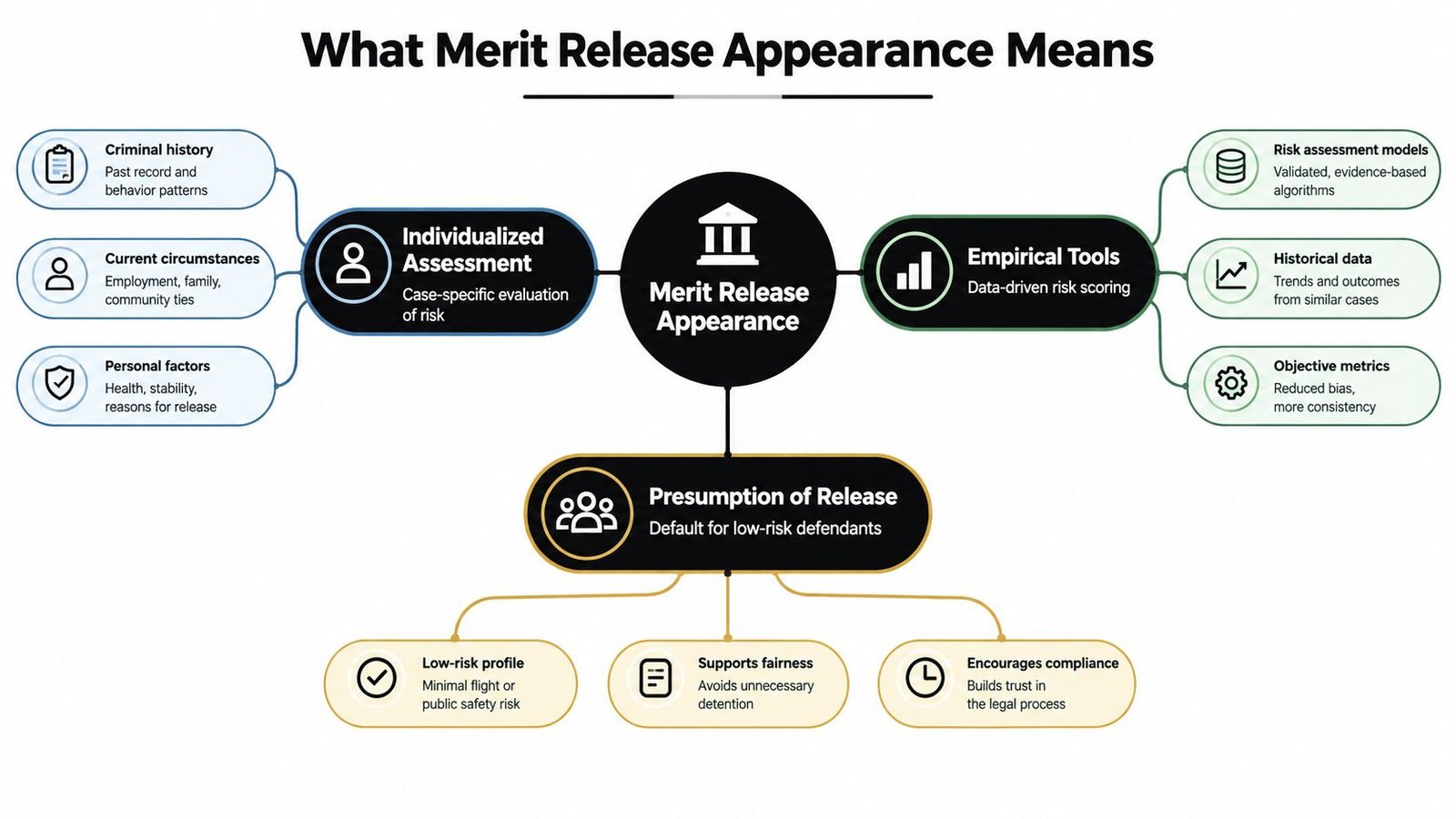
A merit release appearance is the court's early decision about whether a person can be released on conditions the judge believes will hold. The question is practical: can this defendant be managed outside jail, with a court date, clear conditions, and enough structure to reduce risk?
Colorado puts that choice at the first appearance. The court, or someone the court designates, must decide the bond type and release conditions unless an exception applies, and the order has to reasonably protect appearance in court and public safety (Colorado first-appearance statute). That is the courtroom decision families are really waiting for. A bondsman can prepare paperwork, explain options, and post a bond once the court sets one, but the judge still controls the release decision.
What the court relies on when it grants merit release
The court does not look only at the charge label. It looks at the pieces that show whether the person is likely to return, such as address stability, prior court history, family support, and ties to the community. Those facts work together like a set of rails. If the rails are solid, the release plan has a better chance of holding. If the rails are weak, the judge has more reason to require tighter conditions or keep the person detained.
Merit release also includes the legal shape of the bond itself. Colorado law says the bond must require appearance at the specified place and date, and later continuances or transfers stay part of that same obligation (Colorado bond appearance statute). So the date on the paper matters just as much as the release order.
That is where families often get confused. A release order can look permissive, but it still carries a duty to appear, and missing a setting can trigger new consequences. Express Bail Bonds' PR bond overview is a useful reference for separating personal recognizance from a secured bond, because both still depend on the defendant showing up.
The research supports that practical view. In the Colorado Pretrial Assessment Tool study, unsecured release showed a higher court-appearance rate than secured bonds, and larger bond amounts did not line up with better appearance results (Colorado Pretrial Assessment Tool study). That does not promise a result in any single case, but it does show why judges focus on more than money.
A bond protects the court date.
For a worried family, that is the point to hold onto. Merit release is the court deciding whether the person can safely leave jail under a structure it trusts, while a bond is one tool for backing that structure once the judge has made the call.
Who Qualifies for a Merit Release in Colorado
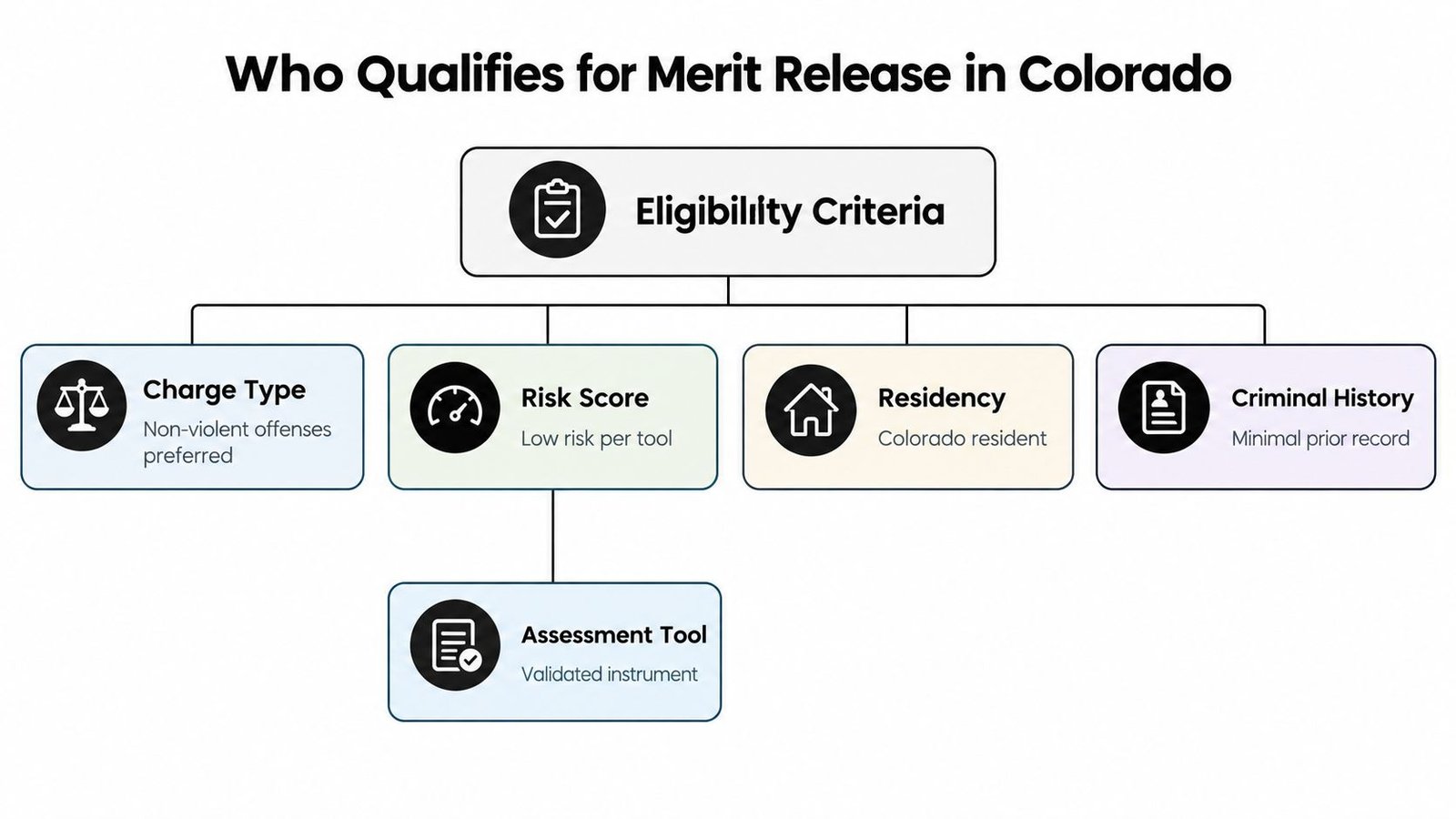
A judge is not looking at the charge alone. The court weighs the person in front of it, using an empirically developed risk-assessment tool when practicable, along with financial condition, employment history, family relationships, residence, prior criminal record, prior failures to appear, likely sentence, and community ties (per C.R.S. 16-4-103, cited above). That gap between legal eligibility and the judge's risk call is where release decisions are really made.
A person with steady work, a local address, family support, and a clean court history usually gives the court more reason to trust a release order. A person with weak ties, prior failures to appear, or no stable place to stay raises a different concern, because the court has to judge whether the next court date will be honored. Those facts do not decide the case by themselves, but they shape the outcome.
Colorado also allows the court to deny personal recognizance when the facts point the other way, including inadequate ties to the jurisdiction, a substantial likelihood of nonappearance, refusal to sign the recognizance, or a prior failure to appear (Colorado personal recognizance statute). The charge matters, but it is not the only thing in play. The family's willingness to help also has limits, because a bondsman can post a bond only after the court has decided what kind of release fits the risk.
What families should bring into the first appearance
A family helps most by bringing facts the court can verify. A current address, employment details, proof of local ties, past court dates, and a dependable phone number give counsel and pretrial services something concrete to present.
If you want a plain explanation of how that release track works, this Colorado PR bond guide is useful because it keeps the focus on the release conditions, not just the label on the bond.
Best evidence travels better than emotional testimony. A verified address, a job site, a childcare schedule, or a counseling appointment often carries more weight than a general promise to show up.
The practical point is simple. Eligibility is individualized. A defendant can look eligible on paper and still receive conditions, supervision, or a secured bond if the judge sees too much risk. Families do better when they treat the first appearance like a document-driven hearing, because that is how the court measures trust.
Inside the First Appearance in a Colorado Courtroom

A family often expects the bond question to wait, but it does not. Under C.R.S. 16-4-103, discussed earlier, the bond decision happens at the first appearance, and that is where the judge starts separating legal eligibility from actual courtroom risk. A charge can make release possible, yet the judge still has to decide whether the person before the court is likely to return, follow instructions, and make the next date.
What usually happens in the room
The hearing begins with the judge or magistrate stating the charges. The prosecutor may ask for conditions that match the perceived risk, while defense counsel can bring forward facts about home address, work, family ties, and prior court history. Pretrial services or the arresting agency may also provide information the court uses to form its release decision.
That decision can lead to release, supervised release, or a secured bond. If release is granted, the next court date is set then, and that date becomes the one the defendant must attend under the bond rules in Colorado (Colorado bond appearance statute). The hearing works like a checkpoint, not a final verdict on guilt. The court is deciding how much trust, structure, or financial backing the case needs at that moment.
For a broader view of first hearing procedure, first court appearance in Brampton offers a useful comparison. The jurisdiction is different, but the basic mechanics are familiar, the court identifies the case, sets the next step, and decides what conditions attach to release.
What to be ready to say and bring
- Accurate contact information: The court needs a working phone number and address.
- Employment and family details: These help show local connections.
- Release paperwork and IDs: Keep anything already provided to the jail together.
- A clear plan for the next hearing: Know who is driving, who is calling counsel, and who is checking the docket.
Families sometimes expect a bondsman to fix everything at this stage. A bondsman can post a bond only after the court sets the terms, so the family's real job is to help present reliable facts. A current address, a job site, a childcare schedule, or a counseling appointment gives the judge something concrete to weigh. That is the kind of information that matters more than a general promise to appear.
For readers who want the procedural steps after release is set, the arraignment and hearing process explains how the next court date can change the case rhythm without changing the basic duty to return.
Merit Release Versus a Surety Bond in Practice
A judge is not choosing between generosity and severity. The court is deciding how much risk it is willing to accept on the facts in front of it, and the bond option only matters after that decision is made. A family can gather the right paperwork and the right contacts, but neither a bondsman nor a form can force the judge to treat every case the same way.
That is the first point families miss. Eligibility under Colorado law opens the door, but the judge still makes an individualized call about appearance risk, community ties, prior record, and the kind of supervision that may be needed. A surety bond enters the picture only if the court sets a secured path or if merit release is not available on the facts.
Side by side comparison
| Factor | Merit / Unsecured Release | Personal Recognizance | Surety Bond via Express Bail Bonds |
|---|---|---|---|
| Court focus | Individualized risk and appearance assurance | Trust that the defendant will return as ordered | A licensed agent posts a surety bond after the court sets terms |
| Upfront payment | No upfront secured deposit | No upfront secured deposit | Premium and paperwork are required once the bond is approved |
| Ongoing conditions | Can include reminders, supervision, or other nonmonetary terms | Can include release obligations and court dates | Can include court-date obligations and any court-ordered conditions |
| What happens if court is missed | Financial and legal consequences can follow | Same duty to appear | Same duty to appear, with bond consequences if terms are breached |
| Best fit | Lower or moderate risk cases with stable ties | Cases where the court trusts the defendant's attendance | Cases where unsecured release isn't realistic, or the family needs a surety path |
As the Colorado Pretrial Assessment Tool study cited above showed, unsecured release outperformed secured bonds on appearance rates, which is why collateral is not the same thing as compliance. A judge may still choose a secured bond if the case facts call for it, because the bond is a tool for managing risk, not a guarantee that someone will show up.
If the family needs a surety route instead of a merit decision, the surety bond versus cash bond guide helps separate the two. Cash paid directly to the court and a surety bond through a licensed agent do different jobs, and families often confuse them when they are under pressure.
Use the least restrictive option that still fits the risk facts. That is the practical standard judges usually try to follow, even when families want the fastest or strongest financial answer.
Decision points center on charge severity, prior record, local ties, and whether the court believes the defendant can return without heavy supervision. When those facts support merit release, the court may use it. When they do not, a surety bond becomes the workable path that lets the person go home while the case continues.
After Release What a Real Appearance Day Looks Like
The first court date after release is where families discover whether the process was understood or merely survived. The defendant has to check the right court, at the right time, and in the right place. If the case is continued, the new date becomes the next legal obligation, not a loose suggestion.
The ordinary reasons people miss court
Wrong courthouse, stale paperwork, transportation trouble, a changed address, work conflict, childcare, or confusion about whether counsel can appear without the defendant are the common operational failures. None of those excuses fix the missed date by themselves, but they explain why people who intended to comply still end up in trouble.
That's why court appearance data matters. The Bureau of Justice Statistics study of felony defendants in the 75 largest U.S. counties from 1990 to 2004 found that about 23% of released defendants failed to appear at least once during the pretrial period, and roughly one in four of those who failed to appear remained fugitives at the end of the one-year study period (BJS felony-defendant study). Most missed appearances don't stay lost forever, but they still create immediate risk.
What families should do in the first 48 hours
- Confirm the date: Write down the exact time, room, and courthouse.
- Verify contact channels: Make sure the court and counsel have the right phone number and email.
- Lock in transportation: Don't assume rides will still be available on hearing day.
- Check for continued hearings: A postponed date is still a real obligation.
- Keep proof of problems: If there's a serious transport or technical issue, document it right away.
A missed appearance is a fixable problem only if someone acts quickly.
That doesn't make the mistake harmless. It just means the family shouldn't freeze if something goes wrong. Call counsel, check the docket, and contact the bond company immediately if a bond is involved. Fast correction matters more than panic.
Common Misconceptions and How Express Bail Bonds Fits In
Families often hear three things that are not quite right. One says posting money is the only way to get out. Another says merit release means no conditions at all. A third says a missed hearing ends the case.
Colorado law is more specific. If a defendant fails to appear under the primary bond condition, the court must declare forfeiture in the situations covered by statute, and the defendant then has 35 days to appear and surrender or show that appearance and surrender were impossible and not their fault (Colorado forfeiture statute). Colorado guidance also says a missed appearance may lead to an arrest warrant, bond revocation, or a higher bond, and the separate failure-to-appear offense can carry 6 months to 1 year of imprisonment and remove eligibility for probation or a suspended sentence (Colorado bail guide).
What a bail agent can and cannot do
A licensed bail agent cannot decide merit release, and cannot erase the defendant's duty to appear. That decision belongs to the court, after the judge weighs the person's ties, the charge, and the risk in front of that courtroom.
What an agent can do is post a surety bond once the court sets the terms, move the paperwork, and help the family get the release process started without spending the day trapped in detention-center logistics. That is the practical lane a bond company works in.
If merit release is not realistic, the bond side still matters. Express Bail Bonds handles the practical steps of surety posting, including electronic applications, payments, and contract documents, which helps when relatives live out of state or cannot sit in a lobby for hours. For county-specific help, the local pages for Jefferson County and Golden and Centennial are the right place to start.
If your family needs the next step handled now, call 720-984-2245 or visit Express Bail Bonds.