
When the phone finally rings after an arrest, most families expect a normal call. It isn't. The number may look strange, the call may start with a recorded message, and if your setup isn't right, the call can fail before you even hear your loved one's voice.
In Colorado, I see the same problem over and over. A family member is ready, phone in hand, but the jail phone system isn't. The issue usually isn't that nobody tried to call. It's that the number wasn't registered, the wrong vendor account was funded, the phone carrier blocked the call, or the jail's rules were different from what the family expected.
If you're trying to figure out how to receive phone calls from jail, the fastest path is to treat it like a jail system problem, not a regular phone problem. You need the right facility, the right vendor, the right number, and the right timing.
How Jail Phone Systems Actually Work
The first thing to know is simple. You can't call into the jail and ask to be connected to an inmate. Jail calls are started from inside the facility, and the jail controls when those calls can happen.
That's why families get frustrated when they keep calling the jail's main number. Staff may confirm general procedures, but they usually cannot patch you through. The incarcerated person has to place the call from an approved phone, kiosk, or tablet system, and only during the facility's allowed calling periods. HomeWAV explains that people outside cannot dial in directly and that success depends on three checkpoints: your account is approved, funds are available, and the call happens during the facility's calling window, according to HomeWAV's jail calling guidance.
The two things that control the call
One is facility permission. A jail may limit when calls can be made, who can be called, and whether the person in custody is currently eligible to use the phone.
The other is payment setup. Historically, jail calling was built around collect calls. A federal review noted that jail and prison calling had long been treated as a high-cost communication system, and by 2018 the FCC had capped interstate rates at $0.21 per minute for debit and prepaid calls and $0.25 per minute for collect calls, as described in the Justice Department review of inmate calling economics.
Practical rule: If you're waiting for a call, don't just keep your phone nearby. Confirm the jail, the vendor, and whether your number is approved.
What this means for families in Colorado
In Denver, Jefferson County, Arapahoe County, and nearby areas, people often assume every jail works the same way. They don't. One facility may route calling through one provider, while another uses a different platform or approval process.
That's why I tell families to start with the basics before they do anything else. Confirm where the person is being held. Then verify the communication process for that specific jail. If you're still sorting out the bigger picture after an arrest, this overview of what happens after you get arrested helps put the call issue in context.
Setting Up Your Account for Fast Call Reception
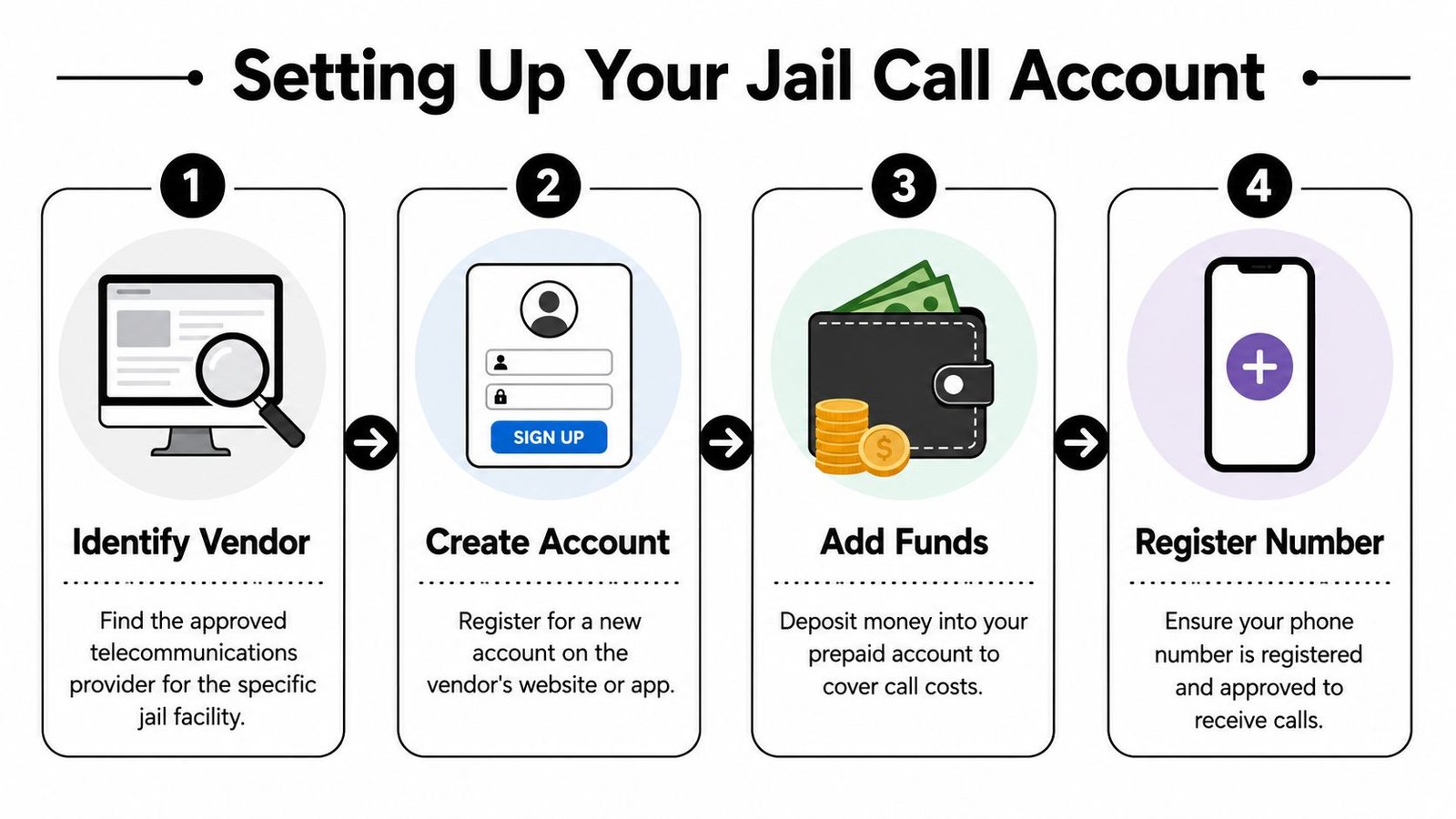
The method that works most reliably is pre-registration plus prepaid funding. That means you register your number first, then create and fund the correct vendor account before the incarcerated person tries to call.
Start with the jail, not Google
Families lose time when they search for “inmate phone account” and sign up with the wrong company. Every facility contracts with its own provider. Before you create anything, identify the exact jail and its approved telecom vendor.
Once you have the right provider, move in this order:
Create the account first
Use your real legal name and contact details.Register the phone number you want to receive calls on
Don't guess which number to use. Pick the number you will answer.Fund the account if the system requires prepaid money
Many systems won't connect the call smoothly if there's no usable balance.Watch for approval or verification steps
Some platforms won't fully activate until identity checks clear.
Here's a visual summary many families find easier to follow before they start:
The biggest point of failure
The details on your account have to match. The Texas Department of Criminal Justice makes this very clear. It requires telephone number registration before calls can be received, and it warns that a common failure point is an identity mismatch. The name on the caller's driver's license must match the telephone service enrollment for the call to connect, according to the TDCJ offender telephone system rules.
That same problem shows up in Colorado all the time, even when the local process is different. If your phone account is under a spouse's name, a business name, or an old billing name, that can create trouble.
If the jail system thinks your number, account, and identity don't line up, the call may never reach you. It may fail silently.
A setup checklist that avoids delays
- Use your exact legal name: Match your ID as closely as possible.
- Pick one main number: Cell and landline switching causes confusion.
- Check your voicemail and spam call settings: Some correctional calls look unusual to your carrier.
- Fund the right account type: Messaging funds and phone funds are not always the same.
- Keep receipts and confirmation emails: If support has to step in, you'll need them.
If you need to handle urgent release logistics at the same time, remote processing matters. Families dealing with both the jail call setup and the bond process often prefer electronic paperwork and payment options, which is why pages like electronic payment processing for bail are useful alongside call setup.
Understanding Collect Calls vs Prepaid Accounts
A lot of Colorado families lose half a day here because they assume any jail call can be accepted the same way. It does not work that way. In Denver, Jefferson County, and nearby facilities, the faster option is usually a prepaid account with the phone vendor that serves that specific jail.
Collect calls still show up in some systems, but they are harder to rely on now. Many cell carriers do not handle them well. Some VoIP and internet-based phone services reject them outright. Even when the jail allows collect calling, the call can fail before your phone ever gives you the option to accept charges.
Jail Call Payment Methods Compared
| Feature | Collect Calls | Prepaid Account |
|---|---|---|
| How it works | Charges are accepted through the receiving phone service, if the carrier permits it | You open the jail vendor account yourself and add money in advance |
| Reliability | Less dependable, especially on cell phones, VoIP, and restricted lines | Usually more dependable once the correct account is funded |
| Control | The phone carrier and billing setup can interfere | You can see the balance, add funds, and confirm the number on file |
| Setup burden | Looks quicker at first, but problems often show up later | Takes more work up front, but usually causes fewer delays |
| Best use | Backup option if the facility still supports it | Primary option for most families in the Denver metro area |
Here is the practical trade-off. Collect calling feels simpler because you wait for the phone to ring and accept the call. But that only works if the jail offers collect calls, your carrier accepts them, and your number is not flagged or restricted. One weak point is enough to stop the call.
Prepaid accounts ask more from you at the start. You need the right vendor, the right phone number, and money in the correct account type. In return, you remove several common billing problems before the inmate ever tries to call.
That is why, in our service area, I usually tell families to treat collect calling as a backup and prepaid service as the main plan.
A Colorado example makes this clearer. Someone may be arrested in the Denver area, but booked into a facility using a different phone provider than the family expected. If the family puts money into the wrong platform, the inmate still cannot call. That mistake happens all the time, especially when relatives are getting advice from someone who dealt with a different county last year.
If you are trying to keep contact open in more than one way, it also helps to review the jail's in-person rules. This guide on whether you can visit someone in jail can help you compare phone contact with visitation so you are not relying on one channel alone.
Navigating Specific Jail Rules in Colorado
Your family can do everything right and still miss the first call if you are working off the wrong county's rules.
That happens all the time in Colorado. Someone is arrested in the Denver metro area, but the booking location ends up being Adams County, Jefferson County, Arapahoe County, or another facility with its own phone vendor, approval process, and call schedule. The jail decides the phone process, not the city where the stop happened and not what worked for a cousin last year.
What changes from one jail to the next
In the Express Bail Bonds service area, the biggest delays usually come from county-by-county differences that families do not see until a call fails. One jail may use Securus. Another may use ConnectNetwork or another provider. Some facilities let an incarcerated person call as soon as booking and housing allow it. Others have tighter approval steps, shorter calling windows, or housing-unit limits that slow everything down.
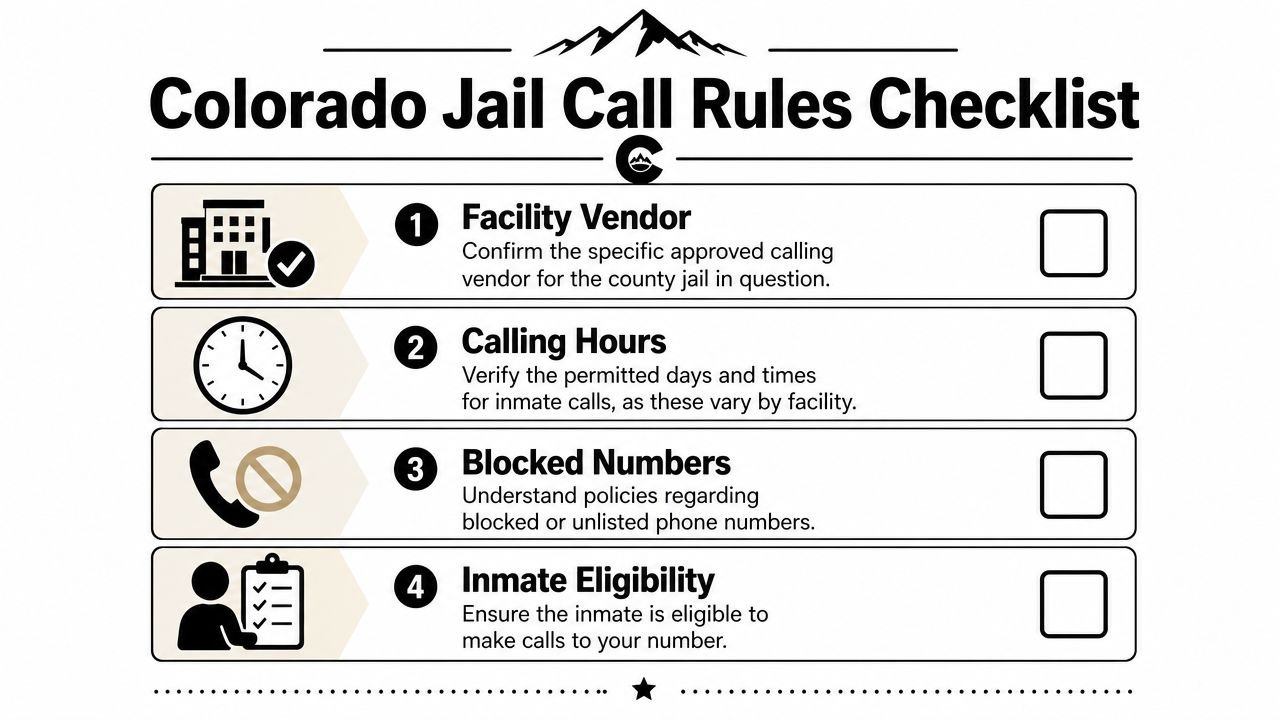
Here is what to verify before you wait by the phone:
- Phone vendor: Set up the account for the exact facility, not just the county you think applies.
- Approved number rules: Some jails are stricter about which numbers can receive calls.
- Calling times: Access often depends on housing schedules, head counts, lockdowns, and dayroom availability.
- Number type: Private lines, work systems, internet-based numbers, and aggressively filtered mobile plans get blocked more often.
- Inmate status: Classification, transfer timing, medical holds, or discipline can delay calling even after booking is complete.
I tell families to confirm the facility first, then the vendor, then the phone number on the account. In that order. If you reverse it, you can spend money and still have no working line.
What this looks like on the ground in Colorado
A Jefferson County family may hear one set of instructions. A Denver-area family dealing with a different jail may hear something completely different. Both may be correct for that facility. The mistake is treating "Colorado jail calls" like one standard system.
A common example is an arrest near Denver that turns into a booking somewhere else in the metro area. The family funds the wrong platform, waits for a call, and assumes the jail is not allowing contact. In reality, the account was set up for the wrong provider or the wrong number format. That is usually a fixable problem, but it costs time.
If you need a county-specific reference, this Adams County jail phone information page is a good example of the local details that matter.
Phone issues outside the jail system can also get in the way. If your device misses other legitimate incoming calls, this guide on how to fix business VoIP issues can help you rule out basic call-delivery problems on your side before you spend more time blaming the facility.
Troubleshooting When You Cannot Receive Calls
If the account is set up and the phone still doesn't ring, don't assume the incarcerated person never called. In many cases, the problem is on the receiving side.
The common failure points
Start with your phone itself. Spam filtering, silence-unknown-caller settings, call screening apps, and carrier fraud protection can all interfere with jail calls. If your device doesn't ring for other important calls either, this guide on how to fix business VoIP issues can also help you work through broader ringing and call-delivery problems that sometimes overlap with correctional call behavior.
Then check the account details again. The number may be entered wrong. The vendor may have your name formatted differently from your ID. The account may have money, but not in the right bucket for phone service.
Free calls still don't mean zero setup
Families often get blindsided by the process. Some jurisdictions have moved to free calling, but that does not automatically mean the phone will just ring with no preparation. In California, recipients still need an active ConnectNetwork account, and incoming calls are still announced as coming from an incarcerated person with the option to accept or block them, according to ConnectNetwork guidance for CDCR recipients.
Reality check: “Free” changes who pays. It doesn't necessarily remove the account, approval, or call-acceptance steps.
What to do next
- Turn off aggressive call filtering: Check your phone and carrier settings.
- Verify the exact number on file: One wrong digit is enough to fail.
- Confirm the right vendor account: Messaging and calling are often separate.
- Ask whether the number needs approval: Some systems require prior authorization.
- Check inmate status at the facility: A person may be temporarily unable to place calls.
If you still can't tell whether the problem is the account, the jail, or the booking status, start with a custody lookup. A Colorado-specific jail inmate search tool can help you confirm where the person is and narrow down which system you should be troubleshooting.
Your Checklist for Staying Connected and Next Steps
A lot of Colorado families get stuck at the same point. They know their person is in custody, they know a call should be coming, but the phone never rings or the call drops before they can accept it. In Denver, Jefferson County, and nearby jurisdictions, the delay is usually caused by one missed setup step, the wrong phone vendor, or a blocked number.
Use this checklist in order. It saves time and cuts out guessing.
The practical checklist
- Verify the exact facility, not just the county
- Confirm which phone company that facility uses
- Set up the right account under the same phone number you will answer
- Add payment if that jail still requires prepaid calling
- Check for carrier spam filters, blocked unknown calls, and call screening apps
- Keep your phone nearby during the jail's calling hours
- Answer the call and follow the prompt right away
- If calls still fail, confirm whether the person has phone access from their housing unit
Phone rules keep changing, and payment is not always the main obstacle anymore. Some prison systems and jurisdictions have shifted to free calling. A 2026 analysis reported that five state prison systems and the federal prison system had implemented free phone calls, affecting more than 330,000 incarcerated people, and that these policies saved incarcerated people and their loved ones $622.5 million, according to Truthout's report on free prison phone call policies. For families, the practical takeaway is simple. Even where calls are free, you may still need the correct account, an approved number, and a phone that will accept the call.
If you are in the Express Bail Bonds service area, I would treat the phone issue and the release issue as two separate jobs. Keep working the call setup so you can hear directly from your loved one. At the same time, start asking what is needed for release, because in many Colorado cases that is what effectively shortens the crisis. Express Bail Bonds handles surety bond processing statewide, and families can complete much of the paperwork electronically.