
You're sitting on the outside while a family member sits in a jail pod, and the number on the bond order feels like a brick wall. That's the moment people start searching how to get bond reduced, but the answer in Colorado usually isn't just “ask for less.” It's building a release package the judge can sign, one that shows the court how the person can get home safely without cash doing all the work.
If the bond is out of reach, move fast and move smart. The first court week matters because the original bond is usually set early, the prosecutor already has the arrest packet, and the defense has to add the missing piece, a documented plan that makes release look reasonable. Families who wait for the next big hearing often lose the best window to challenge the number before the case hardens around it.
When a Bond Feels Out of Reach
The worst calls usually sound the same. A mother in a Denver holding room hears that her son's bond is $50,000 cash-only, and nobody in the family can raise that kind of money before the weekend ends. That's not just a financial problem, it's a timing problem, because the bond question starts moving as soon as the arrest paperwork is complete and the first court setting hits the calendar.
There are three real paths in that moment. One is to wait and hope the case resolves itself at a later hearing, which is slow and usually expensive in the worst way. Another is to ask for a dedicated bond modification, which is the cleanest way to challenge the current amount when the original conditions are unrealistic. The third is to push for a different release package altogether, because Colorado judges are often more willing to change the structure of release than to slash a number without anything else changing.
The first window is the important one
The defense usually learns the bond order quickly, but the prosecutor already has the charging file, police report, and whatever the jail has collected. What the defense has to add is proof, not hope. That means proof of housing, work, family support, treatment, and a release plan that answers the court's fear about flight or safety.
Practical rule: if the bond is impossible, treat the first week like a hearing on the whole release plan, not just a price dispute.
If you want to see how rates work before you start negotiating with a bondsman, use this internal guide on Colorado bail rates. It helps families understand why the same bond number can feel completely different once the court changes the terms.
What Colorado Law Actually Allows
Colorado law gives defense counsel more room than most families realize, but only if the request is framed correctly. Under the state's bond-modification statute, the court can increase or decrease financial conditions, require more security, remove security already posted, or change another bond term. When the defendant asks to decrease the financial conditions or modify bond terms in certain cases, the court must set a hearing, which means the request is not a casual favor, it is a formal event the judge has to hear.
That matters because judges in Denver, Jefferson, and Arapahoe counties are supposed to look at the least restrictive condition that still assures appearance. In plain English, they want to know whether money is really necessary, or whether a lesser condition, like reporting, supervision, or a third-party custodian, would do the same job. The statute gives the defense a real advantage when the original amount acts like detention instead of a risk-control tool.
The bond types judges actually use
Colorado courts work with several release structures, and the judge's choice says a lot about what concern is driving the case. A personal recognizance bond means the defendant promises to return, with no cash paid up front. A surety bond means a licensed bondsman backs the release. A cash bond requires money posted directly with the court or jail.
| Bond Type | What the Defendant Pays | Conditions Typically Added |
|---|---|---|
| Personal Recognizance | Nothing up front | Check-ins, no-contact orders, treatment, travel limits |
| Surety Bond | Premium to a bondsman | Co-signer approval, possible reporting terms |
| Cash Bond | Full amount or required cash portion | Often paired with court appearance obligations |
| PR With Conditions | Nothing up front | GPS, ankle monitoring, treatment, supervision |
Colorado's framework also reflects the 2013 bail reform shift toward release on personal recognizance for many non-violent cases, which is why prosecutors often have to justify why money is needed at all. In the right case, the better argument isn't “lower it.” It's “replace it with a narrower package.” For families looking at risk factors and release planning, the court's logic is easier to understand when you use the same kind of screening lens discussed in pretrial risk assessment guidance.
Building a Bond Reduction Motion That Holds Up
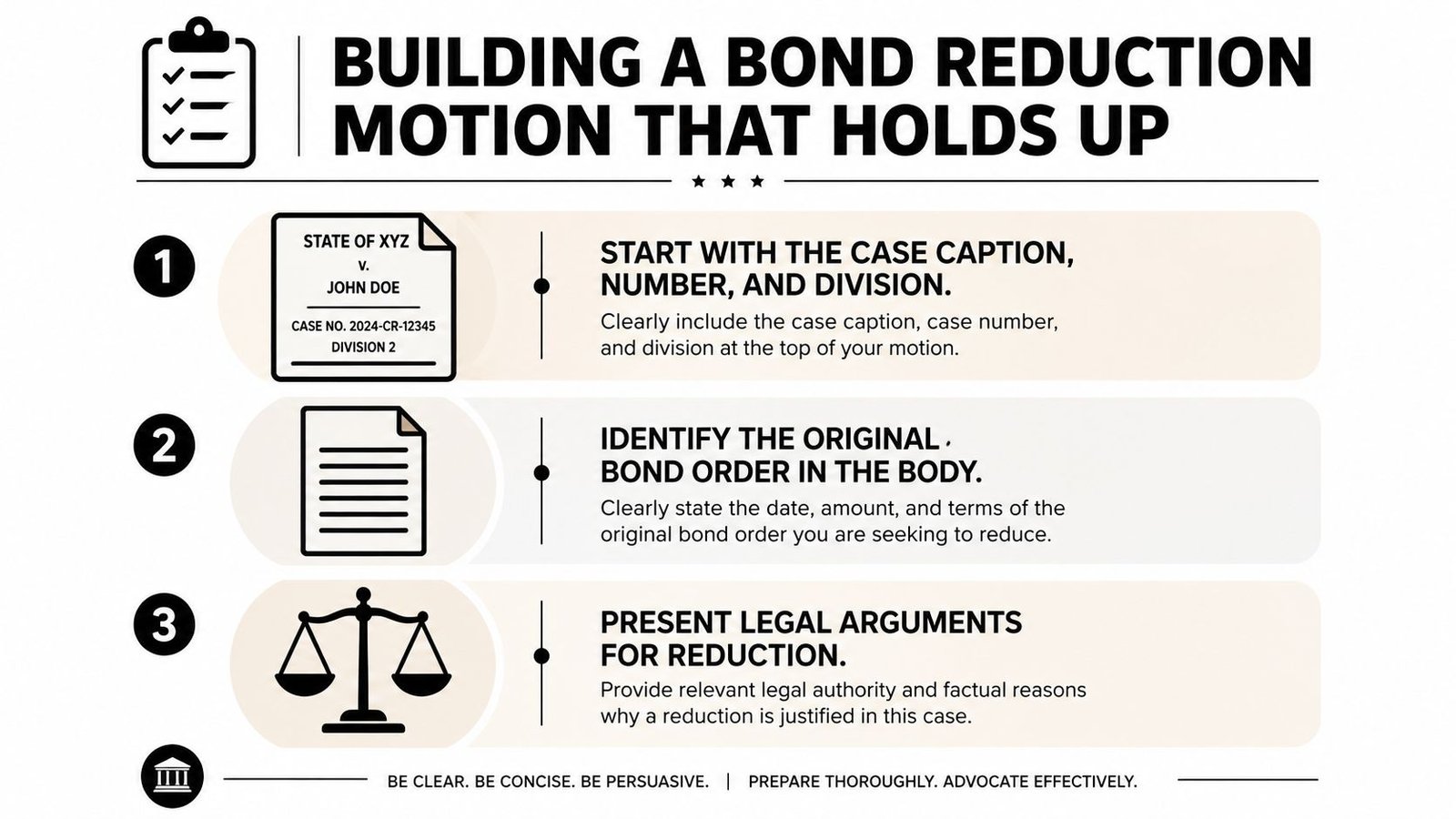
A motion that works in Colorado reads like a package the judge can sign, not a plea for mercy. The caption needs the case number, division, and court. The body needs to identify the original bond order, ask for a specific hearing date, and state the legal basis for changing the amount or conditions. If the motion is vague, the DA will treat it like a stall tactic and the judge will do the same.
The exhibits matter just as much as the argument. A verified employment letter tells the court the defendant has a reason to stay put. A lease or mortgage statement proves a stable address. Proof of children in the home, treatment enrollment confirmation, and character letters on letterhead all help because they turn “my client has ties” into paper the judge can hold in hand.
Serve it like you mean it
The prosecutor has to get notice, and in most districts that means serving the District Attorney's office at least a day or two before the hearing. The bondsman of record should get a courtesy copy too, because surety objections can derail a hearing if the agent feels blindsided. If the defendant is still in custody, ask for expedited setting, because a motion that sits in a stack loses force by the hour.
The best motions don't sound emotional. They sound ready.
If you want a practical court-prep reference while you gather documents, use how to prepare for a court hearing. It fits this process because the judge wants organized proof, not a folder full of excuses.
Inside the Bond Reduction Hearing
A solid hearing in Denver or Centennial is usually straightforward, almost dry. Defense counsel starts by identifying the original bond and the change being requested. The DA responds with flight-risk or public-safety objections. Then the judge looks at the Pretrial Services report, asks the defendant a few direct questions, and decides whether the current order still makes sense.
Judges in Jefferson County often want the answer to be concrete, not emotional. If the defendant says there's stable housing, the judge wants to know whose name is on the lease and whether they can sleep there tonight. If the claim is employment, the judge wants a verified letter, not “my boss said I still have a job.” If treatment is part of the ask, the judge wants dates and provider names, not a vague promise to enroll later.
What usually lands and what usually doesn't
A judge tends to respond well to a specific third-party custodian, a verified address, and treatment already lined up. Those details show structure. By contrast, broad claims about being a good person rarely move the needle on their own. If the answer sounds rehearsed or unsupported, the court often adds conditions instead of cutting the number.
The hearing ends with a written order, and that order replaces the old one. Sometimes the new release is personal recognizance. Sometimes it is a lower cash or surety amount. Sometimes the court keeps the money and adds GPS or curfew terms instead. If you want a broad overview of what bail hearings feel like on the ground, the resource at what happens at a bail hearing tracks the same basic rhythm judges use here.
Asking for Release Without the Money
The strongest request is usually not “make it cheaper.” It's “give the court a better way to control the risk.” Colorado courts routinely use PR bond, unsecured bond, supervised pretrial release, GPS monitoring, daily check-ins, substance testing, no-contact orders, and travel restrictions tied to a verified address. That is the play when cash is doing the wrong job.
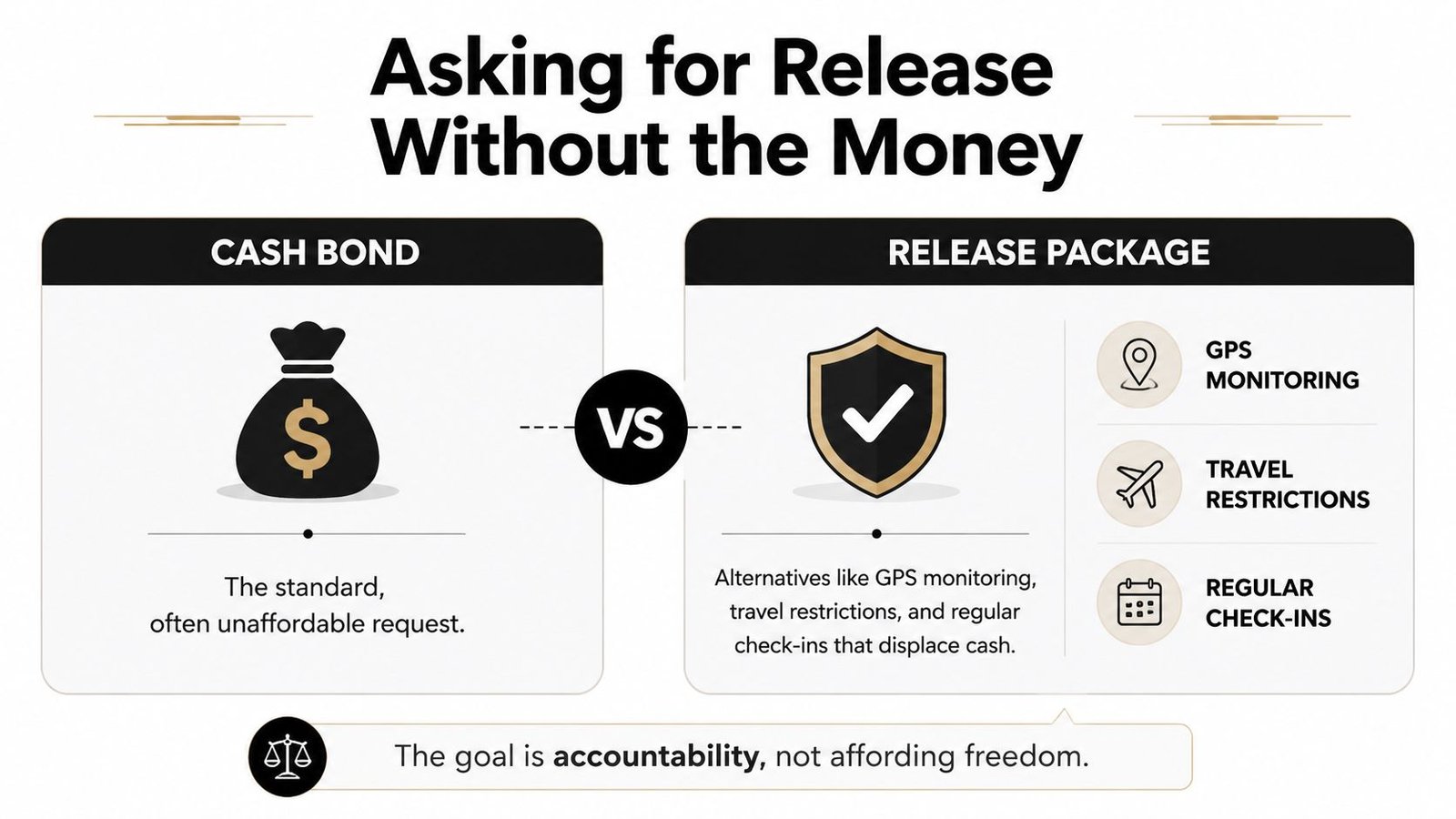
A bond reduction motion gets stronger when each condition answers a concern already on the record. If the judge worries about a prior failure to appear, reporting and a custodian can answer that. If the case involves alleged victim proximity, a no-contact order and travel limits matter more than a random lower number. If there's a gang allegation, GPS and strict supervision can look more realistic to the court than a pure cash cut.
A helpful outside perspective on release planning is the Law Office of Bryan Fagan PLLC on lower bond strategy. The jurisdiction is different, but the core idea is the same, judges care about whether the release package manages risk.
Bottom line: don't ask only for less money. Ask for a release plan that makes money unnecessary.
Working With an Attorney and a Bondsman Together
Courtroom strategy and the bondsman's workflow have to line up, or the order sits there uselessly. If the judge cuts a surety bond from $50,000 to $15,000, the typical 15% premium math changes fast, and a qualified family suddenly has a realistic path to posting. Colorado guidance also notes that the commercial premium is capped at the greater of $50 or 15% of the amount of bail furnished, with only limited extra charges allowed. A reduction can turn a locked-up family into a releasable one.
The bondsman still needs the details before the hearing. The agent needs the new bond type, any added conditions like GPS, the defendant's verified employment, and the custodian's ID if a third party is part of the plan. On some larger bonds, an approved co-signer can affect whether the file gets approved at all, so the hearing and the underwriting process need to be coordinated instead of treated as separate worlds.
What happens after the judge signs
Once the order is entered, the certified copy gets filed with the jail, the surety paperwork is transmitted, and the release moves through the local posting process. In Colorado, that can happen fast when everyone is ready. I've seen defendants walk out the same day because the paperwork was tight, the approval was clean, and nobody had to chase missing details after the ruling.
Express Bail Bonds is one of the Colorado surety options families use when a reduced bond turns into a postable bond, and the process works best when the lawyer and the agent are talking to each other before the hearing. If the new amount fits the family's budget, the release can happen without another week of waiting.
Mistakes That Keep the Original Bond in Place
The first mistake is treating the hearing like a price negotiation. Judges in Denver, Jefferson, and Arapahoe counties hear “the family can't afford this” all the time, and it does not solve the problem by itself. A bond request built on affordability alone sounds like a complaint, not a release plan.
The second mistake is filing and skipping the hearing. A written motion without live argument tells the court the request is not urgent, and if the defendant is still in custody, that signal hurts. The third mistake is assuming the first bond is final, which leads people to sit in jail waiting for trial when a properly supported motion could have been filed much earlier.
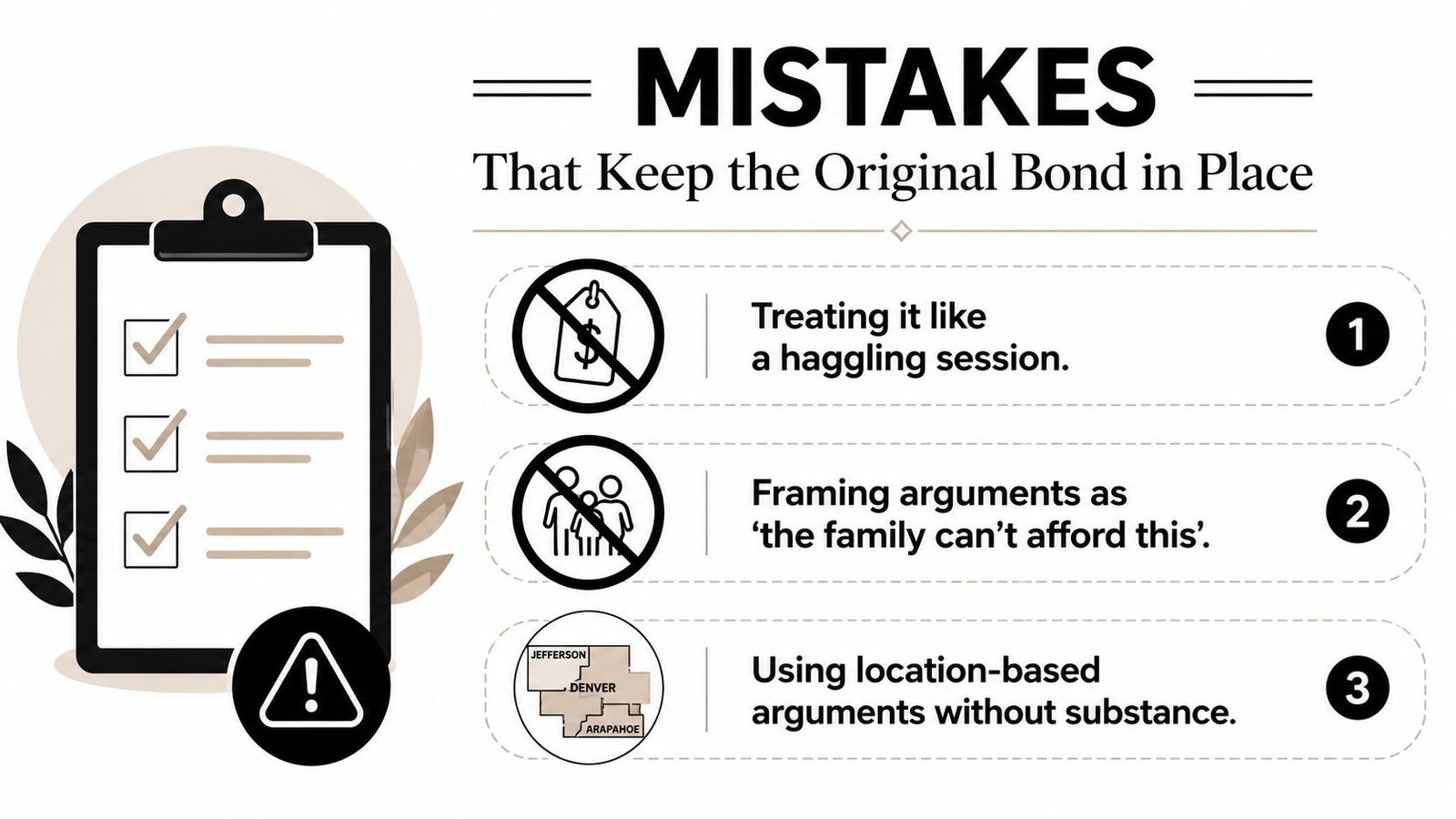
Other errors are just as damaging. Character letters without a release plan don't carry much weight. Failing to notify the bondsman can trigger surety pushback. Offering conditions the defendant can't realistically follow makes the court less willing to trust the proposal.
Practical rule: file early, appear in person, and bring a package the judge can adopt without inventing a new plan from scratch.
If the bond was already violated or a release term is in danger, review the bond-violation guidance at bond violation information before the next hearing. A sloppy response after a problem starts can wreck an otherwise good reduction request.
If you need a Colorado team that understands the difference between a number and a release plan, Express Bail Bonds can help you work through the surety side while your attorney handles the courtroom side. If your case is in Jefferson County or Centennial, start with the local pages for Jefferson County Golden Colorado and Bail Bonds Centennial so you can move fast with the right paperwork and the right local process.