You open your front door and find a packet of court papers on the step. The person who left it is gone. You don't recognize the name on the delivery record, the address is your former home, or the server says the papers were handed to someone who wasn't you. You may have actual notice of the lawsuit, but that doesn't automatically mean the court papers were served legally.
Don't throw the papers away, ignore the case, or argue about the underlying claim before examining service. Improper service can affect personal jurisdiction, procedural deadlines, default rulings, and whether the case can proceed at all. Under the Federal Rules of Civil Procedure, service of a summons and complaint generally must be completed within 90 days after the complaint is filed, and failure to meet that requirement can support dismissal without prejudice or an order extending the time for service. Federal Rules of Civil Procedure
The first hours matter because digital footage can disappear, witnesses can forget details, and a process server's affidavit may become the central evidence in the dispute. This guide shows how to identify the defect, preserve proof, challenge service without waiving the objection, and decide when professional help is necessary.
Recognizing When Court Papers Were Served Incorrectly
A suspicious delivery deserves attention, but suspicion alone won't win a service challenge. Courts usually focus on the governing rule, the identity of the recipient, the delivery method, the location, the server's authority, and the accuracy of the proof filed with the court.
Suppose a server leaves divorce papers with your neighbor, claims service occurred at an address where you moved away, or places documents beside your door without court authorization. You may have learned about the case, but the delivery can still be defective. Many jurisdictions treat improper service as a problem with personal jurisdiction, and courts have repeatedly held that actual notice doesn't cure noncompliant service. A procedural analysis of improper service and void default judgments
Practical rule: Treat the papers as important evidence, not as proof that service was valid.
Why the defect matters
Improper service can invalidate notice, delay the case, require re-service, or support dismissal against the defendant. It can also create a dangerous gap between what the plaintiff claims happened and what happened. That gap is where photographs, video, witness accounts, address records, and delivery logs become useful.
The Federal Rules also distinguish between insufficient process and insufficient service of process. Rule 12(b)(4) addresses a defect in the summons or process itself, while Rule 12(b)(5) addresses a defect in the way service was made. That distinction matters because the court may expect a different procedural objection and supporting explanation. Explanation of Rule 4 service consequences and Rule 12 distinctions
What to do immediately
Write down what happened while your memory is fresh. Record the date, time, location, person involved, words spoken, and anyone who witnessed the delivery. Preserve the envelope and every page exactly as received, then check the docket for the filed return or affidavit of service.
Don't respond to the plaintiff's allegations before getting advice on the service issue. Filing an answer, making certain motions, or participating in the case can affect whether you preserve the objection. For a plain-language starting point, the Tag – Improper Service collection from Brian Hansford Law may help you understand the terminology, while guidance on what to do after court papers are served can help you organize the immediate response.
Common Defects That Make Service Invalid
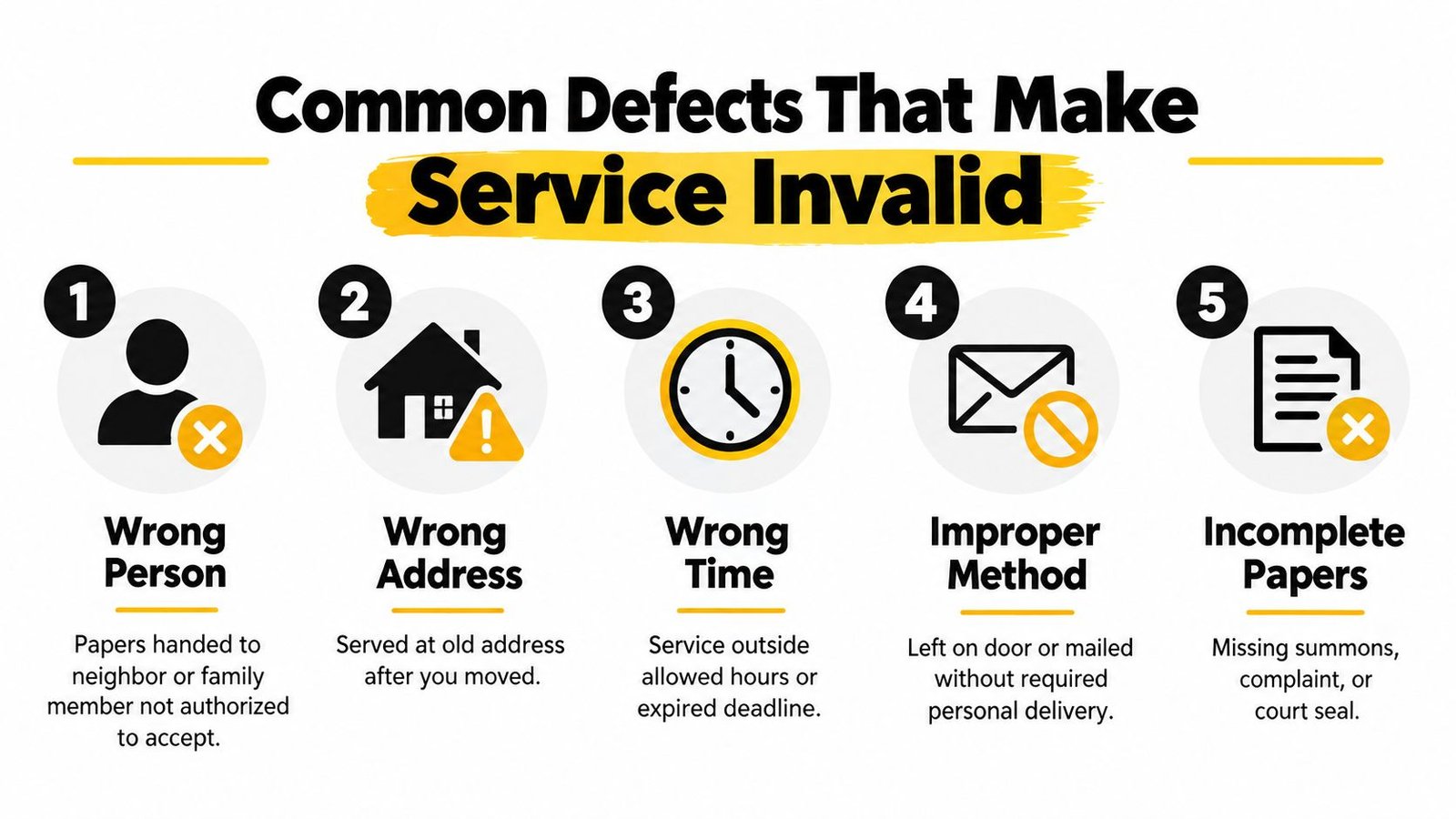
Service fails when the plaintiff or server misses a legally required step. Physical delivery isn't enough by itself. The correct person, method, location, timing, documents, and server all matter under the applicable jurisdiction's rules.
The recipient wasn't authorized
A process server may have handed the packet to a roommate, neighbor, former tenant, employee, or minor. Some rules permit substituted service on a qualifying adult at a qualifying residence or business, but those conditions vary. A delivery to someone who lacks authority can be challenged even if that person gave you the papers later.
The key question isn't, “Did someone connected to me receive an envelope?” Ask whether that person was legally permitted to accept service under the rule used.
The location was wrong
An old residence, former workplace, vacant property, or unrelated business address can undermine service. A plaintiff may argue that the address was your last known location, but the court will examine the rule and the facts supporting that method. Keep lease records, utility records, employment records, forwarding information, or other documents showing when you moved or stopped working there.
The method didn't comply
Personal delivery, certified mail, substituted service, publication, and court-approved alternative service each carry different requirements. Leaving papers on a doorstep, placing them in a restricted area, mailing them without the required receipt, or using an alternative method without court authorization can create a defect.
A common mistake is assuming that a mailed packet is valid because it arrived. The relevant issue is whether mail was an authorized method and whether every required mailing step was completed.
The server lacked authority
Some jurisdictions restrict who may serve process. If the person wasn't legally permitted to serve the papers, the delivery may be invalid regardless of whether the server found the correct address. Check the return of service for the server's name, business information, registration, license, or other required identifying details.
The papers or proof were incomplete
Review whether the packet included the summons, complaint, required notices, attachments, and any court-specific information. A defect in the summons can fall under insufficient process, while a defect in delivery can fall under insufficient service of process.
The proof of service deserves equal scrutiny. California guidance identifies core details such as the case number, court name and address, exact documents served, parties' names, service method, and the server's signed and dated attestation. If different methods were used, separate forms may be required. California guidance on invalid proof of service
How to Document the Defect and Preserve Evidence
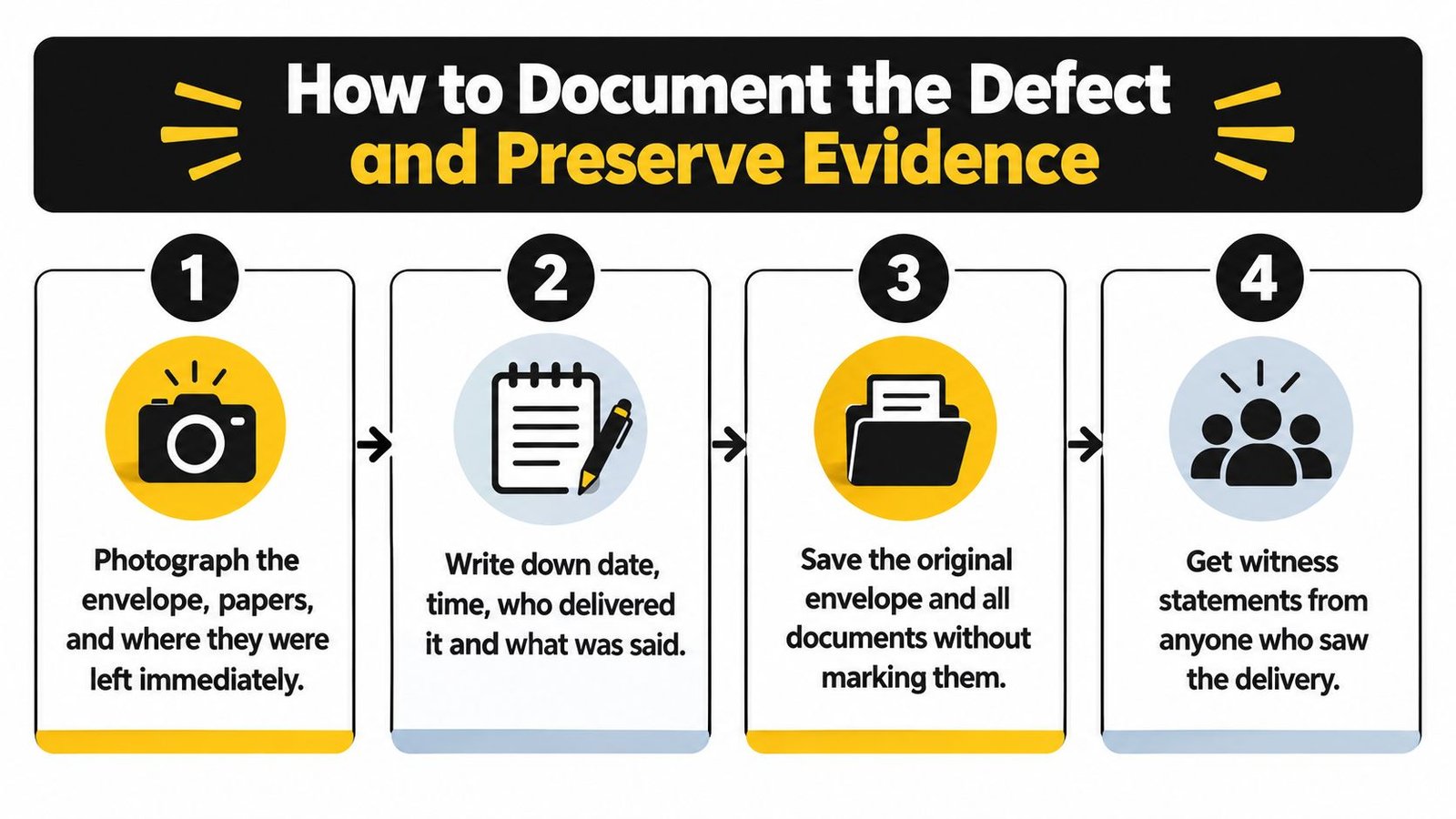
Your strongest argument may be a document showing what happened, not a statement that the delivery felt unfair. Build an evidence folder immediately. Use a cloud folder and a physical folder, but keep original items untouched.
Capture the scene and the documents
Photograph the envelope, every page, the condition of the packet, and the place where the papers were left. Include identifying features such as postmarks, labels, handwritten notes, door locations, and visible damage. Take the photographs before rearranging or writing on anything.
Save the original envelope and documents in a protective sleeve. Don't highlight, staple, annotate, discard, or separate pages from the packet. Make working copies for notes and markups.
Create a delivery timeline
Write a contemporaneous account with concrete details:
- Time and location: Record when and where you first saw or received the papers.
- Server description: Note clothing, vehicle, appearance, name, badge, company, and any statement about authority.
- Delivery method: State whether the papers were handed to you, given to another person, mailed, posted, or left somewhere.
- Conversation: Write down what the server said and what anyone present said in response.
- Recipient facts: Identify who received the packet and whether that person lived or worked at the location.
Don't rely on memory apps that overwrite entries. Preserve the original notes, then create a clean chronology for your attorney or court filing.
Preserve video and digital records
Doorbell cameras, security systems, building access logs, vehicle cameras, text messages, emails, and delivery notifications can establish who was present and what occurred. Download the original files rather than relying only on an online account. Keep metadata when possible, and avoid editing the clips.
If the server's affidavit says you personally received papers but video shows nobody handed anything to you, that contradiction may be central. If the affidavit identifies a location, compare it with GPS information, photographs, access records, and your own location evidence.
Courts and regulators are moving toward more demanding documentation. California's AB 747 is set to require at least three service attempts on different days and times before substitute service, along with time-stamped photographs, GPS data, and server registration details for each attempt. Analysis of California's AB 747 documentation requirements
Collect witness evidence
Ask witnesses to write separate accounts in their own words. Each statement should identify the witness, describe what the person personally saw or heard, and state when the account was written. Don't coach witnesses or circulate one person's version to everyone else.
A useful evidence preservation guide can help you protect digital files before they are overwritten. You can also use court hearing preparation guidance to organize the documents you may need when presenting the issue.
Filing a Motion to Quash or Set Aside Service
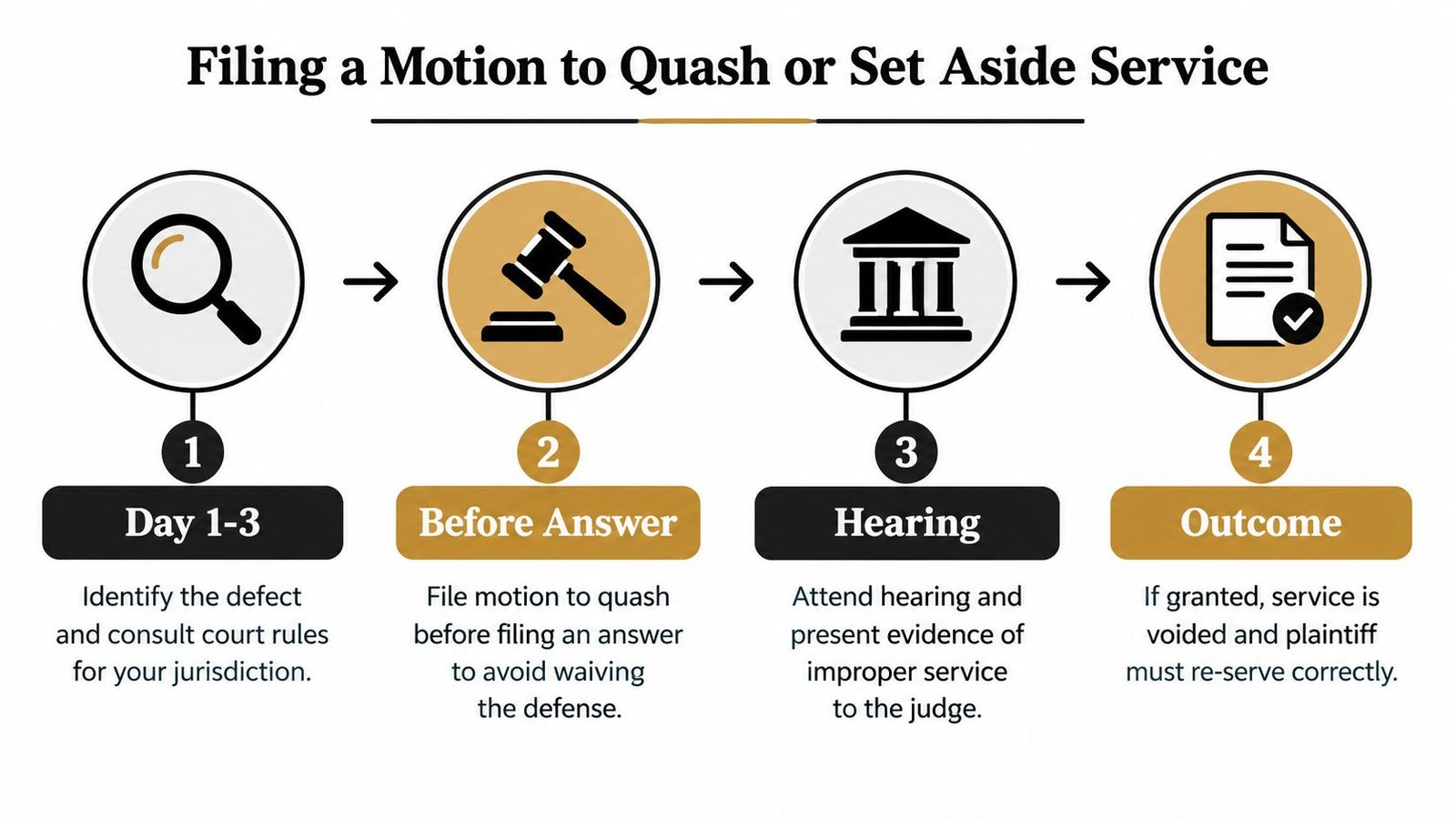
A motion to quash asks the court to invalidate the service attempt. It challenges the court's authority over you or the legal sufficiency of delivery. It isn't an answer to the complaint, and it doesn't address whether the plaintiff's underlying claim is true.
Start with the governing rule
Identify the exact defect and connect it to the rule that controls service. “I wasn't served correctly” is too general. A stronger motion says the papers were delivered to an unauthorized person, at an incorrect location, by an unauthorized server, through an unapproved method, or after the relevant deadline.
Attach the return or affidavit of service, photographs, declarations, video descriptions, address records, and other evidence supporting the objection. If a video file is too large for the filing system, preserve the original and follow the court's procedure for exhibits or electronic media.
File before taking steps that waive the issue
The safest approach is to raise service first, before filing an answer or making a filing that treats the court's authority as established. Read the summons, local rules, scheduling orders, and applicable service statute immediately. Deadlines differ by jurisdiction and case type.
Colorado cases require careful attention to local procedure and the specific court. Don't assume a general online form fits your case. A criminal matter, civil lawsuit, family case, eviction, and protection-order proceeding may use different documents and deadlines. Information about what happens at an arraignment hearing may be useful for criminal proceedings, but it doesn't replace advice about a civil motion to quash.
Prepare for the hearing
After filing, the court may set a hearing and the plaintiff may file an opposition. Bring organized copies of the motion, proof of filing, the return of service, photographs, declarations, and a concise timeline. Explain the defect in sequence. Start with the rule, identify what the server claimed, then show how the evidence contradicts or fails to support that claim.
If the judge grants the motion, the service is quashed and the plaintiff generally must serve you again correctly. If the judge denies it, the case continues and you must protect the remaining response deadline. A granted motion doesn't necessarily decide the merits, and a denied motion doesn't mean the plaintiff's allegations are true.
When to Contact an Attorney or Bail Agent
Handle a service issue yourself only when you can identify the rule, preserve the evidence, meet the filing deadline, and understand the consequences of each filing. A straightforward address error in a low-stakes civil matter may be manageable with careful preparation. That doesn't make the deadline optional.
Professional legal help becomes essential when the case involves criminal charges, a warrant, custody, domestic violence, eviction, substantial financial exposure, or a possible default judgment. An attorney can compare the return of service with the applicable rule, assess waiver risk, request records, and decide whether to seek relief from an order already entered.
Use the right professional
A civil litigation attorney is usually the right person for a summons and complaint. A family-law attorney should handle divorce, custody, or support matters. A criminal-defense lawyer should address a warrant, arrest, arraignment, or criminal case. If you can't afford private counsel, learn how the role of a public defender may apply to your situation.
Bring the complete paper packet, envelope, court docket information, return of service, timeline, photographs, witness names, video files, address records, and every notice received. Tell the attorney what you filed or said after service. Hiding an unfavorable fact wastes time and can damage credibility.
Understand the bail connection
Improper service and bail can intersect when a default judgment, warrant, or detention order followed a defective service attempt. A bail agent doesn't decide whether service was valid and can't replace a defense attorney. The agent's role is to help with release procedures when someone is detained and a bond is available.
Coordinate carefully. The attorney challenges the warrant, judgment, or service defect. The bail agent handles the bond application, cosigner process, payment arrangements, and jail-posting logistics permitted by the jurisdiction. Families should provide both professionals with consistent court information and copies of relevant orders.
For Colorado readers, local resources include Jefferson County bail bond assistance in Golden and bail bonds in Centennial. These resources address release logistics, not the legal validity of service.
Likely Outcomes and What Happens Next
A successful motion to quash usually removes the defective service, not the plaintiff's underlying claim. The plaintiff may serve the defendant again at a verified address through an authorized method, subject to the applicable deadline. Use that interval to organize the digital evidence, substituted-service records, and timeline that show what occurred.
The judge may deny the motion if the evidence supports valid service or the objection was waived. Protect the response deadline immediately. In federal civil cases, the 90-day service rule may lead to dismissal without prejudice or an extension order when service is not completed on time.
State deadlines vary sharply. California generally expects service within 60 days of filing, proof of service within 60 days, and service on a newly added defendant within 30 days of the amended filing. The California civil procedure timing summary outlines those timing rules. South Carolina requires many served papers to be filed within 5 days, with specific summons and proof-of-service requirements under South Carolina Rule 5.
The plaintiff may voluntarily dismiss instead of serving again. Check the docket, preserve every notice and metadata record, and ask counsel whether another filing remains possible. If you or a loved one missed court or faces detention, review what happens if you miss court and act promptly.
If the dispute led to arrest or detention, Express Bail Bonds can help families and attorneys arrange a Colorado surety bond and understand release procedures. Contact the agency by phone or text at 720-984-2245 while your attorney handles the motion, warrant, or underlying case.