
At 2 a.m., your phone rings. A family member is in custody somewhere in Colorado, nobody is sure which facility has them, and the only question that feels urgent is, “How do we get them out?” Start by confirming the detention location, booking status, charges, and bond amount. The charges are accusations, not convictions, but the release process has already begun.
The right choice among cash bail, a surety bond, property, or personal recognizance release can determine what happens over the next several hours. This guide walks through that decision clearly, including Colorado premiums, remote paperwork, county procedures, and the questions a cosigner should ask before signing. For immediate practical steps after an arrest, use this guide to what to do when arrested.
The Moment the Phone Rings After an Arrest
The first hour is about facts, not panic. Confirm the loved one's full legal name and date of birth, ask where they're being held, and find out whether the jail has completed booking. A person may be transferred between facilities, and a family member who drives to the wrong detention center can lose valuable time.
The next question is whether release can happen directly under a county schedule or whether a magistrate must set or review bond. The court may allow release on personal recognizance, require cash, approve a surety bond, or impose conditions such as supervision, no-contact orders, or monitoring. The family doesn't choose the final release terms, but it can prepare to act on them.
Practical rule: Get the facility and bond information before discussing payment. A quote without a confirmed bond amount is only an estimate.
A bond hearing can change the amount or conditions. The defendant's lawyer may argue for a lower bond, unsecured release, or personal recognizance. If the court has already set a bond, a licensed agent can explain whether a surety bond is available and what the cosigner must provide.
The decision tree starts with the bond order
If the court sets cash-only bail, a surety agent generally can't replace it with a bond. If the order permits a surety bond, the family pays a regulated premium instead of placing the entire face amount with the court. If the court releases the defendant on recognizance, there may be no financial payment, but compliance requirements still matter.
Colorado counties don't all process releases in the same way. Posting locations, accepted payment methods, electronic intake, and jail processing times vary. Call someone familiar with the specific facility before you drive anywhere, because the fastest route at one jail may create a delay at another.
What Bail and a Bail Bond Actually Mean
Bail is the amount the court sets to secure a defendant's appearance. Think of it as a security deposit paid to the court. The defendant gets released under the court's conditions, and the cash may be returned after the case concludes, subject to applicable court deductions and the terms governing the payment.
A bail bond is different. A licensed surety or bail agent promises the court that the full bond amount will be available if the defendant fails to appear. The family pays the agent a premium for arranging that guarantee, and the cosigner accepts contractual responsibility for the obligation.
The simplest comparison is this:
- Cash bail: You provide the entire court-set deposit yourself.
- Surety bond: You pay a premium so a licensed bond provider posts the guarantee.
California consumer guidance describes a commonly regulated premium of 10% of the total bond plus actual, necessary, and reasonable expenses, while New York sets maximum premiums on a sliding scale that begins at 10% for bonds from $200 to $3,000 and declines by tier for larger bonds, as explained by the California Department of Insurance and the New York Department of Financial Services. Colorado uses its own statutory framework, discussed below.
Why the distinction matters
Cash can require a large amount of money immediately, even if the court later returns it. A surety bond usually requires less cash at the start, but the premium is generally non-refundable once the defendant is released. Collateral, an indemnity agreement, or a cosigner may also be required.
Read the contract before paying. The difference between bail and a bond affects your liquidity, your risk, and what happens if the defendant misses court.
Bail vs. Bail Bond at a Glance
| Factor | Cash Bail | Bail Bond |
|---|---|---|
| Who pays | Defendant or family pays the court | Family or cosigner pays a licensed agent |
| Amount paid at the start | Full court-set bail amount | Premium, plus any agreed collateral or expenses |
| Refund status | May be returned under court rules after the case | Premium is generally non-refundable after release |
| Main risk | Capital is tied up with the court | Cosigner may owe the bond amount after a failure to appear |
| Best fit | Family can safely provide the full amount | Family needs a surety solution rather than full cash payment |
The Main Types of Bonds to Get Out of Jail
The court controls the available release type. Your job is to understand what each option costs and what responsibility it creates.
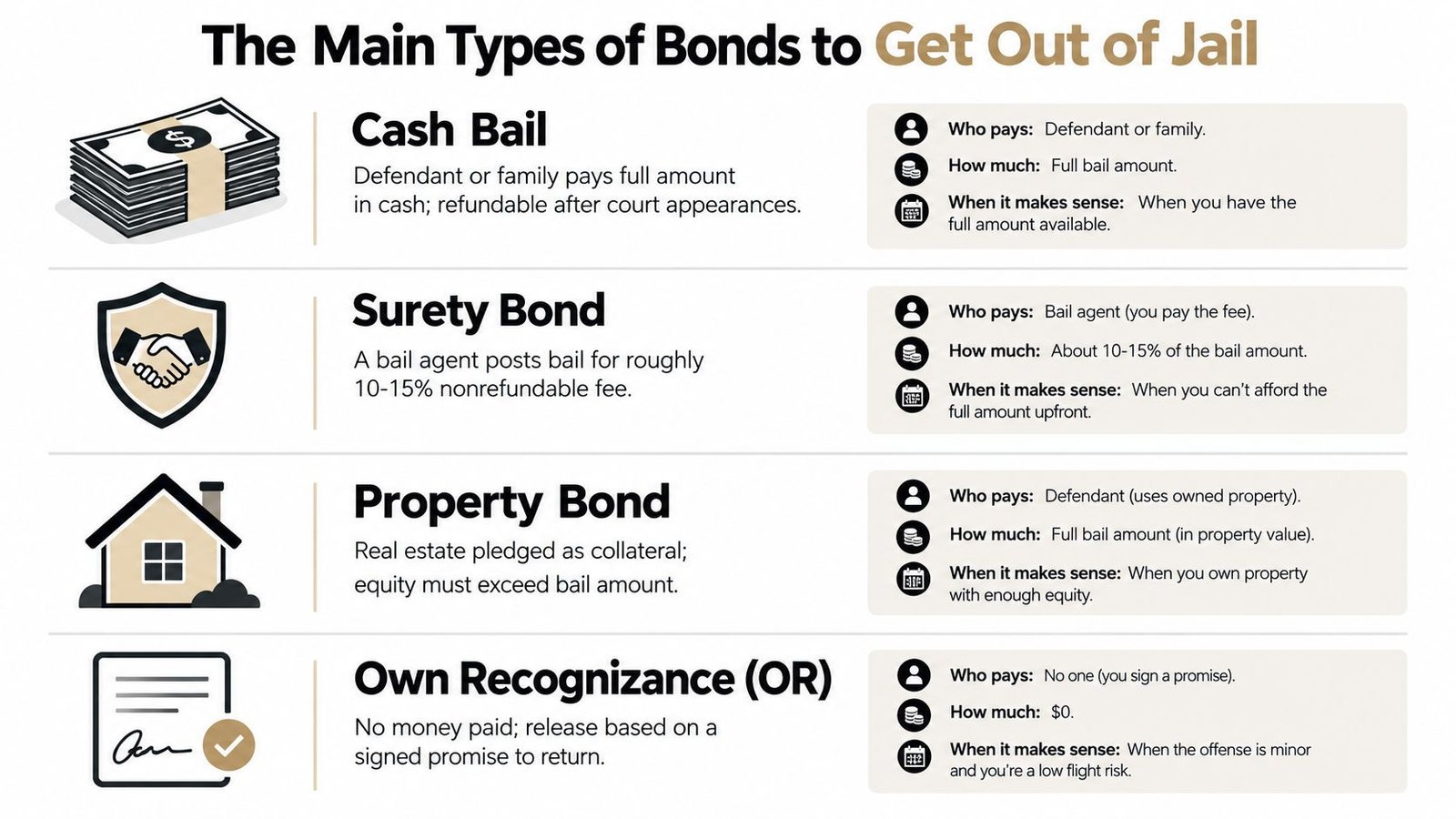
Cash bail
With cash bail, the defendant or family pays the full amount directly to the court or jail authority. This can make sense when the money is immediately available and the family understands that the funds may remain tied up until the case reaches its required resolution.
Cash bail isn't a loan. You should not liquidate essential housing, medical, or operating funds without understanding the court's refund rules and the consequences of a missed appearance.
Surety bonds
A surety bond uses a licensed agent to post the court-required guarantee. In Colorado, the legal premium is generally capped at 15% of the total bond amount, with some agencies offering 10% on larger bonds when an approved cosigner qualifies, as described in Colorado's statutory provision on bail bond premiums.
This is usually the practical option when the family can cover the premium but can't safely produce the entire bail amount. The agent may also evaluate collateral, income, identity, and the cosigner's ability to respond if the defendant misses court.
Property bonds
A property bond pledges real estate equity. The process can involve title review, ownership verification, liens, and formal documentation. It isn't the right emergency solution when release is needed immediately, because the property review may take days rather than hours.
Property also creates serious consequences. If the defendant fails to appear and the bond is forfeited, the pledged asset may be exposed under the agreement and applicable court procedures.
Personal recognizance and unsecured release
A personal recognizance, or own-recognizance, release doesn't require a financial payment at the outset. The defendant signs a promise to return and must follow every condition imposed by the court.
Those conditions can include supervision, no-contact orders, travel limits, reporting, or electronic monitoring. “No money paid” doesn't mean “no obligations.” A violation can lead to a new custody decision and additional legal problems.
Pretrial Release Options Compared
| Release Type | Who Pays | Typical Cost | Best Fit |
|---|---|---|---|
| Cash bail | Defendant or family | Full court-set amount | Family has the full amount available |
| Surety bond | Cosigner or indemnitor pays an agent | Regulated premium, often up to Colorado's 15% cap | Family needs to preserve cash |
| Property bond | Property owner pledges equity | Review, filing, and possible professional costs | Suitable real estate is available and time permits |
| Personal recognizance | No upfront payer | No financial payment, but strict conditions may apply | Court finds the defendant suitable for release |
For a fuller explanation of Colorado bail bond types, focus on the release order first. A bondsman can help explain the available surety route, but the judge decides which form of release is permitted.
How Colorado Sets the Price of a Surety Bond
If the court sets a $10,000 bond, the Colorado premium at the legal 15% cap is $1,500. That is the cost of the surety's guarantee, not a refundable deposit held for the family. Before authorizing payment, ask for the total in writing and confirm what the agent requires to post the bond.
Colorado's premium is calculated from the full bond amount. State law sets the maximum for most cases, so a legitimate agent should explain service, paperwork, collateral, and payment terms rather than promise an arbitrary rate below the statutory cap. Some agencies may offer a 10% rate on bonds over $5,000 with an approved cosigner, but approval controls the offer. The family may still need to provide financial information, collateral, or an agreed payment arrangement.
What the premium covers
The surety company remains exposed to the full face amount if the defendant fails to appear. Collateral can include cash, property, or a deed pledged under the agreement. The Florida Department of Financial Services bail bond consumer guide identifies a 10% state-bond premium and a 15% federal-bond premium, and explains that the premium is earned once the defendant is released, subject to limited refund exceptions.
The premium pays for access to the guarantee. Collateral protects the surety against losses after a missed appearance or other breach. Treat them as separate obligations.
Payment plans and credit approval vary by agency. Ask whether the quote includes filing costs, collateral requirements, or other permitted expenses. For a plain-English explanation of how bond pricing works, compare the explanation with the actual contract before signing.
Surety Bond Premium Examples at Colorado's 15% Cap
| Bond Amount | Premium at 15% | Typical Cash Requirement |
|---|---|---|
| $5,000 | $750 | Premium, subject to agency approval and contract terms |
| $10,000 | $1,500 | Premium, with possible collateral or cosigner requirements |
| $20,000 | $3,000 | Premium, with underwriting review and possible collateral |
These figures show the statutory calculation, not a promise of approval or a specific payment plan. For an out-of-state family, the practical question is whether the agent can explain the quote electronically, collect accurate documents, and confirm the county's posting requirements. County processing can affect timing, but it does not change the premium calculation. The release order and signed contract control what the family owes.
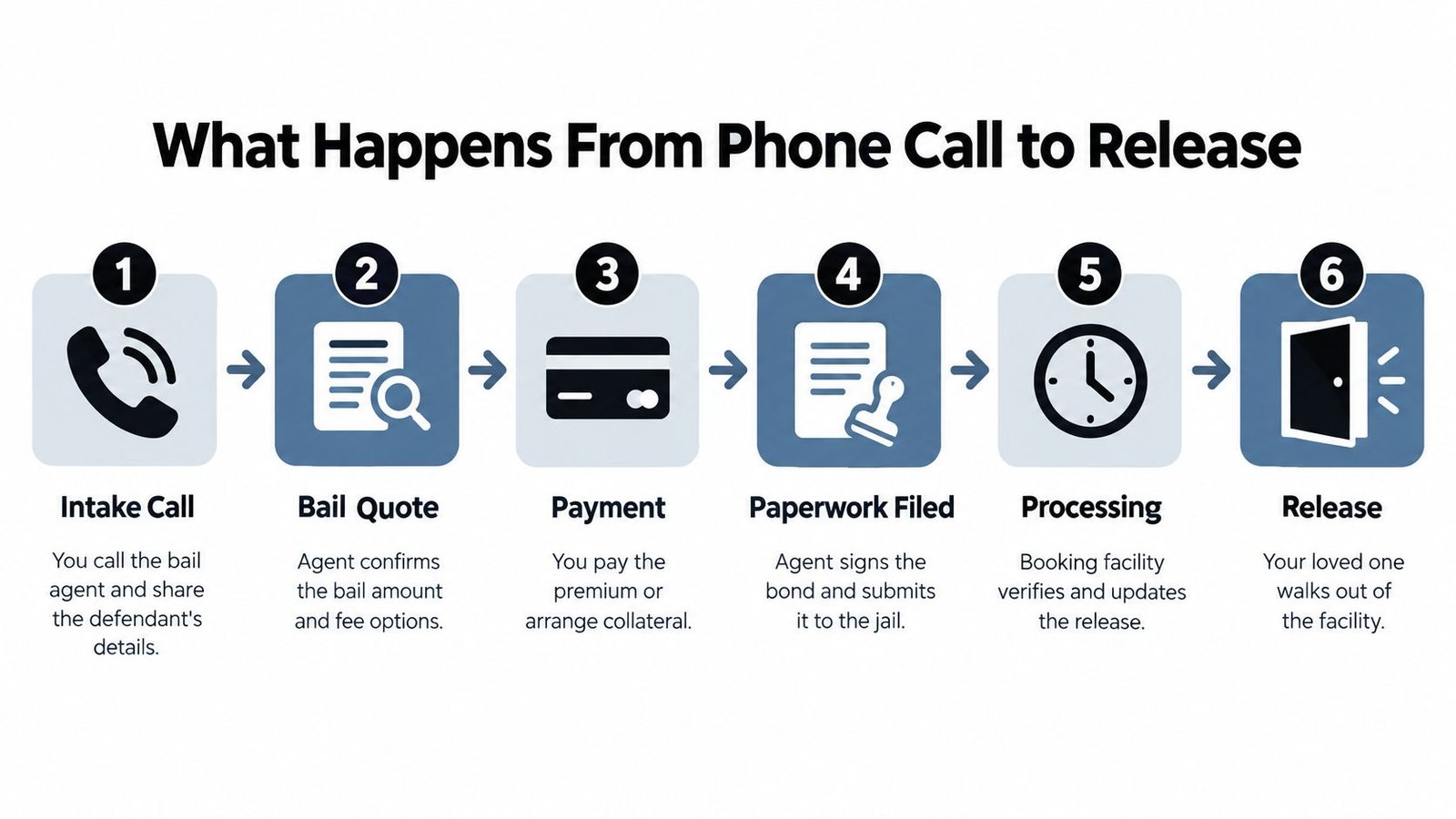
What Happens From Phone Call to Release
A smooth release starts with a complete intake call. Have the defendant's full legal name, date of birth, charges, booking number if available, and holding facility ready. If you don't know the facility, provide the arresting agency, county, and any information from the jail locator.
The paperwork sequence
The agent confirms the bond amount and explains the premium. The cosigner then reviews and signs the bond application and indemnity agreement. The indemnitor is the person who accepts financial responsibility under the contract if the defendant fails to appear or the surety suffers a loss.
Remote signing is useful for out-of-state relatives, but it needs to be handled correctly. Send the signature request to the signer's own email address or phone, complete the requested identity checks, never sign for another person, and keep the completed packet and audit certificate. A remote cosigner shouldn't forward credentials or ask someone else to imitate their signature.
Electronic intake can make the process manageable from a laptop, but it doesn't remove the need for accurate information. A wrong birth date, missing booking detail, or unreadable identity document can send the file back for correction.
From posting to walking out
Once the contract and payment or collateral arrangements are complete, the agent signs and posts the bond with the facility. Jail staff verify the paperwork, update the custody record, and complete the release process. The agent can't control every step after submission, so the family should stay reachable and avoid changing phone numbers during processing.
A realistic expectation is two to six hours, depending on the facility and its workload. That isn't a promise, and a bond hearing, transfer, medical clearance, or incomplete booking can extend the wait.
For a visual overview of the paperwork and posting sequence, watch this process video:
How Colorado Counties Handle Bond Posting
County procedure can matter as much as the premium. Denver County Court says bond posting is accepted in person at the Van Cise-Simonet Detention Center 20 hours per day, seven days a week, including holidays, according to its Bonding and Warrants Division. That extended schedule doesn't mean every release is immediate, but it shows why families shouldn't assume a nighttime arrest must wait for the next business day.
Denver, Arapahoe, Jefferson, El Paso, Adams, Douglas, and Weld may differ in posting location, accepted payment methods, electronic submission rules, and jail release queues. An approved agent may complete much of the transaction remotely, while the facility still performs its own verification and release steps.
County questions to ask before traveling
Call first and ask where the bond must be posted, whether the facility accepts electronic submissions, what payment method applies, and whether the defendant has finished booking. Also ask whether a bond hearing is pending. Driving to a clerk's office before those facts are confirmed can waste the time you need for paperwork.
Claims about exact hours and release windows should come directly from the county or the agent handling that facility. Procedures change, and a neighboring county may use a different workflow even when the charges look similar.
Colorado County Bond Posting Comparison
| County | Posting Hours | Electronic Bond Intake | Typical Release Window |
|---|---|---|---|
| Denver | Extended schedule, including holidays, subject to facility processing | May be available through approved agents | Depends on booking and jail verification |
| Arapahoe | County and facility schedule applies | Confirm with the agent before signing | Depends on submission and facility queue |
| Jefferson | County and facility schedule applies | Confirm with the agent before traveling | Depends on booking and facility queue |
| El Paso | County and facility schedule applies | Confirm approved electronic process | Depends on booking and facility queue |
| Adams | County and facility schedule applies | Confirm approved electronic process | Depends on submission and facility workload |
| Douglas | County requirements apply, especially for property arrangements | Confirm with the facility or agent | Property matters may require additional review |
| Weld | County posting procedure applies | Confirm whether the selected method is remote | Cash and surety timing depend on the posting office and facility |
The useful takeaway is simple: county-level rules create much of the practical friction. Call an agent who knows the holding county before you leave home.
Reading the Fine Print Before You Sign
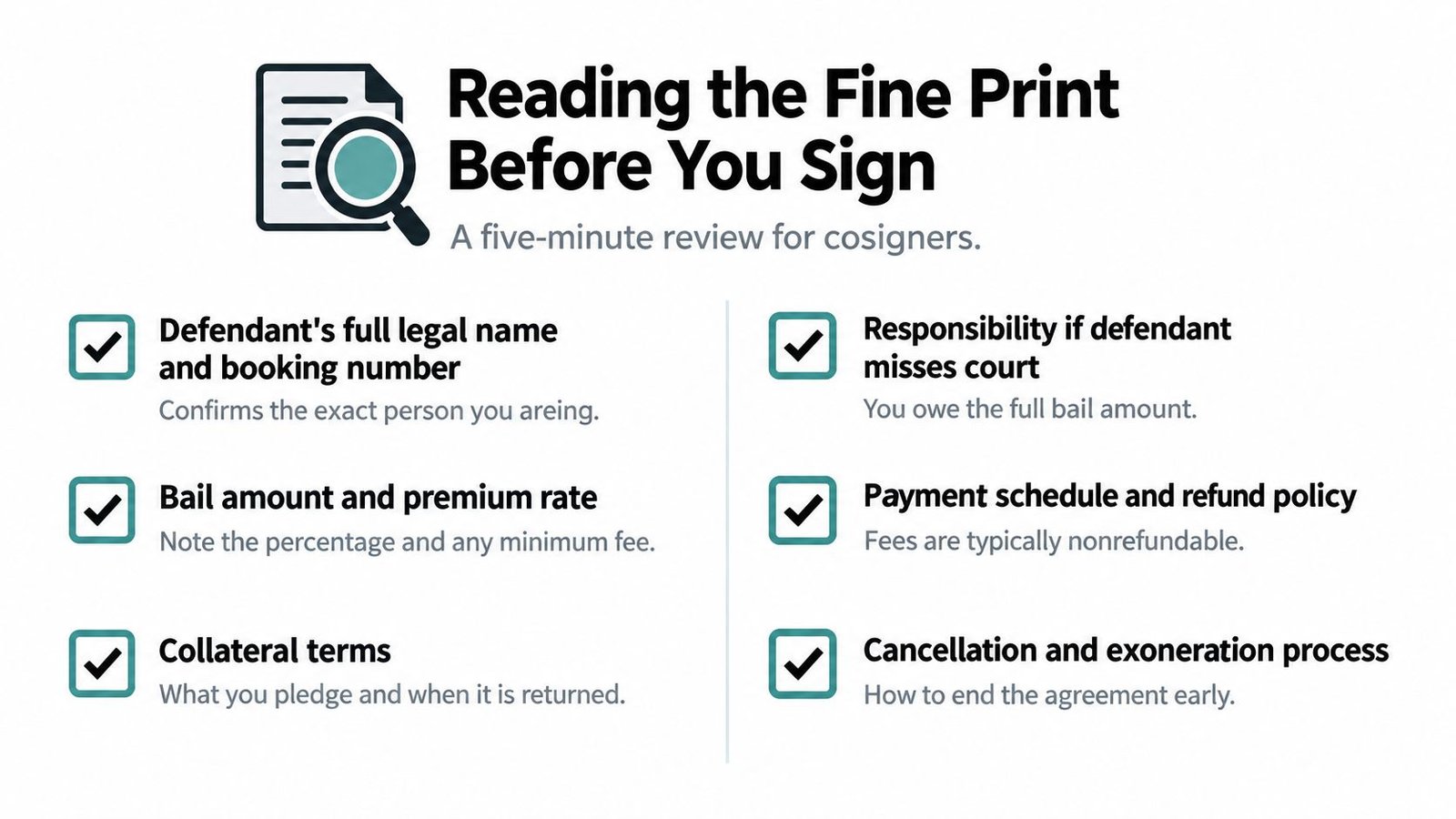
A cosigner should treat the bond contract as a financial obligation, not as a quick formality. Gather the defendant's full legal name, booking number, charges, county of detention, and date of birth before the application begins.
Questions that deserve written answers
Ask the agent to put the quote and obligations in writing:
- Premium rate: Is the calculation based on 15%, or has a qualifying 10% arrangement been approved?
- Collateral: What property, cash, or other security is being pledged, and when can it be released?
- Indemnitor: Who is legally responsible under the agreement?
- Missed court date: What steps follow a failure to appear, and what could the cosigner owe?
- Remote execution: Can an out-of-state cosigner sign electronically, and what identity verification is required?
- Payment terms: Are installments available, and which charges are non-refundable?
- Exoneration: What documentation confirms that the surety obligation has ended?
A standard contract should identify the defendant, bond amount, premium, payment terms, collateral, indemnity obligations, and procedures for cancellation or exoneration. If a clause is unclear, stop and ask for an explanation before signing.
Red flags
Walk away from an agent who refuses to provide the premium or collateral terms in writing. Be cautious if someone demands unexplained cash, adds a “membership” fee, refuses to identify the indemnitor, or pressures you to sign blank pages.
A remote process should be auditable. Use your own device, complete the verification yourself, retain the executed documents, and don't let anyone sign in your name. The bail e-signing guidance for families covers these practical safeguards.
When to Call a Bail Bondsman and What Comes Next
Pick up the phone while your loved one is still in custody, the bond exceeds what you can comfortably pay in cash, or the defendant is held in a county you don't know. A bail agent can confirm the quote, explain Colorado's premium, and begin electronic paperwork before every booking detail is complete. If you're coordinating urgent legal communication, this lawyer call answering guide can help organize after-hours calls, while this guide to using a bail bondsman explains the basic interaction.
Call rather than waiting on email when the jail is processing releases overnight. Have identification and defendant details ready, stay available for verification, and ask for the written contract before payment.
Express Bail Bonds handles Colorado surety bond applications, electronic contracts, payment arrangements, and bond posting coordination for families dealing with urgent custody situations. Visit Express Bail Bonds now to request help, or use its Jefferson County and Golden bail bond service and Centennial bail bonds resource when the detention facility is in those areas.