
The call usually comes at the worst possible time. Late at night. Early before work. Right in the middle of dinner. Someone you care about says they've been arrested, they don't know what happens next, and you're suddenly searching terms like you walk bail bond agency because you need help fast, not a lecture.
That reaction is normal. Families rarely start this process calm and organized. They start with a name, a jail, a rushed explanation, and a lot of fear.
If the arrest happened in Colorado, the most useful thing you can do is work with a Colorado-focused agency that knows local detention centers, local court routines, and remote processing. A statewide provider like Express Bail Bonds matters because release work is practical, not theoretical. The right agent helps you identify the bond type, gather the right information once, and avoid delays caused by incomplete paperwork or showing up at the wrong facility.
That Stressful Call and Finding a Colorado Bail Partner
A lot of families searching you walk bail bond agency are really searching for the same thing. Someone who answers right now, explains the process clearly, and helps get a loved one released without turning the next few hours into chaos.

You Walk Bail Bond Agency is a family-owned and operated company serving Denton and Collin Counties in Texas, with documented service for at least 18 years and 24/7 availability through county-specific phone lines, according to You Walk Bail. That matters if the arrest is in Texas.
If the arrest is in Colorado, local handling matters more than brand recognition from another state. A Colorado agent can tell you whether the jail is moving quickly, whether remote signatures will work for your situation, and whether the person is dealing with a surety bond or a cash-only bond. Those details affect what happens in the next hour.
Why local beats generic search results
The biggest mistake I see families make is assuming all bail agencies handle cases the same way. They don't. Some still rely on in-person paperwork. Some are slow to communicate after the first call. Some don't make the difference between a likely same-day posting and a situation that depends on court action clear enough.
A strong Colorado agency should be able to do four things immediately:
- Confirm the jail location so nobody wastes time calling the wrong facility
- Explain the likely bond path in plain English
- Handle documents remotely if the cosigner isn't nearby
- Set realistic expectations instead of promising instant release
Practical rule: In a bail emergency, speed matters, but clarity matters just as much. Fast answers that turn out to be wrong create more delay than a careful five-minute intake.
Modern intake tools also help. If you want a sense of how agencies are using automation to stay responsive after hours, this guide on AI customer support in bail bonds is a useful reference point.
Families also want proof that an agency communicates well under pressure. Reading client bail bond reviews can help you spot whether people felt informed, respected, and updated during the process.
What to focus on first
At the start, don't try to solve everything at once. You don't need the whole legal strategy tonight. You need the release process started correctly.
Focus on these immediate actions:
- Get the person's legal name exactly right
- Confirm the jail or detention center
- Find out whether bail has been set
- Identify who will cosign if needed
That's enough to move from panic to a workable plan.
Your First Contact Getting Started with Express Bail Bonds
The first contact with a bail agency usually happens in the worst part of the night. A phone is dying, details are coming in pieces, and one family member is trying to hold everyone together. That call does not need to be perfect. It needs to be accurate enough to start.
At Express Bail Bonds, the first job is simple. Confirm who is in custody, find the right Colorado facility, and determine whether a bond can be posted now or whether the case is still waiting on court action. Families often worry that they are calling too soon. In practice, calling early gives the agent time to verify details and prevent avoidable delays.
What to have ready before you call
The fastest intakes usually start with a few basic facts:
- Full legal name of the defendant
- Date of birth
- Jail or detention center location
- Booking number, if you have it
- Basic charge information, if known
- Your relationship to the defendant
- Whether you may need a cosigner
If you only know the person's name and date of birth, call anyway. That is often enough for us to start checking records and asking the right questions.
How a good intake call actually works
A solid intake call feels calm, structured, and brief. The agent should guide the conversation instead of making you guess what matters.
In most Colorado cases, the call follows a practical order:
- Identify the defendant
- Confirm the jail
- Check bond status and amount, if it has been set
- Find out who will be financially responsible
- Explain the next step for paperwork, signatures, and payment
That order matters because bad information at the start creates real delays. If the name is misspelled, the jail is wrong, or the bond has not been entered yet, a family can lose hours chasing the wrong solution.
The right first call lowers confusion. It does not raise false hope.
A good agent should also explain their role clearly so you know who handles the bond, what the cosigner is agreeing to, and what happens after the bond is posted. For a plain-language overview, review this guide on what a bail bond agent does.
What helps the process and what slows it down
Three habits make intake smoother.
- State what you know and what you do not know. A clear “I'm not sure” is more useful than a confident guess.
- Choose one point of contact. One decision-maker keeps updates and paperwork from getting scattered.
- Ask about timing directly. Posting the bond is one step. Jail release happens after the facility finishes its own processing.
That last point catches families off guard. Payment does not mean the person walks out immediately. The jail still controls release timing, and each Colorado facility handles that process a little differently.
If you are searching for You Walk Bail Bond Agency because you need bail help right now, the bigger question is location. If the case is in Colorado, work with a Colorado agency that already knows the jails, court routines, and after-hours process here. That local knowledge saves time, especially when the situation is changing by the hour.
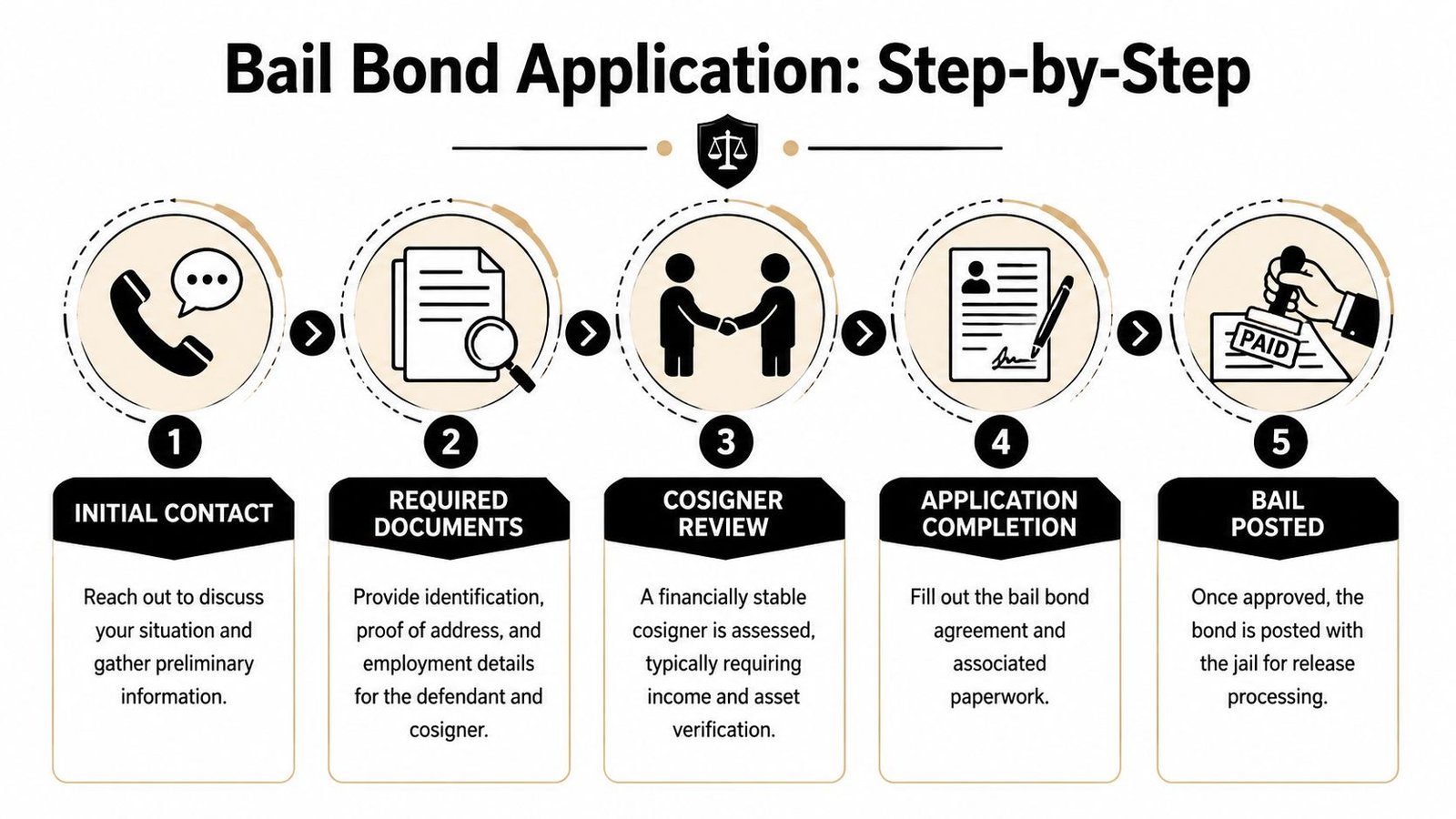
The Application Process Simplified Documents and Cosigners
Once the first contact is done, the case moves from urgency to paperwork. That's usually where families get nervous. They hear “application” and assume it means a long office visit, stacks of forms, and hours lost driving around town.
It doesn't have to work that way.
Who the paperwork is really about
There are usually two people the agency is evaluating.
The defendant is the person being released from custody. The agency needs enough information to identify them, understand the bond, and assess whether the release can be supported.
The cosigner is the person promising to stand behind the bond agreement. That person takes on real responsibility. If the defendant misses court or disappears, the cosigner may be financially exposed depending on the agreement and any collateral involved.
For a clear explanation of that role, review this page on the responsibilities of a bail bond cosigner.
Information and document checklist for bail application
| Required Item | For the Defendant | For the Cosigner |
|---|---|---|
| Full legal name | Yes | Yes |
| Date of birth | Yes | Yes |
| Government-issued ID | Sometimes available through records or later verification | Yes |
| Current address | Yes | Yes |
| Phone number | Yes | Yes |
| Employment information | Often requested | Often requested |
| Jail location | Yes | No |
| Booking number | If available | No |
| Court information | If available | Helpful to know |
| Proof of income | Sometimes requested | Commonly requested |
| Bank or asset information | Sometimes requested | May be requested |
| References | May be requested | May be requested |
Every agency has its own underwriting standards, but this is the practical core. The paperwork is about identity, contactability, and reliability.
Why remote processing matters
A modern workflow makes a real difference. If the defendant is in Colorado and the cosigner is in another city or another state, remote handling can keep the case moving without travel.
That usually means:
- Online applications instead of office-only forms
- Electronic signatures instead of in-person contract appointments
- Electronic payment options for faster completion
- Phone and text updates while the bond is being prepared
This is especially useful for parents, spouses, or siblings who are trying to help from out of state. The old model forced people to appear in person for nearly everything. The better model lets the agency verify identity and complete documents electronically.
What slows applications down
Most delays are not dramatic. They're small and preventable.
- Mismatched names: A nickname on one form and a legal name on another creates avoidable verification issues.
- Missing cosigner documents: The agency can't move if the signer can't prove identity or basic financial reliability.
- Unclear housing plans: Agencies often want to know where the defendant will be staying after release.
- Silence during the process: If the cosigner stops answering the phone, the file stalls.
A bail application isn't hard because it's complicated. It gets hard when tired people rush through it and leave blanks in the places that matter.
The smoothest files come from families who slow down just enough to submit complete, accurate information the first time.
Understanding Your Bail Bond Fees and Payment Options
The money conversation needs to be clear from the start. Families are often calling under pressure, and confusion about cost creates more stress than the paperwork does.
A lot of people searching for You Walk Bail Bond Agency are really trying to answer a simpler question. How much will it cost to get someone out, and what do I have to pay today? In Colorado, Express Bail Bonds handles that by explaining the bond type first, then the premium, then any payment or collateral requirements.
Surety bond versus cash bond
A cash bond means the court or jail requires the full bail amount to be paid directly. If the bond is cash-only, a bail bond company cannot convert it into a surety bond.
A surety bond works differently. The agency posts the bond, and the customer pays a nonrefundable premium for that service. Industry-wide, that premium is commonly a percentage of the bail amount, as explained in the American Progress fact sheet on the bail bond industry.
For Colorado families, the practical takeaway is simple. A surety bond usually lowers the amount you need upfront compared with paying the full bond in cash.
What to ask before you pay
Before any payment is made, get direct answers to these questions:
- Is the bond surety or cash-only?
- What is the premium?
- Is the premium refundable?
- Will collateral be required?
- What happens if the defendant misses court?
- Which payment methods do you accept?
Those questions are not excessive. They are how you protect your family.
The premium in a surety bond is the fee for the service, not a deposit that comes back at the end of the case. If you want a clearer breakdown of standard rates, financing, and accepted payment methods, review these Colorado bail bond payment options before you agree to terms.
When collateral may be required
Collateral does not apply to every file. It usually comes up on higher bond amounts, cases with increased flight risk, or files where the cosigner's financial profile does not support the bond on signature alone.
That collateral might involve real estate, a vehicle, valuable personal property, or another asset the agency can document properly. The right question is not just whether collateral is required. Ask when it will be released, what paperwork controls that release, and what happens if the defendant violates the bond.
At Express Bail Bonds, we explain that part in plain language because families make expensive mistakes during this stage. If the terms are vague, slow the process down long enough to get them in writing.
One money rule: If the agency cannot explain the premium, collateral terms, and cosigner responsibility in plain language, do not pay until they can.
A professional bail agent should be able to walk you through the numbers without pressure, shortcuts, or surprises.
From Posting to Release Jail Timelines Across Colorado
The hardest part for many families starts after payment goes through. You have signed the paperwork, the bond is posted, and your person is still sitting in jail.
That delay does not automatically mean anything is wrong. In Colorado, release time is controlled by the jail after the bond is accepted, and every facility runs that process a little differently.
What happens after the bond is posted
Once Express Bail Bonds submits the bond, detention staff take over. They may still need to finish identity verification, check for additional holds, complete medical or classification review, return property, and clear internal release paperwork.
Some releases move fast. Some do not. The difference often has more to do with jail workflow than with the bond company.
If you want a clearer sense of what affects the wait, this guide on how long bail takes to process in Colorado jails lays out the common delay points families run into.
Why one Colorado jail moves faster than another
A release in one county can take far less time than a release in another county on the same day. Staffing levels, shift change, booking volume, classification procedures, and warrant checks all affect the clock.
Late evening and overnight releases often slow down. Busy metro facilities can also stack up quickly when intake and release are both backed up.
Another issue families miss is the hold problem. A person can qualify for release on the current bond and still stay in custody because another county, court, probation office, or law enforcement agency has placed a hold. In that situation, posting bond on one case does not end the custody issue.
Local knowledge helps more than a generic timeline
People sometimes search for You Walk Bail Bond Agency because they are trying to understand the process fast. That company serves Texas. Colorado families need Colorado-specific answers, because release timing here depends on local jail procedure, not a general promise from another state.
That is why county-level information matters.
If your person is being held near Golden, it helps to read a county-specific page on Jefferson County bail bonds in Golden, Colorado. Local pages often answer the practical questions families ask first, including facility location, common processing issues, and who you may need to contact.
If the case is tied to the south metro area, a local page for bail bonds in Centennial gives more useful context than a broad statewide overview.
What to do while you wait
The best move is to stay reachable and let the process work. Repeated calls to the jail usually do not speed up release, but missed calls from your bond agent can slow it down if a document, signature, or hold issue comes up.
Use the waiting time well:
- Keep your phone on and nearby.
- Watch for text or email updates.
- Plan transportation from the facility.
- Have medications, clothing, or personal basics ready if needed.
- Confirm where the defendant will stay that night.
I tell families this every day. Silence during processing is common. The right Colorado bail partner will keep checking the file, explain what is normal, and tell you quickly if there is an actual problem.
Life After Release Next Steps and Common Questions
The bond process doesn't end at the jail door. Release is the beginning of a new set of responsibilities, and families at this stage either stabilize the case or accidentally make it worse.

What the defendant needs to do immediately
The released person should do three things right away.
- Read every release condition carefully: Travel limits, no-contact orders, and reporting requirements matter.
- Track every court date: Missed appearances create fast, serious problems.
- Stay in contact with the agency and attorney: Silence creates risk for everyone involved.
This isn't paperwork for later. These are active conditions attached to release.
Common questions families ask
Important reminder: A bond solves the custody problem. It does not solve the criminal case.
Do you get the premium money back when the case ends
Usually, no. The premium is generally the fee paid for the surety bond service, not a court deposit held for refund.
What happens if a court date is missed
Missing court can lead to a warrant, bond trouble, and immediate pressure on both the defendant and cosigner. The right move is fast action. Contact the attorney and the bond agent immediately.
What is the cosigner responsible for if the defendant runs
The cosigner can face financial consequences under the bond agreement. That's why cosigning should never be treated as a favor without risk. It's a legal and financial commitment.
What's the difference between bail and bond
Bail is the amount set for release. Bond is the mechanism used to satisfy that release requirement. Sometimes the family pays the full amount directly. Sometimes a surety agency posts the bond instead.
Why do some agencies sound vague about programs or options
That's a fair concern. Some agencies advertise flexibility without spelling out qualifications. For example, You Walk says it offers “several programs that make it easy for clients to obtain their release regardless of funding or collateral ability” and says it is “large enough to offer programs needed to guarantee your loved ones release”, but the company's public pages do not provide specifics on down payments, cosigner requirements, or qualification standards, according to this review of the content gap on the You Walk site. Families should ask direct questions and expect direct answers.
A steadier way to handle the days after release
The best post-release plan is simple. Put court dates in the calendar, answer calls, follow conditions exactly, and involve the cosigner in updates so nobody is surprised by a missed obligation.
People get into trouble after release when they treat bond as the finish line. It isn't. It's the point where responsibility starts counting in a visible way.
If you need fast Colorado bail help right now, contact Express Bail Bonds. They serve detention facilities across Colorado, handle documents remotely, and are available 24/7 by call or text at 720-984-2245 to help you start the release process without confusion.