
The call usually comes at the worst hour. A spouse says someone was arrested after a traffic stop. A parent says their son was taken in after an argument. A friend only knows, “They were picked up somewhere near Denver,” and nothing else.
In that moment, individuals often open a search engine and type jail inmate search colorado. That's the right instinct, but the wrong first click can waste valuable time. In Colorado, the fastest path is usually not a statewide prison search. It's finding the right county jail roster for the place where the arrest happened.
Navigating the First Few Hours After an Arrest
The first few hours feel messy because the information is incomplete. You may have a name, a rough location, and a short phone call. You probably don't yet have a booking number, bond amount, or court date.
That doesn't mean you're stuck. Colorado's local jail system moves a high volume of people through intake, release, and court processing. According to the Vera Institute's Colorado incarceration data, local jails in the state see at least 220,539 bookings each year, and 65% of the jail population is held pretrial. In plain terms, many people in county jails haven't been convicted and may be waiting for bond decisions, release conditions, or a first appearance.
What families usually need first
Most families need answers to four immediate questions:
- Where are they being held
- Have they been booked yet
- Is bail possible
- What should I do next
If you're still trying to understand the sequence from arrest to booking, court, and release, this breakdown of what happens after you get arrested is a useful starting point.
Practical rule: Don't assume “Colorado inmate search” means one database covers everything. It doesn't.
A lot of panic comes from searching too broadly before confirming the jurisdiction. A fresh arrest is usually a county jail issue, not a state prison issue. That distinction matters because one system may show the person quickly, and the other may never show them at all.
Families dealing with related criminal issues outside Colorado often need the same kind of fast orientation. For example, someone trying to decide whether to get legal help after an arrest involving impaired driving may benefit from this plain-English guide on criminal defense for Illinois DUI.
What works in the first hour
Start with the basics you can verify. Legal name. Date of birth if you know it. Approximate arrest location. Which law enforcement agency made contact, if anyone told you.
What doesn't work is bouncing between random databases and social media posts. The fastest searches are focused, local, and patient enough to account for booking delays.
Where to Search County Jails vs State Prisons
The biggest mistake in a jail inmate search colorado situation is searching the state prison system for someone who was just arrested. That's a dead end in most fresh arrest cases.
Many families mix up county jail rosters and the Colorado Department of Corrections. As noted by the Pueblo County inmate lookup context, people often waste critical time searching DOC records when a newly arrested person won't be listed there. Newly arrested people are generally held locally, where bail decisions are relevant.
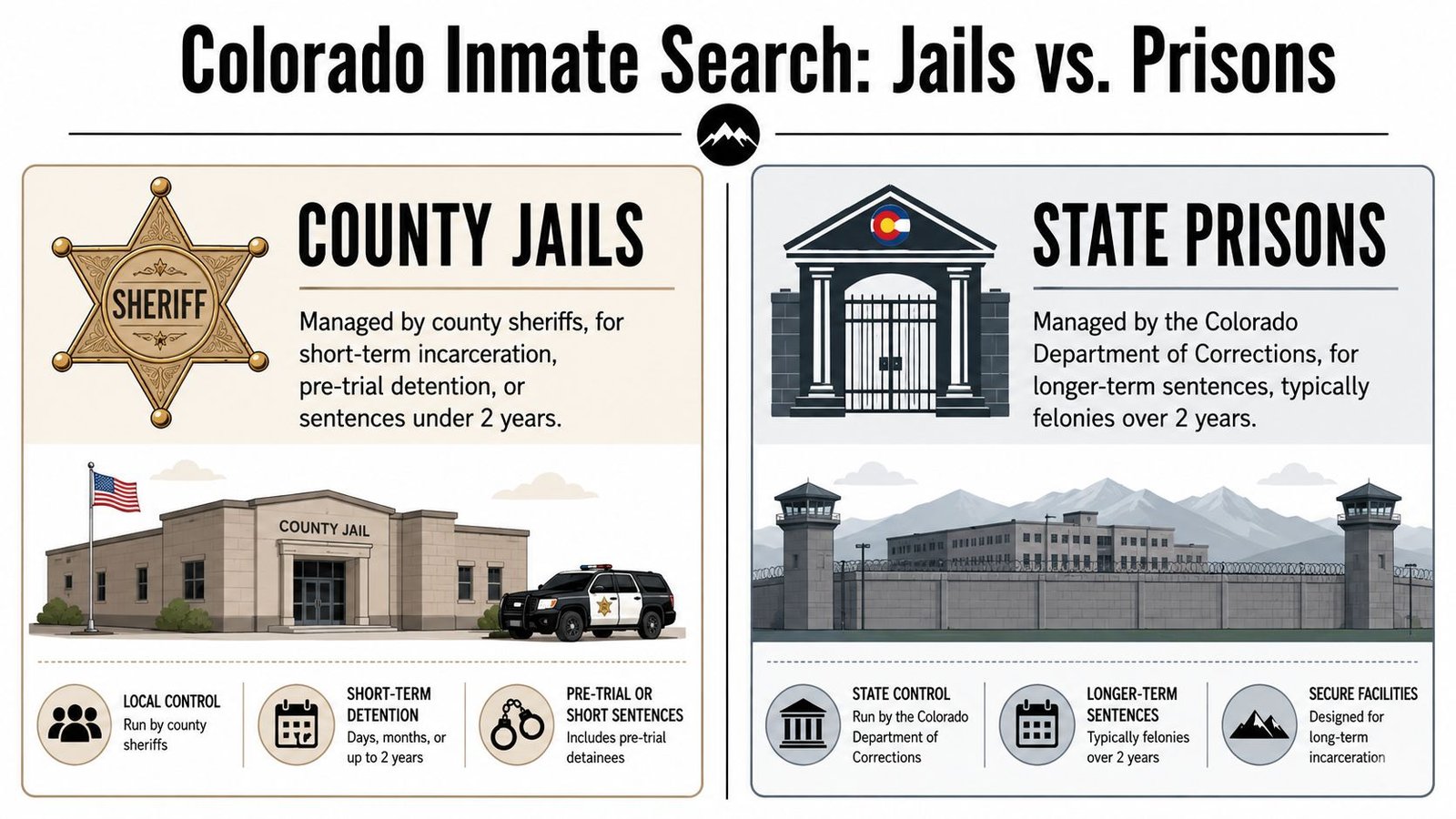
County jail and DOC are not the same system
If the arrest happened today or recently, start with the county sheriff's jail roster. If someone has already been convicted and sent away for a longer sentence, then the DOC system may be relevant.
Here's the quick comparison that saves families the most time:
| Characteristic | County Jails (Sheriff's Office) | Colorado DOC (State Prison) |
|---|---|---|
| Who runs it | Local county sheriff | State corrections system |
| Typical use | Recent arrests, pretrial detention, shorter local custody | Longer-term prison sentences |
| Best search starting point after an arrest | Yes | No |
| Bail relevance | Often relevant | Not typically relevant for a fresh arrest |
| Where families usually go wrong | They skip this and search statewide | They search this too early |
If you need a clean explanation of the legal distinction, this page on the difference between jail and prison lays it out clearly.
A simple decision test
Use this test before you search:
- Was the arrest recent? Search the county jail first.
- Do you know the county or city? Go to that sheriff or detention center site.
- Was the person already sentenced long ago? Then a prison locator may matter.
- Are you trying to arrange bail? Focus on county jail records, not DOC.
If the person was arrested in Denver, Jefferson, Arapahoe, Weld, Douglas, or another county jail system, that's where the active booking and bond information usually starts.
What families should ignore at first
Don't lose time on statewide “offender” searches when the person was just picked up a few hours ago. Don't assume every police department maintains its own complete public inmate list either. In many cases, the booking record appears through the jail that accepted custody, not through the agency that made the arrest.
That one distinction solves a lot of confusion. If you're searching for someone newly arrested, think local custody first.
How to Use Colorado Inmate Search Tools
Once you know the county, the search gets more practical. Most Colorado jail rosters are hosted through a sheriff or detention facility website and usually let you search by name.

A good first move is to use the person's full legal last name, then narrow from there. If the result is empty, don't assume they aren't there. Search tools can be picky, and booking records aren't always entered the way families expect.
For a more focused walkthrough, this guide on how to find someone arrested is worth keeping open in a second tab while you search.
Search the way booking systems actually behave
Most public jail roster tools work best when you use simple inputs:
- Start with the legal last name. Some systems return better results with less information, not more.
- Try first-name variations. A person may be listed under a formal first name instead of a nickname.
- Check spelling carefully. Intake entries can differ from what family members expect.
- Use date of birth to confirm identity. This helps separate people with similar names.
- Look for booking details, not just the name. You want the record with charges, booking date, and bond information if available.
What to expect on the screen
Some rosters show a basic list first. Others open a profile with more detail. If the page is slow, refresh once and wait. Repeated clicking can create more confusion than clarity.
This short video gives a helpful overview of what online search and bail-related navigation can look like in practice:
Search for confirmation, not assumptions. A matching name alone isn't enough. Verify the date of birth, booking date, and location before you act on it.
The best result is the one that tells you you've found the right person. Families often move too quickly once they see a familiar name. Slow down enough to make sure it's the correct booking.
What to Do If You Cannot Find the Inmate
Not finding the person right away is common. It's stressful, but it usually doesn't mean they vanished into some hidden system.
The biggest reason is timing. According to the Prison Policy Initiative's jail processing discussion, most Colorado jails process new bookings within 24-72 hours, and initial court appearances are typically scheduled within 72 hours of arrest. A person may not appear in a public online search immediately after being taken into custody.

The most common reasons a search comes up empty
A missing record usually comes down to one of a few practical issues:
- The booking isn't finished yet. Arrest happens first. Public posting can come later.
- You're searching the wrong county. The arrest location and the holding facility are not always the same.
- The name was entered differently. Hyphenated names, suffixes, and spelling variations can throw off a search.
- The person was transferred within the local system. Some areas move people between intake and housing locations.
- The tool itself is limited. Public rosters aren't always updated instantly.
A calm troubleshooting sequence
If the first search fails, use a tighter process instead of searching randomly.
- Search again using only the last name.
- Try common spelling variations.
- Check nearby counties if the arrest happened near a county line or metro border.
- Wait a bit, then search again rather than refreshing every few minutes.
- If you know the arresting agency, call the non-emergency line or detention desk and ask where the person was taken.
Reality check: An arrest can be real even when the online roster is still blank.
What doesn't help is assuming the website is complete at every moment. Public-facing systems lag behind real-time booking activity more often than families realize.
When to stop searching alone
If you've checked the likely county, tried name variations, and allowed some time for booking, it may be time to get direct help from a professional who deals with detention systems every day. At that point, the issue usually isn't effort. It's knowing which desk, database, or facility to call next.
Understanding the Inmate Roster Information
After you locate the individual, the next step involves interpreting the roster accurately. Many families encounter a page filled with various terms and numbers and are unsure which specific line matters.
The most important fields usually aren't the dramatic-looking ones. They're the identifiers and release-related details.
The fields that matter most
When you pull up a jail record, look for these items:
- Booking number. This is the jail's tracking number for that arrest.
- Full legal name and date of birth. Use these to confirm identity.
- Charges. These are allegations tied to the booking.
- Bond amount. This tells you whether the court has set a monetary bond.
- Bond type. This may indicate whether a surety bond is allowed or whether it's cash only.
- Court date or appearance information. This helps you understand urgency and next steps.
If you're unsure whether a listing means no release is possible, this explanation of no bail meaning can help you interpret the language.
Two terms families often misunderstand
Surety usually means a licensed bail bond agent may be used if the court allows that bond type.
Cash only usually means the full amount must be posted in cash or an approved equivalent directly through the jail or court process, rather than through a surety bond.
The roster tells you what the jail knows. It doesn't always tell you the full story behind the case, and it may not update the moment a judge makes a change.
That's why families should treat the roster as a working record, not the final word on every detail. It's useful, but it isn't perfect.
What to write down before you make calls
Before contacting anyone about release, write down the person's full name, booking number, facility name, listed charges, bond amount, and bond type. If a court date appears, note that too.
That short list prevents repeated mistakes and saves time when you're speaking with the jail, a lawyer, or a bail professional.
Your Immediate Next Steps for Bail
Once you've confirmed the person's location and seen that a surety bond may be available, speed matters. The smoother the information you provide, the easier the release process usually becomes.
That's where practical preparation helps more than panic. Bail work is not only about posting paperwork. It's also about presenting a defendant as someone who will return to court and comply with conditions.

What helps a release move more smoothly
Colorado pretrial decisions often turn on facts that show stability. The Colorado community corrections report supports a point experienced agents already know in practice: community ties and stable employment are important factors in pretrial risk assessment, and presenting that information well can help strengthen the release picture.
Useful information often includes:
- Employment details
- Stable housing
- Family support
- Reliable cosigner information
- A clear understanding of upcoming court obligations
If you need a basic primer on bond structures beyond Colorado, this explanation of Michigan bail bond options is a helpful general reference on how different bond types work.
The practical order of operations
A lot of people try to solve five things at once. Don't. Handle them in order:
- Confirm the facility and bond status.
- Gather the defendant's identifying details.
- Confirm whether the bond is surety or cash only.
- Have a cosigner ready if one may be needed.
- Review the release process before money changes hands.
This guide on how to bail someone out of jail is useful if you want the process in plain language before making a decision.
What not to do
Don't promise the jail something you haven't verified. Don't assume a listed amount means every bond company can handle every bond type. And don't wait until late in the process to gather basic details like date of birth, booking number, and current holding facility.
Good bail decisions are organized decisions. The family that has the right information usually moves faster than the family making frantic guesses.
If you need immediate help locating a detainee, understanding bond type, or posting a surety bond anywhere in Colorado, contact Express Bail Bonds. They serve detention facilities statewide, including Jefferson County and Golden and Centennial and the surrounding Arapahoe County area, and they can guide you through the process by phone, text, or online paperwork when time matters most.