
That phone call usually comes at the worst time. A spouse says your person was taken to jail. A parent only knows there was a traffic stop. A friend texts a name, a birth date, and nothing else. In that moment, what you need isn’t legal jargon. You need a clean path to find the person, confirm where they are, and figure out how to move toward release.
If you're trying to handle an el paso county detention facility inmate search, start with one principle. Slow down enough to verify each detail once. Families lose the most time when they search the wrong jail, rely on a nickname, or assume the first result answers every question. The right search can tell you a lot. It can also mislead you if you don’t know how to read it.
Navigating the First Steps After an Arrest in El Paso County
The first hour after an arrest feels disorganized because everyone around you has partial information. One person knows the city. Another knows the charge they think was mentioned. Someone else says the person should be out soon. None of that is enough to act on.
What helps is narrowing the problem fast. If the arrest happened in or around Colorado Springs, the jail you’ll usually focus on is the El Paso County Detention Facility in Colorado Springs. It serves as Colorado’s largest county jail, with a pre-pandemic peak population exceeding 1,700 inmates and roughly 1,200 inmates housed as of 2022, according to reporting on the facility by The Colorado Sun.

That size matters. In a large facility, intake, classification, court holds, and housing updates can create confusion for families who expect immediate answers. The jail does provide a public inmate search tool through the sheriff’s office website, but the search is just one part of the process.
What to gather before you search
Start with the details that improve the odds of finding the right person.
- Legal last name: Use the name that would appear on a driver’s license or court paperwork, not a nickname.
- Booking number if you have it: This is the cleanest way to search.
- Approximate arrest time and location: That helps you decide whether the person is likely still in booking.
- Any known date of birth spelling issues: Hyphenated names, suffixes, and recent name changes can all matter.
Practical rule: Don’t make decisions off secondhand details alone. Verify the booking first, then make the next call.
Families often ask what happens immediately after arrest, especially if this is the first time they’ve dealt with the jail system. A straightforward primer on what happens after you get arrested can help you understand why someone may not show up online the minute they arrive.
There’s another point worth mentioning for attorneys and law office staff helping worried relatives. Fast, accurate intake on your side matters too. Firms that want to boost law firm client intake often focus on answering calls quickly and gathering complete details up front, which is the same discipline that helps families avoid wasted time during an inmate search.
What works in the first few hours
Panic creates bad shortcuts. Good intake creates options.
A calm first pass usually looks like this:
- Confirm the county first
- Search the official sheriff’s tool
- Check whether the record shows bond information
- Call for verification before taking official action if anything looks unclear
- Keep one person in the family in charge of updates
If you do those five things, the rest of the process gets easier.
Using the Official Online Inmate Search Portal
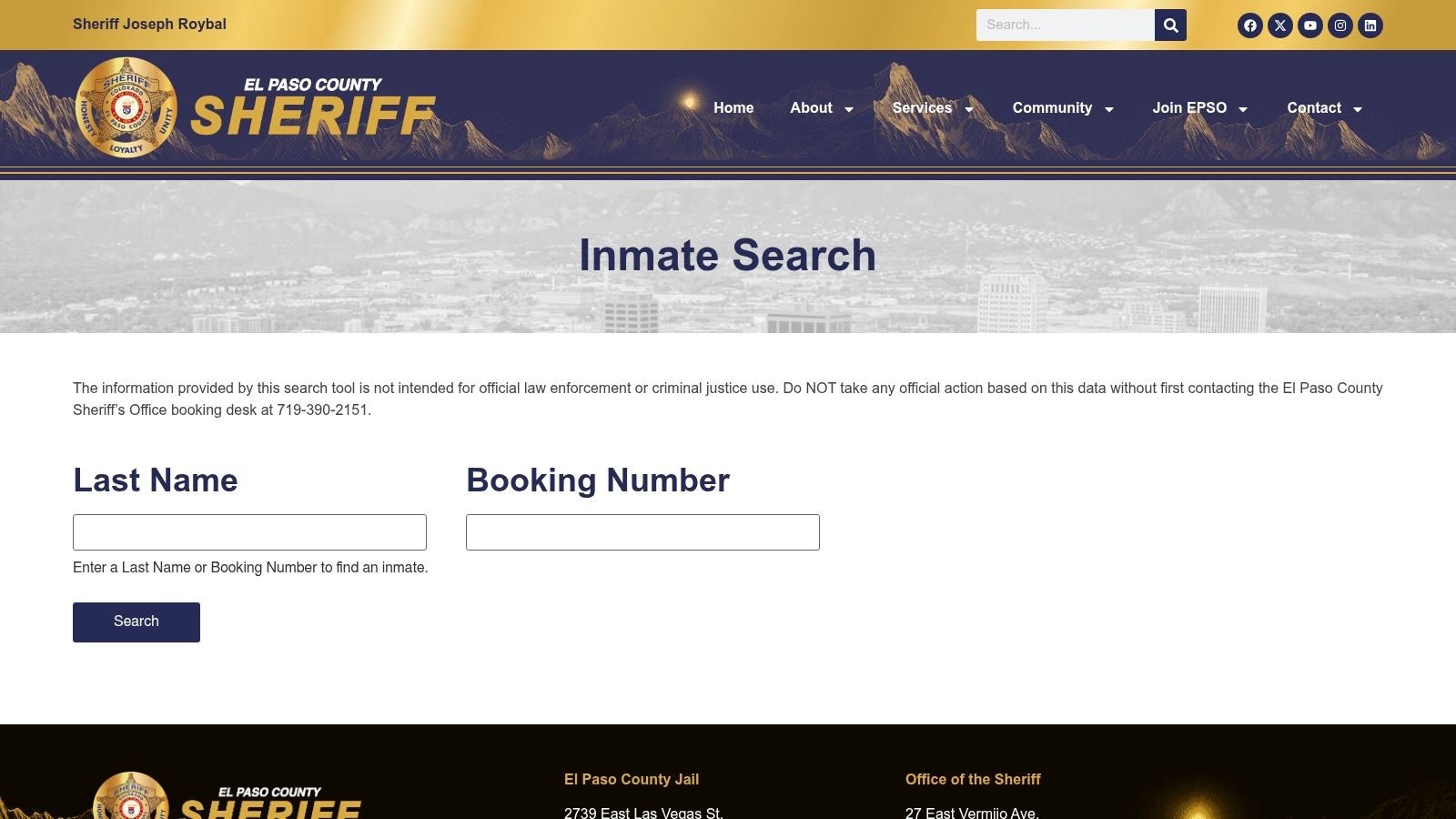
The official El Paso County Sheriff's Office search tool is the fastest place to start. It’s simple by design, which is good for speed but not always forgiving if your information is off by even a little.
A direct walkthrough matters here because most families don’t need a generic explanation. They need to know exactly what to type, what the results mean, and what not to assume.
How to run the search correctly
Use the official sheriff portal and enter either the inmate’s last name or booking number. Full names help narrow the result set, and partial name searches can return 20 to 30 results. Using an exact booking number produces the best match rate, at about 85 to 90 percent, while delays in booking updates of 5 to 30 minutes and name variations can cause 15 to 20 percent of initial searches to fail, as described on the El Paso County Sheriff's Office inmate search page.
That tells you two things right away. First, the system is useful. Second, “no result” doesn’t always mean “not there.”
Best input choices
Here’s the order I’d use when speed matters most:
- Booking number first: If law enforcement, a bondsman, or the arrested person gave you a booking number, use it.
- Last name second: Spell it exactly as it appears in official records.
- Full name when possible: This helps when the last name is common.
- Try formal versions of the name: If “Mike” fails, use “Michael.” If a middle name commonly appears on records, keep that in mind.
A lot of search frustration comes from treating the portal like a social media search bar. It isn’t one. It rewards exactness.
For readers trying to understand related search methods across Colorado, this guide on how to find someone arrested is also useful, especially when the arresting agency and holding facility aren’t the same.
How to read the result line
Once the person appears, slow down and read each field before you click away or start calling everyone in the family.
Look for these items:
| Field | What it tells you | Why it matters |
|---|---|---|
| Name | The listed identity in the jail system | Confirms you found the right person |
| Photo | Visual identity check | Helps separate people with similar names |
| Charges | The allegations listed at booking | Gives context, but not the full legal picture |
| Bail amount | The amount tied to release eligibility | Tells you whether financial action may be needed |
| Custody status | Whether the person is still in custody | Helps prevent acting on outdated assumptions |
If the name matches but the photo or charge pattern doesn’t, stop and verify before you move money or sign anything.
Many families benefit from seeing the process in motion before using the portal themselves. This overview may help:
What does not work well
Some habits waste time:
- Using only a nickname
- Searching once and assuming the result is final
- Ignoring spelling differences
- Treating an empty search as proof the arrest didn’t happen
- Relying on someone’s memory of the bond amount
The portal is strong for quick verification. It’s weaker when you have incomplete or sloppy intake data. That isn’t a flaw so much as a reminder to search like the jail system expects you to search.
When the Online Search Fails What to Do Next
A failed search doesn’t always mean the person isn’t in custody. It often means the information you have and the information the system has don’t line up yet.
That distinction matters because families tend to make the same wrong assumption. They search once, get nothing, and switch into crisis mode. In practice, there are several ordinary reasons the person may not appear right away.
Common reasons you get no result
The first is timing. A person may still be moving through booking, paperwork, classification, or database updates. The second is identity formatting. A hyphen, suffix, middle name, or alternate spelling can be enough to miss the record. The third is user error. People often search the wrong county or even the wrong state.
Search failure usually means “verify and retry,” not “give up.”
If you’ve searched carefully and still don’t find the person, use a more methodical fallback.
Recheck the spelling
Use the full legal last name. If you suspect an alternate spelling, try that too.Wait briefly and search again
Fresh bookings don’t always appear immediately.Call the booking desk for verification
The El Paso County Sheriff's Office cautions users not to take official action without contacting the booking desk at 719-390-2151, as noted in the earlier Colorado jail reporting.Confirm the arrest happened in El Paso County, Colorado
City police contact with someone doesn’t always mean they’ll be held where you first expect.
Don’t confuse Colorado with Texas
This mistake happens more than people think because both facilities use the same county name. The El Paso County Detention Facility in Colorado Springs is not the same as the facility in El Paso, Texas. The Texas facility primarily handles short-term ICE holdings with a very low daily population, while the Colorado jail is the state’s largest county jail, according to the facility distinction summarized in this detention report listing.
That mix-up can send families into the wrong database, the wrong phone tree, and the wrong assumptions about bond or release.
A simple troubleshooting comparison
| Problem | Likely cause | Best response |
|---|---|---|
| No result immediately after arrest | Booking still in progress | Wait, then search again |
| Too many similar names | Common surname | Use booking number or more complete identity details |
| No Colorado result at all | Wrong county or wrong state | Verify agency and location |
| Conflicting information from family | Multiple secondhand versions | Pick one point person and confirm directly |
For broader guidance during those first chaotic hours, this article on what to do when someone gets arrested helps families organize the next steps without guessing.
When a phone call is the better move
The online tool is convenient. It isn’t final authority. If the situation is urgent, a direct call is often the better move when:
- The arrest was recent
- The person may have used another legal name
- You need to verify custody before arranging transportation or childcare
- You’re hearing there may be a hold or release issue
A quick, accurate call beats an hour of repeated bad searches.
You've Found Them What Does the Information Mean
Finding the person in the system brings relief, but it also creates a second problem. Now you’re staring at booking details, charge language, and bond terms that may not be familiar.
This is the point where families either make good decisions or create expensive delays. The screen gives you clues. It doesn’t interpret itself.
Start with identity and booking status
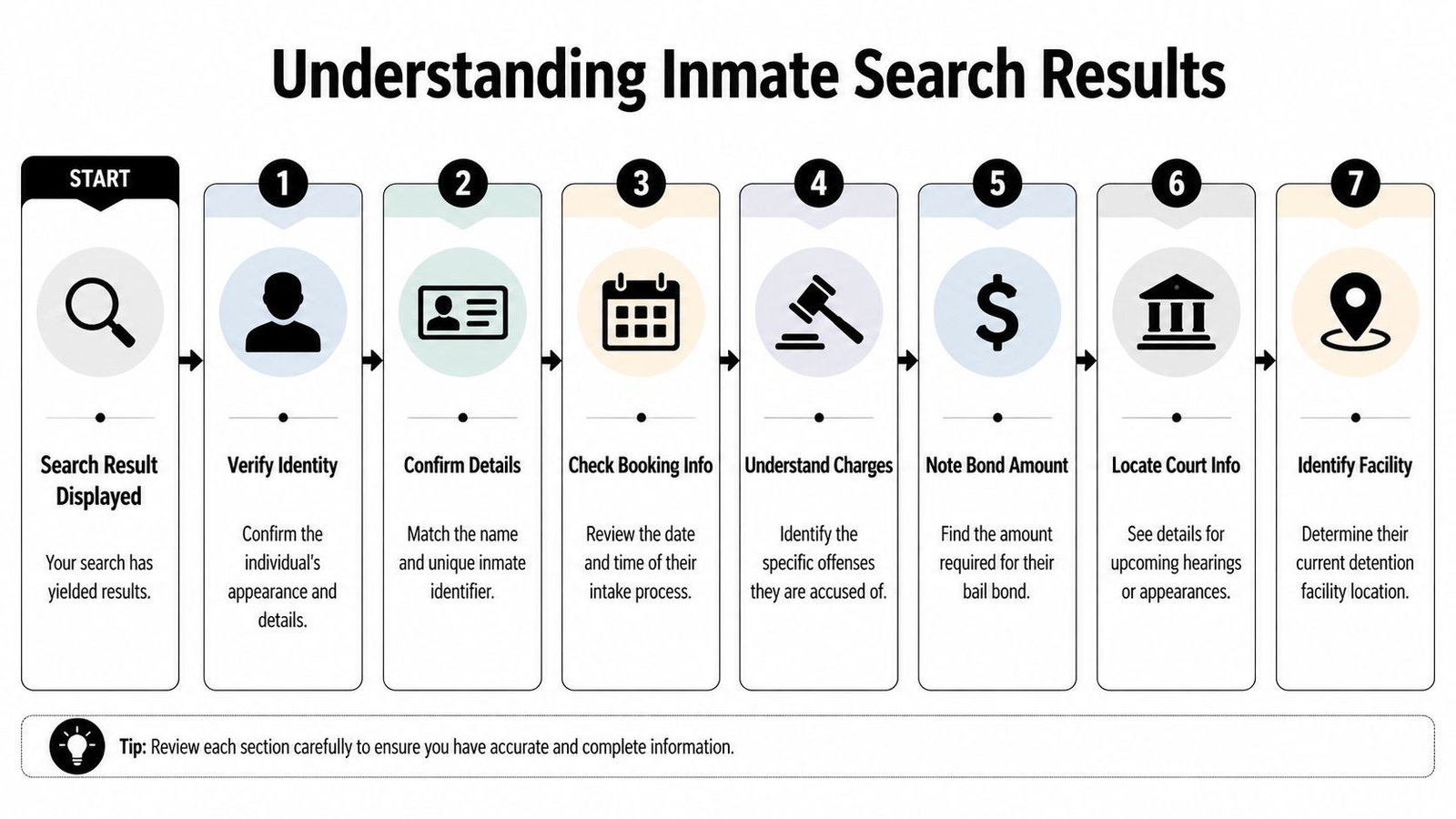
Before anything else, confirm it is the correct person. Match the name, photo, and any other identifying details shown. Families under stress sometimes lock onto a familiar last name and miss that the rest of the record points to someone else.
Then look at the booking status. Is the person in custody, released, transferred, or awaiting another step? That single line changes what you need to do next.
Read the charge list carefully
Charges on the search screen are booking information, not a full legal strategy. They tell you why the person was booked, but they don’t answer every court question. Still, they matter because they often explain why bond was set, why it wasn’t set, or why the release process may be slower.
A useful way to think about charges is this:
- One listed charge: The path may be simpler, but don’t assume release is automatic.
- Several listed charges: There may be multiple issues affecting release timing.
- A hold or restriction noted: That can limit or delay release even if a bond appears elsewhere in the record.
The bond amount matters, but the bond type matters just as much.
Bond type changes your next move
Families often focus only on the dollar amount. That’s understandable, but incomplete. You also need to know what kind of bond is attached to the case.
Here’s the plain-English version:
| Bond type | What it usually means for you |
|---|---|
| Cash bond | The full cash amount may need to be paid directly |
| Surety bond | A licensed bond agent can usually step in |
| PR bond | The person may be released on recognizance without paying a traditional bond amount |
| No bond | Release isn’t available until a court or legal condition changes |
If the listing indicates a PR bond, it helps to understand how recognizance release works and what obligations still follow. This explainer on what released on recognizance means is a useful reference.
What families should do after reading the result
Once you understand the record, act in order:
- Confirm identity
- Note the charge list exactly as shown
- Write down the bond amount and bond type
- Check for any hold or no-bond language
- Prepare questions for the jail, attorney, or bond professional
Don’t rely on memory here. Screenshot the result if allowed on your device, or write the details down clearly.
A few common reading mistakes
Families often trip over the same issues:
- Assuming listed charges equal a conviction
- Treating “bond set” as “release is automatic”
- Missing a hold because they only looked at the amount
- Confusing PR release with no further obligations
Search results are useful because they compress a lot of information into one page. They’re also dangerous when read too fast.
How Express Bail Bonds Can Expedite the Release Process
Once you know the bond information, the practical question becomes simple. Who can move this forward quickly, accurately, and without adding more confusion?
That’s where a professional surety process can save time. Families trying to do everything themselves often get stuck on paperwork, logistics, jail procedures, or payment questions. A licensed Colorado agency that handles these cases every day can usually reduce the back-and-forth and keep the process moving.

What a surety bond does
A surety bond is often the practical choice when families don’t want or can’t post the full amount directly. For Colorado clients, Express Bail Bonds states that it posts surety bonds at a 15% premium, or 10% for bonds over $5,000 with a cosigner, and offers electronic processing, as described in the company background provided and the earlier Colorado facility reference.
That matters because a family in crisis usually doesn’t need more errands. They need a path that can be handled quickly, with clear instructions.
What makes the process faster
The strongest benefit isn’t just financing. It’s coordination.
Express Bail Bonds serves Colorado statewide and offers online applications, electronic documents, and remote payment handling through the main Express Bail Bonds website. For El Paso County cases specifically, their Colorado Springs El Paso County bail bond page gives local contact options and service details.
That remote process is especially helpful when:
- The cosigner lives outside Colorado
- The family doesn’t want to wait at the jail
- The arrest happened overnight
- Several relatives are trying to coordinate from different places
A fast release process usually starts with complete information, not rushed information.
Why statewide experience matters
Even when the booking is in El Paso County, the family helping may live somewhere else. That’s why statewide coverage is useful. Express Bail Bonds also maintains service pages for nearby metro areas, including Jefferson County bail bonds in Golden and bail bonds in Centennial.
Those pages matter less because of geography and more because they show the agency works across multiple Colorado detention systems. That usually means better familiarity with county-by-county differences in intake, posting, and release flow.
Reviews and reassurance
Families also want some sign that they’re dealing with a responsive company. If you’re comparing options, review pages can help. Express Bail Bonds provides public review access through this Google review profile and this additional review link.
What usually makes the biggest difference, though, is having someone answer clearly when you call. In this part of the process, speed and calm communication matter more than sales language.
Frequently Asked Questions About the Inmate Search Process
How long does it take for someone to appear in the inmate search
Not always immediately. The sheriff search information notes there can be 5 to 30 minute data lags after booking, and sometimes the delay is more about name formatting than timing. If a recent arrest doesn’t appear, search again carefully and verify with the jail if needed.
What if I only know the person’s nickname
Start by finding the legal last name. The official portal works best with formal identifying information, not casual names. If you don’t have that, gather it before assuming the person isn’t in custody.
What if the search returns too many people
That usually happens with a common surname. Add more precise information if possible, and use the booking number if anyone has it. The photo and custody details also help you avoid choosing the wrong person.
What if the bond amount looks unaffordable
Don’t assume your only option is to come up with the full amount in cash. The bond type matters, and a surety option may be available depending on the case. The right next step is to confirm the bond type before making financial decisions.
What happens after bond is posted
Posting bond starts the release process. It doesn’t mean the person walks out the same minute. The jail still has internal steps to complete, and release timing can vary based on booking volume, holds, and facility procedures.
Can I call instead of relying on the website
Yes. In fact, that’s the better move when the information is urgent or the online record seems incomplete. The inmate search tool itself warns users not to take official action without contacting the booking desk first.
Can I send money or property through the search page
Usually, no. The inmate search is for locating and reviewing detention information. Property, commissary, and release-property procedures are handled through separate jail processes. Always check the jail’s current instructions before assuming a family member can drop something off.
What’s the biggest mistake families make
Searching too fast and acting too soon. The fix is simple:
- Verify the right facility
- Use the legal name
- Read the full result
- Confirm bond type before arranging payment
- Call when the record doesn’t make sense
If you need help posting bail anywhere in Colorado, Express Bail Bonds is available 24/7 to guide you through the process, explain your options clearly, and handle fast electronic paperwork so you can move toward release without wasting critical time.