
An arrest usually throws a family into two crises at once. One is emotional. The other is procedural. People want to know who will help their loved one, who can get them out, what happens first, and why the system feels so confusing.
That’s where a lot of families ask the same question: what is the role of a public defender?
The short answer is that a public defender is the court-appointed lawyer for someone who can’t afford private counsel. The fuller answer matters more. A public defender protects constitutional rights, speaks for the accused in court, challenges the prosecution’s evidence, and helps a person make decisions that can affect freedom, work, immigration status, family stability, and the future.
At the same time, families often expect a public defender to do things that no lawyer can fully control, especially at the start of a case. A public defender can argue for release, but the judge sets bail. A public defender can prepare a defense, but they may be handling many cases at once. Understanding both the power and the limits of that role can lower panic and help you make better decisions in the first few days.
Understanding the Public Defender A Constitutional Right
A public defender is not just a “free lawyer.” A public defender exists because the Sixth Amendment right to counsel means a person facing criminal charges must have legal representation, even if they can’t afford to hire a lawyer privately.
That right matters most when life is least stable. If your family member has just been arrested, the first court dates can move quickly. Charges are read. Bail may be discussed. Deadlines begin. A public defender steps in as the person whose job is to protect the accused person’s legal rights from the beginning.
Who gets a public defender
Courts generally appoint a public defender for people who qualify financially. You may hear the word indigent. In plain language, that means the court decides the person doesn’t have enough money or available resources to hire private counsel.
In practice, that usually involves paperwork about income, expenses, debts, and assets. Families sometimes assume that being employed automatically disqualifies someone. It doesn’t always work that way. The court looks at the person’s financial situation, not just whether they have a job title.
Practical rule: If you think your loved one may qualify, complete the financial paperwork carefully and honestly. Small mistakes can slow down appointment.
Why this system matters
Public defense is not a tiny corner of the legal system. Roughly 5.6 million Americans rely on public defenders, and a Bureau of Justice Statistics census found that 957 public defender offices handled over 5.5 million cases. That same census showed funding differences between state-funded and county-funded offices, which affects staffing and resources available to attorneys, according to the BJS survey design study on public defense.
That helps explain why the experience can feel different from one place to another. One office may have more investigators or support staff. Another may have fewer people carrying the same kinds of responsibilities.
What families should understand early
The public defender is the legal shield. They are not the jail release mechanism. Those are related issues, but they aren’t the same. If you’re trying to understand the first release stage, this guide on what pretrial release means in Colorado can help make the language less intimidating.
A good way to think about it is this:
- The court appoints the defender to protect rights and handle the case.
- The judge controls conditions of release.
- The family often has to handle the practical side of getting a person home.
That division surprises people. It shouldn’t. It’s one of the biggest reasons families feel lost in the first 48 hours.
The Core Duties and Responsibilities of Counsel
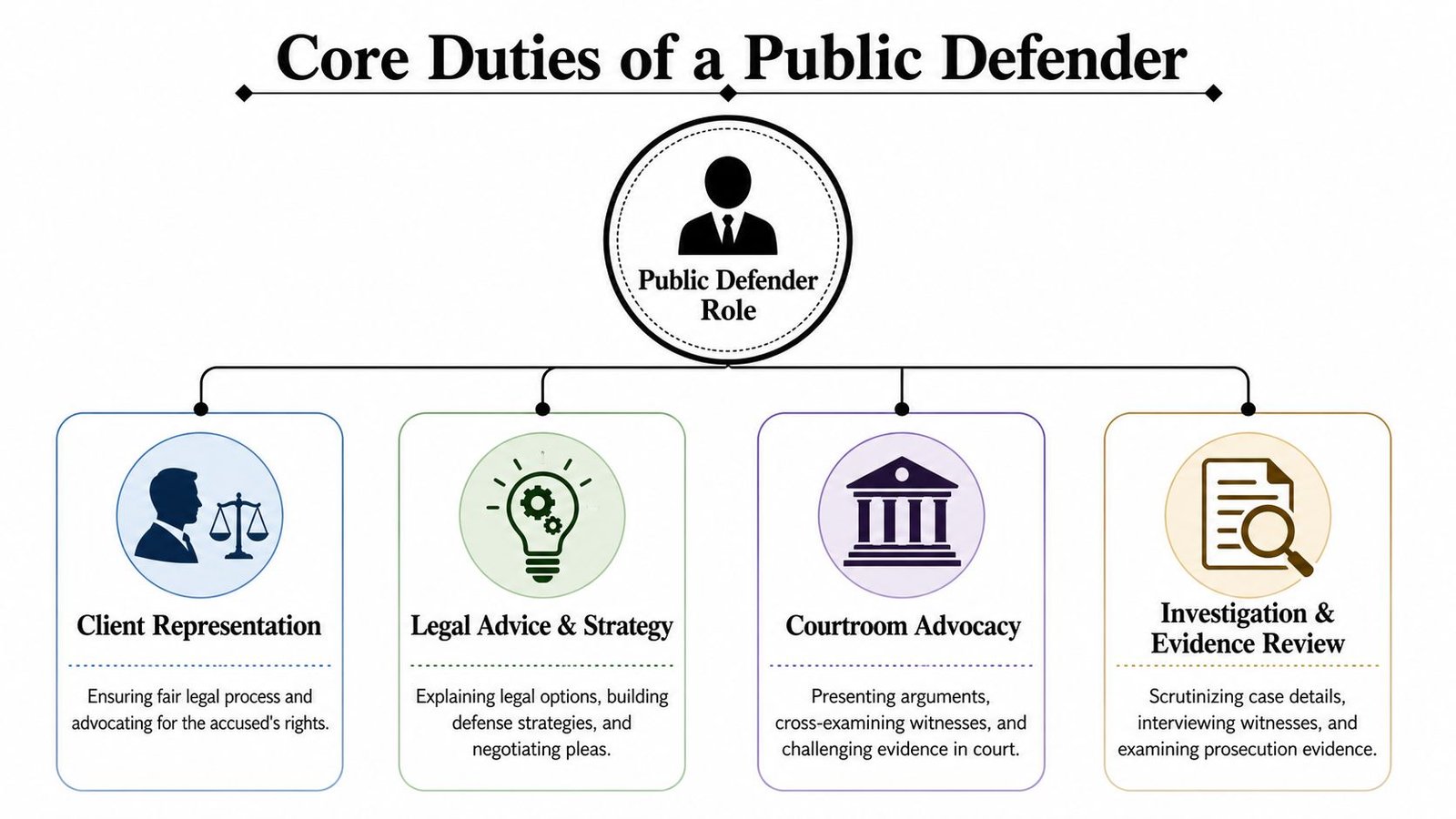
A public defender is often best understood as a legal project manager for the defense. They don’t just stand next to the accused in court. They coordinate strategy, gather facts, challenge weak evidence, advise the client, and push the case toward the best available outcome.
What they do from day one
At the start of a case, the public defender usually handles immediate court appearances such as arraignment and early hearings. They explain the charges, speak with the client about basic facts, and begin identifying urgent issues.
Those urgent issues often include:
- Release arguments such as asking for personal recognizance or lower bail
- Protection of rights including silence, search issues, and unlawful statements
- Case triage so the lawyer knows what must be done first
A family may see only a few minutes of court and assume little happened. In reality, a lot of legal sorting can happen very fast.
Building the defense
The next layer is the actual case work. That may include reviewing police reports, body camera footage, phone data, witness statements, lab reports, and prior court filings. In modern cases, digital evidence can become a major part of the defense process.
Some legal teams also rely on tools that help organize spoken notes and case details. For readers curious about workflow support, transcription tools for legal professionals show how technology can help lawyers and law students capture information more accurately.
Public defenders also prepare for court by:
- Filing motions to exclude or suppress evidence when the law supports it
- Negotiating with prosecutors about charges, plea offers, or alternatives
- Preparing cross-examination if the case goes to a hearing or trial
Experts are part of the job too
A public defender’s role can include asking the court for expert help. That matters when the prosecution’s case depends on technical evidence that a jury may misunderstand without explanation.
Under Ake v. Oklahoma, public defenders can seek funding for specialists such as digital forensics experts, DNA analysts, and toxicologists. A cited summary states that expert witnesses can overturn or mitigate outcomes in 25 to 40 percent of cases, according to this discussion of expert witnesses in criminal defense.
A strong defense is not just “telling your side.” It often means testing whether the government’s side is reliable.
That’s one reason clients should gather and preserve anything that may help the lawyer, including messages, photos, receipts, work records, and names of possible witnesses.
If your loved one is preparing for the next court date, this practical guide on how to prepare for a court hearing can help organize the basics.
Managing Expectations The Reality of Public Defense
One of the hardest parts of this process is emotional. Families often think, “If the lawyer cared, we’d get more calls.” In many cases, the problem isn’t indifference. It’s volume.
The public defense system carries a very heavy workload. In 2023, new national standards recommended that attorneys devote 35 hours per felony case for competent representation. Yet some defenders are carrying far more work than that standard realistically allows. In St. Clair County, Missouri, defenders handled 350 felony cases per lawyer in 2022, according to the Arnold Ventures summary of the national workload report.
Why communication may feel limited
A public defender may spend much of the day in court, moving from hearing to hearing. They may also be responding to jail calls, plea deadlines, prosecutor emails, emergency motions, and clients with trial dates coming first.
That can create a painful mismatch between what families need emotionally and what the office can deliver practically.
Common frustrations usually come from this gap:
- “We haven’t heard back.” The lawyer may be in court most of the day.
- “They only talked for a few minutes.” Early hearings are often brief and focused on urgent decisions.
- “Why haven’t they investigated everything yet?” The lawyer may need discovery first, or may be triaging immediate risks.
How to make your contact count
When communication is limited, efficiency matters. A clear message helps more than repeated messages that say only, “Call me back.”
Use a short, useful update instead:
- Identify the case clearly with the client’s full name and date of birth
- State the reason for the message such as a witness name, work verification, or medical issue
- Keep a running list of questions so you ask them together, not one at a time across many voicemails
The quieter a public defender seems, the more important it is to send organized information instead of emotional fragments.
That isn’t cold advice. It’s practical advice. Your loved one is better served when the lawyer can act on concrete facts fast.
If you’re still trying to orient yourself after the arrest itself, this step-by-step explanation of what happens after you get arrested can help you understand why the process feels so rushed and disconnected.
Public Defender vs Private Attorney Key Differences
Families often ask whether they should stay with appointed counsel or try to hire private counsel. There isn’t one right answer for every case. The better question is what each option changes in real life.
Public defenders are licensed lawyers who focus on criminal defense. Many are in court constantly and have deep practical experience with judges, prosecutors, local procedure, and fast-moving hearings. Private attorneys may offer more direct access and, in some situations, more individualized time.
Public Defender vs. Private Attorney at a Glance
| Factor | Public Defender | Private Attorney |
|---|---|---|
| Cost | Appointed for those who qualify financially | Paid directly by the client or family |
| Selection | Usually assigned by the court | Chosen by the client or family |
| Caseload | Often heavy and shaped by office demands | May be more controlled, depending on the lawyer |
| Courtroom familiarity | Often broad experience in criminal court | Varies by attorney and practice focus |
| Support structure | May draw on office investigators, staff, and shared resources | Depends on the size and structure of the private practice |
| Communication style | Can be efficient and time-limited | May offer more frequent direct contact |
| Specialization | Often handles a wide range of criminal matters | Some private lawyers focus on narrow niches |
What families often misunderstand
A public defender is not automatically less skilled because they are court-appointed. In many courthouses, public defenders handle criminal matters every day and know the local system very well.
A private attorney is not automatically better because the family pays for the service. The key questions are fit, communication, bandwidth, and the lawyer’s actual criminal defense experience.
Ask practical questions such as:
- How often will the lawyer communicate directly?
- Who handles investigation?
- Who appears in court if the main attorney is unavailable?
- Does the case need unusual technical expertise?
A simple way to decide
If your family has limited resources and the appointed lawyer is competent, prepared, and engaged, a public defender may be the right path. If the case is unusually complex, or the family strongly values choosing counsel and having more direct attorney access, private representation may make sense.
The real choice is not “free lawyer versus real lawyer.” It’s “assigned counsel within a strained system versus hired counsel with different time and cost trade-offs.”
That framing is more honest and more useful.
The Public Defender's Limited Role in a Bail Hearing
The bail hearing is where many families become confused and disappointed. They expect the public defender to “get the person out.” That’s not how the system works.
A public defender does play an important role at bail. They can argue for release, point out community ties, explain work history, raise medical or family responsibilities, and ask the judge for lower conditions. But the judge makes the final decision.
What the defender can do
At a bail hearing, the public defender may present information like:
- Stable housing
- Employment
- Family caregiving duties
- Lack of flight risk
- Reasons less restrictive conditions would work
That advocacy matters. It can shape the judge’s view of the client. It can also help set up later arguments if release conditions become an issue again.
But there is a line families need to see clearly.
What the defender cannot do
The defender cannot override the judge. They cannot post the bond. They cannot convert a cash or surety requirement into immediate release by themselves.
A helpful summary of this gap explains that public defenders handle bail hearings, but their influence is limited by judicial discretion. They argue for reduced bail, while the final amount is set by the judge. That leaves families to handle the practical release step through the bail process, as described in this overview of what public defenders do and how bail decisions work.
This short explainer can help you understand how that hearing works in practice:
Why families need a second plan
Think of the bail hearing as two tracks running at the same time.
First, the public defender argues for the lowest possible barrier to release. Second, the family prepares for the possibility that the judge will still set a bond amount or conditions that must be satisfied.
That’s why learning what happens at a bail hearing matters so much. It helps you separate the legal argument from the actual release mechanics.
If the judge sets a surety bond, the public defender’s work in that moment is advocacy. The family’s work is action.
Actionable Steps After an Arrest
Once the first shock passes, families need a plan. Not a perfect plan. Just a workable one.
The first priority is release. The second is helping the defense do better work once the person is out and can communicate more clearly.
Step one focuses on release
If the judge allows release through bail, act quickly and carefully. Learn the bond type, verify the jail, confirm the case details, and understand what conditions apply.
A practical starting point is this guide on how to bail someone out of jail. It walks through the process in plain language.
For Colorado families who need immediate help, Express Bail Bonds serves detention facilities across the state. If your loved one is being held in that area, the company also provides location-specific help for Jefferson County in Golden and Centennial bail bond needs.
Step two starts after release
Once your loved one is out, the defense can usually function better. Meetings are easier. Documents can be gathered. The client can help locate accounts, records, and witnesses.
That matters even more in cases involving digital evidence. A cited summary explains that public defenders use eDiscovery and technology-assisted review in modern criminal cases, and that after release, clients can help by providing access to devices and accounts. It also notes that these tools can cut review time from months to weeks, according to this discussion of eDiscovery for public defenders.
A simple family checklist
Bring order to the chaos with a short checklist:
- Write a timeline: Start with the arrest, then list every contact, search, statement, and court date you know about.
- Preserve documents: Save screenshots, receipts, work schedules, GPS history, photos, and medical paperwork.
- List witnesses: Include full names, phone numbers, and what each person may know.
- Protect devices: Don’t delete texts, videos, or account data that may later matter.
- Prepare focused questions: Ask about next dates, release conditions, no-contact orders, and what information the lawyer needs most.
You can also read what prior clients say about fast, professional help through these Google reviews for Express Bail Bonds and these additional client reviews.
Frequently Asked Questions About Public Defenders
Does a public defender only help in court
No. Court appearances are only part of the job. Public defenders also advise clients, review evidence, negotiate with prosecutors, raise legal objections, and prepare the defense outside the courtroom.
Can a public defender help lower bail
Yes. A public defender can argue for lower bail or for release on less restrictive conditions. But the judge makes the final decision.
Why hasn’t the public defender called us back
The most common reason is workload, not lack of concern. Public defenders often spend large parts of the day in hearings, jail calls, and urgent case work. A short, organized message is usually more helpful than repeated emotional messages.
Can we choose which public defender we get
Usually, no. The court typically assigns counsel through the public defense system. That’s one of the biggest differences between appointed counsel and private representation.
Should we tell the public defender everything
The client should be honest with their own lawyer. Defense advice only works when the lawyer has accurate facts. Families should also share useful documents and witness information, but they should avoid posting about the case online or discussing details broadly with others.
If we post bail, does the case go away
No. Bail only affects release from custody while the case is pending. The charges, court dates, and legal defense still remain.
Can a public defender get experts or investigators
Yes, in some cases. When technical evidence is important, the defense may seek experts or investigative support through the court process.
What can families do that actually helps
A few things help a lot:
- Stay organized
- Follow bond conditions carefully
- Keep all court dates
- Gather records quickly
- Avoid discussing the case on social media
- Help the client stay reachable and stable after release
When should we act on bail
As soon as you know the bond conditions allow it. Time matters because release can make it easier for the person to work, care for family, collect records, and participate in the defense.
If your loved one needs to get out of custody fast in Colorado, contact Express Bail Bonds. Their team serves families statewide and can help you understand the release process, move quickly on a surety bond, and take the next step with more clarity during a stressful time.