
When you’re pulled into the Colorado legal system, you’ll hear a lot of confusing terms thrown around. Two of the most important—and often mixed up—are ‘grand jury’ and ‘petit jury.’ Getting them straight is crucial, because they play vastly different roles in your case.
Think of it this way: a grand jury is an investigative group. Their job is to look at the prosecutor’s evidence and decide if there’s even enough of it to formally accuse you of a serious crime. A petit jury, which is what most people picture when they think of a jury, is the trial jury. They listen to the entire case in court and decide whether you are guilty or not guilty.
Grand Jury Vs Petit Jury At a Glance
Understanding this fundamental difference is the first step for any defendant or family member trying to navigate the justice system. The path your case takes—from the initial accusation to the final verdict—is shaped entirely by which jury you’re facing and when. It’s a distinction that directly impacts critical next steps, like securing a bail bond for pretrial release. Facing an indictment from a grand jury can feel like a shock, so it helps to know what to do when someone gets arrested to prepare for the road ahead.
The core of their difference lies in the standard of proof. A grand jury only needs to find "probable cause"—a reasonable basis for believing a crime may have been committed—to issue an indictment (a formal charge). A petit jury, on the other hand, must be convinced "beyond a reasonable doubt," a much, much higher bar to clear.
Key Differences Between a Grand Jury and Petit Jury
To make these distinctions even clearer, the table below breaks down the essential functions and procedures for both grand juries and the more familiar petit (trial) juries.
| Characteristic | Grand Jury (Investigative) | Petit Jury (Trial Jury) |
|---|---|---|
| Purpose | To decide if there is probable cause to issue an indictment (charge someone with a crime). | To listen to evidence at trial and determine guilt or innocence. |
| Standard of Proof | Probable Cause | Beyond a Reasonable Doubt |
| Participants | Prosecutor and witnesses only. No judge or defense attorney present. | Prosecutor, defense attorney, judge, defendant, and witnesses. |
| Setting | Private and secret proceedings. | Public courtroom trial. |
| Outcome | Returns an "indictment" (true bill) or "no bill." | Renders a verdict of "guilty" or "not guilty." |
As you can see, these two bodies operate in completely different worlds. The secretive, one-sided nature of a grand jury proceeding contrasts sharply with the open, adversarial process of a trial in front of a petit jury.
The size and voting rules are also worlds apart. Federal grand juries are larger, with 16 to 23 members, and an indictment only requires a majority vote from at least 12 jurors. Petit juries are smaller, typically with 6 to 12 members, and their verdict for a conviction must almost always be unanimous.
The grand jury is meant to act as a shield, protecting citizens from baseless prosecution. In contrast, the petit jury is the ultimate decider of fact, weighing the evidence presented by both sides in a public trial.
Navigating this complex system requires expertise and, often, immediate action. Whether you're in Jefferson County or Centennial, having a reliable partner can make all the difference. If you or someone you know is facing an indictment or arrest, contact Express Bail Bonds 24/7 for fast, professional help anywhere in Colorado. You can find our main office on Google Maps and see our other convenient location here.
The Investigative Role Of The Grand Jury
When people think of a jury, they usually picture the courtroom drama they've seen on TV. A grand jury, however, operates completely out of the public eye. Its job isn't to determine guilt or innocence but to investigate potential crimes and decide if there's enough evidence—known as "probable cause"—to formally charge someone.
Think of it as a powerful screening tool. The grand jury acts as a check on prosecutors, making sure the government can't just bring serious felony charges against someone without having a solid foundation of evidence first. It's a one-sided affair, though. The prosecutor runs the show, presenting evidence and compelling witnesses to testify under oath, all without a judge or defense attorney in the room.
How The Secretive Process Works
The secrecy is intentional. It’s there to protect the reputations of people who are investigated but ultimately not charged. If the grand jury decides the evidence isn't strong enough, the case is dropped, and by law, the proceedings remain confidential. This prevents someone's name from being dragged through the mud over an investigation that went nowhere.
But there's a flip side to that secrecy. Because the process is so one-sided, the prosecutor presents their case without any opposition. Witnesses are questioned without a defense lawyer present to object or cross-examine, and the strict rules of evidence you'd see in a trial don't apply.
An indictment is not a conviction. It is the formal start of a serious criminal case, signaling that the prosecution believes it has enough evidence to proceed to trial.
For anyone who receives a subpoena to testify or finds themselves the target of an investigation, this can be an incredibly stressful experience. If you've been contacted, it's critical to get legal advice right away. You might also want to read our guide on the difficult choice of turning yourself in if a warrant is issued to understand what your options are.
The Outcome: An Indictment
If the grand jury agrees there is sufficient probable cause, it issues what's called a "true bill." This document officially becomes a formal accusation known as an indictment, and it marks the official start of a criminal case. Almost immediately, an arrest warrant is issued for the person named in the indictment.
For families in Colorado counties like Jefferson County or Arapahoe County, an indictment can land like a bombshell, turning a private investigation into a very public and frightening legal battle. While federal grand juries are a core part of the American justice system, their use has seen a 25% reduction since 2019, with about 126,000 Americans serving annually.
Once an indictment comes down, the first and most urgent priority is dealing with the arrest and getting your loved one released from jail. This is when you need help, fast. Contact Express Bail Bonds right away to figure out your next steps and start the bail process. We provide bail bonds in Centennial, services for Jefferson County, and support for communities across the state. Our offices, including one at this Google Maps location, are ready to assist 24/7.
How A Petit Jury Decides Guilt Or Innocence
If the grand jury is the secret first act, the petit jury—what most people call a trial jury—is the main stage. This is where a case is argued in a public courtroom, and it’s nothing like the one-sided, investigative nature of a grand jury. A trial is a true adversarial contest between the prosecution and the defense.
At the heart of this process is your constitutional right to an impartial jury. These jurors aren't investigators; they are neutral fact-finders. Their entire job is to listen to the evidence from both sides, hear witness testimony, and examine the exhibits before making a final judgment.
The Higher Standard of Proof
The single biggest distinction between a grand jury and a petit jury comes down to the standard of proof. A grand jury only needs "probable cause" to issue an indictment. A trial jury, however, must find a defendant guilty "beyond a reasonable doubt." This is the highest and most demanding standard in our legal system.
What does that actually mean? It means the prosecutor’s evidence must be so strong and convincing that no other logical conclusion can be drawn from the facts except that the defendant committed the crime. If there's any other reasonable explanation, the jury is required to acquit.
A trial jury's verdict has to be unanimous. Every single juror must agree on the outcome, whether it's "guilty" or "not guilty." If even one juror disagrees, the group is deadlocked, resulting in a "hung jury" and a mistrial.
For a defendant who is out on bail, the trial is the moment everything has been leading up to. Being free gives you the crucial ability to work closely with your legal team, which is a massive advantage in crafting a solid defense. Our guide on how to prepare for a court hearing offers some really practical tips for this critical phase.
The Role of an Impartial Jury
The right to a trial by our peers is so foundational that John Adams once called it the "heart and lungs of liberty." Jurors are chosen through a screening process called voir dire, where lawyers for both the prosecution and defense can question them to uncover any potential bias. The whole point is to assemble a panel of citizens who can weigh the evidence fairly and without prejudice.
The screenshot below shows a typical courtroom layout, highlighting where the jury sits in relation to everyone else.
This specific arrangement isn't accidental. It’s designed to give the jury a clear, unobstructed view of all the evidence and testimony, reinforcing their position as neutral observers tasked with a life-altering decision.
Getting out of jail on bond with a trusted service like Express Bail Bonds provides the essential time you need to prepare for this complicated process. If you need assistance in Centennial, our local agents are here to help. You can find our main office at this Google Maps location and another one here. Having an experienced team for bail bonds in places like Jefferson County lets you focus on what really matters: building your defense.
A Tale of Two Rooms: How Grand and Petit Jury Procedures Differ
To really understand what an indictment means for your case, you have to look at the massive procedural gap between a grand jury and a petit jury. It’s not just a small difference; it’s the difference between an investigation and a trial. How these two bodies operate day-to-day determines everything about a case’s beginning versus its end.
Let's break down how they work by comparing their rules on secrecy, legal representation, evidence, and the decisions they make. You’ll see why a grand jury indictment is just the start of the legal battle, not the final judgment.
Secrecy and Legal Representation
The most dramatic difference is who gets to be in the room. Grand jury proceedings are held entirely in secret. Only the prosecutor, the jurors, and any witnesses they call are allowed inside. It’s a closed-door, one-sided process designed to protect the reputations of people who might be investigated but never charged.
A petit jury trial, on the other hand, is exactly the opposite—it’s a public event in an open courtroom. The defendant is there with their lawyer, who has the right to confront and cross-examine witnesses, object to the prosecutor's evidence, and build a defense. This is the adversarial system in action, where both sides get to tell their story.
Think of it this way: The grand jury acts like an investigative tool for the prosecution, where the defense has no say. A trial jury, however, referees a structured fight between two opponents—the prosecution and the defense—who present their cases to a neutral audience.
Evidence Rules and Decision Outcomes
The kind of information each jury gets to hear is also worlds apart. In a grand jury setting, the rules of evidence are relaxed. The prosecutor can present almost anything, including hearsay or evidence that would never be allowed at trial, to convince the jurors there is probable cause to move forward.
During a petit jury trial, the rules are incredibly strict. A judge oversees everything to make sure only proper, legally obtained evidence is presented. This strictness is vital because the jury’s decision hinges on a much higher standard: guilt beyond a reasonable doubt.
The timeline below gives you a bird's-eye view of the public phases of a petit jury trial, from the courtroom proceedings to the verdict.
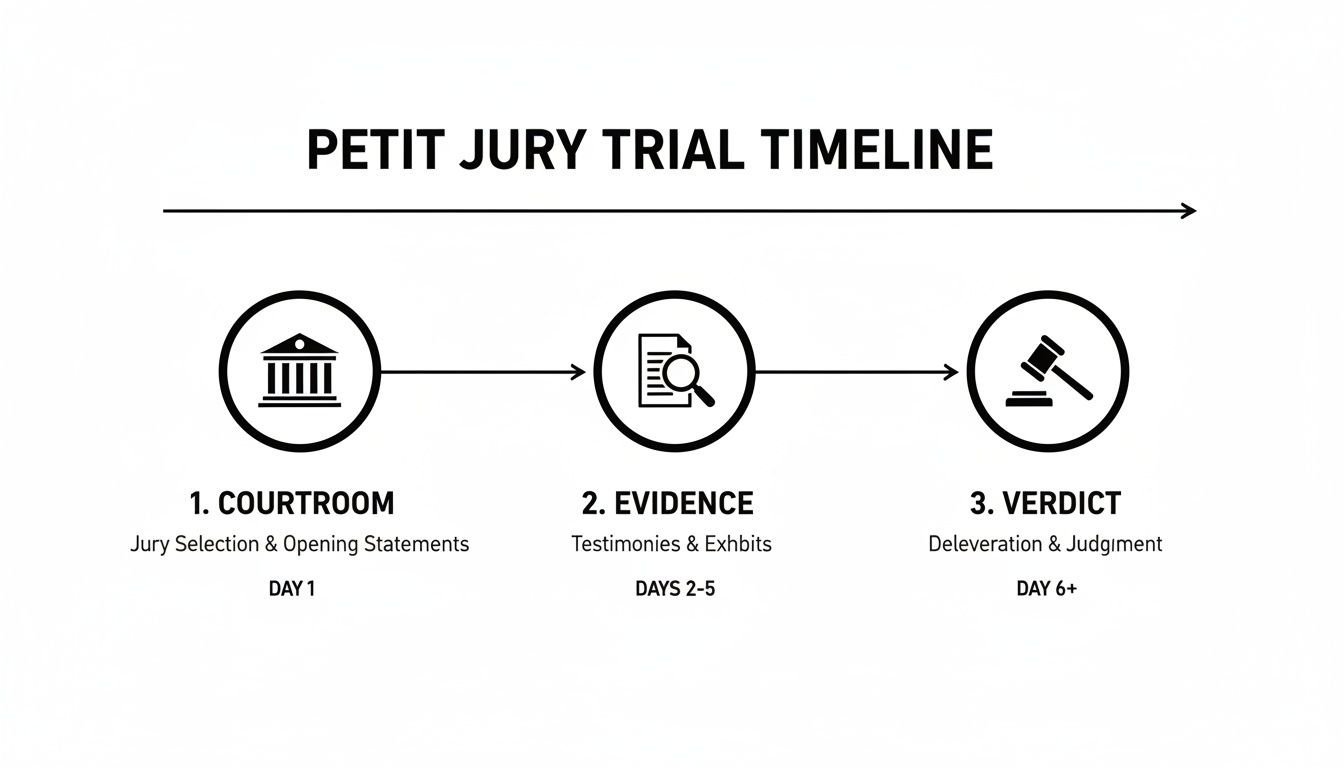
This process highlights the open, structured environment of a trial, which couldn't be more different from the secretive nature of a grand jury investigation.
Finally, the conclusions they reach have very different meanings and even different names.
- A grand jury issues an "indictment." This is simply a formal accusation that a crime may have occurred. It is not a finding of guilt.
- A petit jury delivers a "verdict." This is the final decision in the case—either "guilty" or "not guilty."
An indictment gets the case started, but a verdict is what ends it. Once an indictment is issued, the first priority is often securing release from custody. Understanding what is pretrial release is a crucial next step, as it sets the stage for building your defense. If you need immediate help in Jefferson County or Centennial, call Express Bail Bonds for a free consultation.
What To Do After A Grand Jury Indictment
Hearing that a grand jury has handed down an indictment can feel like the world is crashing down. It's a deeply stressful and confusing moment that instantly shifts a behind-the-scenes investigation into a public criminal case. The single most important thing to remember is this: an indictment is not a conviction. It’s the formal beginning of the legal fight, not the end.
Once an indictment is issued, an arrest warrant is usually generated immediately. This kicks off a chain of events: an arrest and booking, quickly followed by an arraignment hearing. At the arraignment, the charges are read aloud, and a judge will determine the conditions for release, including setting a bail amount. Getting a handle on what happens at an arraignment hearing is a crucial first step for your family as you figure out how to navigate this new reality.
Your First Priority: Securing Release
Following an indictment, the absolute top priority is getting released from custody. This is the moment a professional bail bond agent becomes your most essential partner. Remaining in jail puts a defendant at a huge disadvantage, making it almost impossible to keep a job, provide for family, or actively participate in their own defense.
Posting a surety bond through a trusted bail company is the quickest path to getting out of jail. Rather than needing to pay the entire bail amount in cash, you pay a much smaller, non-refundable premium—typically 10-15% in Colorado—to the bail agent. The agent then posts a bond for the full amount, guaranteeing the court that you will show up for all future proceedings.
Securing pre-trial release isn't just about comfort; it's a strategic necessity. The freedom to collaborate closely with your attorney, continue working, and maintain family stability provides the foundation for a strong and effective defense.
This process enables a swift release, putting control back in your hands while you prepare for the next major phase of the legal journey: a potential trial before a petit jury.
Taking Action and Preparing Your Defense
Once you're out, the real work on your defense can begin. Being free allows you to meet with your lawyer on your own terms, help track down evidence, and contact potential witnesses without the stifling restrictions of being incarcerated.
Don't wait. The moments after an indictment are critical. Taking immediate, decisive action to secure your freedom is the first step toward protecting your rights and building the strongest possible case for the road ahead. For immediate help anywhere in Colorado, including service in Centennial and Jefferson County, contact Express Bail Bonds 24/7. Our team is standing by at our convenient locations, like the one you can find here on Google Maps.
Frequently Asked Questions About Colorado Juries
When you're suddenly thrust into the legal system, the difference between a grand jury and a trial (petit) jury can feel like a blur. Let's clear up some of the most common questions and concerns that defendants and their families have during this incredibly stressful time.
Does a Grand Jury Indictment Mean I Am Guilty?
Absolutely not. This is one of the most common—and frightening—misconceptions. An indictment simply means the grand jury found "probable cause" to believe a crime may have been committed.
Think of it as a green light for the prosecutor to proceed with the case, not a final verdict. The standard of proof is low. A trial jury, or petit jury, operates on a much higher standard, requiring the prosecution to prove guilt "beyond a reasonable doubt." Many people who are indicted are later found not guilty at trial.
Can I Refuse to Testify Before a Grand Jury?
You can, and should, invoke your Fifth Amendment right against self-incrimination. This means you can't be forced to provide testimony that could be used against you. However, you can't just ignore a subpoena and refuse to show up.
Failing to appear or improperly refusing to testify can result in contempt of court charges. It's crucial to have an attorney with you to navigate this. Never respond to a grand jury subpoena without first getting legal advice to make sure your rights are fully protected.
Facing an indictment or arrest can feel overwhelming, but remember you have rights and options. Securing pretrial release is the first and most important step toward building a strong defense and regaining control.
How Does Bail Help My Case Before a Petit Jury Trial?
Getting out of jail on bail is one of the single most important things you can do to prepare for trial. Being free allows you to work side-by-side with your lawyer, track down witnesses, and actively participate in gathering evidence for your defense.
It also means you can keep your job, support your family, and maintain a sense of stability. This dramatically reduces the personal and financial chaos an arrest causes, giving you the focus and freedom needed to build the strongest possible defense for your day in court.
When you need to act fast after an indictment or arrest, Express Bail Bonds provides the quickest and most reliable path to freedom. Our experienced agents serve all of Colorado, including Jefferson County and Centennial, with 24/7 support. Visit us online at https://expressbailbonds.com/ or contact our local offices for immediate assistance, which you can find on Google Maps here and here.