
When it comes to bail, the core difference between a cash bond vs a surety bond is simple. With a cash bond, you are on the hook for the entire bail amount, paid directly to the court. A surety bond, on the other hand, lets you pay a bail bonds agent a much smaller, non-refundable fee to post the full amount for you. The right choice really boils down to your personal finances and how much of your own cash you're willing to put on the line. For immediate assistance, contact Express Bail Bonds.
Understanding Your Bail Options in a Critical Moment

When a friend or family member is arrested, the top priority is getting them out of jail—fast. That process starts with understanding the two main ways to post bail here in Colorado, and the path you take has significant financial consequences, both now and down the road.
The first route is a cash bond. This is exactly what it sounds like: you deliver the full bail amount in cash directly to the court or jail. It's straightforward, but it often means coming up with a large sum of money on short notice, which can be a huge burden in an already stressful situation. If you're new to this, it helps to understand the terminology; you can read about the difference between bail and bond in our guide.
Your other option is a surety bond, which is where a licensed bail bonds agent comes into the picture. This is the service a company like Express Bail Bonds provides.
A surety bond is essentially a financial guarantee. An agent posts the entire bail amount on your behalf, and in return, you pay them a non-refundable fee, known as a premium. This makes securing a release far more accessible for most people.
Key Financial Differences
The immediate out-of-pocket cost is the biggest dividing line between a cash bond and a surety bond. A cash bond requires you to pay the full amount upfront—whether that’s $10,000 or even $100,000—tying up your savings until the case is fully resolved, which can take months or longer.
In contrast, a surety bond lets you pay just a fraction of that. Here in Colorado, the premium is typically 15%. So, for that same $10,000 bond, you would pay a bondsman $1,500. This gets your loved one out quickly without forcing you to drain your bank account.
While laws vary by state, the fundamental principles are often quite similar. For a broader perspective, resources explaining Bail and Bond in Texas can offer a helpful overview of how these systems work elsewhere.
Here's a quick breakdown of how they stack up:
| Feature | Cash Bond (Paid to Court) | Surety Bond (Paid to Agent) |
|---|---|---|
| Upfront Cost | 100% of the total bail amount | A smaller percentage (10-15% in CO) |
| Who Guarantees Appearance | You and your personal funds | The bail bond company |
| Refundability | Yes, minus court fees, after case closes | No, the premium is a non-refundable fee |
| Financial Risk | Your entire bail amount is at risk | You are liable for the full amount if defendant flees |
| Best For | Lower bail amounts or when you have liquid cash | Higher bail amounts, preserving assets |
Ultimately, whether you're in Centennial or anywhere else in Colorado, knowing these differences is the first step toward making a smart decision under pressure. If you need help, don't hesitate to contact us.
Comparing Costs, Risks, and Timelines
When you’re faced with the choice between a cash bond and a surety bond, it really boils down to three things: how much cash you have on hand, what kind of financial risk you’re willing to take, and how fast you need to get someone out of jail. Each path is a completely different journey, both financially and logistically. Making the right call during a stressful time starts with understanding these differences.
The most glaring distinction is the upfront money required. A cash bond means you have to pay the full bail amount—100% of it—directly to the court. A surety bond, on the other hand, is handled by a bail bonds agent like Express Bail Bonds and only requires you to pay a non-refundable percentage, known as a premium.
A Real-World Colorado Scenario
Let's put this into perspective with a realistic example. Imagine a judge in Jefferson County sets bail at $20,000.
Cash Bond Path: To get your loved one released, you’d have to come up with the entire $20,000 and hand it over to the court. That money is now completely tied up. You can't touch it for legal fees, rent, or emergencies until the case is fully resolved, which could take months or even years.
Surety Bond Path: Instead of draining your savings, you’d call a bail bonds agent. Here in Colorado, the standard premium is typically around 15%. So, for that same $20,000 bond, your out-of-pocket cost would be a one-time, non-refundable payment of $3,000. This makes securing a release much more achievable and keeps your cash free for other critical expenses.
For most families, this single difference makes the surety bond the only practical choice. Coming up with the full cash amount for a bond can cause immense financial hardship, while the fixed premium for a surety bond is a known, manageable cost. Check out our reviews to see how we've helped others.
Understanding Refundability and Financial Risk
The idea of getting your money back is where these two options really diverge. With a cash bond, you are supposed to get the full amount back from the court, but there’s a catch. This only happens after the case is completely over and the defendant has made every single court appearance. Even then, courts often subtract administrative fees, so you might not get every dollar back.
The premium you pay for a surety bond is non-refundable. Think of it as the fee the bail bonds company earns for taking on the massive financial risk and guaranteeing to the court that the defendant will show up.
Key Insight: The trade-off is pretty straightforward. A cash bond demands a huge upfront payment with the possibility of a partial refund down the road. A surety bond requires a much smaller, non-refundable payment that secures an immediate release without freezing your life savings.
This is where you have to think about your personal risk tolerance. When you pay a full cash bond, you're putting your own capital on the line. With a surety bond, the bail agent assumes the primary financial risk with the court, although the person who cosigns is still liable to the agent if the defendant skips bail.
Cash Bond vs. Surety Bond: A Practical Comparison
To make things even clearer, let's break down the key factors side-by-side. This table gives you a direct look at the essential differences in cost, risk, and the overall process when choosing between a cash bond and a surety bond in Colorado. For a deeper dive, you can also learn more about how much a bail bond typically costs in our detailed guide.
| Comparison Point | Cash Bond (Paying the Court Directly) | Surety Bond (Using an Agent like Express Bail Bonds) |
|---|---|---|
| Upfront Cost | 100% of the total bail amount (e.g., $20,000 on a $20,000 bond). | A 10-15% non-refundable premium (e.g., $2,000 – $3,000 on a $20,000 bond). |
| Refundability | Yes, the principal is returned minus court fees after the case ends. | No, the premium is a fee for service and is non-refundable. |
| Financial Risk | You risk losing the entire bail amount if the defendant fails to appear. | The bail agent assumes the risk with the court; you are liable to the agent. |
| Timeline to Post | Depends on how quickly you can gather the full cash amount and deliver it. | Can be posted very quickly, often within minutes of completing electronic paperwork. |
| Privacy | Your name and funds are directly on record with the court. | The transaction is handled privately through the bail bond agency. |
At the end of the day, for families in Centennial or anywhere else who need a fast, affordable, and private solution, a surety bond offers some serious advantages. It minimizes the financial disruption to your life and puts an experienced professional in your corner to navigate the release process.
When a Cash Bond Might Be the Right Call
Surety bonds are the go-to solution for most families, but there are times when paying the full bail amount directly to the court—a cash bond—just makes more sense. The right choice really comes down to the specific circumstances, your financial situation, and what the judge has ordered.
The Best Use Cases for a Cash Bond
One of the clearest scenarios is when the bail amount is quite low. If bail is set at a few hundred dollars, say $500 or less, paying it in cash can be cheaper than paying the minimum premium to a bail bondsman. You'll have your money tied up for a bit, but you avoid paying a non-refundable fee for a relatively small bond.
Sometimes, though, the decision is made for you. A judge can order a "cash-only" bond, which means you have no other option. This usually happens when the court has serious concerns about the defendant being a flight risk or due to the severity of the charges. In these cases, paying the full amount is the only way to secure a release.
Another situation where a cash bond comes into play is when someone has plenty of liquid assets on hand. If you have the funds readily available, you might prefer to handle the process directly with the court. This way, you keep control over your money instead of paying a fee you won't get back. You’re essentially betting on the full return of your capital once the case is over, even if it takes months or years.
This side-by-side comparison breaks down the key differences between the two.
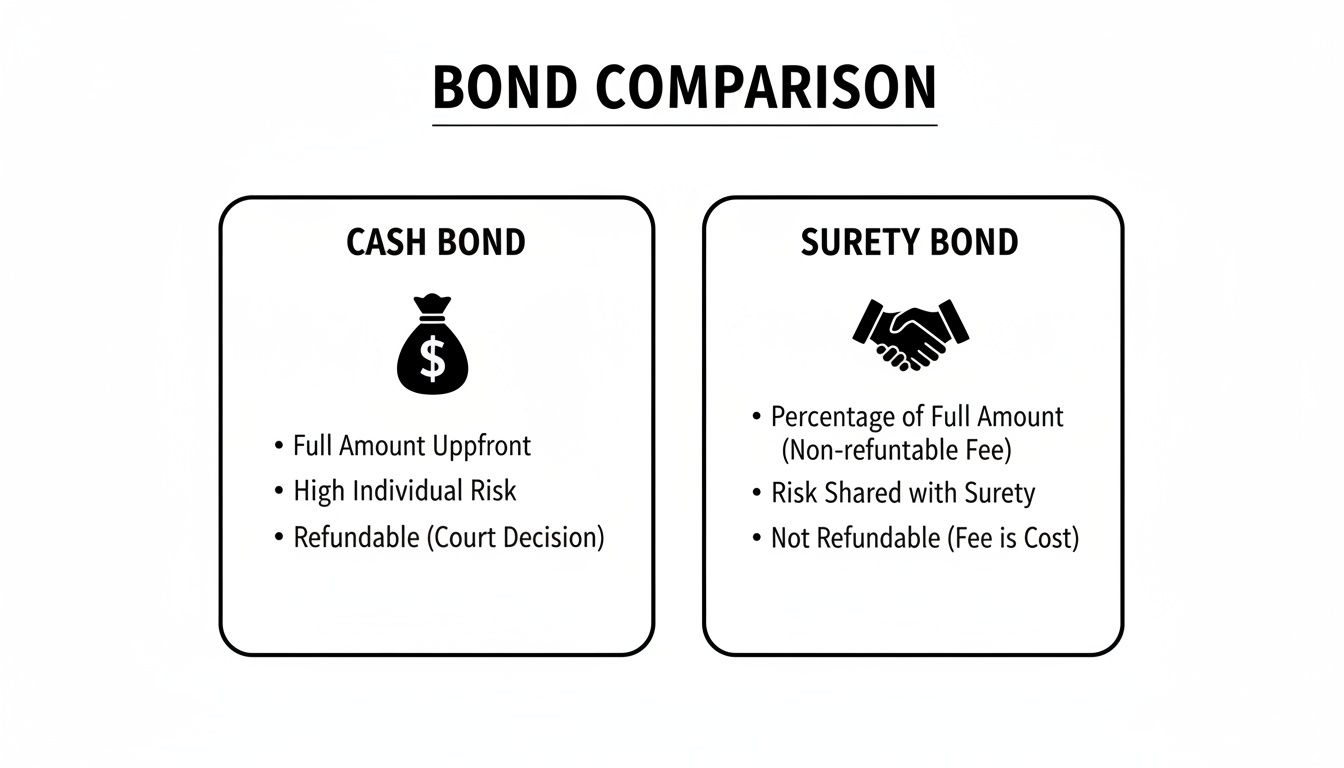
As you can see, a cash bond might be fully refundable, but it requires you to put 100% of the bail amount on the line upfront. A surety bond completely removes that massive financial burden in exchange for a smaller, non-refundable fee.
The Bottom Line: Choosing a cash bond comes down to a simple trade-off. You're staking your own money directly with the court for the chance to get it all back later, minus any court fees or fines.
The question of refunds is a big one for most people, and we cover it in detail in our article exploring if you get bail money back. Understanding your options clearly is what we're all about, and we're here to provide that expert guidance for every situation. For a free consultation, contact Express Bail Bonds.
Why Surety Bonds Offer a Strategic Advantage

When you're dealing with a high bail amount, the choice between a cash bond and a surety bond stops being a simple preference and becomes a crucial financial decision. For most families, a surety bond isn't just another option—it's the only practical way to maintain financial stability during an incredibly stressful time. It lets you keep your hard-earned money available for what comes next.
The most significant benefit is immediate asset preservation. To post a cash bond, you have to come up with the full amount, which often means draining savings, cashing out investments, or dipping into retirement funds. That kind of sudden financial hit can be crippling, leaving you without the resources to hire a good lawyer, pay the mortgage, or cover daily expenses while the case is ongoing.
A surety bond helps you avoid that crisis. Instead of paying the court the entire bail amount, you pay a bail agent a smaller, non-refundable premium—in Colorado, this is typically 15%. That single payment gets the job done without tying up your life savings, giving you the financial breathing room to focus on building a strong defense.
The Power of Professional Expertise
Beyond the immediate financial relief, working with a professional bail bond agency gives you access to invaluable expertise. The legal system is confusing and can feel overwhelming. An experienced agent from Express Bail Bonds becomes your guide, handling all the complex paperwork and making sure every document is filed correctly and on time.
This professional oversight is more important than you might think. Simple mistakes in the paperwork can cause major delays, which means your loved one stays in jail longer than necessary. Our agents know the ins and outs of the procedures at every facility across Colorado, from Jefferson County to Denver, which helps speed up the release process. You can learn more about the specifics of what a surety bail bond is and how it works in our detailed guide.
A surety bond does more than just get someone out of jail; it provides a structured, professional framework that reduces stress and uncertainty. You're not just paying a fee—you're gaining an ally who knows how to get the job done right.
Cost Savings and Modern Convenience
For larger bond amounts, a surety bond presents a clear cost-saving advantage. At Express Bail Bonds, we can often secure a reduced premium of just 10% for bonds over $5,000 when there's a qualified cosigner. This discount can easily save you thousands of dollars, freeing up even more of your funds for the legal fight ahead.
Think about it this way: a $50,000 felony bail in Denver would require you to hand over the full amount for a cash bond, a sum that would wipe out most people's savings. With a surety bond, you only need to pay a 15% premium ($7,500). This leaves $42,500 of your own money in your account, ready for attorney fees, rent, and other critical needs.
On top of that, our streamlined electronic process makes securing a bond easier than ever. If you're in Centennial or have a cosigner living in another state, all the necessary paperwork and payments can be completed online. This modern approach means you don't have to drive to a jail, saving you precious time and adding a layer of convenience during a difficult situation.
The Surety Bond Process From Start to Finish

When someone you care about is arrested, the last thing you need is a complicated, drawn-out ordeal to get them released. The surety bond process is specifically designed to be quick and clear, breaking down a stressful situation into a few straightforward steps. We've spent years perfecting this process to make it as fast and painless as possible, from the moment you call us to the moment your loved one is released.
Knowing what to expect can make a world of difference. It removes the mystery and gives you the confidence of knowing you have an expert on your side. We take care of the details so you can focus on what matters most—your family. See what our clients have to say about our process on Google.
A Simple Five-Step Path to Freedom
The whole thing can often be sorted out in just a few minutes over the phone or online. You don't even need to leave your house to drive to a bail bond office or a jail.
Here’s a look at how it works:
- First Contact & Key Details: It all starts with a quick call or text. We just need some basic information to get started, like the defendant's full name and the facility where they're being held.
- Upfront Consultation: Right away, we'll tell you exactly what the cost will be. We break down the non-refundable premium and any other fees so there are absolutely no surprises later on. We also walk the cosigner through their financial responsibilities for guaranteeing the bond.
- Digital Paperwork: We send all the necessary forms straight to your email. You can fill them out and sign them from your smartphone or computer in a matter of minutes, wherever you happen to be.
- Secure Online Payment: After the paperwork is signed, you'll get a secure link to pay the premium online. This quick payment finalizes our agreement and gives us the green light to post the bond.
- Bond is Posted, Release Begins: As soon as everything is in place, one of our licensed agents heads directly to the correct Colorado jail to post the bond and get the release process started.
The real difference between a cash bond and a surety bond snaps into focus during a crisis. Let's say bail is set at $25,000. With a cash bond, you're expected to come up with that entire amount on the spot. With a surety bond, you only pay a small fraction of that as a premium, and we put up the full $25,000 guarantee for you.
This efficient system is all about getting your loved one home fast. If you want to dive deeper, our guide on how bail bonds work has even more detail. We’ve built our reputation on being fast, reliable, and compassionate, and we're proud of our track record. The surety process offers a level of speed and financial flexibility that just isn't possible when you're trying to pull together a massive cash bond on short notice.
Common Questions About Bail Bonds in Colorado
When you're trying to figure out the difference between a cash bond vs surety bond, a lot of questions come up. Getting straight answers is the best way to feel confident about your next move. We've put together the questions we hear most often to give you the clarity you need during a pretty stressful time. Our clients trust us because we’re transparent, and you can see that for yourself in our client reviews.
Is The Surety Bond Premium Refundable?
This is probably the most common—and most important—question we get asked. The short answer is no. The premium you pay a bail bond agent, which is usually 10-15% of the bail in Colorado, is non-refundable.
It helps to think of it like a service fee. That premium is how the bail bond company gets paid for taking on the entire financial risk with the court on your behalf. It also covers our professional service of handling the release process from start to finish. Once we post the bond and the defendant is out, our job is done, and the fee has been earned.
What Happens If The Defendant Misses a Court Date?
If you cosign a surety bond, you're giving your financial guarantee that the defendant will show up for every single court date. A missed appearance puts that guarantee on the line.
Legally, you become responsible for paying the full bail amount to the bail bond agency. But a good bondsman doesn't just sit back and wait. At Express Bail Bonds, we get to work immediately, contacting both the defendant and you, the cosigner. Our goal is to fix the problem—usually by getting the court date rescheduled—before the bond is forfeited.
When a defendant misses court, it doesn't automatically mean the cosigner owes the full bond amount. Our first step is always communication and problem-solving to get the defendant back in compliance with the court, protecting everyone involved.
Can You Get a Surety Bond With Poor Credit?
Absolutely. It’s often possible to get a surety bond even if the defendant has bad credit. The decision really hinges on the cosigner, not the defendant's credit score.
We look for a qualified cosigner—someone with a steady job, roots in the community, and a solid financial history who is willing to take on the financial responsibility. A strong cosigner gives us the confidence we need to post the bond. This is how we help people get released when credit issues would otherwise be a major roadblock. We work with qualified cosigners all the time for clients in Jefferson County.
How Long Does The Release Process Actually Take?
We can get our side of the paperwork done incredibly fast, sometimes in just a few minutes electronically. But the final release time is completely up to the jail. Once we post the bond, the detention center has to run through its own release procedures.
That process can take anywhere from a couple of hours to several hours, and it all depends on the facility and how busy they are. We always give our clients in places like Centennial a realistic timeline, making sure they understand the jail controls the final step. Our job is to get the bond posted as quickly as humanly possible to get that clock started.
When you need fast, reliable answers and a clear path forward, trust the experts who have served Colorado since 1988. Express Bail Bonds is available 24/7 to help you navigate the surety bond process with confidence and speed. Contact us now to get started at https://expressbailbonds.com/.