The call comes at an hour when nothing's open. Someone you care about is in a Colorado jail, a judge has set a bond, and you're staring at a surety bond application on your phone with no idea which field matters most. You've got a card in one hand and a half-remembered bail amount in your head.
That's the moment where paperwork either moves fast or sits for hours. The application itself isn't complicated. What slows it down is a name spelled one way in the jail's system and another way on the court order, a bond amount that changed after a hearing, or a cosigner who hasn't sent ID yet. Get the inputs right and the rest is a sequence you can follow line by line.
Information and Documents to Gather Before You Apply
Use this document checklist first, then work the application in order. A clean packet lets the agent match the person, the charge, the court order, and the cosigner obligation without sending papers back for corrections.
| Item | What to Gather | Why It Is Needed |
|---|---|---|
| Defendant identity | Full legal name and date of birth, spelled as in the court record | Name and date of birth must match the bond order |
| Case and booking details | Case number, booking number and detention facility | Identifies the file the bond is posted against |
| Bond order | Bond amount and bond type from the judge's order | A different amount or type delays release |
| Cosigner identity | Government photo ID, phone number and email | Confirms who is liable for the bond |
| Residence proof | Deed or long-term lease, recent utility bill | Shows established residency in the area |
| Income and employment | Recent pay stubs or employer contact | Shows stable income to back the obligation |
| Credit and background | Written consent for a credit and background check | Required for cosigner approval |
| Collateral | Description and ownership papers for any pledged property | Secures the bond when the agent requires it |
| Payment | Payment method and identity of the payer | Premium must be paid before the agent posts the bond |
The items that cause the most trouble
Name and date of birth. Middle names, hyphens, and a swapped month and day in a birth date are enough to bounce a packet. Copy them from the booking record or the court file, not from memory or a text message. Our guide to the documents you need for a bail bond walks through what to photograph and what to type.
Bond order details. Check the amount and type against the current court order. If a hearing changed the amount, the older sheet in someone's phone creates the wrong request. That error sends the application back before payment, because the bond has to match what the court will accept.
Case and booking details. The case number, booking number and detention facility identify the file the bond is posted against. A missing booking number may still be traceable, but the jail and the defendant's identifying details need to be right before the agent can move the paperwork toward the facility.
Cosigner strength. We look for cosigners with stable employment, established residency such as owning a home or a long-term rental history in the area, and a decent credit score. That's why the deed or lease and the pay stubs aren't busywork. They're how the agent judges whether the person guaranteeing the bond can carry it. Cosigner approval typically involves a credit and background check, so written consent belongs in the first packet.
Cosigner signature. A cosigner is taking on a real obligation, not just confirming that they know the defendant. Before signing, that person should understand the agreement, the payment responsibility, and any collateral described in the paperwork. Express Bail Bonds uses secure, electronic contracts that cosigners can review and sign from anywhere in the country.
Third-party payers. If a relative in another state is paying, say so up front and confirm their authority to pay. Families juggling court dates, scanned IDs, and out-of-state signatures sometimes bring in virtual legal assistants to keep the document set and deadlines organized in one place.
Use this numbered sequence before submitting:
- Confirm the defendant's full name, date of birth, the jail, and the bail amount.
- Gather the case number, booking number and current bond order.
- Collect cosigner ID, residence proof, income proof and written consent for checks.
- Identify the payer and the payment method.
- Describe any collateral and gather ownership papers if collateral is part of the plan.
- Review the agreement before signing so the obligation is clear.
Before the first call, have four things in hand: the defendant's full name, date of birth, the jail, and the bail amount.
When you call us for a bond, have the defendant's full name, date of birth, the jail they're in, and the bail amount ready. Those four answers let us tell you in one conversation whether the bond can be posted as ordered.
Checking the Premium Against the Colorado Limit
Multiply the bail amount by 0.15, compare that result with $50, and the larger figure is the statutory maximum premium or commission. Colorado's sunset review of bail bond regulation identifies the 15% limit and the $50 minimum as the applicable restrictions, and illustrates the math: for a $10,000 bail amount, the maximum premium or commission at 15% is $1,500.
| Bail Amount | 15% of Bail | Statutory Maximum Premium |
|---|---|---|
| $300 | $45 | $50 (the $50 floor controls) |
| $500 | $75 | $75 |
| $5,000 | $750 | $750 |
| $10,000 | $1,500 | $1,500 |
| $20,000 | $3,000 | $3,000 |
The floor only matters on very small bonds. Once 15% clears $50, the percentage controls, and the cap is a ceiling rather than a required price. Our surety bond rates page shows how a quoted premium sits against that ceiling.
What the cap doesn't cover
The Colorado bail-bond statute generally allows fees on a bond posted with a court only when they cover an actual court or law-enforcement filing charge, secure collateral storage, or premium financing. Anything outside those categories deserves a question.
Ask for an itemized written breakdown of every line on the application: premium, any filing charge, any storage charge, any financing cost. Rules differ by state, which is why an explainer on how much bail costs in Texas from the Law Office of Bryan Fagan PLLC is useful for comparison and useless as a Colorado quote.
Practical rule: if the quoted premium is above the statutory maximum, or a line item doesn't match a permitted category, stop and ask for the calculation in writing before you sign.
How to Complete the Application Step by Step
Colorado's Chief Justice Directive on bail bond procedure sets out the sequence a complete application follows, and the state's JDF 370 appearance-bond form records the surety, penal sum, premium, signatures, and identity-verification details. The flow below maps that sequence to what you do.
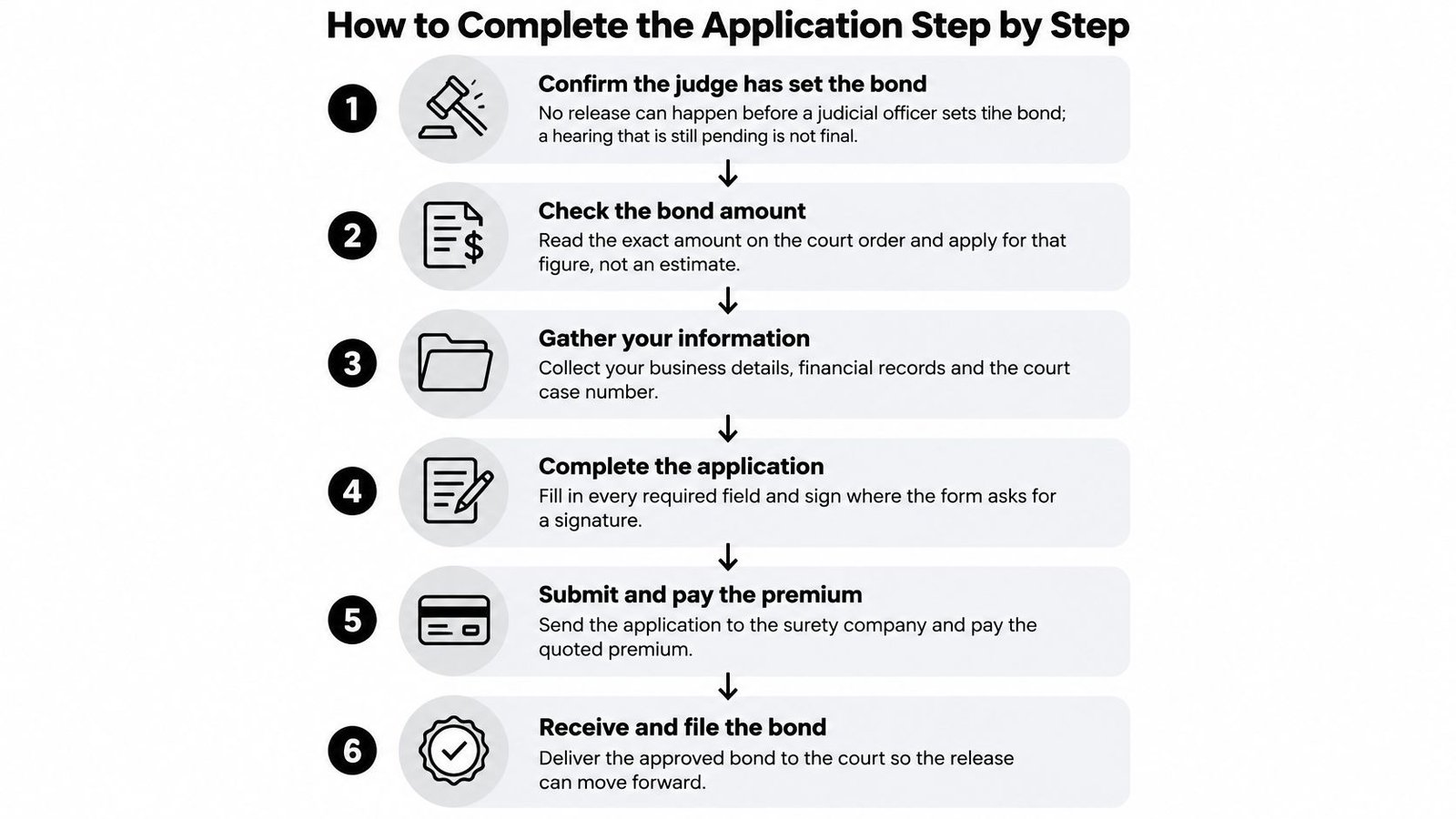
- Confirm the judge has set the bond. Colorado rules generally prohibit release until a judicial officer sets the bond. The common slip is treating a hearing that's still pending, or a recommendation awaiting review, as a final order.
- Check the bond type and amount against the court record. Read the figure on the order itself. A number from a friend, a booking sheet, or an earlier phone call isn't the order, and applying for the wrong figure means redoing the packet.
- Collect the defendant's identifying and booking details. Full legal name, date of birth, case number, booking number, and facility, copied exactly. Transposed digits in a booking number are a quiet, common cause of rejection.
- Identify the licensed agent and any required cosigner or collateral. Colorado's official guidance confirms a professional surety agent may require a cosigner and/or collateral. Decide who's signing before you start, because chasing a second signature later adds hours.
- Calculate and disclose the premium in writing before money moves. You should see the bond type, total premium, refund policy, cosigner obligations, collateral terms, court conditions, and the facility's submission requirements in writing first. That's also your chance to check the math.
- Sign the appearance bond form and the agreement. To get a bond, you fill out an application and sign a bail bond agreement with the bail company. Read the penal sum on the form, not just the premium line, because those are two different numbers with two different meanings.
- Submit identity verification and signatures for filing. Driver's-license or passport verification is preferred, though other official documents may be accepted. Send clear, uncropped images; a glare spot over a birth date can send the packet back.
We provide an online application and payment system, so most of this happens on a phone. If you've never signed a contract electronically, our walkthrough on how to sign an esign document covers the tap-by-tap part.
Here's the sequence in motion, from the first call to the signed packet.
A completed application isn't a posted bond, and it isn't a released defendant. An electronically finished form can't override an unapproved bond amount, a felony-review requirement, a court condition, an active warrant, or a jail-specific intake rule. The jail still has to accept the paperwork and the court still has to approve the terms.
Cosigner Liability, Collateral and Refund Rules
Most cosigners think they're guaranteeing the premium. They aren't. The bond form makes the cosigner jointly and severally liable for the full penal sum if the defendant defaults, which means the surety can pursue any one signer for the whole amount, and a forfeited bond can bring court costs and interest on top.
Colorado law also requires the financial arrangement to be documented before the agent accepts anything of value. Under Colorado's insurance statutes, the producer must commit the arrangement to writing, sign and date it, and obtain the defendant's or indemnitor's signature, describing payment of all or part of the premium, commission, or fee and including the payment schedule. The same law states that, subject to statutory exceptions, a compensated surety earns the bail premium in its entirety when the defendant is released from custody.
Approval of a cosigner typically involves a credit and background check, so expect that consent form to be part of the packet, not an afterthought. If you're pledging property, read our explanation of bail bond collateral before you hand over a deed.
The refund windows are narrow
Colorado's criminal procedure statutes set out the specific events and deadlines that can move money back to a cosigner.
| Event | Timing | What the Court May Do |
|---|---|---|
| Surety surrenders the defendant | Before the initial appearance date fixed in the bond | After a hearing, order a refund of part or all of the premium to prevent unjust enrichment |
| Bond terms changed or altered | Within 14 days after posting | After a hearing and factual findings, order a partial premium refund |
| Bond terms changed or altered | More than 14 days after posting | No premium refund under that provision |
| Court exonerates liability with premium paid | After exoneration | Collateral is released under the agreement |
| Premium earned on release | When the defendant is released from custody | Premium is earned in full by the compensated surety, subject to statutory exceptions |
The surrender lever is the one most families never hear about. If you believe the defendant will miss a court date, call the agent before that date. The surety can surrender the defendant and be exonerated, which is the route to a possible premium refund. Pledged collateral comes back only after the court exonerates liability and the premium has been paid.
Keep the bond, the surrender paperwork, the court order, and every payment receipt in one folder. Refund arguments are won with dates on paper.
Why Applications Stall and How to Fix Them
Three stages get confused constantly: application submitted, bond posted, and defendant released. Each has a different gatekeeper. The court authorizes the bond, the jail accepts the payment and paperwork, and the surety or third-party payer completes required notices before posting.
Colorado's HB25-1015 clarified that bonds eligible for in-person posting must also be postable online, including by credit card, and required each jail to provide online-posting instructions by October 1, 2025, as reflected in the state's administrative order on criminal bonding procedures for pretrial intake. That order also recognizes distinct release types, including personal recognizance, cash, and corporate or commercial surety, and lets courts require cosigners or extra conditions. Online availability narrows the gap. It doesn't make an application instant.
We handle online application, payment, contract documents, and bond posting at most Colorado detention facilities, and the hold-up is usually one identifiable link in that chain.
| Symptom | Likely Cause | Fix |
|---|---|---|
| Application submitted but no posting | Jail has not accepted electronic documents or payment | Call the jail for its online posting instructions and confirm acceptance |
| Agent says the amount is wrong | Court changed the bond after the application was filed | Get the current court order and resubmit with the new amount |
| Name or date of birth rejected | Spelling or date differs from the court record | Correct the application so it matches the order exactly |
| Release on hold after payment | Cosigner documents not verified | Send ID, residence and income proof together as one set |
| Stalled after hours | Jail or agent is outside business hours | Ask for the after-hours procedure before paying |
| Felony case still waiting | Judicial review of the bond recommendation is pending | Confirm with the court whether review is pending and when it will occur |
Diagnose in this order
- Bond type first: ask whether the order calls for a surety, cash, or recognizance release, because a surety application against a cash-only order goes nowhere.
- Jail acceptance second: ask the facility directly whether it has accepted the electronic documents and the payment, not whether it "supports online posting."
- Cosigner status third: confirm whether a cosigner is required and whether their file is complete. Our surety bond qualifications page explains what makes a cosigner approvable.
- Court changes last: check whether the bond was amended before posting, since a modified amount voids the paperwork you already signed.
Some fixes take a day. A pending felony review can take longer, and no amount of resubmitting speeds up a judge.
Decide the Release Route and Start the Application
Signing a bail application commits real money, so confirm the release route before anyone pledges a deed or a savings account. Ask the court clerk or the defense attorney whether the order can be satisfied another way. Personal recognizance, an unsecured appearance bond, supervised release, or a cash deposit may be available depending on what the judge ordered. A commercial surety is one route among several in Colorado, and it is not automatically the cheapest or the safest option for the person signing.
What a surety bond changes is the amount you front. Instead of paying the full bail in cash to the court, you pay a premium, and the bond company puts up the full amount on your behalf. That premium is the fee for taking on the obligation, so weigh it against the cost of tying up cash or property with the court yourself.
If a surety bond is the route, the filing is electronic. A cosigner reviews and signs the agreement from anywhere in the country, on a phone or a computer, and the defendant and the cosigner both sign and present government photo ID. Once the paperwork is signed and the premium is paid, a licensed agent goes to the jail and posts the bond with the court clerk.
Bring the bond amount, the detention facility, and the defendant's full name and date of birth, plus the payment method for the first premium installment. Ask for the after-hours procedure before you pay, so posting does not wait for morning. Jail workflows vary widely by county and state, and a detailed look at the Tarrant County jail bond process shows how much local intake rules shape the timeline.
Express Bail Bonds is licensed, bonded and insured in Colorado, and agents answer call or text at 720-984-2245 around the clock. Jefferson County readers can start with the Jefferson County bail bonds page in Golden, and readers in the south metro can use the Centennial bail bonds page for the local facility details. You can apply online anytime through the secure application form and get a clear, no-obligation quote before you commit to anything.
When you are ready, Express Bail Bonds will check the order, quote the premium against the Colorado limit, and send the electronic agreement for the cosigner to sign. We handle the application, payment, contract documents, and posting at most Colorado detention facilities, day or night. Start the secure application online or text 720-984-2245, and we will tell you which link in the chain is holding your release.