Colorado's online-bond legislation set October 1, 2025, as the deadline for jails to establish online payment of post bonds without requiring the payer, surety, or third-party payer to appear at the jail, according to the Colorado session law. That changes what an out-of-state relative can arrange, but it doesn't make payment the same thing as release. Before spending money, you still need to confirm the bond type, understand the contract, and check whether anything else prevents the person from leaving custody.
Colorado surety bond requirements involve several separate decisions: what the court orders, what the licensed agent needs to issue the bond, and what the cosigner agrees to repay. Keeping those decisions separate helps you avoid confusing a manageable upfront payment with a much larger financial obligation.
What a Colorado Bond Premium Costs at Each Bail Amount
The premium is the fee paid to the bail agent for issuing the surety bond. It isn't the full bail amount, and it isn't collateral. The judge sets bail; the producer quotes the premium within Colorado's legal limits.
Under Colorado Revised Statutes § 10-2-707 in the state's Title 10 compilation, the maximum premium is the greater of $50 or 15% of the amount of bail furnished. That's a statutory ceiling, not a requirement that every agent charge the maximum.
Maximum Colorado bail bond premium by bail amount
The calculations below apply that statutory rule. The small-bond example matters because multiplying by the percentage alone doesn't always give you the permitted maximum.
| Bail amount | 15% of bail | Maximum premium |
|---|---|---|
| $200 | $30 | $50 |
| $1,000 | $150 | $150 |
| $5,000 | $750 | $750 |
| $10,000 | $1,500 | $1,500 |
| $20,000 | $3,000 | $3,000 |
For example, the larger bond in the table doesn't mean the family must hand the producer the entire court-set amount. The premium pays for the surety's undertaking, while the full bail amount remains important to the court obligation and the cosigner's potential exposure.
A quote below the ceiling can be lawful. A premium above the ceiling isn't justified just because an arrest happened overnight, the family lives elsewhere, or the paperwork feels urgent.
Separate the premium from other charges
The same statute generally prohibits separate bond charges except for court or law-enforcement filing fees, actual costs of securely storing collateral, or premium financing. If an invoice includes a processing, convenience, administrative, or other unexplained line item, ask what authorized category it falls under before paying.
The premium is commonly collected upfront unless a payment arrangement is approved. It's generally non-refundable once the bond is posted, so read the agreement's refund language rather than assuming that dismissal of the case returns the fee.
Before you pay: Ask for the premium, any permitted additional charges, and any collateral requirement as separate written entries. A single total doesn't tell you what you're purchasing or pledging.
A Colorado bail schedule explanation can help you understand the terminology, but use the actual court order to verify the defendant's bond. Don't rely on an amount repeated by a friend if the court has since changed it.
Finish with a simple calculation. Find the bail amount on the order, multiply it by 0.15, and compare that result with the statutory minimum before comparing the quote. If financing is offered, ask what it costs, what remains unpaid after release, and when each payment is due.
How a Colorado Surety Bond Works Behind the Scenes
A surety bond works somewhat like a co-signed guarantee on a lease. The guarantor doesn't purchase the apartment or erase the tenant's obligations. Instead, the guarantor promises to answer financially if the required obligations aren't met.
For bail, the court sets the bond, and a licensed bail agent working with a surety insurance company provides the undertaking. The defendant must still attend court and comply with release conditions. Paying the agent doesn't transfer those responsibilities away from the defendant.
The process involves distinct people with different responsibilities.
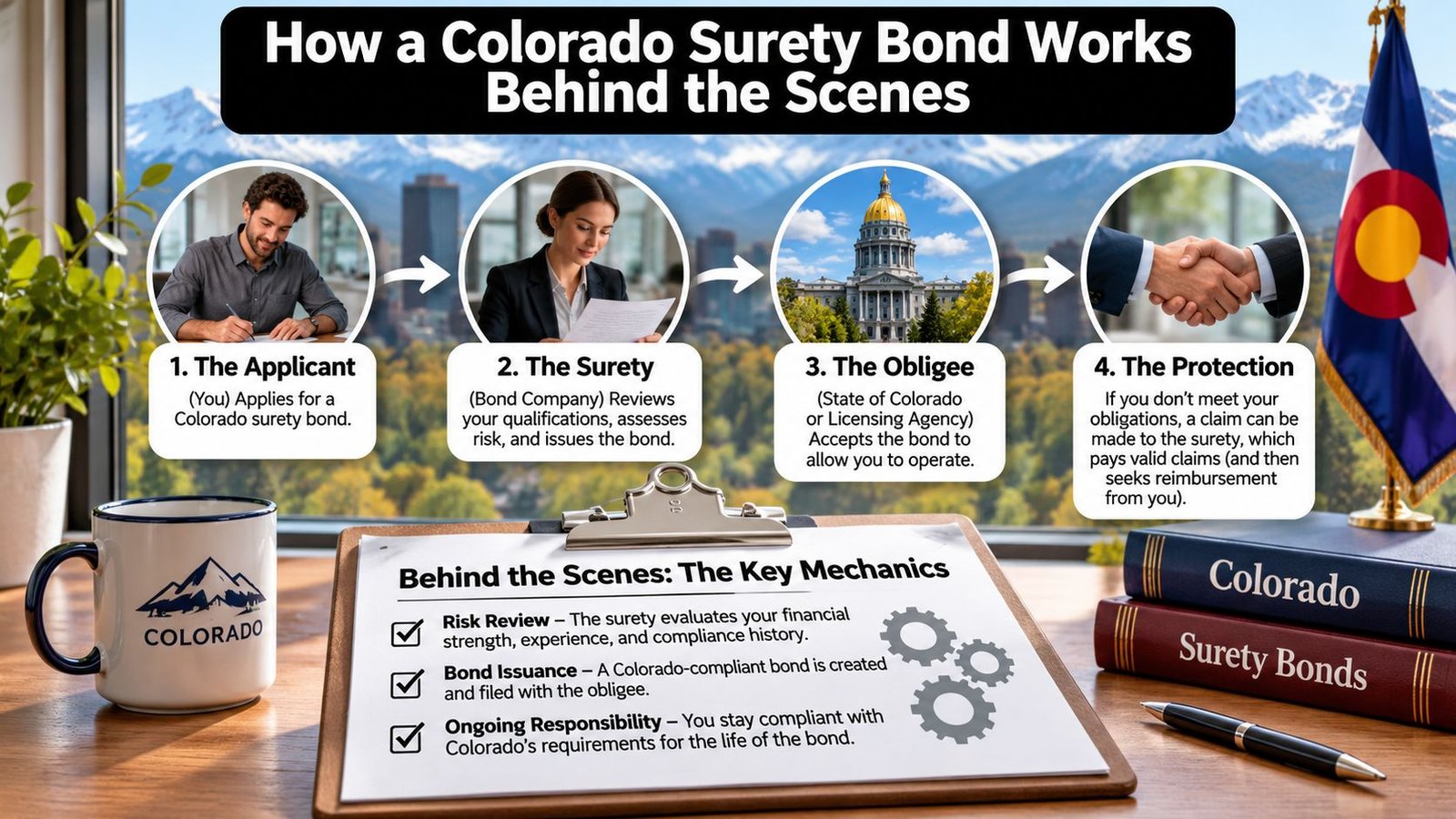
What the cosigner actually guarantees
The indemnitor, commonly called the cosigner, agrees to reimburse the producer or surety for obligations covered by the indemnity agreement. If the defendant misses court and the bond is forfeited, that exposure can reach the full bail amount, not merely the premium.
Say a parent arranges a bond for an adult child. The parent may focus on whether there's enough money available to make the initial payment, but the more consequential question is whether the parent can accept the contract's reimbursement obligations if the child fails to appear.
A missed appearance can trigger court procedures, forfeiture issues, and contractual consequences. The exact amount owed and available remedies depend on the agreement and what happens in court, so don't treat every missed date as an automatic final bill without further proceedings.
The premium is the immediate expense. The indemnity agreement determines the larger financial risk you're accepting.
Who oversees the transaction
The Colorado Division of Insurance administers and enforces the insurance laws governing bail-bond agents and handles complaints against them. Its oversight also includes an annual Premium Fee Statement reporting obligation for agents.
Keep the agency's legal name, the producer's name, and the surety company's name with your records. Those details help distinguish a disagreement about the bond contract from a question only the court can resolve.
Before signing, get clear answers to these questions:
- Who is the surety? Identify the insurance company behind the court undertaking.
- Who is the indemnitor? Confirm exactly who is signing the reimbursement obligation.
- What happens after a missed appearance? Ask whom to contact, what notices to expect, and which contractual expenses may become payable.
A posted bond is a step toward release, not a substitute for satisfying the court's remaining conditions.
Documents to Gather Before Posting a Colorado Bond
Prepare a small, accurate information packet before calling. You don't need to understand every court abbreviation, but you do need enough information to identify the right defendant, case, and bond order.
Use this checklist to organize the details.
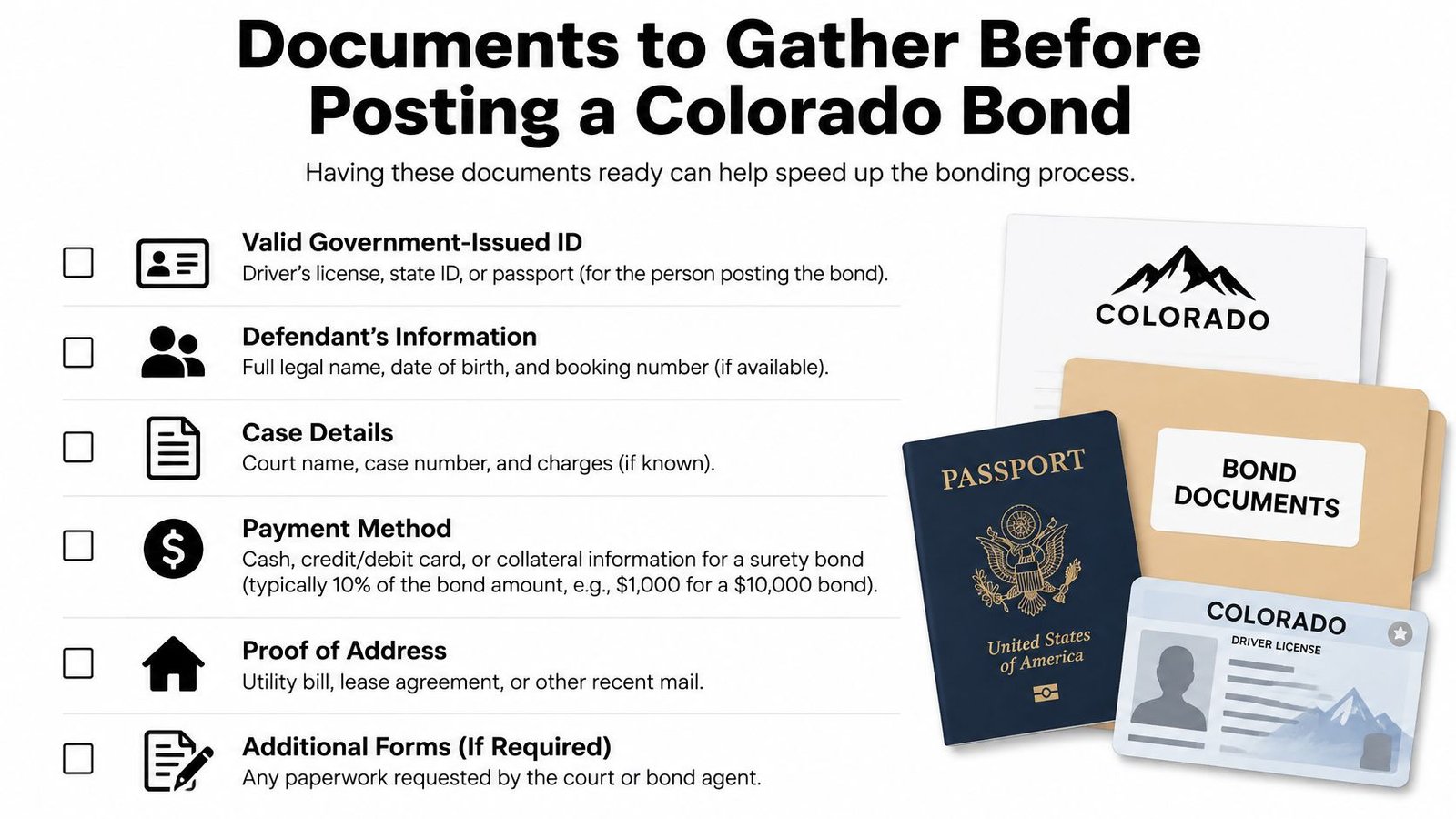
Gather the identifying information
- Defendant's full legal name, date of birth, and booking or inmate number. Similar names can cause confusion, so use the facility's record rather than a nickname.
- Holding facility and county. Identify where the person is currently held, not where the arrest happened.
- Court name, case number, and next court date if known. Keep separate cases separate instead of assuming a single bond resolves everything.
- Bail amount exactly as shown on the order. Include the bond type and any restrictions appearing alongside the amount.
- Cosigner's government photo identification and current address. Have clear, readable copies ready for identity verification.
- Any written disclosure or agreement already received. Save the complete document, including attachments and signature pages.
A misspelled surname or incorrect booking number can hold up posting while the facility and agent reconcile the records. If you're unsure about a detail, mark it for verification instead of guessing.
An example bail application can help you recognize the information you'll be asked to supply. Review it before entering information hurriedly on a phone.
Check what you receive before paying
Under Colorado's bail-producer disclosure statute, the producer must provide written disclosure before accepting money or collateral, document the premium-payment arrangement, and provide receipts. The indemnity agreement must identify the bail amount, defendant, court, premium, collateral, and return conditions.
Compare the contract against the verbal quote line by line. If the person on the phone described a payment arrangement, make sure the written terms reflect it before you sign.
Look especially closely at these entries:
- Payment allocation. Identify what pays the premium and what, if anything, is pledged as collateral.
- Unpaid balance. Check whether the initial payment satisfies the premium or starts an installment arrangement.
- Additional charges. Require an explanation of each separate amount.
- Return conditions. Confirm what must happen before pledged property is released.
The headline percentage isn't the only consumer-protection issue. Under time pressure, an unclear contract can cause more trouble than a calculation error because it leaves the cosigner uncertain about future obligations.
Keep one folder, electronic or paper, containing the application, disclosure, agreement, receipts, court order, and messages confirming posting. Date your notes and record whom you spoke with so another family member can follow the same information.
Who Can Cosign a Colorado Bond and What Agents Check
Being related to the defendant doesn't automatically qualify someone to cosign. The producer evaluates whether the proposed indemnitor has enough financial stability and a meaningful connection to the defendant to support the obligation.
At Express Bail Bonds, we look for these characteristics:
- Stable employment. Consistent work helps demonstrate an ability to meet financial commitments.
- Established residency. Homeownership or a long-term rental history in the area can help establish stability.
- A decent credit score. Credit standing helps inform the financial review.
These are underwriting guidelines, not a universal court-issued test. Different agents may evaluate the same circumstances differently, and there isn't a single qualification checklist that guarantees approval.
Assess your ability to accept the obligation
Before completing an application, consider how long you've held your job and lived at your current address. Review whether your credit is in good standing and whether existing financial commitments leave room for another obligation.
The hardest question is also the most useful: Could you manage the full bail obligation if reimbursement became necessary? Don't make that decision based only on whether you can afford today's payment.
You should also think about communication. Can you reliably reach the defendant, help them keep track of court notices, and respond promptly if the agent contacts you? Practical support doesn't replace financial qualification, but it matters when you're deciding whether to take responsibility.
An out-of-state relative can still help
A sister living outside Colorado doesn't necessarily have to travel to become a cosigner. We use secure electronic contracts that family members can review and sign from anywhere in the country, allowing them to help without flying to Colorado.
Remote signing changes how documents are completed, not what the signer promises. Read the entire agreement on a screen large enough to review it comfortably, and download the signed version rather than relying on continued access to a signing message.
Our cosigner requirements guidance explains the qualification considerations. Tell us early if employment, residency, or credit presents a concern so we can assess the proposed arrangement before you plan around it.
Before paying, ask which criteria apply to your circumstances and whether collateral or another qualified indemnitor could address a missing requirement. Confirm in writing that remote signing is accepted for the particular transaction, since another agency's procedures may differ.
How Collateral Works and When It Comes Back
Collateral is pledged property, not the fee for issuing the bond. The premium pays for the undertaking; collateral secures specified obligations if the transaction doesn't proceed as promised.
When real estate secures a bond, Colorado's Title 10 collateral provisions require written disclosure to the property owner when the initial application is filed. After the required disclosure, collateral may secure compliance with the bond, unpaid premium or related fees, and actual costs the producer incurs in issuing the bond.
Understand what the property secures
Consider a homeowner who proposes pledging a house to support a relative's bond. The property paperwork should identify the pledge and the obligations it secures, rather than treating the house as security for any expense the agency might later name.
The owner should understand the difference between allowing someone to use an address on an application and signing documents that encumber property. Don't sign a property-related document until you understand which interest is being pledged and who has authority to pledge it.
Ask for clear answers about:
- The property description. Confirm exactly what is being accepted as collateral.
- The secured obligations. Match them to the written agreement rather than relying on a verbal description.
- The owner's responsibilities. Establish who must sign and what documents must be supplied.
- The release process. Identify who handles the return or discharge and how to request confirmation.
Our bail bond collateral guidance can help you prepare questions before committing property.
Property-owner safeguard: Keep the disclosure and every signed property document together. A receipt for the premium isn't a substitute for a record of the collateral pledge.
Track exoneration rather than assuming the pledge ended
Exoneration means the court has discharged the surety's liability under the applicable procedures. When that occurs and the premium has been paid, collateral securing the bond must be released under the statutory framework.
A family member hearing that the case is finished should still obtain confirmation of the bond's status. Don't assume that leaving jail, attending a hearing, or receiving favorable news automatically completes the collateral-release paperwork.
Before signing, ask about the expected release process and any documents needed from the court. Once exoneration is confirmed, request release in writing, retain the response, and verify that any necessary property-release documents have been completed.
Why Bond Terms and Release Timing Vary by Case
Check these questions before sending payment: Can the facility process the bond remotely? Is the order surety-eligible rather than cash-only? Is another issue preventing release? Electronic payment removes a travel requirement, not court review or jail processing.
Release timing factors and what to confirm
| Factor | Effect on release | What to confirm |
|---|---|---|
| County or jail accepts online bond payment | Remote posting is possible through the facility's process | Ask the facility whether it accepts online bonds |
| Bond is surety-eligible, not cash-only | A commercial surety bond can be posted | Ask the agent or court clerk |
| Judge's release conditions | Nonmonetary conditions may apply alongside or instead of a bond | Read the court order |
| Booking, identification or hold checks | Processing can delay release | Confirm the booking number and any holds |
| Court date or open warrant | An unresolved warrant or missed date can block release | Check the court record |
Colorado's bail-producer licensing and training framework requires an authorized, licensed producer and at least 24 hours of approved education before appointment: 8 hours on bail bonding, comprising 2 on the criminal court system, 2 on ethics, and 4 on bail-bond laws, plus 16 hours on bail-recovery practices. The framework also describes House Bill 13-1236, effective May 11, 2013, which emphasized individualized bond decisions rather than unnecessary monetary conditions.
That individualized approach means similar charges don't necessarily produce identical release terms. Ask for the producer's license number and verify it; we're licensed by the Colorado Division of Insurance.
Use the video alongside your case-specific checks, not instead of the court order.
An out-of-state attorney can coordinate eligibility and online acceptance before payment, but an unresolved hold from another jurisdiction can still prevent release. Our jail release guidance helps organize those questions without promising a fixed release time.
Post the Bond and Confirm Release
Once the order, payment arrangement, and proposed cosigner are ready, keep the transaction organized around written confirmations. A submitted application, a completed payment, an accepted bond, and an actual release are different milestones.
Use the process below to track which milestone has been reached.
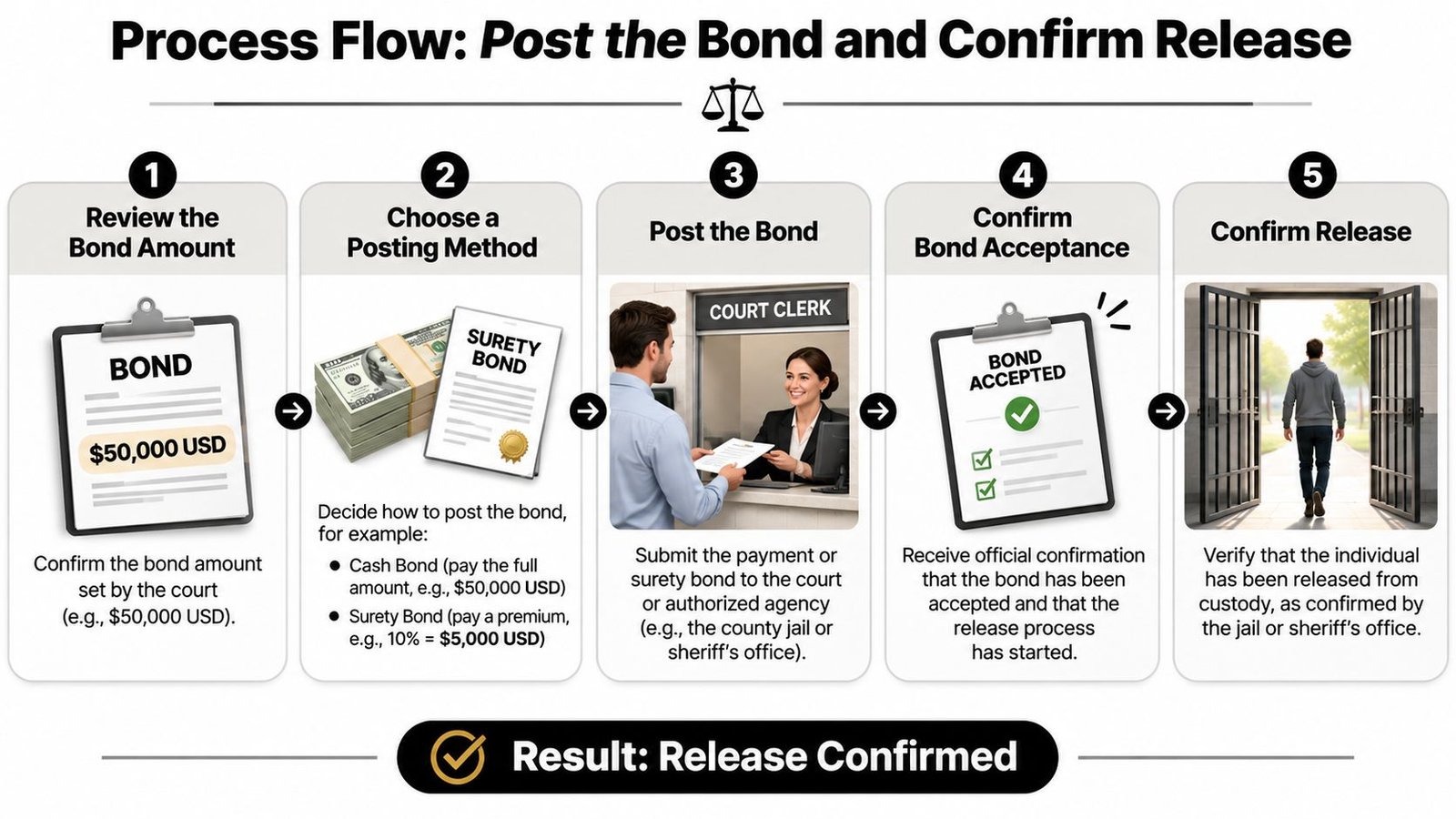
Complete the posting sequence
Confirm the amount, facility, and county. Have the current bond order and booking information available. Tell the agent about separate cases or known holds instead of assuming the facility will resolve them through the same bond.
Contact the agency with the case details. You can call or text 720-984-2245, available 24/7, or contact Express Bail Bonds online. Ask us to confirm whether the particular facility accepts online bonds and whether we can handle the proposed transaction before relying on general statewide availability.
Complete the electronic application and contract. We offer electronic application and contract documents, and a cosigner elsewhere in the country can review and sign securely. Read every attachment, check the names against the booking record, and download the completed documents.
Make the agreed payment and obtain posting confirmation. Save the receipt, then ask whether the bond has been submitted to and accepted by the facility. A successful payment notification alone doesn't establish that the jail has accepted the bond.
Record the expected release window and next court date. Ask what processing remains and whether there are unresolved conditions. Arrange transportation after confirming the release status rather than assuming the person will be waiting outside immediately.
Maintain the records through exoneration. Put court notices, payment records, and agency correspondence in the same folder. Continue tracking the defendant's obligations and any unpaid balance until you have confirmation that the bond obligation has ended.
We offer online application, payment, contract documents, and bond posting at most Colorado detention facilities. We serve jails in Denver, Jefferson County, Arapahoe County, and throughout Colorado, but the specific facility's procedure still needs confirmation before you pay.
If release hasn't happened yet
Ask a precise question rather than asking whether everything is done. Is the application awaiting approval, is a signature missing, has the facility accepted the bond, or is jail staff completing release processing?
Write down the answer and who provided it. If a family member calls later, they can ask about the unresolved item instead of restarting the entire conversation.
Don't submit another payment or begin another bond transaction just because you're anxious about a delay. First establish whether the existing bond has been accepted and whether an unrelated court or custody issue is responsible.
- Missing document. Ask which specific page, signature, or identification item is needed and how to send it.
- Court restriction. Have the attorney or court clerk clarify the order rather than expecting an agent to change it.
- Custody hold. Identify which jurisdiction issued it and who can explain the next step.
- Processing still underway. Ask when a status check would be useful without demanding a release guarantee the agent can't give.
For local information, use our resources for Jefferson County and Golden or Centennial. If release is urgent, call with the defendant's booking information and court order ready so we can check eligibility and the facility's posting process before you commit funds.
Express Bail Bonds offers electronic applications, payment, and contract documents to help families arrange Colorado surety bonds, including relatives coordinating from another state. Visit Express Bail Bonds or call or text 720-984-2245 to review the bond requirements, confirm facility procedures, and identify the next step for your loved one's release.