The call comes late. A bail amount gets quoted over the phone, someone drives to the jail or pays online, and by morning your family is holding a piece of paper with a number and a signature on it. Many people glance at the total, recognize the figure they were quoted, and put the paper in a drawer without reading another line.
That paper carries more information than the total. It's the only document in the entire transaction that ties a payment to a specific defendant, a specific bond amount and a specific purpose, whether that purpose was a premium, collateral or an installment. Read the wrong way, it's a souvenir. Read the right way, it's the record that settles arguments later.
Here's how to read one line by line, how to check the premium against Colorado's ceiling, and how long to keep the whole packet before you can safely stop worrying about it.
What a Bail Bond Receipt Really Records
A bail bond receipt is the formal, prenumbered record of money, collateral or other consideration given for a defendant's release. It works as the numbered claim ticket at a coat check. The number ties one item to one owner, and that number is what makes the claim provable hours later when the room is crowded. A receipt does the same job with more detail: it ties one payer, one defendant, one bond amount, one agent and one exact sum into a single entry.
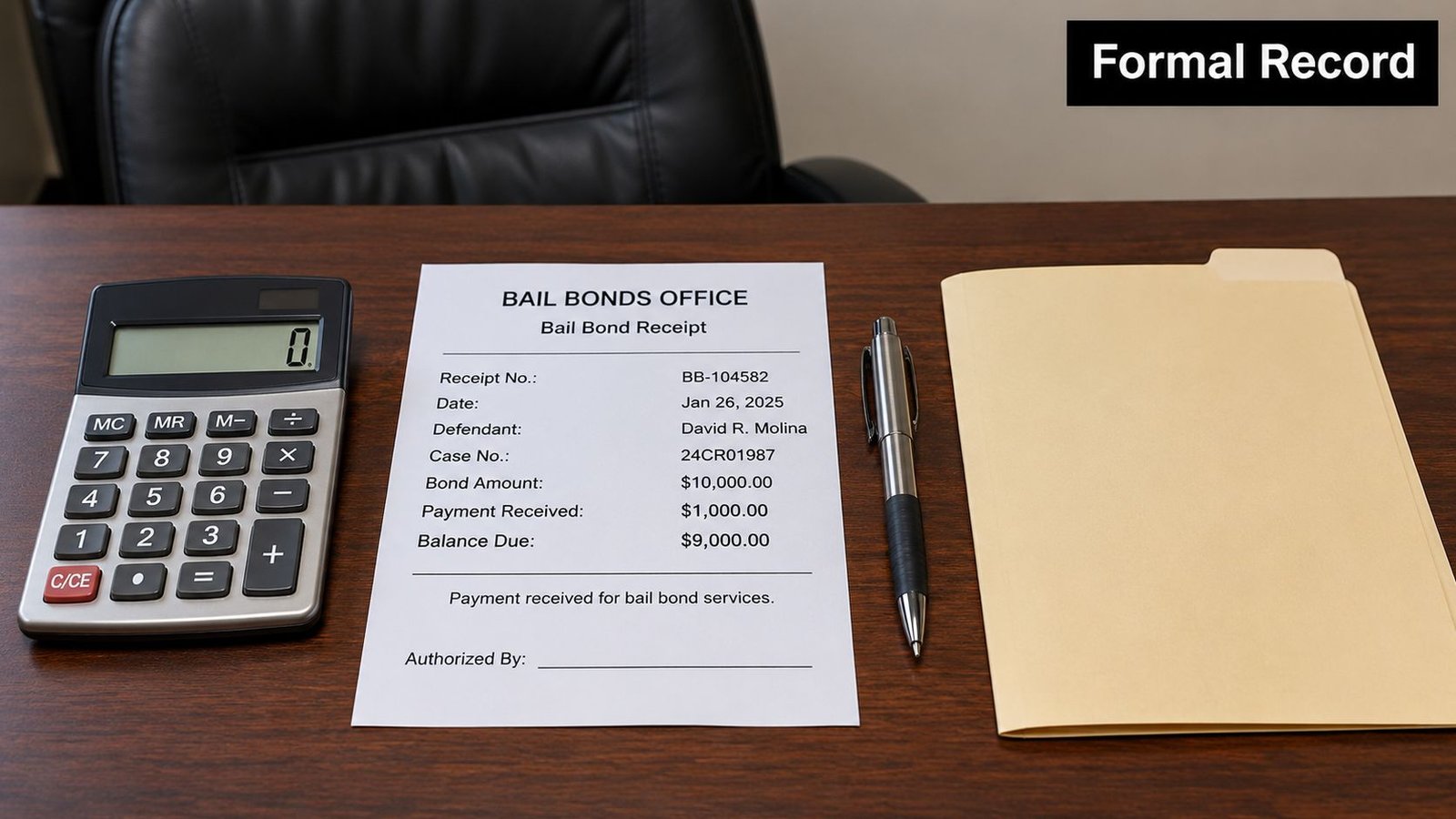
Colorado regulates that entry instead of leaving it to habit. A licensed insurance producer who posts a bond and accepts payment must issue a prenumbered, signed receipt for every payment received, showing the date, the defendant's name, a description of the consideration received and the amount of money, according to the Colorado bail bond statutes in Title 10. The same statutes require a separate signed and dated receipt for each premium payment, listing the amount paid.
Timing is part of the record too. Colorado legislative materials explain that a bond is posted when the surety or the defendant pays, as evidenced by the timestamp on the bond or the bond receipt. That timestamp answers a question that matters later in court: not only whether money was paid, but when.
Families end up holding receipts they can't fully explain all the time. A cousin covers the premium while you pledge a truck as security; the receipt in your hand shows a dollar figure that matches neither what you paid nor what you promised. That's exactly the moment to slow down, because a well-drafted receipt separates those two things into different lines.
The habit worth building: read the receipt the day you get it, keep the original, and compare it against the signed agreement and your bank statement while the transaction is still fresh in your mind.
The Fields Every Bail Bond Receipt Should Show
Here's the checklist to hold against your own paperwork. Read it with a pen in hand, because each line answers a different question.
| Field | What to Verify | Why It Matters |
|---|---|---|
| Receipt number | Prenumbered and in sequence | Gaps or duplicates reveal missing or altered records |
| Payment date | Matches your bank or card statement | Proves when the payment was made and when the bond was posted |
| Defendant's full name | Spelled as in the booking record | Ties the payment to the right case |
| Payer name | Your name, plus your relationship to the defendant | Identifies who is responsible for the premium or collateral |
| Amount received | Matches the amount you actually paid | Confirms the premium or payment was recorded correctly |
| Purpose of payment | Labeled premium, collateral, installment or authorized fee | Separates a premium from collateral or an unauthorized charge |
| Bond amount (penal sum) | Matches the court's bail amount | Confirms the obligation the agent is securing |
| Power-of-attorney or bond form number | Present and matching the bond paperwork | Links the receipt to the bond document |
| Agent and company details | Name, address and telephone number present | Lets you contact the right person with questions |
| Producer signature | Signed and dated | Makes the receipt a valid record of the transaction |
Three checks to run before you pay again
Run these in order, because each one catches a different mistake.
- Name against the booking record. Confirm the defendant's name is spelled exactly as the jail has it. A misspelled name is a small error with a large consequence when someone needs to prove the payment belongs to that case.
- Bond amount against the court paperwork. The penal sum on the receipt should match the bail the judge set. If the receipt says $10,000 and the court docket says $7,500, stop and ask.
- Amount received against your statement. Compare the receipt figure with the bank or card line. Remote payments are where mismatches hide, and the written record is what lets you tell an authorized charge from an unsupported one.
For installment payments, the receipt has to do more than confirm one deposit. It should show the amount just paid, the remaining balance and the next due date, so the receipt and the payment plan agree with each other. The details an agent collects on your side are laid out in this bail application example, and they're the same details that should reappear on every receipt.
When a field is blank
A missing field isn't a clerical nuisance. It's the first question to ask before any more money leaves your account. Ask in writing, by text or email, so the answer sits next to the record it corrects.
These field requirements track Colorado's rules. If the bond was posted in another state, confirm what that state requires with your agent rather than assuming this list carries over unchanged.
Bail Bond Receipt Versus Other Bail Paperwork
Your sister pays part of the premium by card, signs the agreement from her phone, and later receives a schedule of the remaining dates. Three papers look official. Only one lets you match the premium, the collateral, and the bond amount against the payment plan. That document is the bail bond receipt. The others answer different questions.
Bail paperwork works like a grocery checkout. The shelf tag names a price before you pay. The store policy lists the rules. The layaway card lists what is still due. The receipt is the slip you hold up when the card statement, the tag, and the layaway card do not agree. A bail bond receipt does that same matching job for the bond.
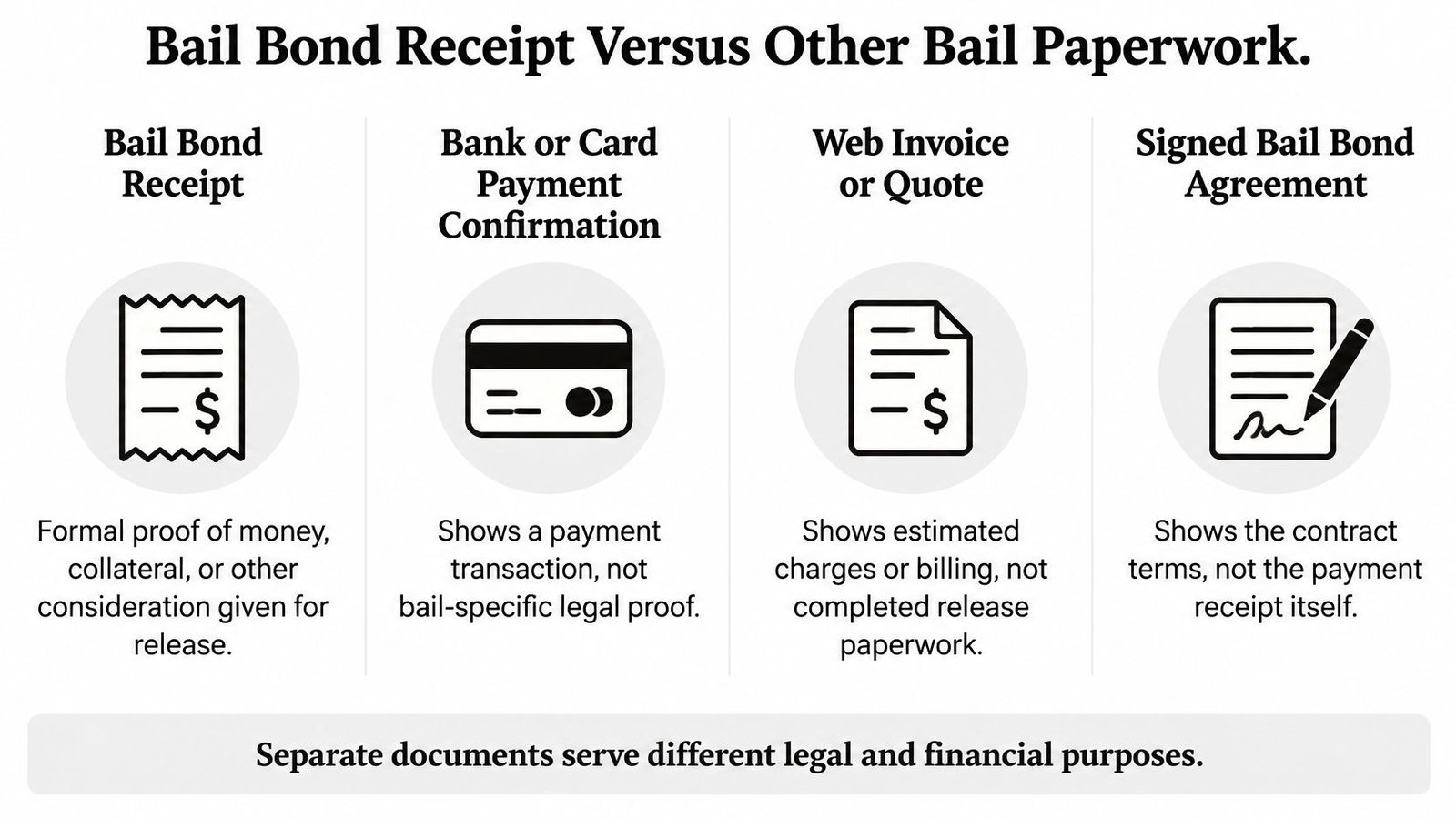
A bank or card confirmation proves money moved to a payee. It usually will not name the defendant, the bond amount, or the purpose of the payment, so it cannot settle a dispute about a balance. A web invoice shows a price before anyone paid it. The signed agreement shows the terms you accepted. A collateral receipt records the property pledged, its condition, and the case details that tie that pledge to this bond: the bail amount, the defendant's name, the court case number, the court, and the premium charged. A payment schedule shows what is still owed, not what has already been received. Keep all of them. Use the receipt to check that they describe the same case and the same money.
Documents that look similar and what they prove
| Document | What It Proves | Replaces the Receipt? |
|---|---|---|
| Bail bond receipt | Payment, payer, defendant, purpose, bond amount, and how those figures sit against the payment plan | Yes, it is the record you reconcile against |
| Bank or card payment confirmation | That money moved to the payee | No, it may not name the defendant or purpose |
| Web invoice or quote | A price offered before payment | No, it is not proof of payment |
| Signed bail bond agreement | The terms and obligations you accepted | No, it does not record each payment |
| Collateral receipt | The pledged property, its condition, and the case details (bail amount, defendant, case number, court, and premium) | No, it records the pledge, not each payment received |
| Payment plan schedule | Agreed installments and due dates | No, it shows future payments, not received ones |
Some demands have nothing to do with your bond at all. Colorado legislative materials state that anyone posting a money bond, including one posted online, has the right to receive a copy of the bond paperwork and information about the next court date, and that bond payments are made payable to the holding county rather than to the incarcerated person, per the 2025 Colorado bond legislation. The same materials state that bond, booking, and other fees or debts do not have to be paid to secure release on a money bond.
A short walkthrough shows how the paperwork fits together in practice.
The rule that prevents most losses: if a payment demand doesn't line up with the fields on your receipt, pause and verify before paying. A legitimate charge can always be explained in the same terms the receipt uses.
When you need to see how the agreement, the disclosure, and the receipt fit together, this overview of contract documents shows what each signed page is for.
Working Out the Premium on Your Receipt
The premium is what the agent charges for putting up the full bond amount, and it should sit on its own line, separate from any collateral. Colorado limits a producer's premium or commission to the greater of $50 or 15% of the bail amount, and restricts additional charges to specified categories such as court or law-enforcement filing fees, secure collateral storage and premium financing, as set out in Colorado's bail bond statutes.
The formula takes ten seconds. Multiply the bail amount by 15 percent, compare the result with $50, and the larger of the two is the ceiling.
| Bail Amount | 15% of Bail | Maximum Premium (Greater of $50 or 15%) |
|---|---|---|
| $200 | $30 | $50 (minimum applies) |
| $5,000 | $750 | $750 |
| $10,000 | $1,500 | $1,500 |
Reading the premium line on your own receipt
On a small bond, the minimum does the work. Fifteen percent of a $200 bond is $30, so the $50 floor is the binding limit, and a receipt showing $30 on that bond isn't automatically wrong; it's under the cap. On a $1,000 bond, the calculation lands at $150, well clear of the minimum, so $150 is your reference point.
On larger bonds, the percentage sets the number. A $5,000 bond tops out at $750 and a $10,000 bond at $1,500. If the premium line on your receipt comes in above the figure you calculated, ask the agent to break the difference into its components. Sometimes the extra is an authorized category, like a court filing charge or collateral storage. Sometimes it's financing. Both should be labeled as such, not folded into a number that looks like a premium.
Expert note: a receipt that lumps premium, fees and collateral into one round figure tells you nothing you can check. Ask for the breakdown before you sign anything.
Installments complicate the math in a useful way. Each installment receipt should match the schedule you agreed to and show a running balance, so the sum of your receipts equals the total premium rather than trailing behind or overshooting it. To see how premium, risk and cosigner terms are weighed before a bond is written, this explanation of the surety bond premium walks through the logic.
Collateral Receipts and What They Protect
Collateral changes the paperwork. When a family pledges a vehicle, a deed or cash instead of only paying a premium, Colorado requires a separate collateral receipt that is prenumbered, dated and written, signed by the producer and by the defendant or indemnitor, and it must describe the collateral in full along with its condition when received, per the Colorado bail bond statutes on collateral. The same provisions call for case details on the document: the bail amount, the defendant's name, the court case number, the court where the bond is executed and the premium charged.

The vehicle title example
Say a family pledges a pickup truck to secure a $10,000 bond. A receipt that says "vehicle" protects nobody. A receipt that records the make, model, year, title number, mileage and the dent on the rear quarter panel protects both sides, because it establishes what was handed over and what condition it was in on the day it changed hands.
Run three checks while the agent is still in front of you. Does the description identify the item precisely enough that a stranger could pick it out of a parking lot? Does the case number match the court paperwork you already have? Are both signatures on the document, the producer's and the defendant's or indemnitor's? If any answer is no, the receipt isn't finished yet.
That description earns its keep at the end of the case. When the bond obligation ends and the collateral comes back, the receipt defines exactly what must be returned and in what condition, which is the difference between a short conversation and a long dispute. The bail bond collateral process, from pledge to return, follows the same document.
How Long to Keep Your Receipt and Why
A family calls two years after release because a payment-plan statement does not match what they remember paying. The receipt is the page that settles the argument. It lets the payer line the premium, the collateral, and the full bond amount up against the payment plan, the way a bank statement lets you match each charge to the original bill. Without that page, "we paid" is a memory. With it, the numbers either agree or they do not.
Three years is the working number. Colorado requires a producer who posts a bail bond to keep copies of receipts, indemnity agreements, bonds, disclosure statements, payment plans, revocation requests and related records for three years after the bond is discharged and collateral is returned, or after the required notice that a promissory note has been satisfied, under the state's bail bond record retention rules. Regulators get a defined inspection window. You get the same benchmark for your own files.
The clock starts at discharge, not at the arrest. A bond discharged in March 2022 stays on the producer's books until at least March 2025. If the case runs long, those three years begin only when the bond is discharged and the collateral comes back.
Four storage steps that take ten minutes
- Scan the day you receive it. Photograph or scan the receipt while the agent's signature is fresh, and name the file with the defendant's last name and the payment date.
- Keep the original with the packet. The receipt belongs in the same folder as the bond paperwork, the payment plan and any collateral receipt, not in a purse or a glove box.
- Save electronic receipts as PDFs. A PDF preserves the timestamp, payment reference and delivery confirmation, which is what makes an emailed receipt as usable as a paper one.
- Write down the next court date. Store it with the packet, because a missed appearance is the event that turns a routine file into an urgent one.
After release, the Express Bail Bonds team follows up to confirm the defendant is out and gives guidance on court date compliance and bond conditions. A complete packet makes that conversation short, because the premium, the collateral and the bond amount already sit on one page next to the payment plan. If the original receipt goes missing, ask the agent for a duplicate. Producers keep copies through that three-year window, so a replacement is normally a phone call away. For questions about what happens to money at the end of a case, this explanation of whether bail is refundable covers the difference between a premium and a deposit.
Check Your Receipt and Get Help Today
It is 2 a.m., the jail has a bail figure, and the receipt in your hand is the only sheet that can reconcile three numbers before anyone pays again: the bond amount, the premium, and the collateral. Lay it beside the payment plan the way you would match a grocery receipt to a bank charge. Each line should name the same defendant, the same bond, and the same dollars.
The decision rule is simple. If a field is blank, if the premium sits above the ceiling you already worked out, if the collateral description is vague, or if a new payment demand does not match the document, call the bail agent before sending another dollar. A phone call sorts a mismatch early. A forfeiture is a much more expensive place to discover it.
A licensed, bonded, and insured team can read the receipt with you line by line and give a clear, no-obligation quote before any money is paid. Call or text 720-984-2245, any hour of the day, or start through the online application and payment system, where cosigners can review and sign secure electronic contracts from anywhere in the country.
Have four things ready before you call: the defendant's full name, date of birth, the jail where the defendant is held, and the bail amount. With those, an agent can pull up the details and tell you what the paperwork should show.
General information about the process lives at Express Bail Bonds, with local pages for families in Jefferson County and Golden and for Centennial. If you want a second set of eyes on the wording of an agreement or a receipt before you sign, a legal document review AI can help you spot missing terms and unclear clauses quickly.
When the paperwork feels like a second job, Express Bail Bonds takes it off your hands. The agency has posted surety bonds across Colorado since 1988, handles the documents and court coordination, and walks families through every line of the receipt so they can see what was paid and what it covered. Call or text 720-984-2245 any time to get the bond posted and the record straight.