
Search the La Plata County sheriff's online roster using the person's full legal name and, where the form allows it, a date of birth, then call the La Plata County Detention Facility at 970-247-1161 if no record appears. Those two steps resolve the question in almost every case, and the second step is the one families skip.
Here's the gap in the usual advice. People treat a blank roster as a verdict, either that the arrest never happened or that the person has already been released. Neither conclusion follows from an empty screen. The facility recorded 2,151 bookings in 2025, according to The Durango Herald, and every one of those bookings moved through an intake process before it could ever appear on a public list. In the hours between arrest and roster entry, the screen tells you nothing at all.
The key skill in a La Plata County jail inmate search is knowing which source answers which question, reading a record correctly once you find one, and having a fallback ready when the name isn't there yet.
Where to Search and What Each Source Shows
The La Plata County sheriff's online roster is the default starting point, and it answers exactly one question: who is in custody at the Durango detention facility right now. Before you type a name, open the page and confirm it sits on a county or sheriff domain and that the search field works. La Plata County's public material doesn't surface a verifiable inmate-roster page in the results I can confirm (La Plata County community services page), so confirm the roster is live before you trust what it returns.
The detention facility is at 742 Turner Drive in Durango, Colorado, and public inmate information comes either through the county sheriff's roster or from calling the detention center directly (county records search guide). Search with the person's full legal name. A roster reflects current custody rather than the full history of a criminal case, so a name that isn't there may be a booking that hasn't finished processing.
The comparison below is the one I keep on hand when a family asks which site to open first.
| Source | Use it for | Limit |
|---|---|---|
| Sheriff online roster | Current custody status, booking date, charges and bond information | Shows people currently held; verify the page is current |
| Detention facility, 970-247-1161 | Confirming custody when a recent arrest is missing from the roster | Staff can only confirm what is recorded; call during intake |
| La Plata County records check | Local records history for a named person | $10 fee; limited to La Plata County records |
| Colorado Department of Corrections search | Anyone who has entered state prison custody | Wrong first stop for a county jail booking |
| VINELink statewide search | Secondary cross-check of custody status | Does not replace the booking facility's record |
A county jail lookup isn't a prison search. Start with the county detention authority. A Department of Corrections search only fits once someone has entered state custody, and VINELink works as a cross-check on custody status rather than a substitute for the booking facility's own record (Colorado jail and inmate records guide). Other Colorado systems show why freshness matters: Jefferson County's lookup displays only people currently in custody and warns that its information updates every 15 minutes and stays subject to change, a useful benchmark but not evidence of La Plata County's own refresh interval.
Practical rule: a roster result is a snapshot, not a case file. Copy it, timestamp it, then verify it against the facility.
Pages and phone numbers drift. La Plata County took over public-health services from San Juan Basin Public Health on January 1, 2024, after the agency had served the community for more than 70 years, and the Clerk and Recorder's office sorts resources by department rather than under one unified lookup. That's why old directories and third-party jail pages carry numbers that no longer ring. If the roster shows your person, copy the details. If it shows nothing, the next steps matter more than the screen does. If you want to widen the net first, this walkthrough on how to search arrest records covers the county, state and court layers. For questions about whether a warrant exists in your own name before a court date, the plain-language Law Office of Bryan Fagan guidance explains how court records and law-enforcement sources differ.
How to Run the Search Step by Step
A sheriff's roster rarely fails because the database is broken. It fails because the query was too loose or the reader stopped at the first hit. A multi-county inmate locator tool is fine for a first pass, but the county booking record governs.
Work these seven steps in order.
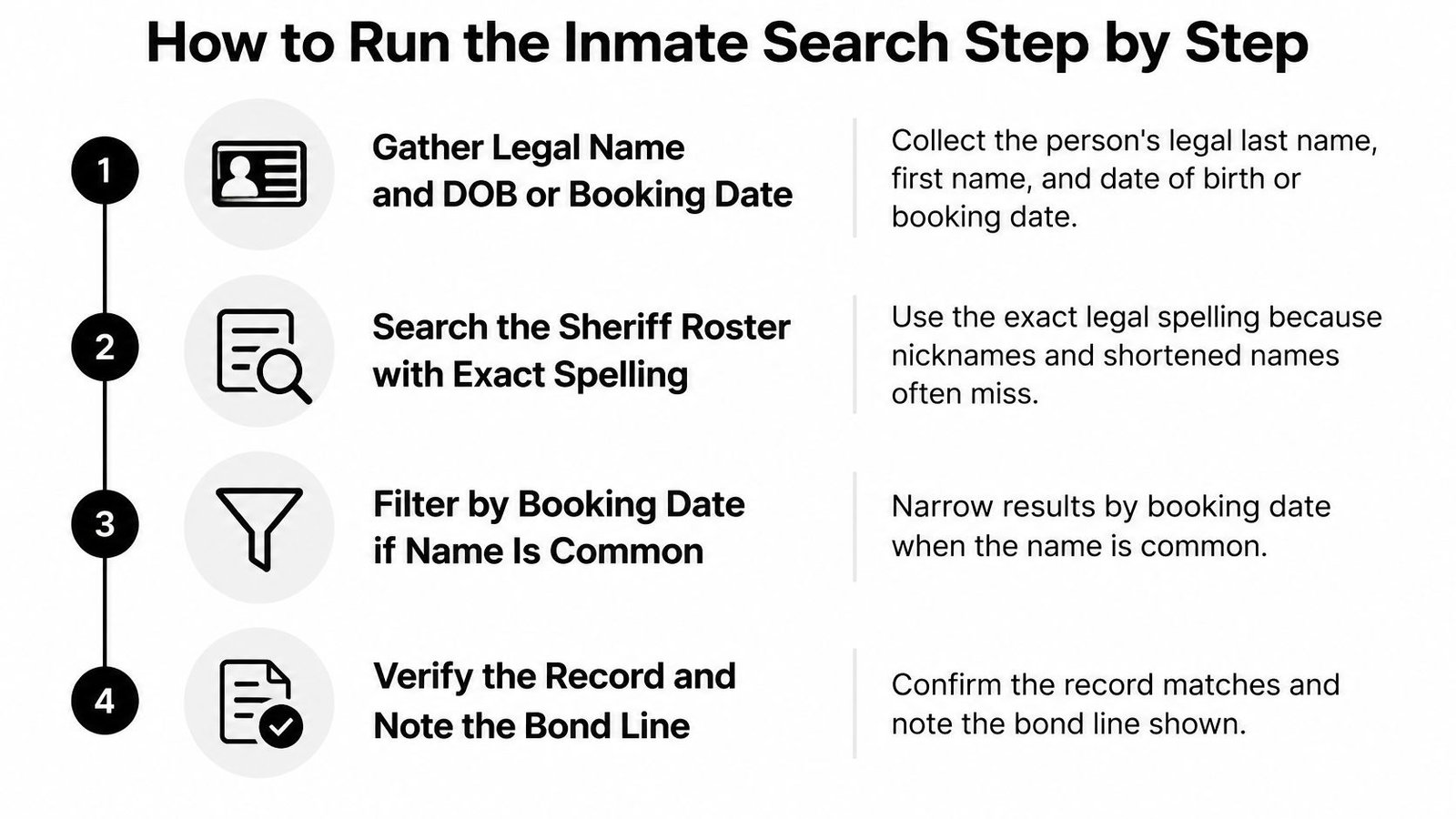
- Gather the identifiers first. Legal last name, first name, date of birth, and the booking date if anyone has it. Searching without a date of birth is how people end up quoting charges that belong to a stranger with the same surname.
- Search the exact legal spelling. Nicknames, middle-name swaps and shortened versions miss constantly. If the arrest report says "Mike," try Michael and the surname before assuming the record is absent.
- Repeat with a partial name or a variant. Drop the last letter, try the maiden name, try the hyphenated form. Matching is usually literal, so spelling differences at booking become missing records at search.
- Compare the date of birth before you believe anything. A common surname can return several bookings at once. The date of birth separates them; a name alone does not.
- Check the custody status line. You want a record marked as currently held. A historical booking or a release entry can look identical to an active one if you only read the top of the page.
- Write down everything, including the time you looked. Booking number, facility, listed charges, bond type, court information, exactly as displayed. A screenshot with a timestamp settles arguments an hour later.
- Call the facility to verify. Do this before anyone pays money or drives to Durango. Colorado public-record guidance notes that inmate information can be requested from the relevant county sheriff and that sensitive details, ongoing investigations and security-related material may be withheld (Colorado public offices records guide).
What a confirmed record looks like
A reliable hit carries a booking number, names the Durango facility, shows a status confirming the person is in custody, and displays a bond line. If any of those four are missing, you have a partial result, not a confirmation. No La Plata County source publishes a search-success rate or a database refresh schedule, so treat any quoted percentage as guesswork.
The screen may not show juveniles at all and may redact identifying details on adult records. Treat every record as a current snapshot of custody, which means it can change before you finish reading it.
Blank Results and When to Call the Facility
Booking isn't instant. Intake runs identity checks, warrant checks, medical screening and classification, and it can take roughly two hours to a full day depending on how busy the facility is (recent bookings and arrests listing). Volume is ordinary rather than suspicious: U.S. local jails held 658,700 people at midyear 2024, according to the Bureau of Justice Statistics.
Picture the pipeline. Someone is arrested or cited, transported, processed at intake, booked, screened and classified, then housed. The roster updates somewhere after booking, and a later transfer or release changes it again. Any one of those stages can strand a search.
A blank result is inconclusive. It doesn't prove a release, and it doesn't prove that no arrest happened.
Match the symptom to the cause
| Symptom | Likely reason | What to do |
|---|---|---|
| Name missing after a recent arrest | Intake and booking still in progress; intake can take about two hours to a full day | Wait a few hours, search again, then call the facility |
| Name missing after a citation | Person was cited and released instead of lodged | Check the arresting agency and any paperwork given at arrest |
| Name missing after several days | Transfer, release or a record not published online | Call the facility to ask about custody and transfers |
| Name appears under a different spelling | Legal name differs from the name used at arrest | Search by partial name, booking number or date of birth |
| Several people with the same name | Common surname on the roster | Compare date of birth before acting on any result |
Capacity shapes what you see. The detention center's average daily population rose from about 165 inmates to as many as 207 in 2024, against 260 physically usable beds that classification standards keep from being fully occupied (Durango sheriff capacity letter). When housing and classification tighten, transfers and release decisions move on operational grounds, which is one more way a name leaves the list while the court case continues.
The call that settles it
Have the full legal name, date of birth, booking date, arresting agency and approximate arrest time in front of you. Call the facility at 970-247-1161, or visit 742 Turner Drive, Durango, CO 81303, and ask directly whether the person is in custody (detention facility inmate search page). Then ask whether booking is complete, whether the person was transferred or released, whether another agency holds them, the bond amount and type on file, and the next court date. Call during business hours, note the date, time and the name of the person you spoke with, and keep those notes with your search record. A directory of county jail phone numbers saves time when a transfer means starting over in a new county.
Bond Type and Court Records Explained
The bond line is the most misread field on a roster. It shows a number, and families assume that number is the price of release. It isn't always, because the roster rarely says what kind of bond the judge set.
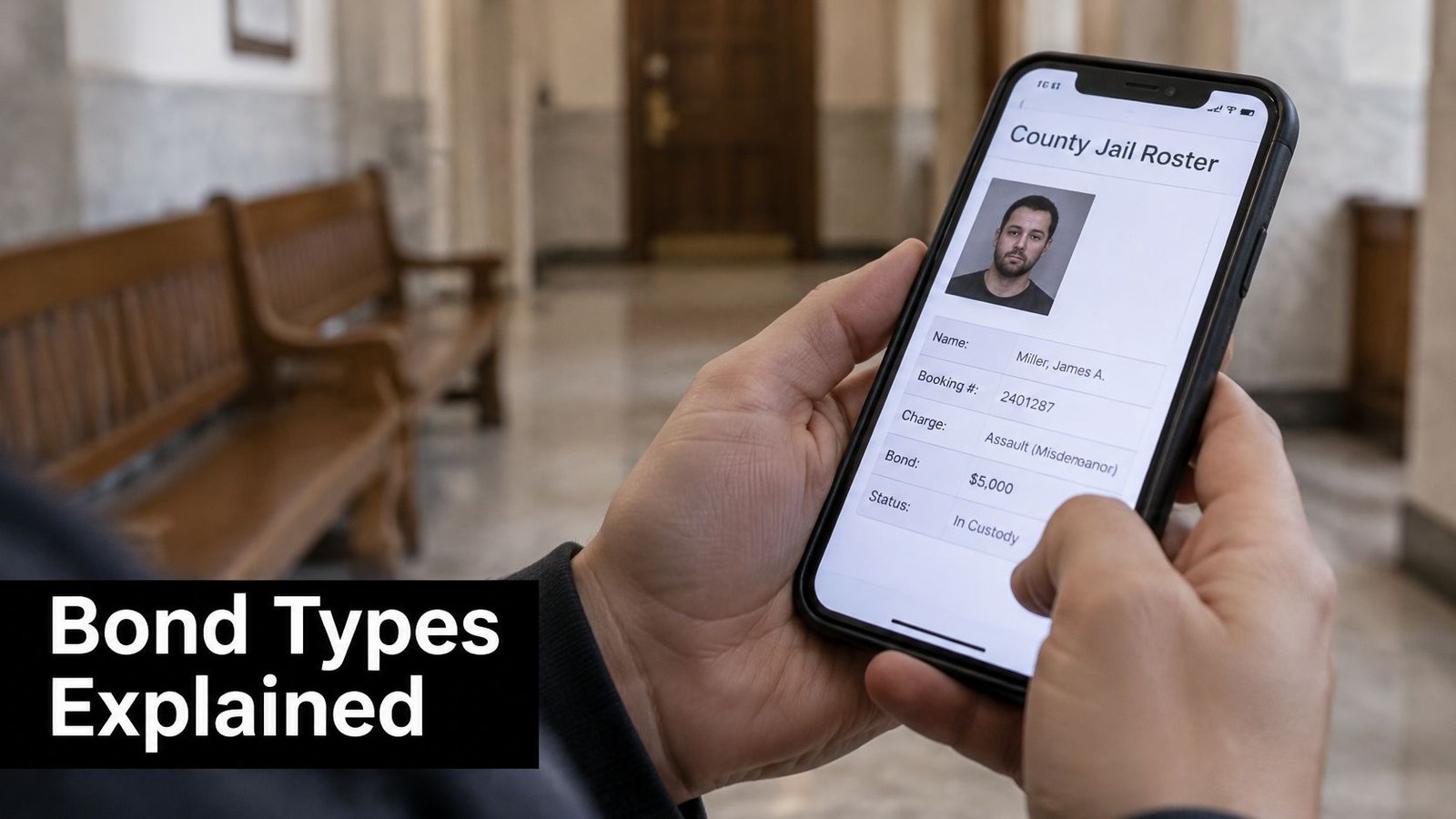
Four bond types and what each one asks of you
- Surety bond: a licensed agency posts the full amount with the court, and you pay a premium rather than the whole figure. A bail agency belongs in the process for this type of bond.
- Cash-only bond: the full amount goes to the court in cash. No agency can post it for you, so a bail company that promises otherwise is wasting your day.
- Personal recognizance: release on a written promise to appear, with no money up front. People miss this one because it shows as a release, not a payment.
- Restricted release: an amount plus conditions such as supervision, electronic monitoring or a hold from another jurisdiction. The money alone won't open the door.
Bond amounts and conditions can change between the arrest and the first appearance, and holds from other counties attach without changing the number on the screen. Confirm the current amount and the authority behind it with the court or the facility before anyone pays.
Jail records and court records are different animals. A person released on personal recognizance drops off the roster the same day, while the case carries on through the courthouse, and a missed date can produce a new warrant. Reading the roster alone will never tell you that. Third-party directories also show stale bond figures and instructions that no longer apply, which is why the county and court record is the reference. When you need the docket rather than the custody record, MatterAlert's guide to federal docket searches explains how court indexes are organized so you search the right system. Before posting anything, take four questions to the court or facility: the case number, the bond type, the amount with any conditions, and the next court date. Understanding the different types of bail bonds helps you match the answer to the right route.
Confirm the Record Before You Arrange Release
Three confirmations sit between a roster record and a smooth release: that the person is in custody, what the bond requires, and who posts it. Skip the first and you pay against the wrong case. Skip the second and you show up with a payment the jail won't accept.
Write the answers into one note before you call anyone.
The bond amount and conditions should come from the detention facility or the court, not from a directory listing, since third-party jail pages can carry outdated phone numbers and public instructions (bail bond instructions listing). One call to the facility settles custody and the current bond line at the same time.
If the bond is a surety bond, Express Bail Bonds reviews the options with Colorado families and completes the release remotely, with the application, payment and contract documents handled electronically, and guidance is free. Agents work across all Colorado counties, so the release from jail process looks the same whether you're twenty minutes from Durango or three states away. Have the defendant's full name, date of birth, the jail holding them and the bail amount ready when you call. Expect the jail to take one to eight hours to process the release after the bond posts, depending on staffing and how busy it is that day.
Express Bail Bonds posts surety bonds statewide and answers bail questions free of charge, day or night, including the ones that start with a blank roster screen. Call or text 720-984-2245 with the defendant's name, date of birth, the jail and the bail amount, and an agent can walk you from confirmation to posting without a trip to the detention center. Visit Express Bail Bonds to see how the process works before you commit to anything.