There's no single clock for when prisoners can make phone calls. In Colorado, a newly booked person can usually call only after intake, on an outgoing line, during that facility's calling hours, and calls are often limited to about 15 minutes.
If you're waiting for a call right now, the silence doesn't necessarily mean the person can't reach you or hasn't tried. Booking may still be underway, the person may not have access to a housing phone, or the jail may have paused calls for count, court movement, staffing, or security. The quickest way to narrow it down is to identify which facility has custody and ask what stage the person is in.
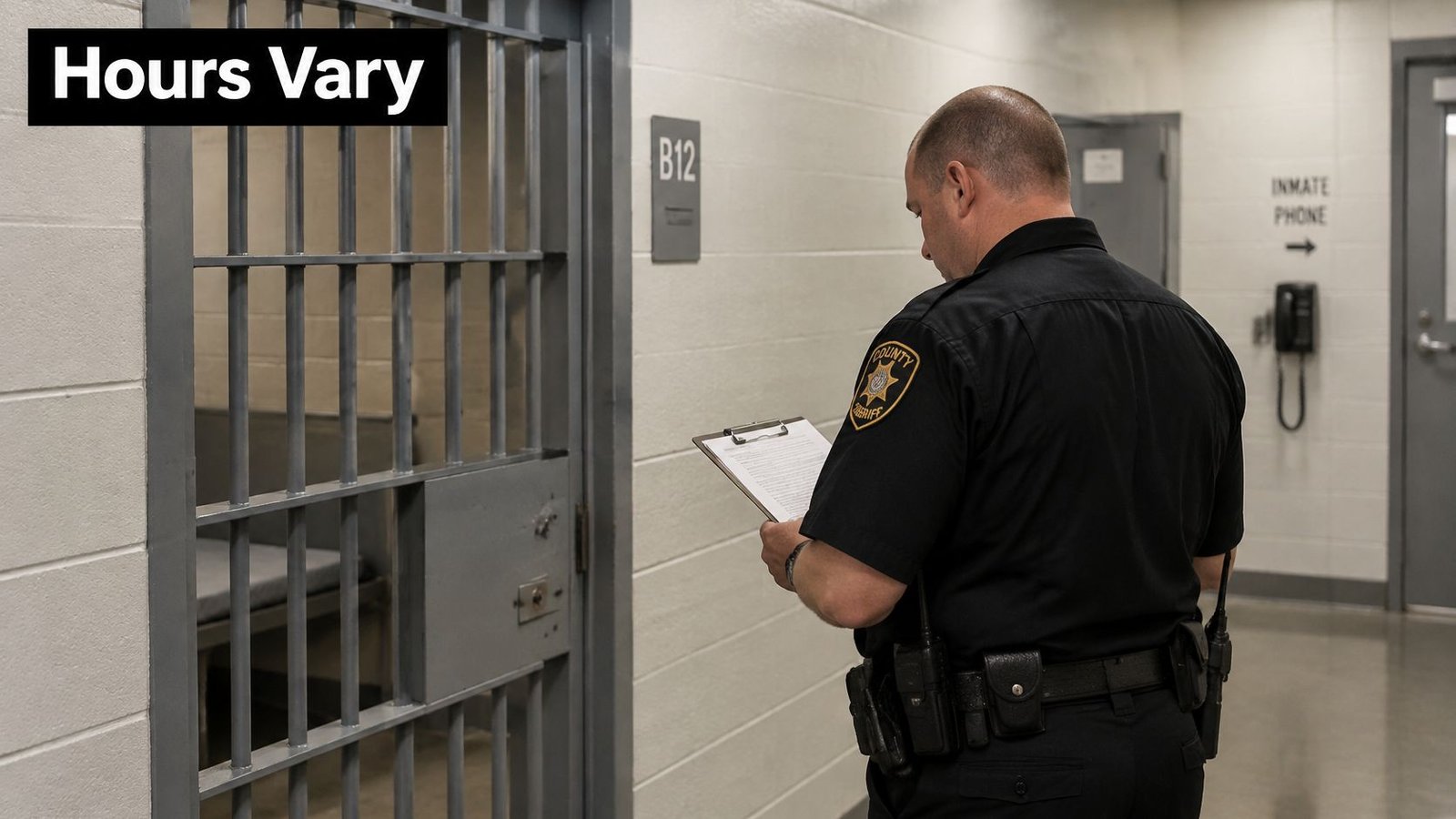
Phone Windows by Facility Type
| Setting | Earliest realistic window | Usual hours | Incoming calls | Typical length |
|---|---|---|---|---|
| Colorado county jail after arrest | After intake; sometimes before general population | Facility-set; Gilpin dayroom access is 8:00 a.m.–11:00 p.m. | Not accepted | Often 15 minutes |
| Colorado state prison | After the recipient is on an approved list | Facility-set calling schedule | Not accepted | Facility-set limit |
| Federal prison | After admission and local procedures | Ordinarily 6:00 a.m.–11:30 p.m. | Outgoing system | At least 3 minutes if funded; some facilities cap calls at 15 minutes |
| Phone restriction or discipline | Access reduced or suspended | Warden or jail limits | No | Shorter or suspended |
| Family emergency | May fall outside normal hours | Case by case | Still outgoing | Set case by case |
The table shows why “when can prisoners make phone calls?” has no single answer. A county jail's first opportunity may come after intake, while a state prison may require an approved contact list. A federal facility has its own schedule, and local officials can shape how that schedule works in practice. These are different clocks, not one nationwide guarantee.
For federal prisons, the Bureau of Prisons telephone policy sets ordinary operating hours between 6:00 a.m. and 11:30 p.m., with phones unavailable overnight from 11:30 p.m. until 6:00 a.m. The warden sets the local schedule, so housing-unit routines, staffing, population, and demand can affect actual access. A funded caller is ordinarily allowed at least three minutes, while a facility handbook may set a longer maximum or a shorter one based on conditions. One handbook example limits calls to 15 minutes and provides 300 minutes per month unless the person is restricted.
Federal rules also set a baseline of at least one call per month, unless access has been restricted as a disciplinary sanction. That baseline doesn't mean unlimited access or a right to call at any preferred hour. The warden can impose limits for security, good order, discipline, or public protection.
Practical rule: Match the row to the building first, then confirm that day's policy with the jail or prison. A general guide to jail rules can help you understand common restrictions, but it can't tell you whether a particular person has cleared intake or whether phones are available right now.
From Booking to the First Call
Think of the first call as a hallway with doors that must open in order. A phone may be inside the building, but the person still needs to pass through booking, be given access, and reach an open line.
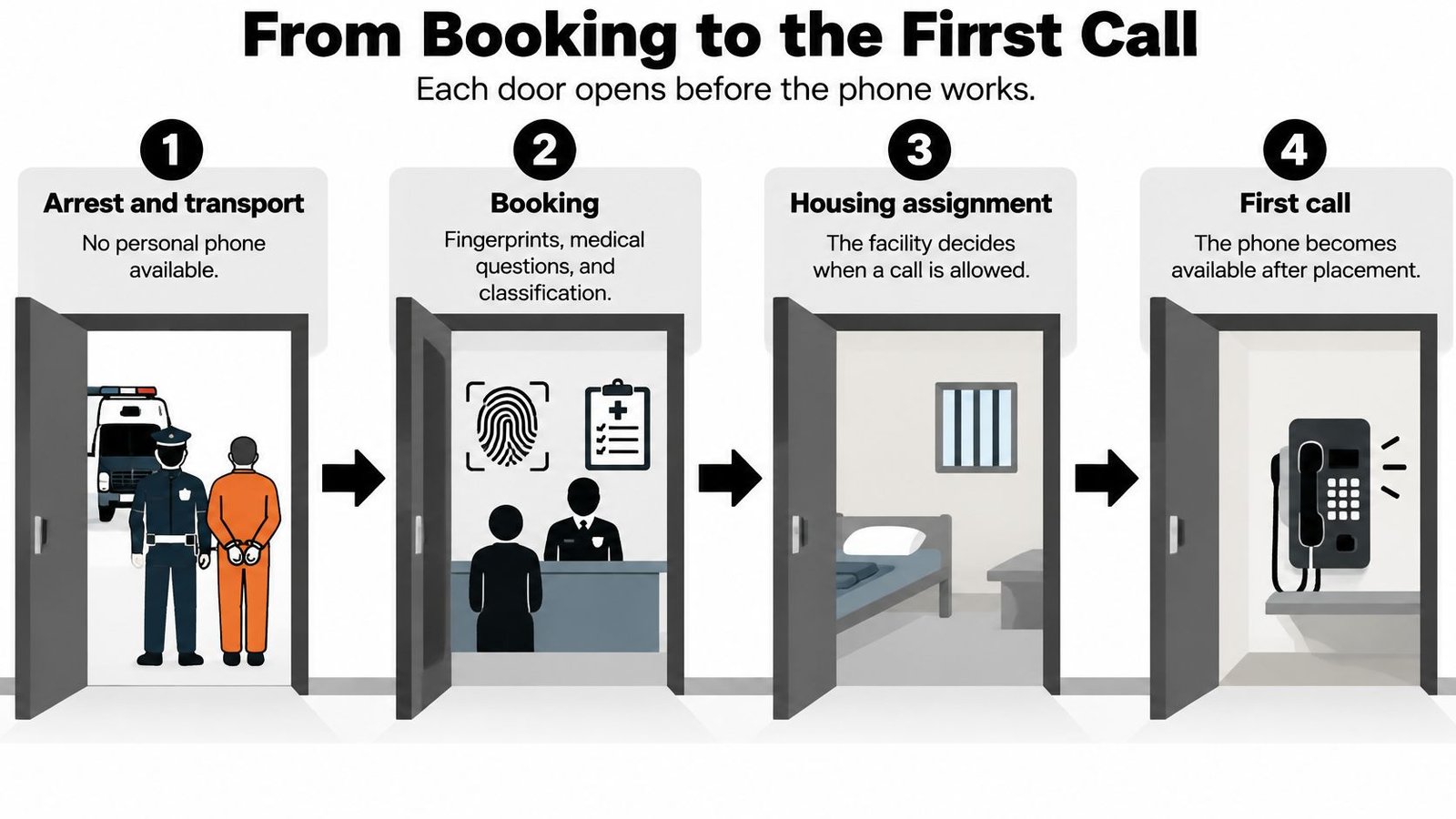
Arrest and transport. During arrest and transfer, the person generally won't have access to a personal phone. Their belongings may be held while officers bring them to the facility.
Booking. Staff take identifying information, fingerprints, medical details, and other information needed for classification. The process can pause for staffing, safety checks, court activity, or other facility needs, so arrival at the jail doesn't mean a housing phone is immediately available.
An intake or booking phone. Some jails may allow a call before the person enters general population. Others may not make a phone available until intake and classification are finished. Ask whether an intake phone is currently operating rather than assuming the person can use one.
Housing assignment. Once the facility assigns a housing area and allows movement, the person may gain access to a housing, dayroom, or unit phone. A phone can still be unavailable if staff have closed the area or are managing another institutional activity.
Account, PIN, or collect setup. A working phone doesn't guarantee a connection. The person may need an account balance or PIN, or the recipient may have to accept a collect call. A failed connection can be a payment or setup issue rather than a sign that no call was attempted.
An open calling window. Count, meals, court returns, lockdowns, emergencies, and limited phone availability can interrupt access. Even after all earlier steps are complete, the call may have to wait for the next available period.
Colorado jail standards require written policies on telephone access, frequency, schedules, duration, costs, and restrictions. They also address legally required booking calls and reasonable calls when the incarcerated person or another person pays, while allowing limits for staffing, security, court orders, emergencies, phone availability, and equal access. The Colorado jail standards took effect July 1, 2026.
A bond posting can lead to release before a regular housing-phone routine matters, but it can't guarantee a call at a specific minute. If you're trying to understand what happens from arrest through booking in another state, what happens after a Connecticut arrest offers a useful overview of that separate process.
Ask the jail three direct questions: Has booking cleared? Is an intake phone available? Is a prepaid balance required? For a general explanation of the timeline, see how long booking takes in jail.
How Colorado Jails Set Their Own Hours
Two people arrested in neighboring counties can face different phone rules that same evening. Colorado county jails set local procedures, and access can depend on where someone is housed, when staff allow movement, and whether a phone is available.
| Facility | Phone access | Stated hours | Incoming calls | Call length |
|---|---|---|---|---|
| Gilpin County | Phones may be available before general population | Dayroom 8:00 a.m.–11:00 p.m. | Outgoing calls | Facility-set |
| Larimer County | Collect and prepaid calls from housing areas | Based on facility needs | Not accepted | 15 minutes |
| Jefferson County | Personal identification number required | Facility-set | Not accepted | 15 minutes |
| Boulder County | New number gets one free minute before a prepaid account | Facility-set | Not accepted | Facility-set |
| Colorado Department of Corrections | Approved phone list only | Facility-set | Not accepted | Facility-set |
Gilpin County's guidance says a phone may be available before someone enters general population, while dayroom access runs from 8:00 a.m. to 11:00 p.m. That means someone in pretrial detention might have an opportunity to call, but a late-night plan can still fall outside the stated dayroom window. The Gilpin County Detentions information also illustrates why intake status and phone location matter.
Larimer County allows collect and prepaid calls from housing areas, but calling times depend on facility needs. An afternoon that appears to fall within an ordinary phone period may still be interrupted by count, staffing, or another operation. Jefferson County requires a PIN and caps calls at 15 minutes. Its attorney-client calls are treated as an exception to ordinary monitoring.
Boulder County's introductory free minute for a new number doesn't mean a full prepaid account is already active. It's a limited first connection, not a promise that later calls will go through without the required account setup. Colorado Department of Corrections facilities also use approved contact lists, which is a different process from dialing a relative's number.
A rule published by one county doesn't automatically apply in another. Check the exact facility's current communication page, then ask whether the person is still in booking, in a housing unit, or at court.
You can use a Colorado county jail phone-number directory to find the right facility contact. Don't substitute rules for Denver, Arapahoe, Douglas, or El Paso County based on what a neighboring jail allows.
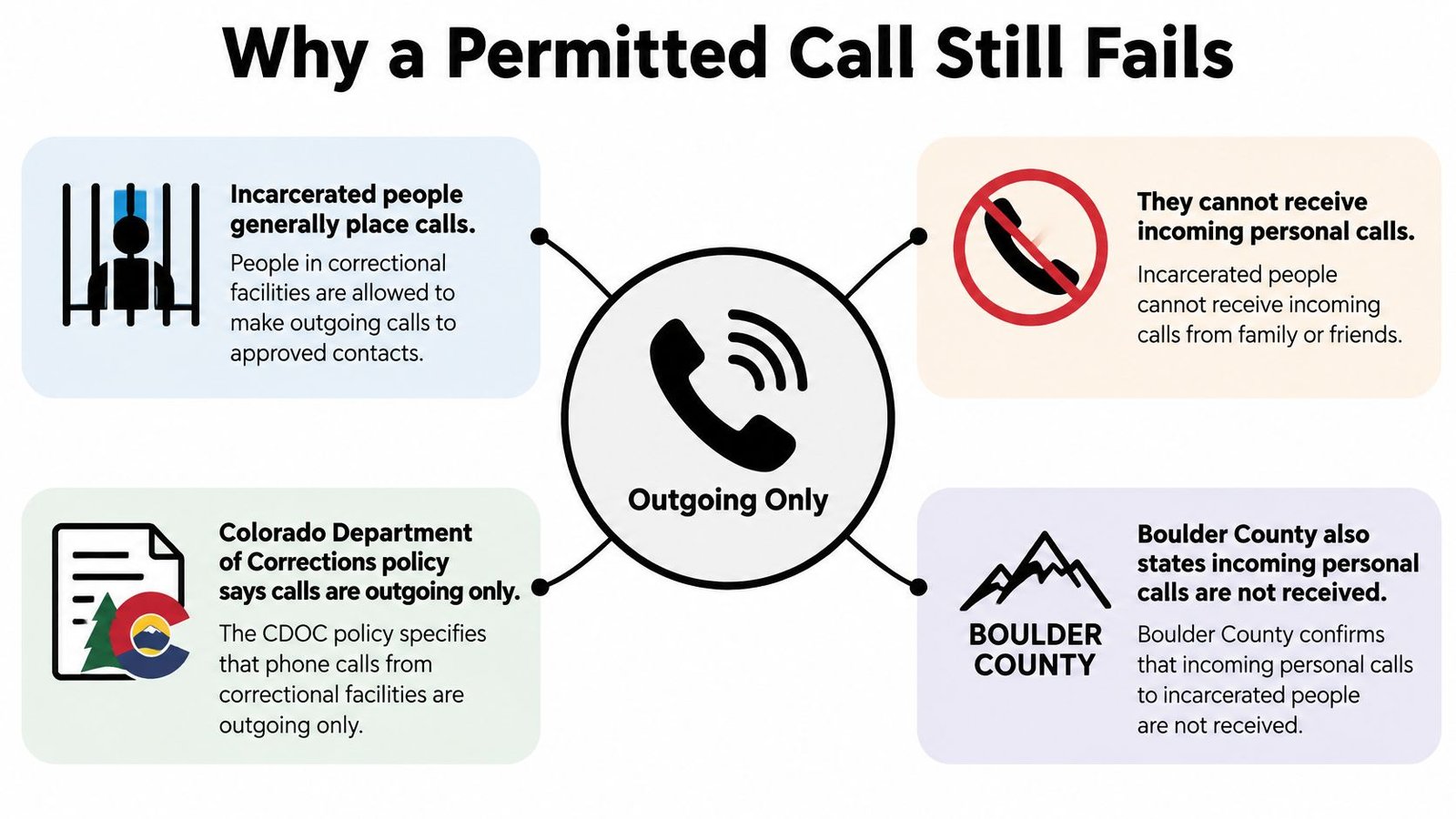
Why a Permitted Call Still Fails
Incarcerated people generally make outgoing calls; relatives can't call into the facility and ask staff to connect a personal call. Colorado Department of Corrections policy and Boulder County both describe outgoing-only access. If a call doesn't arrive, check the connection in order instead of assuming the person has no phone access.
Check the approved number. A state-prison caller may only reach people on an approved phone list. The recipient may need to send a direct phone number to the incarcerated person so it can be added and reviewed.
Check the account and PIN. Jefferson County requires a PIN. A new number in Boulder County may receive an initial free minute before a prepaid account is established. If a call is collect, the recipient must be able to accept it; a rejected call won't connect.
Use a direct line. Boulder County prohibits call forwarding and three-way calls. A workplace switchboard, forwarded mobile number, or conference-call setup can block a call even if the number itself is correct.
Expect monitoring. Larimer County records and monitors calls. Assume nonprivileged conversations may be recorded, and don't use an ordinary jail line for confidential legal discussion. Arrange attorney calls through counsel and the facility's legal-call procedure.
Verify the current window. Count, meals, lockdowns, court returns, and staffing can close phones that appeared open on a schedule. A person who is still in booking or classification may not have access to the housing phone yet.
Ask about restrictions. A federal disciplinary sanction can reduce or suspend access below the ordinary monthly baseline. Repeatedly redialing a number won't remove an institutional restriction.
The Colorado Department of Corrections contact guidance describes approved lists and other call controls, including limits on forwarded and three-way calls. When a call fails, change one thing at a time: confirm the direct number, check the account balance, verify list approval, and then ask whether the facility's phones are open. For a practical guide to the receiver's side of the process, see how to receive phone calls from jail.
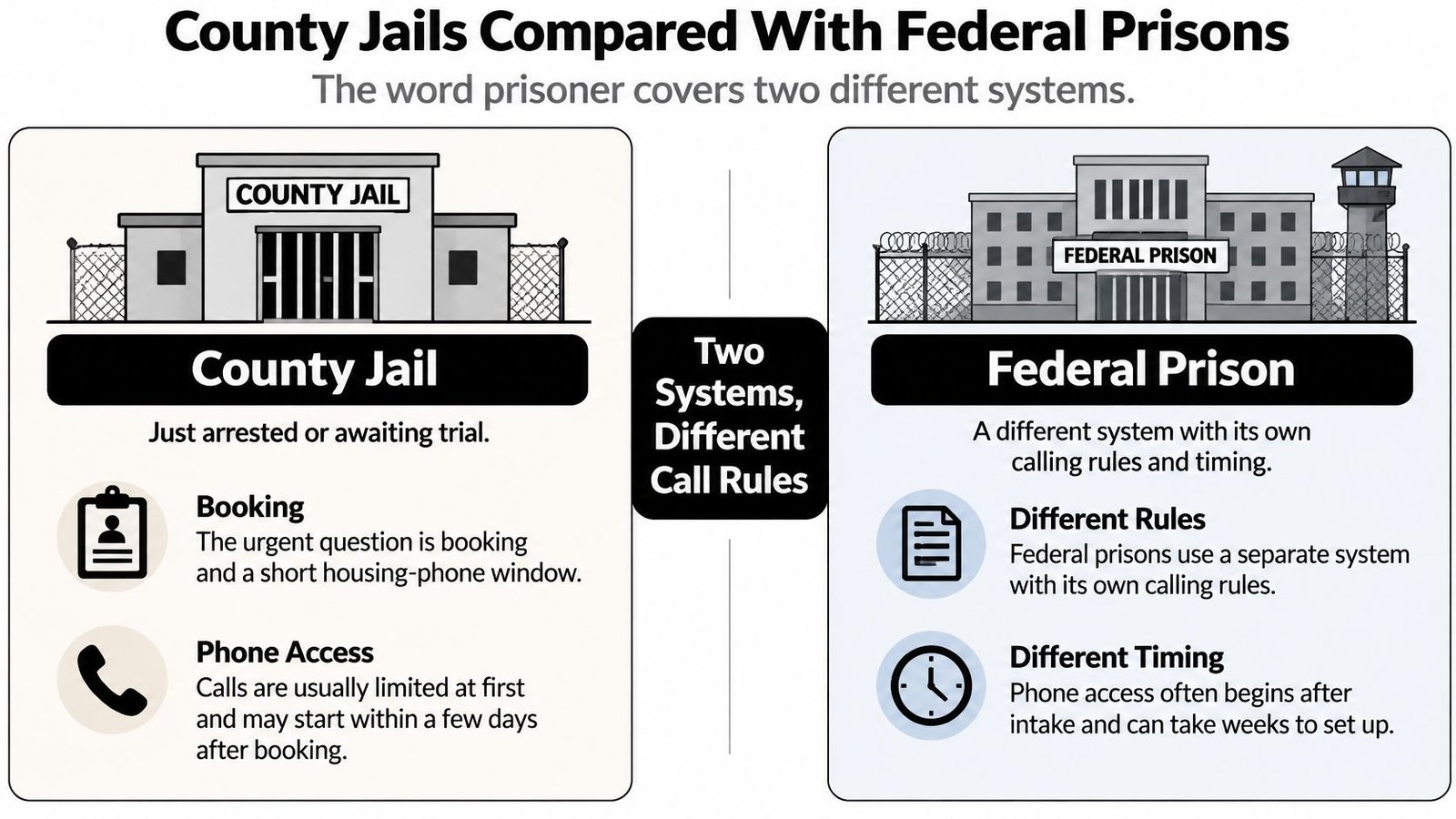
County Jails Compared With Federal Prisons
The word “prisoner” can refer to someone in very different situations. A county jail commonly holds people who were recently arrested or are awaiting court proceedings. A federal prison holds people serving federal sentences, so the practical questions are more likely to involve approved contacts, funds, and the facility's calling schedule.
| County jail | Federal prison |
|---|---|
| The first concern is whether booking and classification are complete. | The first concern is whether local admission and contact procedures are complete. |
| Phone access follows local housing, staffing, and security routines. | Phone access follows federal rules and a schedule set locally by the warden. |
| A person may be transferred, released, or moved through court during the day. | Ongoing access is managed through facility procedures, available funds, and any restrictions. |
For a county jail, ask whether the person has cleared booking and whether a phone is available in the current location. Colorado standards require each jail to publish its own policies for access, schedules, frequency, length, costs, and restrictions. That makes local confirmation essential, especially when the person has just arrived or has been moved.
In a federal prison, the baseline is at least one call each month unless a disciplinary restriction applies. Ordinary phone hours are 6:00 a.m. to 11:30 p.m., with the overnight period closed, and the warden sets the local schedule. Federal regulations ordinarily allow a funded caller at least three minutes, while the warden can set a different maximum based on population and demand.
The U.S. Department of Justice Office of Inspector General review describes how federal phone access changed over time. It reports that prisoners were once limited to one staff-placed call every three months; by the time of the review, most could make calls according to what they could pay for or what recipients would accept. The review also found inmate phones available an average of 18 hours per day. That average is not a promise of access at a particular facility or hour.
The distinction is useful when deciding what to ask next: jails are local and can change access around immediate operations, while prison calls follow longer-term facility procedures. For a plain-language comparison of the terms, read the difference between jail and prison. Neither system guarantees round-the-clock calling.
Other Jurisdictions and State Prisons
If the person is in a state system outside Colorado, use that institution's own rules rather than applying a Colorado county-jail schedule. The same basic questions still help: Is the person admitted and classified? Is the recipient approved? Are calls available at that time? Does the caller need an account?
In England and Wales, prisoners generally can't receive incoming personal calls. They call approved friends and family using prison phones, and prison security checks the intended contact list after admission. Approval may take a few days, so a newly admitted person may not be able to place a personal call immediately. Local hours matter too. Bedford Prison's published guidance lists phone access from 7:00 a.m. until 10:00 p.m., or until 11:00 p.m. for enhanced prisoners, and says approval can take up to five days. The UK government guidance on staying in touch with someone in prison explains the approved-contact process.
Minnesota has a different kind of timing rule. Since May 14, 2025, the Minnesota Department of Corrections has required a 15-minute wait after a completed prisoner call before another call can be made, except at MCF-Red Wing. The Minnesota Department of Corrections phone-call information explains that interval.
Colorado state prisons also use an approved-list system. People in custody can't receive incoming personal calls and may call only people on the approved phone list. A recipient may need to provide a direct number so it can be submitted for approval.
Don't assume that an approval, schedule, or waiting rule transfers from one state or institution to another. Look up the specific facility's current communication page and ask how the person's admission status affects access.
Call for Release Help Instead of Waiting
If your main goal is to speak with the person, prepare a direct number and ask the jail about account setup, approval, and the current phone window. The person may need to wait for booking or an open housing phone, and a short call limit may leave little time to sort out practical questions.
If your goal is to bring someone home, you don't have to wait for them to call before asking about a bond. Have the defendant's full name, date of birth, jail, and bail amount ready. After a bond is posted, the jail can take one to eight hours to process a release, depending on staffing and how busy it is.
For readers navigating a different county's process, this resource on how to find an inmate in Harris County can help clarify where to begin when locating someone in custody. For Colorado support, use the Jefferson County and Golden bail-bond resource or the Centennial and Arapahoe-area bail-bond resource.
Express Bail Bonds can explain costs and what a cosigner agrees to do during a confidential consultation. If release needs to move before the next housing-phone window, call or text 720-984-2245.
Express Bail Bonds offers round-the-clock phone and text access to licensed bail-bond support, so you can ask about the release process without waiting for a jail call. Visit Express Bail Bonds to discuss the next steps for your situation.