Why do so many families walk into the right court system but the wrong building, then lose hours while someone stays in custody? With Denver County Court, the building matters as much as the bond amount. A clerk's window can't always post an in-custody bond, and published hours don't always match across pages. Route the task first, then pay.
Denver County Court Offices, Hours and Phone Numbers
Denver County Court handles criminal, municipal, traffic and civil matters for the City and County of Denver. The clerk's office and the detention center serve different tasks, so check the address and contact route before travelling.
| Office | Address | Hours | Phone |
|---|---|---|---|
| Criminal and municipal clerk services | Lindsey-Flanigan Courthouse, 520 West Colfax Avenue | Court business hours; check the court contact page | Court contact page |
| Bonding office and in-custody courtrooms | Van-Cise Simonet Detention Center, 490 West Colfax Avenue | Published hours are 7:00 a.m. to 7:00 p.m. Monday to Friday, and 7:00 a.m. to 5:00 p.m. weekends and city holidays | 720-337-0062 |
| In-person bond posting | Van-Cise Simonet Detention Center, 490 West Colfax Avenue | 20 hours a day, seven days a week, including holidays | 720-337-0062 |
| Online public portal | No street address | Online where the case is eligible | 720-337-0062 for bonding questions |
Two schedules to check
The bonding office's published hours and the 20 hours a day listed for in-person bond posting describe different schedules. Confirm which service is available at your arrival time by calling 720-337-0062. The courthouse contact page also provides current clerk-service contact details.
The Lindsey-Flanigan Courthouse handles clerk services tied to the case file. In-custody courtrooms and bonding are at the Van-Cise Simonet Detention Center. For jail contact details, use the Denver County Jail phone number information before setting out.
Practical rule: Use the table to choose the office for your task, then confirm its hours and contact route before travelling. That check can prevent a wasted trip across Colfax.
Matching Your Task to the Right Office
Showing up at Lindsey-Flanigan to post an in-custody bond is the costliest routing mistake. The Denver County Court contact page separates criminal and municipal clerk services at 520 West Colfax Avenue from the in-custody courtrooms and bonding office at 490 West Colfax Avenue, with the bonding office at 720-337-0062.
Going to the clerk's office may not post a bond at all. Match the task first.
Route by task
- Posting for someone in custody: Go to the Van-Cise Simonet bonding office, or post online where the case qualifies, because that office runs release.
- Property bond: Book an in-person appointment with the court first. Staff can't evaluate it at the counter without one.
- Questions about a criminal or municipal case: Contact Lindsey-Flanigan clerk services, which keep the case file.
- Finding a person or case number: Search the online portal first, then call the bonding office if the record shows an active hold.
- Surety agent paperwork: Bring it through the bonding process once the agent has confirmed registration.
Bring the case number whichever office you choose. Both offices ask for it first, and without it staff have to search while you wait. Confirm hours by phone from the table above before travelling, especially on weekends and city holidays.
Finding the Right Case in the Court Portal
Locate the correct case before you pay anything. Paying on the wrong case doesn't release anyone, and it can leave another hold untouched.
The infographic below shows the three search routes you'll use most.
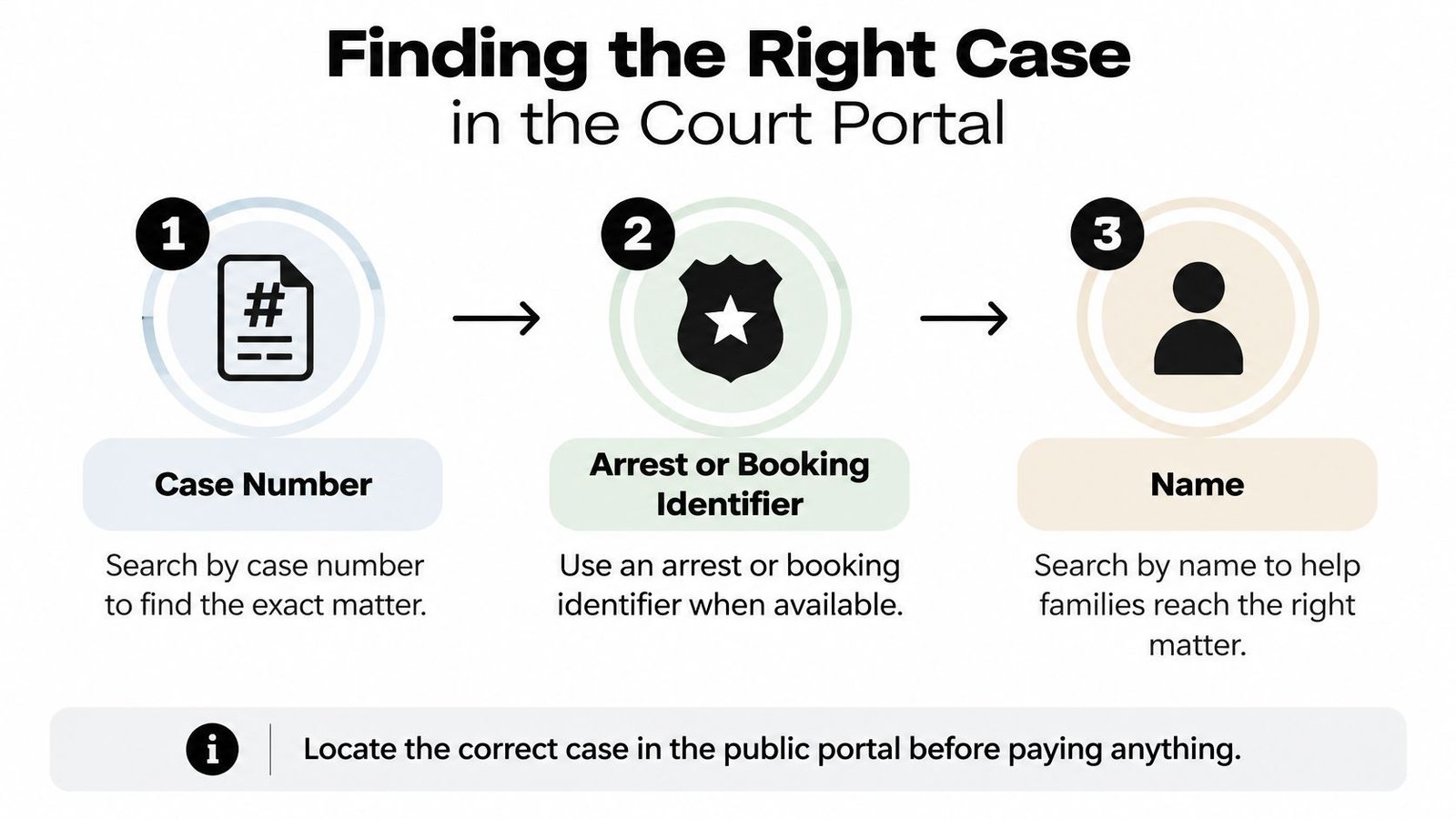
The Denver County Court public portal page supports searching by case number, arrest or booking identifier, or name, and it can allow eligible users to post monetary or personal-recognizance bonds.
- Open the portal from the court's official website.
- Search by case number or booking identifier first. Those are the most exact. Use first name, last name and date of birth only if you don't have a number, and check the general approach in this guide on how to search arrest records.
- Check for more than one active case. Denver requires a separate bond for each case.
- Open the matching record. Note the status, bond amount, any warrant and the next court date.
- Write down any active hold or warrant before paying.
This short video walks through what to look for before you act on a result.
Posting through the portal can clear an outstanding warrant, schedule a bond-return hearing, or possibly facilitate release for someone in custody. Eligibility depends on the warrant or case circumstances, so a visible option doesn't guarantee posting. We also provide links to official court and inmate search tools for Denver County, Jefferson County, and Adams County if the record isn't in Denver.
You need three confirmed details before moving on: case number, bond amount and next court date.
Bond Types and Who Can Post Each
Check the bond type on the portal record before you choose a payment route. The wrong route wastes time, and some routes only work for registered agents.
| Bond type | Who can post | How it is posted | Key requirement |
|---|---|---|---|
| Cash bond | Any eligible payer | Online where eligible, or at the bonding office | Eligibility depends on the case and monetary bond status |
| Personal-recognizance (PR) bond | Eligible applicant for the case | Online where eligible | Eligibility depends on case circumstances |
| Professional surety bond | Registered bail-bond agent | Online with power-of-attorney upload | Agent must be registered and upload POA documents |
| Out-of-county bond | Eligible applicant | Online where eligible | Eligibility depends on the case and the county holding the defendant |
| Property bond | Property owner applicant | In-person appointment with the court | Appointment required before evaluation |
The Denver County Court online bonding portal supports cash bonds, personal-recognizance (PR) bonds, professional surety bonds, and out-of-county bonds. Eligibility depends on the specific case and monetary bond status.
Three blockers to check early
Registration comes first for surety bonds. The court requires registered bail-bond agents and upload of power-of-attorney documentation. If either piece is missing, don't expect the bond to go through. The broader differences between routes are explained in this overview of the types of bail.
Multiple cases need multiple bonds. Verify the defendant in the Public Portal by first name, last name, date of birth, or case number, then count every active case. One posted bond doesn't resolve all holds.
Not every warrant qualifies online. Online posting may address an eligible warrant, but the warrant itself decides. Ask the bonding office to confirm the route before paying, and remember that bond terms and appearance obligations remain binding after release.
What to Bring and What to Expect at Court
Gather your documents before you leave home. Missing one identifier can send you back to the portal or home again.
The checklist below covers the core items staff ask for first.
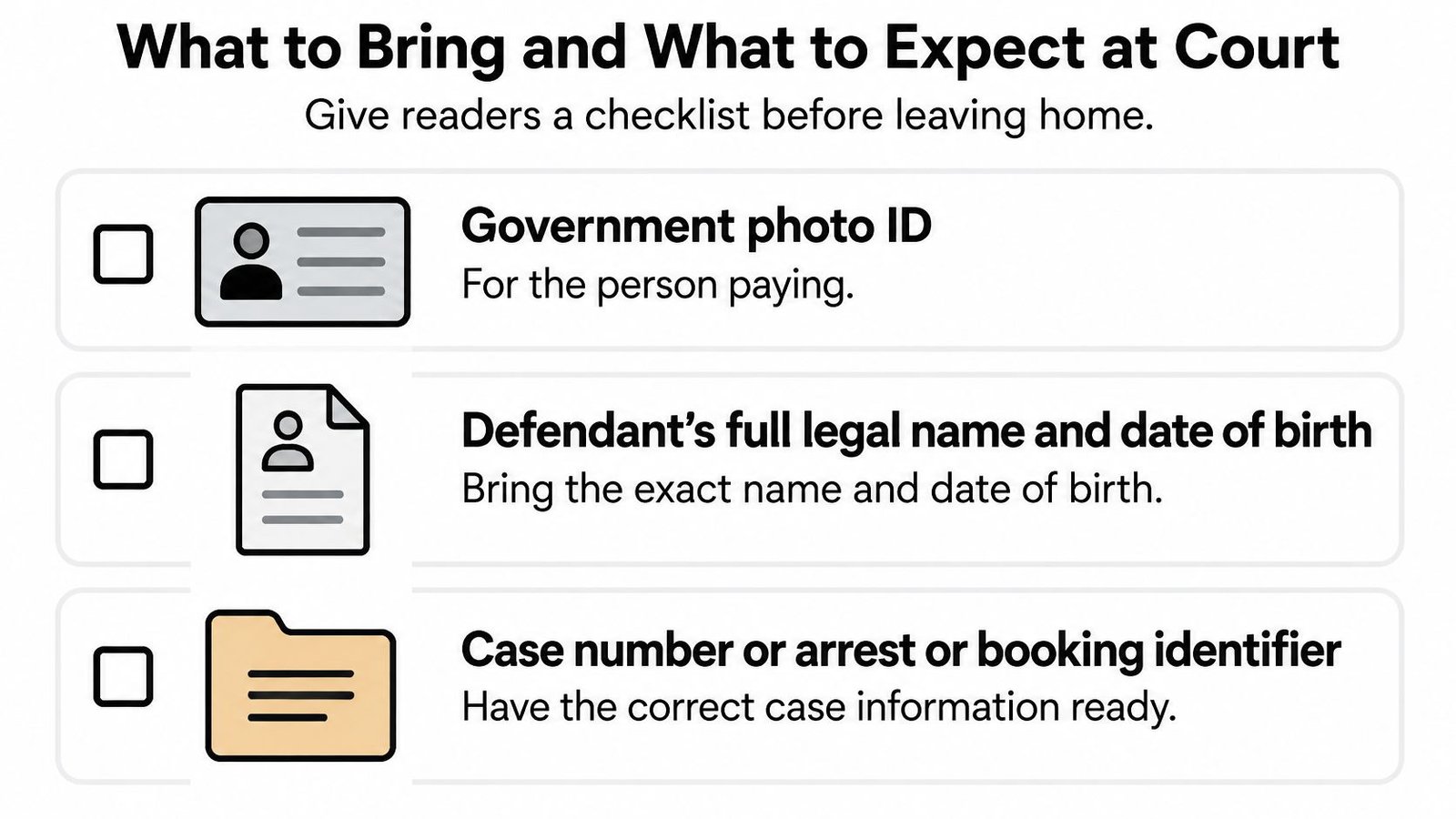
- Government photo ID for the person paying.
- Defendant's full legal name and date of birth, exactly as booked.
- Case number or arrest or booking identifier from the portal.
- Bond amount in writing, with the charge it attaches to.
- Payment method, with a plan for any card fee.
- Surety documents where an agent is posting, including proof of registration and power-of-attorney paperwork.
- Photo ID for any cosigner or co-applicant.
- Bond receipt and paperwork once issued, kept with the next court date and time.
For general preparation, this guide on what to bring to court helps you avoid simple omissions. Attorneys coordinating several releases at once often keep their own files moving by delegating administrative tasks to legal virtual assistants, so court dates and receipts don't sit in an inbox.
On arrival, allow time for security and waiting, and get there before the bonding office closes. Follow staff directions on which courtroom or window to use. The defendant must attend every scheduled court date listed on the bond paperwork, so confirm the document list with the bonding office before the trip in case requirements have changed.
How to Post Bond at Denver County Court
Which building and posting route does the bond require? Confirm those details before traveling. The court's in-person bonding service is at Van-Cise Simonet, so a trip to a courthouse office may not be the right step.
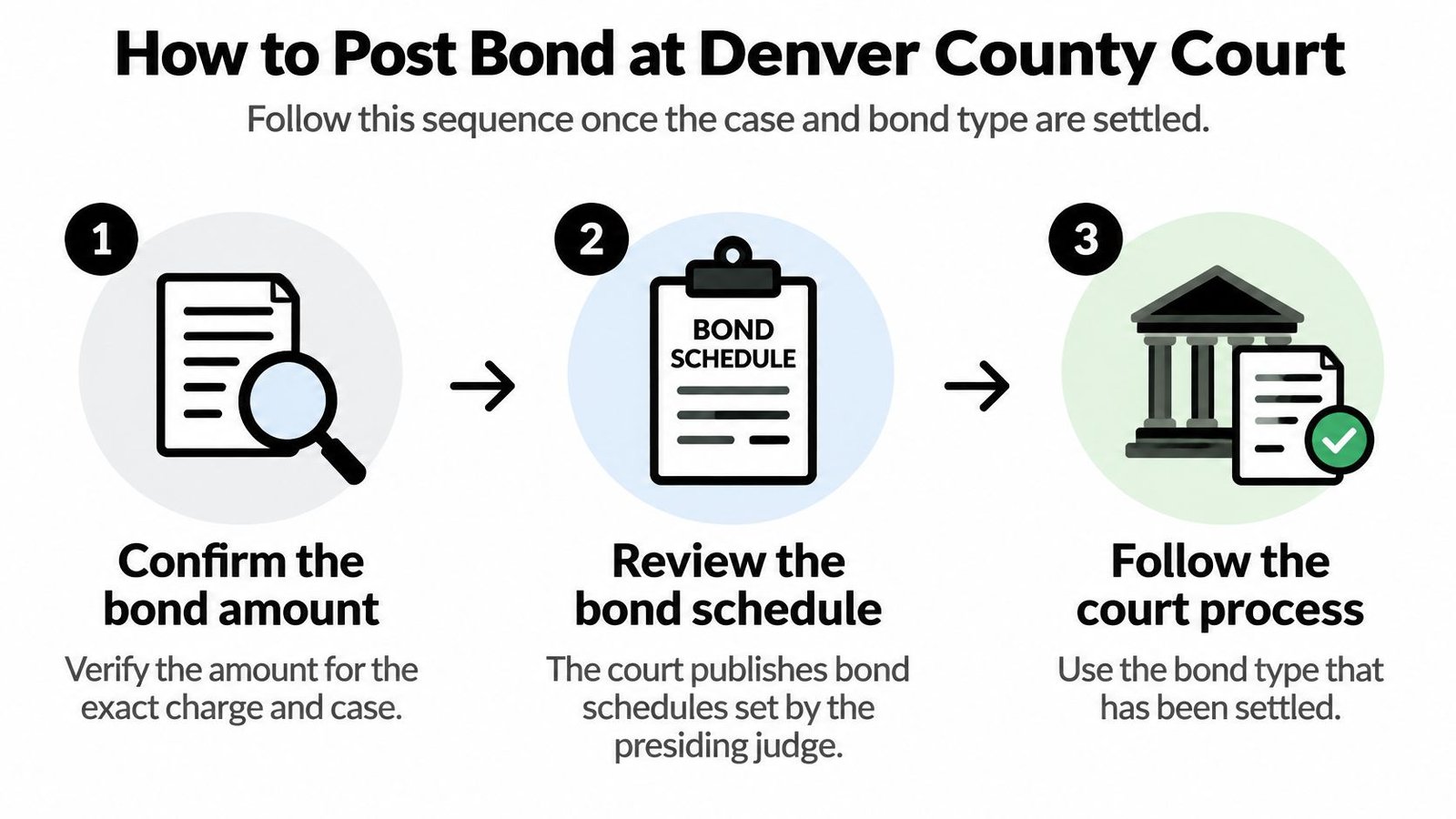
The Denver County Court bonds page publishes bond schedules ordered by the presiding judge for pre-arraignment release. It also says in-person bond posting at Van-Cise Simonet is available 20 hours per day, seven days per week, including holidays. Check the court's instructions before setting out, and confirm which route applies to the specific case.
Posting sequence
- Confirm the amount for the charge and case. A published schedule is a starting point. A jurisdictional hold may affect the amount due or the steps needed before release.
- Choose the bond route. Use the comparison table above, then contact the bonding office if the case record does not make the route clear.
- Arrange surety paperwork. If a bail-bond agent is posting, confirm that the required power-of-attorney documents are ready for submission.
- Post in person or online, if eligible. For in-person posting, go to the Van-Cise Simonet bonding office. Online posting is an option only when the case qualifies and the court's process permits it.
- Pay and keep the paperwork. Keep the receipt with the bond documents so you have a record of the transaction.
- Ask about release status. If release has not followed posting, ask the bonding office what step remains and whether any hold affects the case.
Posting the bond starts the release process, but it does not itself confirm that the person has left detention. Follow the bonding office's directions and keep the receipt and documents together. Express Bail Bonds offers online applications, payments, contract documents, and bond posting at most Colorado detention facilities. Availability depends on the facility and the case.
Property bonds follow a separate process. Evaluation requires an in-person court appointment, so confirm the appointment requirements before making a trip.
Before leaving, make sure you have the posted-bond receipt and paperwork, and ask for an estimated release time. A verbal update is not a substitute for the documents.
Release Timing and Fees to Expect
When should someone expect release after bond is signed? The answer depends on which timeline applies. The ordinary processing window starts after signature, while the personal-recognizance rule has a different trigger.
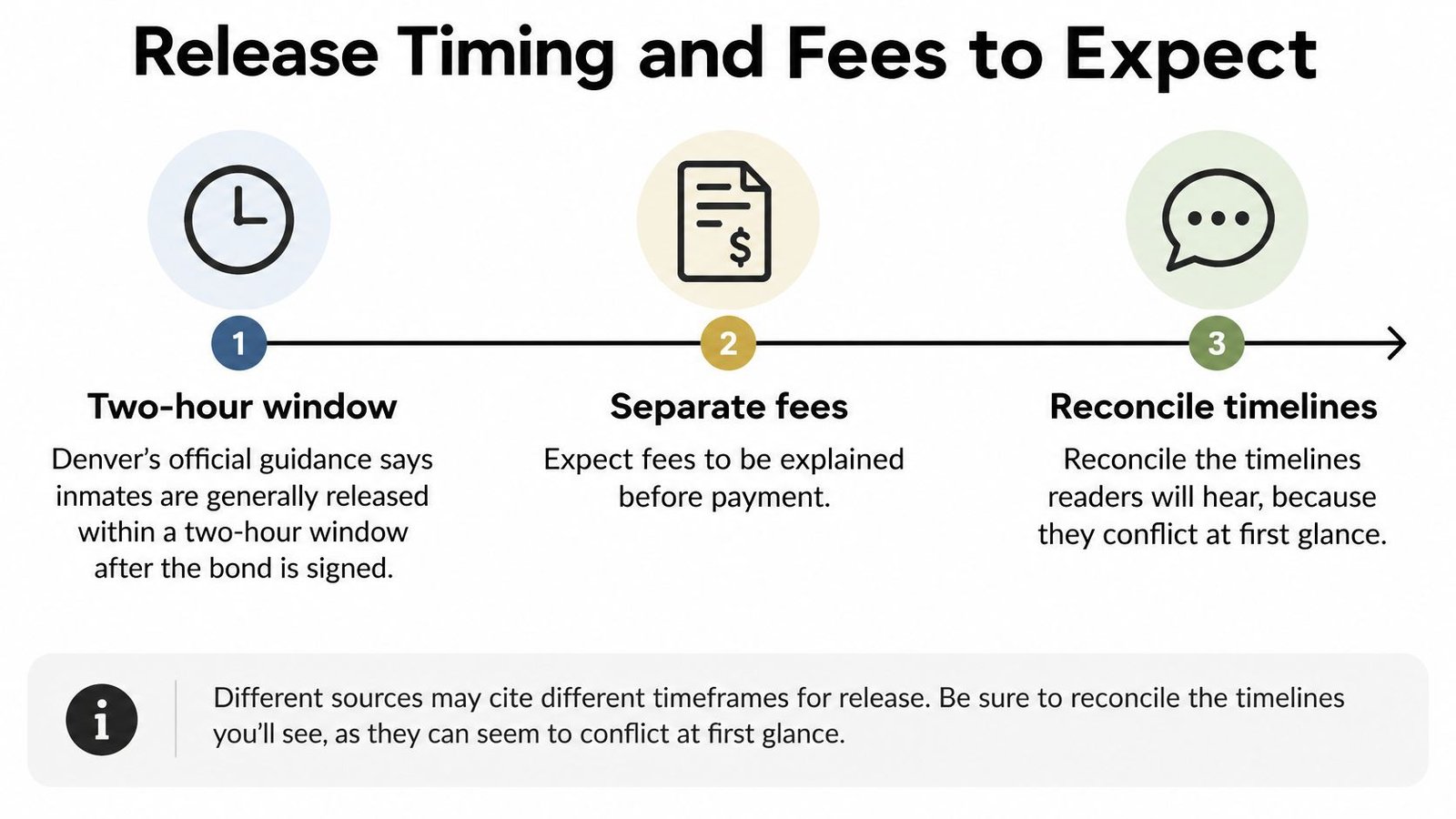
The Denver Sheriff Department court services page says inmates are generally released within a two-hour window after the bond is signed. The statutory-rights notice on that page says a defendant must generally be released within six hours after a personal-recognizance bond is set and required notification occurs, subject to extraordinary circumstances.
These windows have different starting points and apply to different circumstances. Electronic-monitoring installation can add processing time, so ask the bonding office early whether monitoring is ordered and what timing to expect. For more detail, see this guide to how long bail takes to process.
Fees and questions to ask
For a money bond, the bond amount is required for release. Bond or card fees may instead be billed after release. Ask the bonding office for the exact amounts in writing and clarify whether each fee is due before release or later.
If processing goes beyond the relevant window, ask the bonding office for the reason and request a written explanation. Before leaving the detention center, keep the bond paperwork and confirm the next court date. A release does not remove the need to understand any later payment or court obligations.
Common Problems and How to Fix Them
Most delays follow a pattern. Find your symptom, check the likely cause, then apply the fix before paying again or travelling again.
| Symptom | Likely cause | Fix |
|---|---|---|
| Case not found in portal | Name spelled differently or booked under another identifier | Search by date of birth, case number or booking identifier |
| No online bond option | Case or warrant not eligible online | Post at the Van-Cise Simonet bonding office; book an appointment for a property bond |
| Defendant still held after posting | Another active case or hold | Check every case and post a separate bond for each |
| Release later than expected | Ordinary processing, PR-bond six-hour rule or electronic monitoring | Compare with the two-hour and six-hour windows and ask the bonding office for the reason in writing |
| Surety bond not accepted | Agent not registered or power-of-attorney missing | Confirm registration and upload the POA documents |
| Unexpected fee after release | Bond fee or card fee treated as post-release debt | Request a written breakdown and the bond paperwork |
The two problems that cause the most confusion
A missing portal record usually isn't proof that no case exists. It's often a spelling, identifier or timing problem, so change the search method before you assume the person isn't there and don't pay against a near match.
An unexpected fee after release also catches families off guard. Don't ignore it and don't assume it's an error. Request a written breakdown, match it against your receipt, and keep it with the bond paperwork.
When you're stuck: State the symptom, the case number and what you've already tried. Staff can route that faster than a general request for help.
If a defendant stays held after you've posted, I'd check for a second case first. That's more likely than a payment disappearing, and it's fixable once you see the full hold list.
Other Colorado Counties and Related Resources
Denver County Court handles Denver matters only. A person held in another county is handled by that county's jail and court, with its own hours, forms and fee rules.
Check the Denver portal first to confirm whether the record is here. If it isn't, search the tool for the county where the arrest happened instead of posting in Denver and hoping it transfers.
We serve jails in Denver, Jefferson County, Arapahoe County, and throughout Colorado, so surety help doesn't stop at the Denver line. For nearby help, use the Jefferson County and Golden bail bond resources when the hold is in Jefferson County. For Arapahoe County, use the bail bonds in Centennial resources for that area.
Each resource points to local help for that county, while court rules stay with the county that holds the defendant. Confirm those rules locally before posting, then use the same discipline you'd use in Denver: correct case, correct bond type, correct office, paperwork kept together.
Confirm Your Bond Route and Act
Turn the checks above into action in this order. Don't pay until the first three steps are settled.
- Pull the case details. Get the case number, bond amount and next court date from the portal.
- Call the bonding office. Reach Van-Cise Simonet at 720-337-0062 to confirm hours and the bond route for each case.
- Choose the bond type. Pick cash, personal-recognizance, professional surety, out-of-county or property using the comparison table, then confirm eligibility for that specific case.
- Get surety help if you need it. Call Express Bail Bonds at 720-984-2245, reachable 24/7, or start at Express Bail Bonds online for application, payment and contract options where available. Our main office is at 1304 Elati Street, Denver, CO 80204, and we cover all Colorado jails.
- Keep everything together. Store the receipt, bond paperwork and next court date in one place.
Bond terms stay binding after release. The release gets someone home, but the next court date is the obligation that matters most. Miss it, and the bond, the warrant risk and the money all come back into play.
I'd act on the phone confirmation first if you're travelling any distance. It costs minutes and prevents the wrong-building mistake that costs hours.
If you're facing a Denver bond tonight, Express Bail Bonds can confirm the case, explain the surety route and start the paperwork without making you guess which building or window you need. Call or text 720-984-2245 any time, or visit Express Bail Bonds to begin the application and get clear next steps for release.