
Colorado county-court drug-case filings increased from 4,150 in FY2020 to 9,943 in FY2024, approximately 140%, according to the Colorado Judicial Department's annual statistical reporting. That statewide change helps explain why choosing a Denver criminal defense attorney means more than finding someone who appears in court. You need counsel who understands the charge, the assigned court, the evidence, and the decisions that can't wait while your family arranges release.
Legal defense and bond posting are separate jobs. A lawyer advises the defendant and protects legal rights. The jail and, when appropriate, a licensed bondsman handle the mechanics of posting the court-authorized bond.
First-Day Checklist Before You Hire
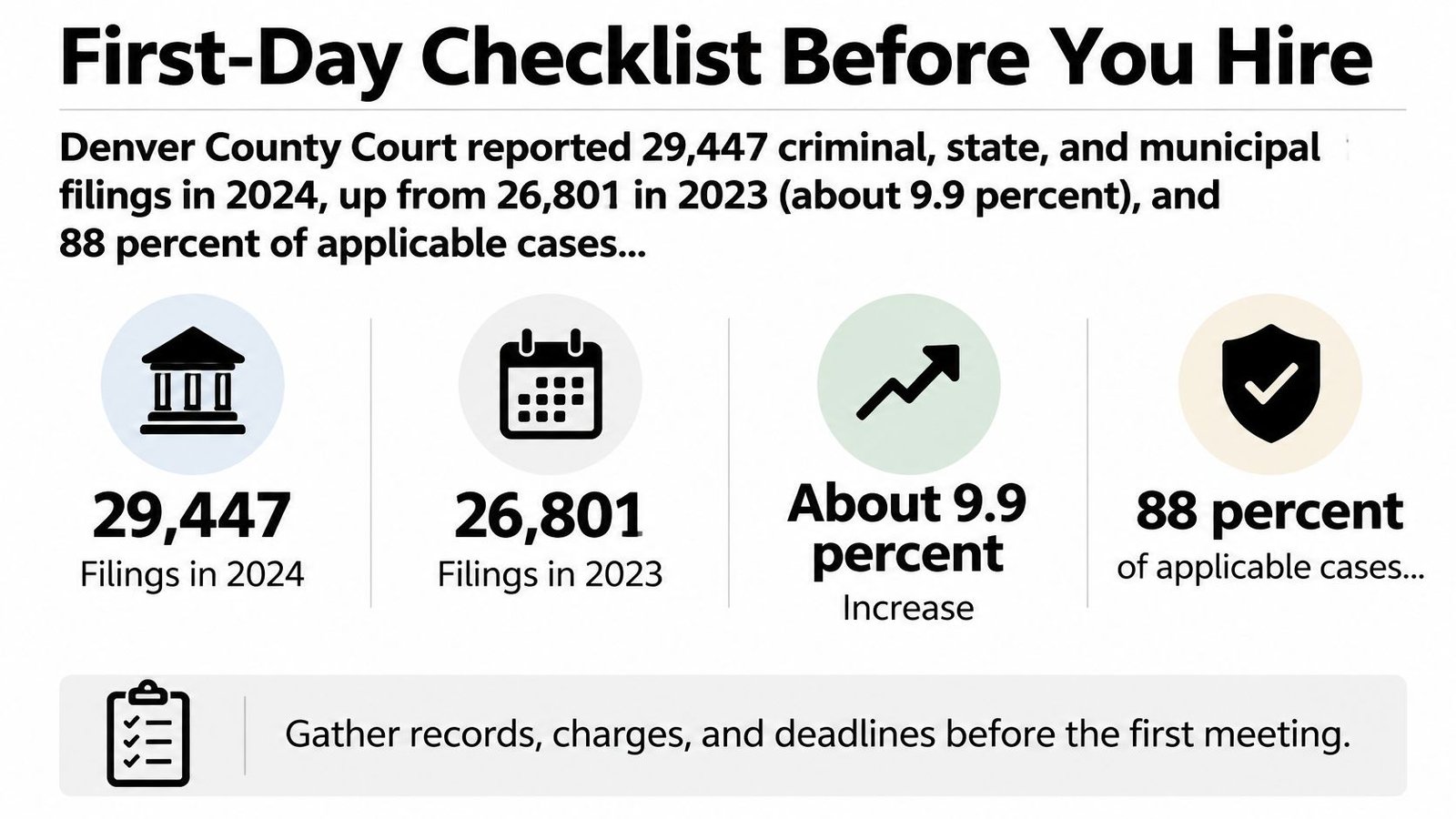
Denver County Court's annual report records 29,447 criminal, state, and municipal filings in 2024, up from 26,801 in 2023, about 9.9%, and says 88% of applicable cases reached disposition within 180 days, making early preparation important.
- Confirm the booking details. Write down the booked name, date of birth, exact charge, and facility. Don't assume an arrest in Denver means every related case is in the same court.
- Check booking status. Under Denver Court Services guidance, a bond can't be posted until fingerprints clear and booking is complete; release is generally within two hours after all parties sign, and a bonding-company premium isn't refunded.
- Identify the bond type. Confirm personal recognizance, cash-only, or surety eligibility before paying anyone. The Colorado pretrial guidance published for Delta County distinguishes personal recognizance, which has no monetary condition, from secured monetary release and calls for least-restrictive conditions reasonably necessary for appearance and safety.
- Protect information. Don't discuss the incident with family, other detainees, or social media audiences. Preserve messages, phone records, photographs, and location information for counsel without deleting or editing anything.
- Assign the work. Counsel handles probable cause, evidence, plea exposure, and challenges to release conditions. The jail or a licensed bondsman addresses posting eligibility, payment, cosigners, and paperwork.
Keep the immediate tasks visible while gathering records.
First-day bond decisions and baselines
The Colorado Judicial Branch bonding procedures provide the misdemeanor and petty-offense schedule entries below and require consideration of empirical risk information and individual circumstances, including finances. These are schedule baselines, not promised release amounts.
| Decision | Who answers it | Baseline or rule |
|---|---|---|
| Class 1 misdemeanor bond | Judicial officer | $1,000 schedule baseline |
| Class 2 misdemeanor bond | Judicial officer | $500 schedule baseline |
| Class 3 misdemeanor bond | Judicial officer | $250 schedule baseline |
| Petty offense | Judicial officer | Personal recognizance; $150 listed on the schedule |
| Cash-only versus surety-eligible | Court sets type; jail or bondsman posts | Confirm before paying anyone |
| Premium on a surety bond | Licensed bonding company | Not refunded at case end |
| Release after signatures | Denver jail | Generally within about two hours |
| Personal-recognizance timing | Sheriff | Within six hours after the required readiness conditions are met, absent extraordinary circumstances |
Denver's legal-rights notice specifies that the six-hour personal-recognizance window follows bond setting, return to jail, and notice that the bond is ready; it also permits a $10 bond fee and a card fee of no more than 3.5% as debts after release if unpaid at bonding, with no other bond-related fees.
Our guide to what to do when arrested helps families organize those immediate tasks. In Denver County, we serve the Van Cise-Simonet Detention Center and the Downtown Detention Center.
Release doesn't replace a defense. Conditions can affect work, housing, treatment, travel, and contact with an alleged victim, and a violation can create a new case.
How to Search and Interview Defense Counsel
A family calling after a Friday DUI booking needs a lawyer who can identify the court and prepare for the next advisement. A larger firm isn't automatically the better choice if nobody can explain who will appear. Prefer a concrete staffing answer over a polished sales presentation.
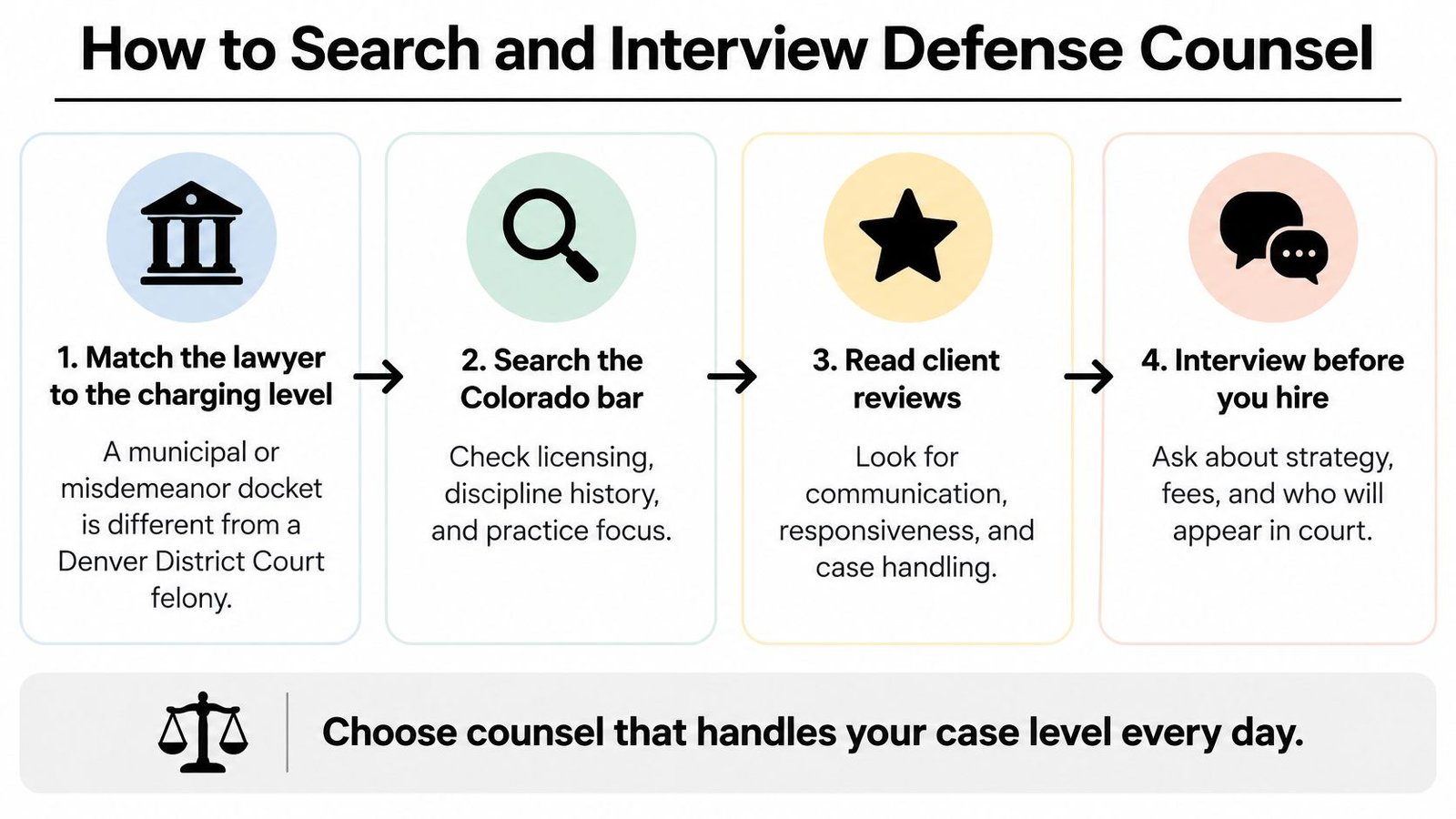
Start with the charging level and court. Municipal prosecution, a county-court misdemeanor, and a Denver District Court felony involve different daily work. Look for recent criminal practice that matches the actual case, not just a website that lists criminal defense beside unrelated services.
Use this checklist to organize the search before making calls.
Verify the lawyer before discussing payment
Search the Colorado Supreme Court attorney registry for the lawyer's license status. Check the individual attorney, not just the firm name, and review available disciplinary information. A professional-looking website doesn't establish that the person answering the phone is the attorney who will represent the defendant.
Then look for evidence of relevant local work. Ask the lawyer for examples of comparable Denver matters they can discuss without revealing confidential information. The clerk can explain access to public case records, but shouldn't be asked to recommend a lawyer or predict a result.
Client reviews can help you spot communication patterns. Look for descriptions of returned calls, explained hearings, and clear billing rather than treating a favorable outcome as proof that another case will end the same way. Reviews aren't a substitute for checking licensing and asking direct questions.
If the defendant remains in custody, request a consultation that day. Give the office the charge, facility, case number if available, and next appearance before launching into a detailed account of the incident.
Keep the interview focused on the actual work
Use these hiring questions, and write down the answers:
- Court coverage: Who in the firm will appear at advisement?
- Recent Denver practice: How many Denver County or District Court criminal cases did you handle in the last year?
- Trial experience: Have you tried cases in this division, or mostly negotiated?
- Evidence access: How fast can you get the police report and body-worn video?
- Communication: Who calls me about court dates?
A useful answer identifies a person, a task, or a practical obstacle. For example, counsel may explain that obtaining video depends on disclosure procedures rather than promising immediate access. That distinction shows more care than guaranteeing a delivery date before reviewing the file.
Hiring rule: Choose the lawyer who explains what they can do next, what they still need to learn, and who will do the work.
Dismissal claims deserve particular caution. Georgia DUI Schools' dismissal guide can help readers understand why evidence and procedure matter, but it addresses another state and isn't a Colorado defense roadmap. Ask Denver counsel to evaluate Colorado law and the actual evidence rather than importing an online argument.
This video offers an additional resource while you prepare for the consultation.
Walk away from guaranteed dismissals, pressure to pay before anyone identifies the courthouse, or advice to discuss the incident publicly. A lawyer should also distinguish a preliminary assessment from a conclusion based on reviewed evidence.
If the fit is right, put the engagement in writing promptly. Send the booking location and next court date immediately, and obtain confirmation that the office received them. Don't assume payment alone means someone has arranged the next appearance.
Public Defender and Court-Appointed Counsel
If the household can't afford private counsel, raise that issue at the first advisement rather than assuming representation is out of reach. Tell the judge or advisement clerk that the defendant wants to request appointed counsel. Do this before committing money to a private retainer the household may not be able to sustain.
Appointment isn't automatic. The court evaluates eligibility, and the family should be prepared to provide the financial information requested rather than guessing whether the defendant qualifies.
Prepare the request
- Ask about the process: Find out how to submit the request and which financial forms are needed.
- Gather supporting information: Bring income, household, and expense information so missing documents don't hold up the application.
- Identify custody concerns: Make sure the request reaches the appropriate court staff when the defendant can't handle paperwork personally.
- Keep contact details current: Counsel needs a reliable way to reach the defendant after release.
Our explanation of the role of a public defender can help relatives understand what appointed representation involves. The attorney represents the defendant, not everyone contributing money or helping with transportation.
Appointed and private counsel both owe professional duties to the defendant. The distinction isn't that paying privately purchases a more serious defense. Cost, availability, staffing, and communication arrangements are practical considerations, while the defendant's interests remain central.
A family member can help organize documents without becoming the lawyer's client or receiving every confidential detail.
Once counsel is appointed, establish who handles the assigned division, how evidence requests will be made, and how the defendant receives updates. If private counsel is chosen instead, obtain a written agreement before work begins.
Raise the representation decision before the first court date whenever possible. If that hasn't happened, don't skip court; ask for counsel and explain the situation at the appearance.
Fee Structures Worth Comparing Before You Sign
Compare what the lawyer will do, not just the amount requested up front. An agreement limited to negotiating a plea isn't equivalent to an agreement covering contested motions and trial. There's no useful public Denver price list that can replace a written description of the work.
The relevant considerations include the charge, expected work, complexity, and the client's objectives. A lawyer shouldn't promise a result to justify the fee, and a family shouldn't assume a larger payment guarantees a better outcome.
Criminal defense fee structures compared
| Fee type | Fits best | Ask before paying | Refund posture |
|---|---|---|---|
| Hourly | Motions, trial, or an unpredictable felony | Rate, increment, experts, who bills | Unearned trust funds should be returned |
| Flat fee | DUI, municipal, or a misdemeanor aimed at a plea | Which hearings and sentencing are included | Often earned by stage, not all at signing |
| Retainer against hourly | Ongoing felony with an open timeline | Evergreen amount and trust-account handling | Unused portion returned if not earned |
| Hybrid | Plea now, possible trial later | The exact event that starts the trial rate | Plea portion may be earned; trial time billed later |
With hourly billing, ask how the office records time and which staff members bill. Clarify whether jail visits, travel to the Downtown Detention Center, investigator work, and expert consultation are additional expenses. A stated hourly rate tells you little without knowing what activities generate charges.
A flat fee needs boundaries. The agreement should distinguish advisement, negotiations, motions, sentencing, and trial rather than using a broad phrase such as handling the case. Ask what happens if a separate case appears or the prosecution changes the charges.
A retainer against hourly charges is an advance against future work, not necessarily the total cost. Ask how statements will show deductions, when replenishment is required, and how remaining unearned funds are returned. For a hybrid agreement, identify the event that changes billing, such as a decision to proceed to trial, rather than accepting an undefined trial-preparation surcharge.
Initial the scope, not just the payment page
Every agreement should identify the client, court, case number if available, and who may appear. It should also say what ends representation and whether any appeal or later proceeding falls outside the engagement.
Before paying, mark the terms that can otherwise cause disagreements:
- Included stages: Identify each covered hearing and whether sentencing is included.
- Separate expenses: Clarify investigators, experts, records, and travel charges.
- Earning milestones: Ask when each portion of a flat fee becomes earned.
- Closing the account: Confirm how unused funds and the final billing statement are handled.
Colorado lawyers generally must keep unearned fees separate and return amounts they haven't earned. Don't assume every flat fee becomes earned at signing; ask the lawyer to explain the agreement's milestones in plain language.
Keep the legal budget separate from release expenses. Our explanation of how bail-bond costs work addresses a different transaction, not payment for representation.
Initial the included stages before transferring funds. If the agreement and the consultation sound different, ask the lawyer to revise the writing first.
Deadlines a Strong Defense Tracks Early
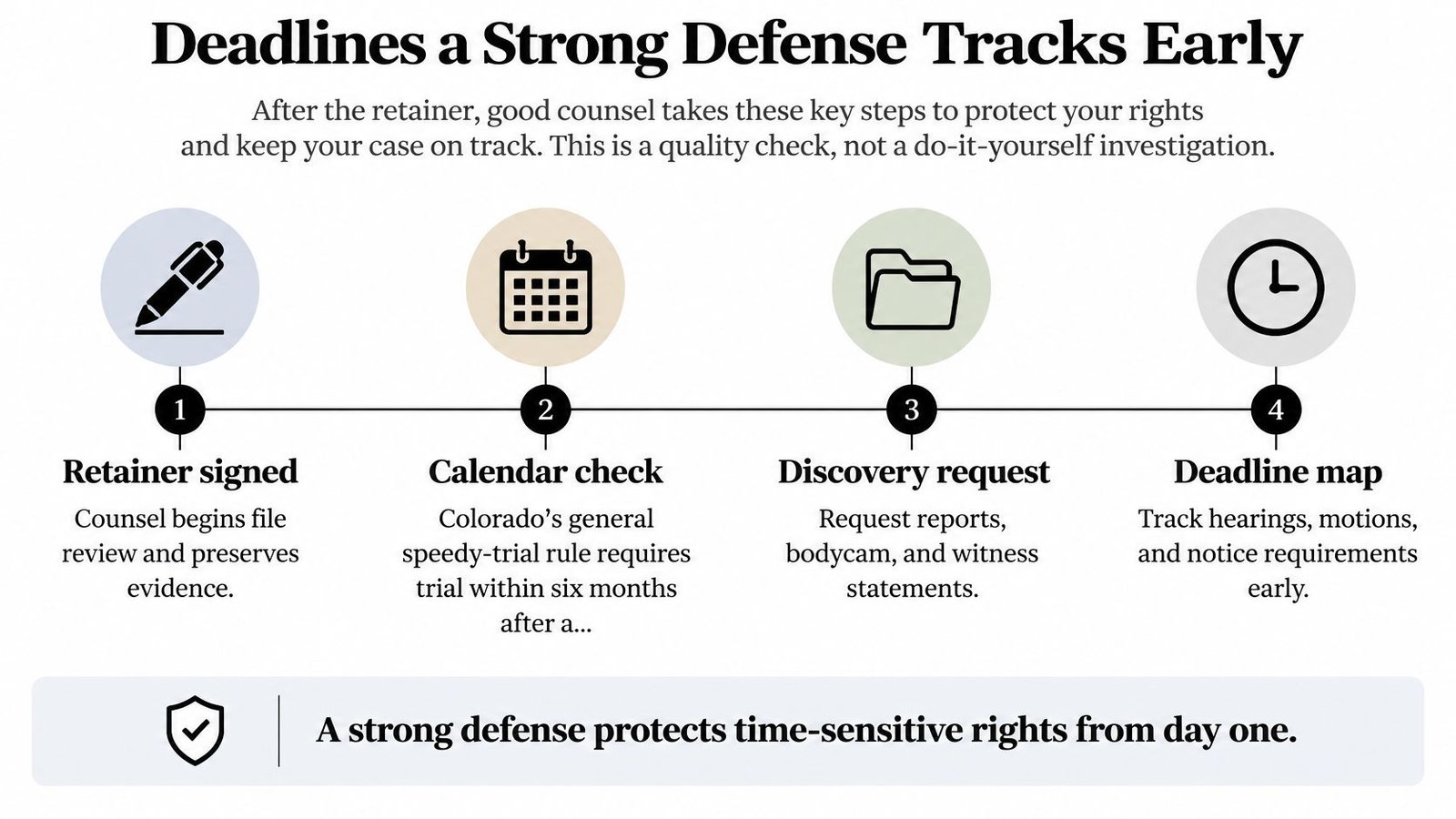
Colorado's general speedy-trial benchmark is six months after a not-guilty plea, and missing the applicable period ordinarily requires dismissal with prejudice unless an exception applies, as explained in Colorado appellate authority on speedy trial and continuances. That authority also illustrates a serious trap: a defense-requested continuance following late discovery can waive the claim absent prosecutorial bad faith.
The calendar therefore needs more than a trial date. Counsel should identify the plea date, record applicable exclusions and continuances, and explain the effect of a proposed delay before the defendant agrees. Dismissal with prejudice means the dismissed charge cannot be refiled, but reaching that result requires case-specific legal analysis.
Discovery needs its own deadline map
The Colorado judicial omnibus case-management order illustrates discovery completion 35 days before trial and defense objections or sanctions requests 21 days before trial, along with division-specific preservation requirements. These aren't universal dates to copy blindly; counsel must read the order governing the assigned division and compare disclosures against Colorado Rule of Criminal Procedure 16.
Discovery is the evidence exchanged through the case. Counsel should collect and index police reports, witness statements, the defendant's statements, recordings, expert materials, and information favorable to the defense. Receiving a large digital folder isn't the same as confirming that disclosure is complete.
Good review includes checking whether video files open, whether recordings cover the relevant period, and whether reports identify evidence that hasn't arrived. Counsel should also consider metadata, chain of custody, and Brady material, meaning favorable evidence the prosecution must disclose.
The timeline below highlights the work that should begin after engagement.
A known discovery problem can become harder to challenge if counsel doesn't raise it at the required readiness conference. Undisclosed exhibits may also face exclusion under the governing order. The practical response is a disclosure log, targeted requests or subpoenas for missing records, and timely objections rather than an informal promise to sort things out later.
Calendar safeguard: Late evidence doesn't automatically give the defense both extra preparation time and a preserved speedy-trial claim. Counsel should explain the available options before requesting a delay.
Set an after-hire communication routine
Ask the office to name the person who communicates with the defendant and any authorized family contact. Agree on a status-update routine, including what happens when there's no new court activity.
Send counsel the following promptly:
- Booking documents: The booking record, charge information, and facility details.
- Release paperwork: The signed bond documents and written conditions.
- Court notices: Every notice to appear, hearing notice, and related envelope or electronic message.
- Preserved records: Original messages, photographs, and location information without edits.
Our court-process steps guide can help families sort documents by stage. For relatives comparing cases across states, A-1 Driving School's resource on understanding Georgia DUI laws shows why jurisdiction matters, but it shouldn't supply deadlines for a Denver prosecution.
These are legal deadlines, not odds of winning. If counsel can't identify the next appearance or explain the speedy-trial calculation after the initial file review, request a written calendar before agreeing to a continuance.
Call Counsel First Then Arrange the Bond
If the defendant remains booked, send the lawyer the charge, facility, and next court date now. Let counsel address the legal consequences of release conditions while the family verifies the court-authorized method of posting. Don't delay legal help while shopping for a bond.
When the court authorizes a surety bond, a licensed Colorado bondsman can handle posting while the attorney prepares the defense. A cash-only order requires a different payment route, and personal-recognizance release doesn't call for purchasing a surety bond.
Use the booking location to choose the next step
We're based in Denver and have served Denver since 1988. Our agents are licensed by the Colorado Division of Insurance. We don't provide legal advice, and we don't post cash-only bonds.
Use the location of detention, not the relative's home address, to organize the posting process:
- Statewide coordination: Our Colorado bail-bond website helps families arrange eligible surety posting across Colorado with fast release processing.
- Jefferson County or Golden: Use our Jefferson County and Golden information when that's where the person is booked.
- Centennial and Arapahoe area: Use our Centennial bail-bond information for that detention location.
We offer online application, payment, and contract documents, with bond posting at most Colorado detention facilities. An out-of-state relative can complete documents electronically while the Denver lawyer prepares for advisement, rather than trying to drive between detention centers overnight. Jail processing still controls when the person leaves custody.
Our Colorado bail-schedule guide can help you understand the terminology before discussing the actual order. The defendant's court paperwork, not an online estimate, determines the authorized bond.
Choose counsel who can name the court, identify the next legal task, and explain the applicable speedy-trial date once the plea history is established. Then call or text us at 720-984-2245, available 24/7, for a completely confidential bond consultation limited to arranging an eligible surety bond. Keep detailed discussion of the alleged offense with the attorney.
Express Bail Bonds offers statewide surety-bond assistance and electronic application, payment, and contract processing while your Denver criminal defense attorney handles the legal case. Visit Express Bail Bonds with the booking location and bond information ready, or call or text 720-984-2245 to coordinate eligible posting.