Your phone rings late on a weekend. Someone you care about has been arrested, the jail's listing shows a charge you don't recognize, and a search for a Colorado bail schedule turns up several PDFs with different amounts. Before you move money or arrange a bond, you need to know which district's order applies, what the charge classification means, and whether the person can be released before seeing a judge.
The biggest trap is treating a printed number as the amount due tonight. An older mountain-county order and a newer guide can give very different references for the same felony class, and neither replaces the bond authorized for that person.
What a Colorado Bail Schedule Is For
A bail schedule is a preset reference a court or judicial district uses to help handle release decisions, including when someone is booked at night, over a weekend, or on a holiday. It can provide a starting point before a judge is available. It isn't a statewide price list, and it doesn't promise that the jail will accept payment or a surety bond.
Colorado's reliance on financial bonds has deep roots. In a study of cases booked in Colorado counties in 1983, the Bureau of Justice Statistics found that 92% of booked defendants were released before trial, and more than 77% of those released were released under bond. Those are historical findings, not a forecast of what will happen at a jail tonight.
The modern framework changed when Governor John Hickenlooper signed House Bill 13-1236 on May 11, 2013, the first major overhaul of Colorado's bail statutes since 1972, as described alongside the current framework in Colorado's bail provisions. The emphasis shifted toward individualized decisions rather than assuming that every arrest calls for money bail.
Practical rule: Identify the district, the charge, and the release restrictions before treating any schedule amount as actionable.
For a family handling a weekend arrest, the useful questions are:
- Where was the person booked? Match the county to the correct court or district.
- What's the most serious charge? Use the classification entered on the booking, not a guess based on the offense name.
- Is financial release authorized? Some cases require judicial action first.
- What bond is entered? That determines the next step.
A schedule helps you ask better questions. The jail's current record and the court's order determine what you can do with the answers.
Felony Guide Amounts by District and Year
A Routt County booking for a Class 2 felony can lead to two very different figures in mountain-county PDFs: $50,000 in the 2008 Grand, Moffat, and Routt order and $10,000 in the 14th Judicial District's 2024 guide. The printed year and district matter. So does the catch: a schedule is a reference, and money bail may not be allowed in a particular case.
The 14th Judicial District order lists references including $10,000 for a Class 2 felony and $5,000 for a Level 2 drug felony. It directs readers to use the most serious offense and describes the schedule as a guide, not a mandatory limit.
Felony bail guides by district and order year
The historical figures below come from the 2008 Grand, Moffat, and Routt bond order. The Fourth Judicial District column refers to a separate district order.
| Charge class | 14th District 2024 guide | Fourth District 2025 reference | 2008 Grand, Moffat, Routt order |
|---|---|---|---|
| Class 1 felony | Not listed in the cited guide | No bond for ordinary F1 | No bail |
| Class 2 felony | $10,000 | $50,000 | $50,000 |
| Class 3 felony | $5,000 | $10,000 | $20,000 |
| Class 4 felony | $3,000 | $3,000 | $10,000 |
| Class 5 felony | $2,000 | Listed in the Fourth District order | $5,000 |
| Class 6 felony | $1,500 | Listed in the Fourth District order | $2,000 |
| Level 2 drug felony | $5,000 | Listed in the Fourth District order | Not listed in the cited order |
| Level 3 drug felony | $2,000 | Listed in the Fourth District order | Not listed in the cited order |
| Level 4 drug felony | $1,000 | Listed in the Fourth District order | Not listed in the cited order |
“Not listed” means the cited document does not provide a figure for that row. The Fourth District's Class 5, Class 6, and drug-felony amounts are in its order and must be read there, rather than estimated from another district's column.
The year identifies the document, not necessarily the order a jail is applying now. A judge may set a different amount, and an older schedule is not a current quote.
Why an older mountain-county PDF can mislead you
Suppose someone is booked in Routt County on a charge recorded as a Class 2 felony. A search result shows a mountain-county PDF, and its county names match. That alone does not tell you whether the order applies to the booking.
An authentic court document can still be outdated for a current case. Check the issuing district, the date printed in the order, any amendment or replacement language, and instructions about judicial review. The website's upload date and a search engine's ranking do not establish which order controls.
A court PDF can be genuine and still be the wrong reference for tonight's booking.
Charge classes aren't interchangeable
A drug-felony level and an ordinary felony class belong to different rows. Use the classification entered for the charge, not a similar-looking number in another category.
The Fourth District also distinguishes ordinary felony classifications from cases with a crime-of-violence designation. That designation can change which reference applies. If several charges appear, identify the most serious offense and follow the order's instructions rather than adding schedule amounts yourself.
For a family member calling from out of state, gather the booking details and the facility name first. Keep the order heading and date with any saved table image. A dollar figure without its district, year, and applicable charge category is not enough to guide a payment decision.
Misdemeanor Benchmarks and the Denver DUI Example
Misdemeanor bookings call for a different lookup than felony bookings. Start with the highest charge shown, then find the local pre-advisement procedure, meaning the procedure that may permit release before the first court appearance. A misdemeanor label doesn't automatically make another district's commissioner list applicable.
The Sixth Judicial District pre-advisement order lists $1,000 for a Class 1 misdemeanor, $500 for Class 2, $250 for Class 3, and personal recognizance for a petty offense. These commissioner-authorized references facilitate release before the first appearance and bind bond commissioners, not the judicial officer who later hears the case.
Misdemeanor, petty, and Denver DUI bond benchmarks
Denver's example comes from the Denver County Court criminal bond schedule, effective February 20, 2025, which lists $1,500 with a personal-recognizance option for DUI or DWAI with no prior offenses.
| Charge or offense | Listed amount | Who is bound | Where it comes from |
|---|---|---|---|
| Class 1 misdemeanor | $1,000 | Bond commissioners, not judges | Sixth Judicial District pre-advisement order |
| Class 2 misdemeanor | $500 | Bond commissioners, not judges | Sixth Judicial District pre-advisement order |
| Class 3 misdemeanor | $250 | Bond commissioners, not judges | Sixth Judicial District pre-advisement order |
| Petty offense | Personal recognizance | Bond commissioners, not judges | Sixth Judicial District pre-advisement order |
| DUI or DWAI with no priors | $1,500 with a personal-recognizance option | Denver County Court schedule | Effective February 20, 2025 |
The distinction between a commissioner's authority and a judge's decision matters. A commissioner can operate under the applicable intake order, while a judge makes the later judicial decision. Don't read a commissioner benchmark as a guarantee that the amount or conditions can never change.
Reading the Denver DUI row correctly
Say a family member is booked in Denver for DUI and the record indicates no prior offenses. The Denver row includes both a monetary reference and a recognizance option. It doesn't tell you to buy a surety bond before checking which release option has been authorized.
Ask whether the booking qualifies under that row and what the current record says about release. Don't assume “no priors” from a family member's recollection if the jail's classification hasn't been confirmed. Don't use the Sixth District misdemeanor list to replace Denver's offense-specific procedure.
For more background on how the charge and local procedure affect the next step, use our guide to DUI bail amounts. The immediate task remains confirming the actual entry, not finding the lowest figure online.
A useful call to the jail can stay focused:
- Identify the case. Give the person's full name and booking information.
- Confirm the highest charge. Ask whether another charge changes the applicable release procedure.
- Ask about recognizance. Find out whether it's authorized, pending, or unavailable under the current entry.
- Separate authorization from processing. Ask what still has to happen before release can proceed.
The recognizance option is particularly easy to miss when someone is scanning for a dollar sign. A relative may be ready to borrow money even though the next useful step is completing the authorized release paperwork.
Also distinguish a court appearance from release processing. A hearing, a bond entry, and the person's physical discharge are separate events. Ask which event is pending so you don't arrange transportation around an assumption.
How to Read a Schedule Before You Pay
The Fourth Judicial District's published schedule says judges and law enforcement may use it to promote equal treatment, but judicial officers must apply the statutory bond factors under C.R.S. § 16-4-101 et seq., according to the district's official bond order. Its ordinary felony references include no bond for F1, $50,000 for F2, $10,000 for F3, and $3,000 for F4, with crime-of-violence classifications potentially increasing the reference.
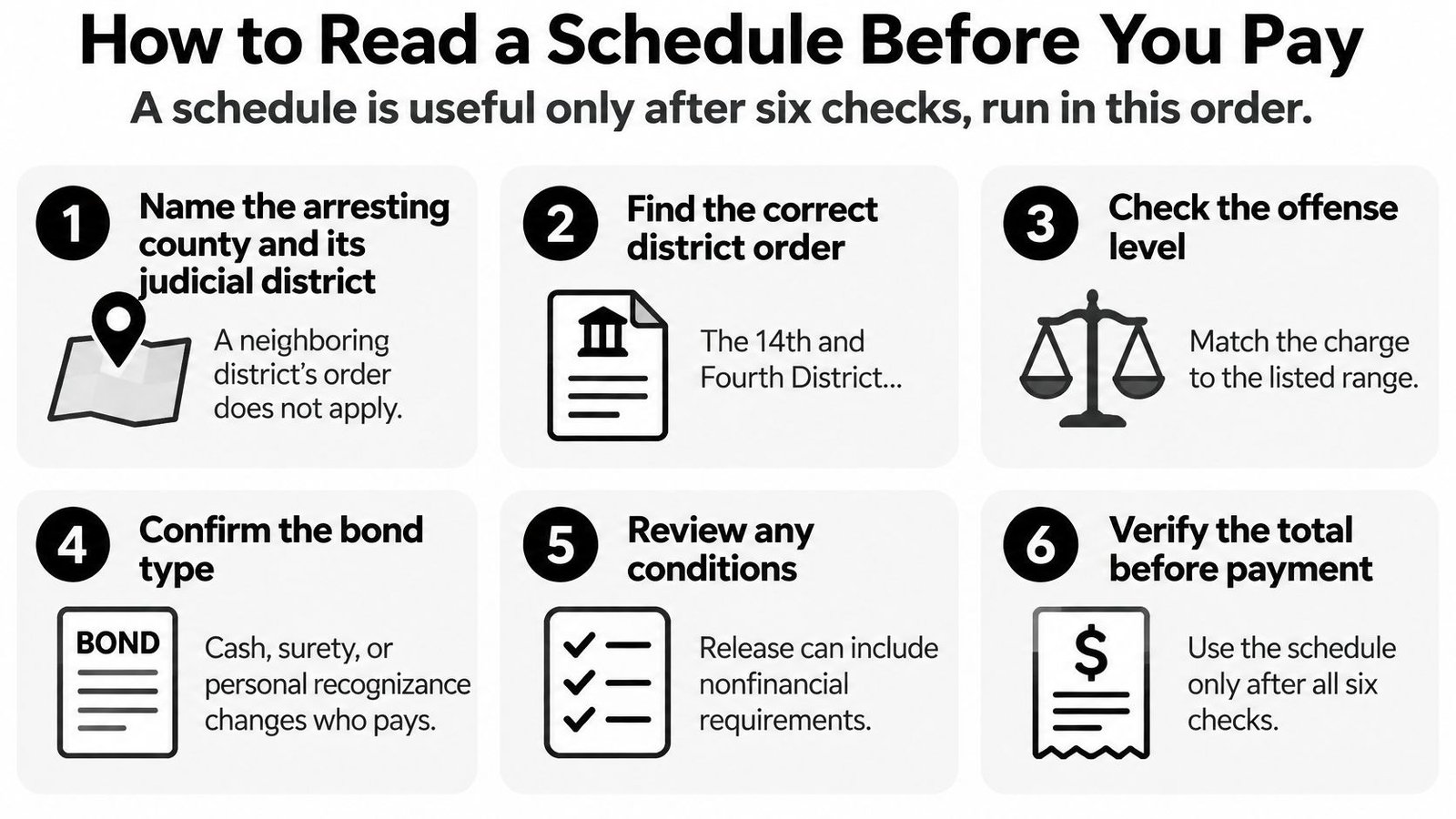
Run these checks in order:
- Name the arresting county and judicial district. Confirm the holding facility too. A neighboring district's schedule doesn't become applicable because its courthouse is nearby.
- Identify the most serious offense. Match the recorded classification to the applicable order. Don't total separate rows without an instruction authorizing that calculation.
- Flag special designations. Check for crime-of-violence, domestic-violence, or protection-order issues. These can affect the applicable reference or required procedure.
- Check whether judicial review comes first. Ask whether release is permitted before advisement or whether the person must appear before a judge or magistrate.
- Read the permitted bond forms. Look for cash, surety, property, personal recognizance, or an authorized combination. A dollar amount doesn't answer this question.
- Obtain the actual authorization. Confirm the bond entry with the jail before anyone quotes a premium or predicts release timing.
Keep a written note of the answer to each check, including who provided it. If a public inmate page is unclear or appears incomplete, ask the holding facility to confirm the current court-authorized entry. End with the jail's authorization, not a screenshot of a schedule.
Cash, Surety, and Personal Recognizance Bonds
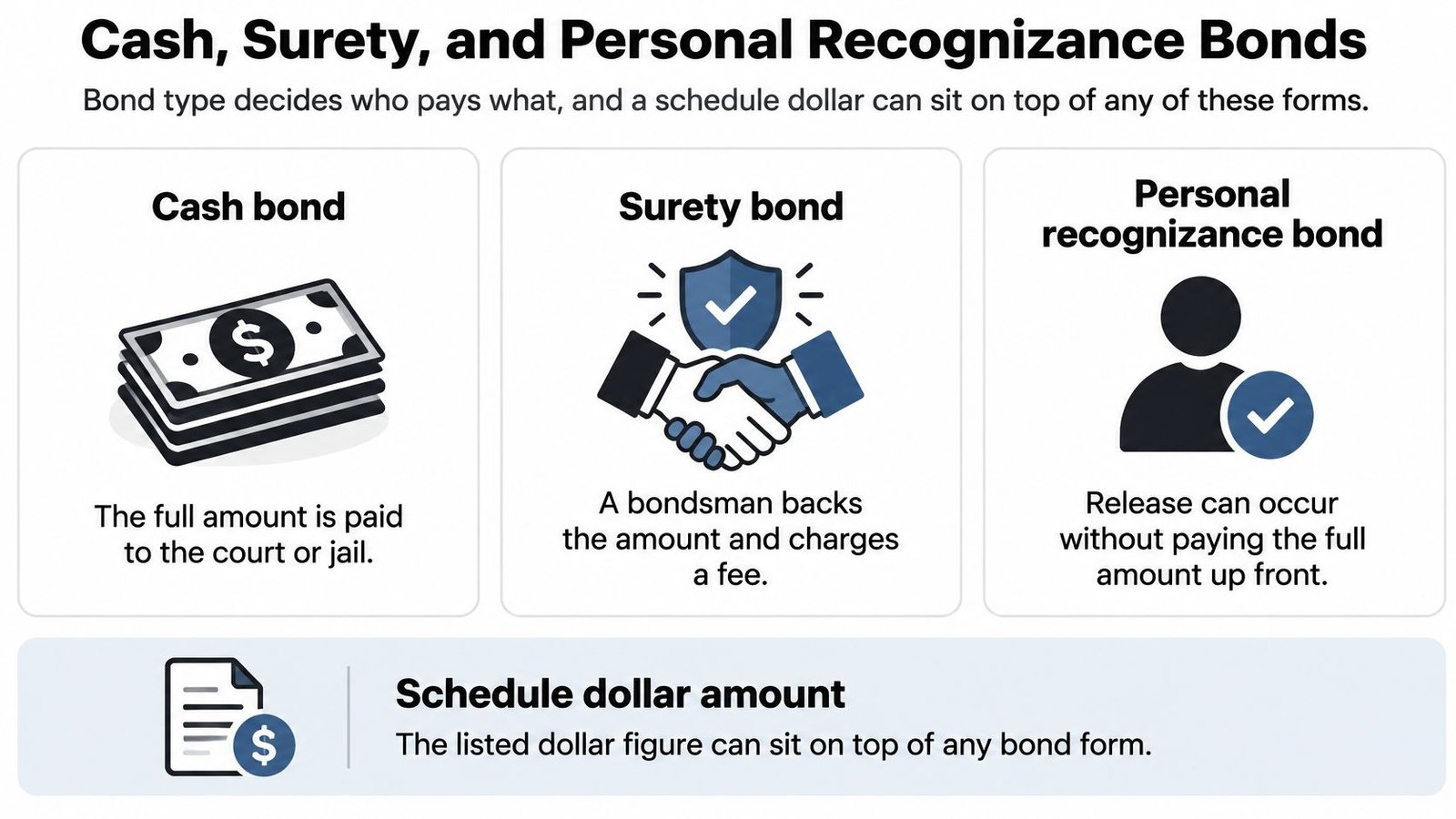
Bond type determines the financial mechanics. The amount shown and the method permitted are separate pieces of information, so read both before deciding who needs to pay.
What the payment actually does
| Bond form | What secures release | What to clarify |
|---|---|---|
| Cash | Full authorized amount paid to the court or jail | Accepted payment method and return procedure |
| Surety | A licensed agency backs the bond | Premium, contract obligations, and any collateral |
| Personal recognizance | A written promise to appear | Required paperwork and release conditions |
| Property | Approved real-estate equity pledged as security | Court approval and supporting documents |
For cash bonds, Gilpin County's jail guidance says the full bond amount is required and may be returned after all required court appearances are attended and completed; it also lists a $10 jail processing fee. Confirm the facility's instructions before bringing funds rather than assuming another jail accepts the same payment method.
A surety premium is the agency's fee, not money held by the court for return at the end of the case. Personal recognizance doesn't require purchasing that service, although the person must still comply with the release order. Property is a separate security arrangement with its own approval and paperwork.
Our explanation of bond types can help you distinguish those arrangements. The decisive detail is the authorized form: a surety agency can't turn a cash-only order into a surety order, and arranging a surety isn't a substitute for completing recognizance paperwork.
When a Dollar Amount Does Not Control Release
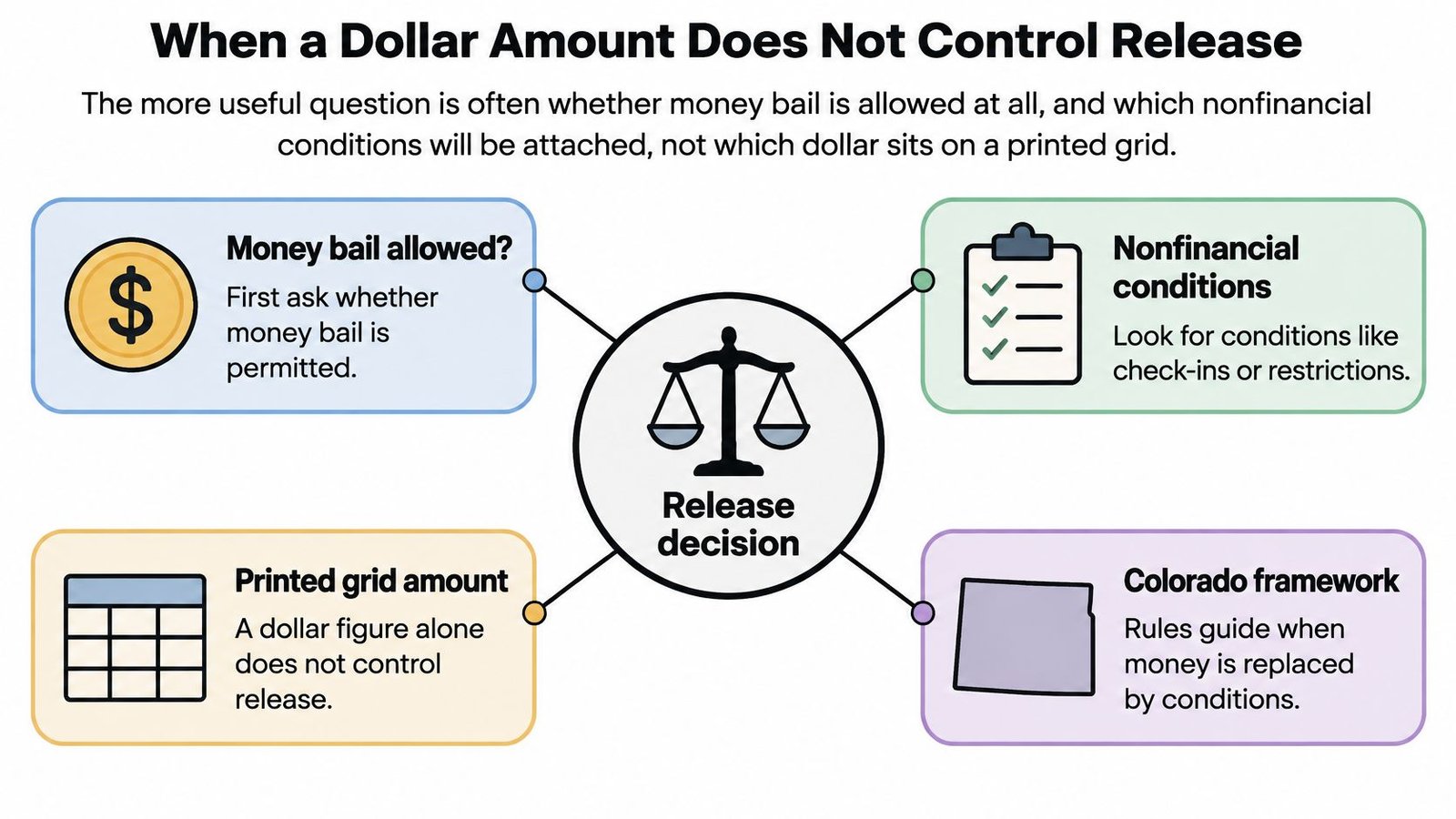
A schedule may list a dollar amount, yet the person may not be eligible for release on that bond form. The charge, court procedure, and release conditions can determine what happens next, so the printed figure is only one part of the decision.
Colorado's framework calls for considering different bond types and the least restrictive appropriate option, as explained in the Colorado pretrial-release guide. That distinction matters before a family arranges payment: the court may require a procedure or condition that money alone cannot satisfy.
When the offense limits financial conditions
For some lower-level offenses, the law limits the financial conditions a court may impose, subject to statutory exceptions. The relevant question is the charge and its authorized penalty, not a family's estimate of the likely sentence.
Other charges, exceptions, and required procedures can affect the outcome. A misdemeanor label alone does not tell a family which release rule applies to the booking.
A schedule may still show an amount even when the proper release route is nonfinancial. If the order authorizes personal recognizance, the next steps may involve signatures, instructions, and arrangements to comply with conditions.
Before paying: Read the conditions line as carefully as the amount line.
Protection orders can determine the next step
Protection-order procedures may affect when release is authorized. In some situations, personal recognizance may be available only after those procedures are completed. Arranging money does not complete a pending court step.
For example, in a domestic case, a person may need to receive a protection order before becoming eligible for nonfinancial release. A relative focused only on the schedule could arrange a surety bond that the final order does not require. Ask what court action remains pending.
Once a no-contact condition is entered, family logistics must follow it:
- Choose an approved destination. Do not assume the person can return to a shared home.
- Check transportation arrangements. Plan a pickup that does not create prohibited contact.
- Keep messages within the order's limits. Do not assume communication through relatives is permitted.
- Address belongings through proper channels. Ask counsel how necessary items can be retrieved without violating restrictions.
These are compliance questions, not ways around the order. If its wording is unclear, the defendant should seek legal advice rather than rely on a family interpretation.
Risk information affects the judicial decision
Judges may consider available pretrial-services risk information when deciding release. That information helps inform the decision. It is not a price category that a relative can turn into a bond quote.
Prepare accurate details for counsel and pretrial services. Confirm the person's address, transportation options, work schedule, and ability to follow proposed supervision. Do not promise treatment placement or monitoring arrangements that have not been confirmed.
A release order may include supervision, treatment, monitoring, or a no-contact condition. The family can help by understanding the exact obligations and supporting compliance. Payment does not remove those conditions.
The guide to what happens at a bail hearing explains the hearing process. An attorney can address a request for a different bond or different conditions. A bond agency works within the authorization the court has entered.
Eligibility, procedure, bond form, and conditions all shape a release decision. A dollar figure answers only part of the question, and sometimes it does not determine the next step.
Where to Confirm the County Order
Use the booking county, not the defendant's home address, to begin the lookup. For a county without a published amount in this guide, don't fill the gap with a neighboring county's number.
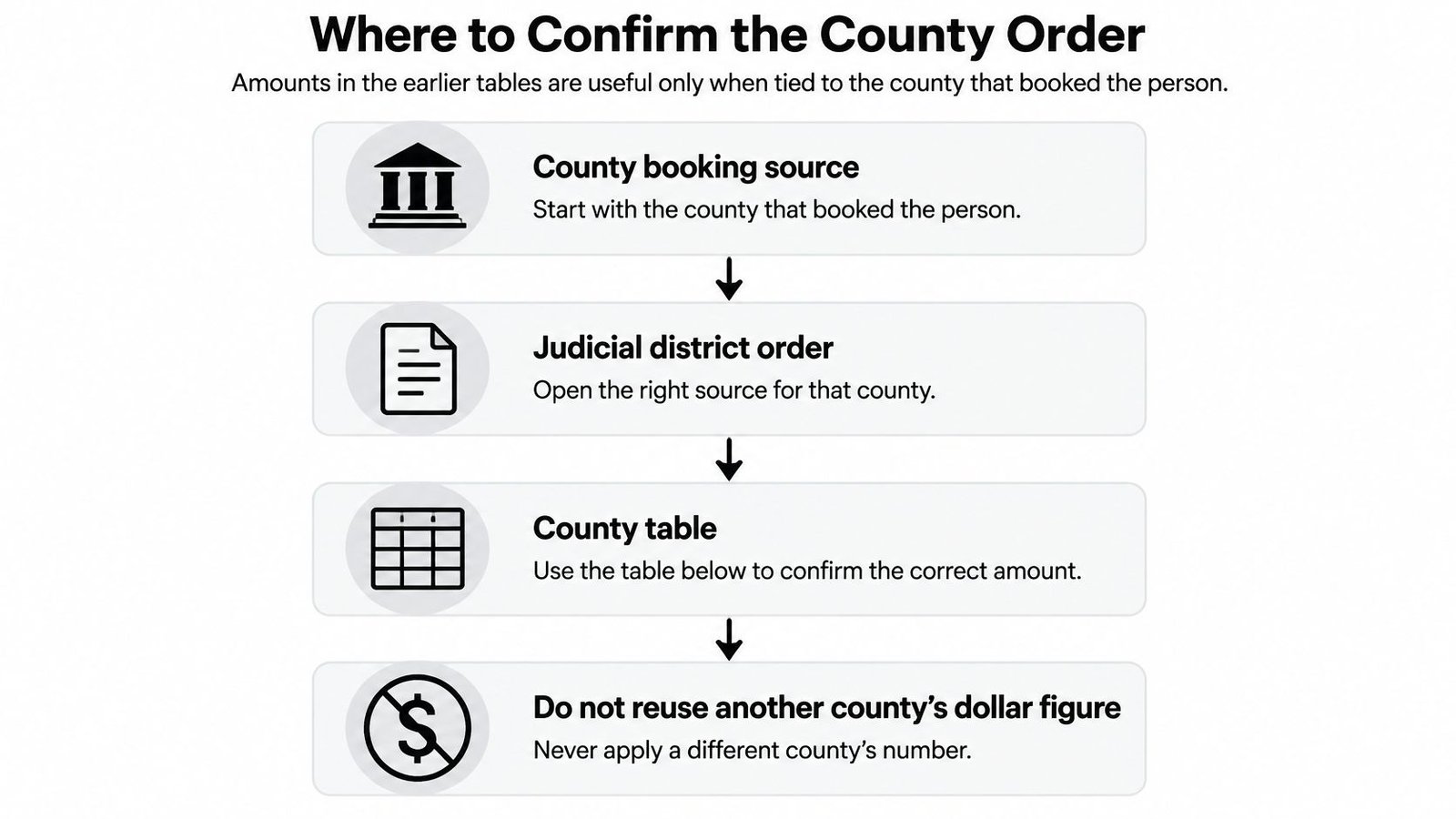
Official source to open by booking county
| Booking county or case | Official source to open |
|---|---|
| Grand, Moffat, or Routt | 14th Judicial District felony guide, confirming the order year |
| Misdemeanor commissioner amounts | Sixth Judicial District pre-advisement order |
| Denver DUI or DWAI | Denver County Court criminal bond schedule, effective February 20, 2025 |
| Gilpin | Gilpin County jail guidance for cash return and $10 processing fee |
| Counties in the Fourth Judicial District | Fourth Judicial District 2025 schedule, not for mountain-county bookings |
| Jefferson, Arapahoe, Adams, or other | Judicial Branch chief-judge orders, sheriff bond page, and inmate search |
For Jefferson County, Arapahoe County including Centennial, and Adams County, this guide doesn't supply a published local amount. Open the applicable chief-judge order, then the sheriff's bond instructions and the inmate record. If the records disagree, ask the holding jail to clarify the current authorization.
We provide links to official court and inmate-search tools for Denver County, Jefferson County, and Adams County. Our county jail phone-number directory also helps you reach the facility handling the booking.
We serve jails in Denver, Jefferson County, Arapahoe County, and all Colorado counties. That statewide coverage doesn't make local procedures interchangeable. Keep the official order, the facility's instructions, and the live booking entry together when you call.
Confirm the Live Bond Before You Post
Open the current inmate record and confirm the holding jail, highest charge, bond amount, and authorized bond form. If an abbreviation is unclear, ask the facility to explain it before sending payment. Also ask whether any required court appearance or release condition remains unresolved.
Have the person's full name, date of birth, and detention facility ready. If you have a booking number or case number, keep it nearby so the correct record can be located.
Match the posting method to the entry
- Surety authorized. Request a quote based on the amount entered and review the contract before signing.
- Cash only. Follow the court or jail's payment instructions; we don't post cash-only bonds.
- Personal recognizance. Confirm the required release paperwork and conditions rather than purchasing a surety.
- Property authorized. Obtain the court's approval requirements before preparing documents.
In Colorado, the bail bond premium is typically 10% to 15% of the total bail amount, so a $10,000 bond has a premium of $1,000 to $1,500. The premium isn't the full bond amount, and it isn't a court deposit that comes back when the case ends. Get the actual quote and obligations in writing.
We offer online applications, payment, contract documents, and bond posting at most Colorado detention facilities. When surety is authorized, our online bond-payment process lets relatives handle the paperwork remotely rather than travel to the jail solely to complete agency documents.
We're available 24/7 by call or text at 720-984-2245. Ask us to confirm the entry before quoting the posting, and don't plan a pickup until the facility's release process is clear. Completing payment doesn't itself establish when the person will walk out.
Express Bail Bonds offers licensed Colorado surety-bond help and electronic paperwork, starting with the bond authorized for the booking. Call or text 720-984-2245, or visit Express Bail Bonds to confirm your next step before arranging payment. For local help, use our Jefferson County and Golden page or our Centennial and Arapahoe County page.