
Colorado law caps a commercial bail premium at the greater of $50 or 15% of the bail amount, and Express Bail Bonds often arranges 10% on bonds over $5,000 when an approved cosigner qualifies. If someone you care about has just been booked, the amount you need to arrange may be the premium, not the full bond, but the contract, court conditions, and cosigner's risk still matter.
It may be late, and you may be trying to read a booking screen while calling family members and figuring out who can help. The court-set bond is the amount attached to the release order. A surety premium is a separate charge for a licensed bond company to post that bond. Think of it as a service cost that isn't returned just because the person later comes home from court, not as a payment of the entire bond to the court.

A lower upfront amount can matter when a family is trying to keep someone connected to work, caregiving, housing, and legal help. Research on San Francisco's ability-to-pay bail policy found that pretrial detention fell by 11% after courts gave more attention to defendants' finances. The released defendants were also 3 percentage points less likely to be convicted, with no consistent statistically significant increase in later arrests or convictions. Broader financial research linked pretrial detention with a 4%–6% higher probability of household insolvency within three years, including a 0.79-percentage-point increase in Chapter 7 filings relative to baseline (research on ability-to-pay bail and household financial effects).
“Affordable” therefore means more than finding the smallest advertised percentage. A family needs to know what's due now, whether a cosigner is taking on later responsibility, and whether another release option could avoid a premium. For a comparison of how bond costs are discussed in another state, what Texans pay for bail bonds offers useful context, but Colorado's rules and the court's order govern a Colorado case.
Why Families Search for an Affordable Bails Bond
At midnight, a family may see a bond amount on a booking screen and wonder whether that full sum is due before their loved one can come home. The answer depends on the release method. With a cash bond, the court may require the full amount. With a surety bond, a company posts the court-ordered bond, while the family pays a separate premium under a written agreement.
For example, a $5,000 court bond does not automatically mean the family pays a bondsman $5,000. The court bond is the amount securing the person's release under the court's order. The premium is the fee paid for the surety company to arrange and post that bond. It is generally not returned after the case ends. Collateral, if required, is different: it is property pledged to support the agreement, and the contract explains when it may be returned.
A household budget has to account for more than the premium. Ask whether collateral is required, what is due upfront, and whether the jail charges a separate $10 fee. Those amounts serve different purposes, so a quote should spell them out rather than combine them into one unclear total.
Start with the cash needed tonight, then ask what responsibility continues after release. A small initial payment does not show the full financial risk.
Release timing can affect a family's daily finances. Someone in custody may miss work, be unable to care for children, or have less ability to help prepare a defense. That pressure is why families often look for an affordable option that fits the cash available now, not just a low figure on a quote.
The court's order determines which release paths are allowed. Some people may qualify for an option that does not require paying a commercial bond premium, while others may need a surety bond. Families comparing costs across states can read about what Texans pay for bail bonds, but Colorado rules and the court's order apply to a Colorado case. Before paying, confirm the authorized release method and get the bond company's terms in writing.
How Colorado Caps the Premium You Pay
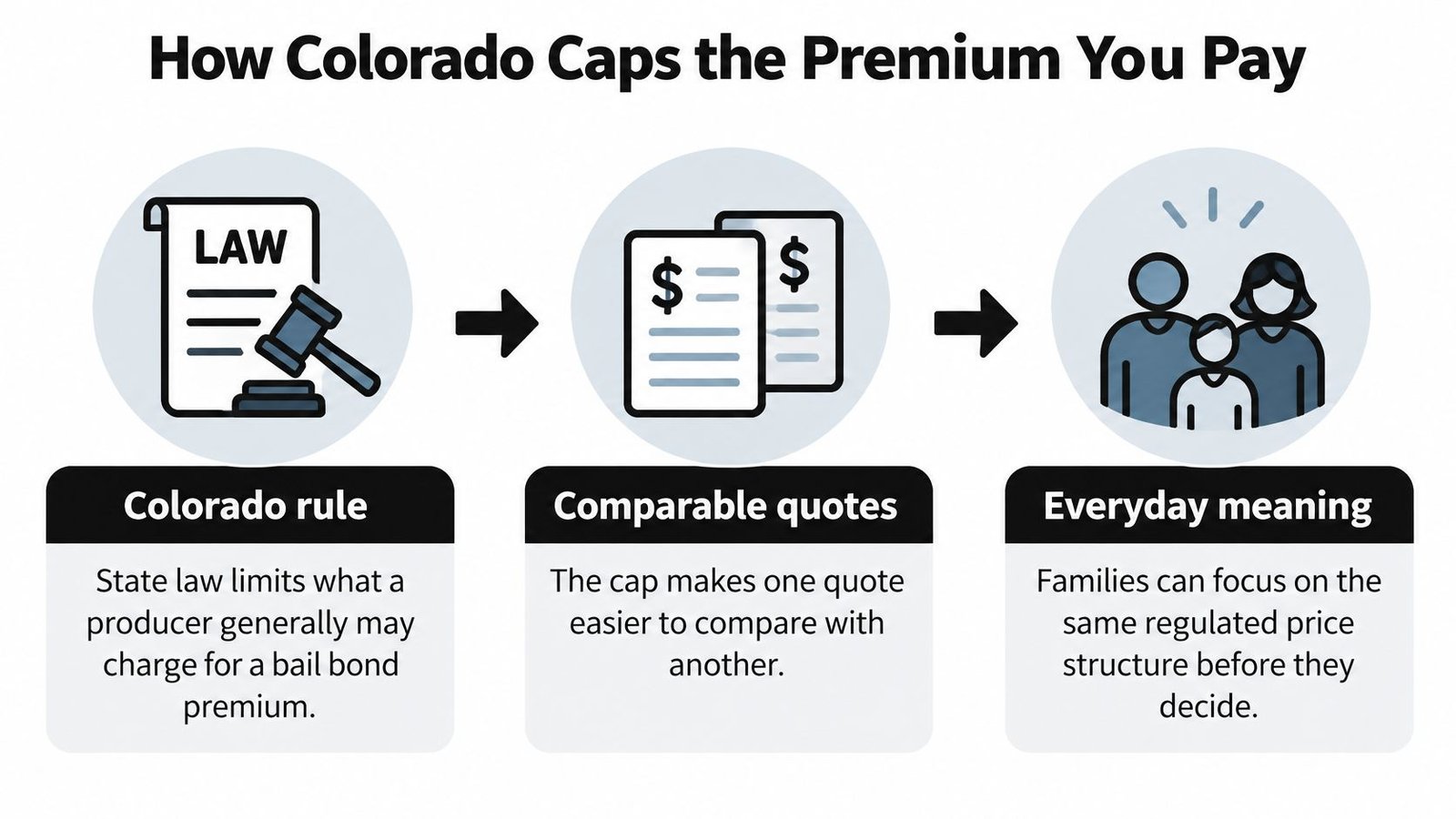
Colorado gives families a benchmark for comparing commercial surety quotes. Under Colorado Revised Statutes § 10-2-707, an insurance producer who writes a bail bond generally can't charge more than the greater of $50 or 15% of the bail furnished.
For a $5,000 bond, 15% is $750, so that is the maximum premium under the percentage calculation. On a very small bond, the $50 minimum may be greater than 15% of the amount. The rule sets a ceiling; it doesn't promise that every case will be charged the maximum or that each family will qualify for the same rate.
Ask what each line on the quote means
The premium isn't the only thing a family may see on paperwork. Colorado generally bars a producer from adding separate fees for a bond posted with a court unless the charge covers an authorized expense. Examples include a court or law-enforcement filing fee, secure collateral storage, or premium financing. Ask the agent to identify any such charge and explain what it covers.
Colorado also requires the premium, commission, or fee arrangement, including the payment schedule, to be documented in writing before consideration is accepted. That means you shouldn't have to rely on a verbal summary when deciding how much money is due and when. The Colorado Department of Regulatory Agencies' 2025 sunset-review materials describe the same 15% ceiling and $50 minimum.
The cap is useful because it gives you a statewide reference point, but it doesn't answer every affordability question. You still need to understand whether the quoted amount is due at once, whether financing is available under written terms, and whether the company is asking for collateral. Request an itemized written explanation before paying.
Release Paths That Can Cost Less Than a Bond
A family facing a $20,000 court bond may not need to put $20,000 on the table. The judge chooses the release conditions, not the family or bail agent. Colorado policy directs courts to consider conditions that reasonably support court appearance and protect people or the community, while avoiding unnecessary pretrial detention (Colorado pretrial policy and bond guidelines).
| Release path | Upfront payment | Later exposure | When it fits |
|---|---|---|---|
| Cash bond | The full court-set amount goes to the court | The court may keep the payment if the person fails to appear | The order allows cash, and funds are available |
| Personal recognizance | No monetary deposit under the cited framework; the person promises to appear | The person must follow court requirements | The court approves release on that promise |
| Professional surety bond | A premium goes to a licensed bondsman; a cosigner or collateral may be required | The surety may face forfeiture, and the cosigner may have contractual obligations | The court allows a surety bond and the family can meet its terms |
| Property bond | Qualifying Colorado real-estate equity is pledged | The property may face court action | The court permits it and enough equity is available |
| Pretrial supervision or other nonfinancial conditions | May avoid a bond premium, depending on the order and program | The person must follow supervision and other release conditions | The court finds these conditions appropriate |
Each option affects household cash flow differently. A cash bond ties up the full amount with the court. A surety bond usually requires a nonrefundable premium, rather than the full bond amount, and may also involve collateral. A release without a money deposit can avoid that premium, but the person still has to meet the court's conditions.
A property bond is not the same as paying cash. Colorado requires unencumbered equity equal to 1.5 times the bond amount. For example, a $20,000 bond requires at least $30,000 in unencumbered equity (Colorado Judicial Branch information on bond types). That equity is pledged, not paid as a premium.
The least expensive route may not be the fastest, and the court must approve the release terms. A surety bond may be an option when the family cannot pay the full cash amount. Recognizance or supervision may avoid a nonrefundable premium if the judge authorizes it. A reported analysis of more than 40,000 cases found that people released without cash bail returned to court 92% of the time (reported analysis of release without cash bail). That finding does not predict what will happen in an individual case, but it shows that a cash payment is not the only way courts can address appearance.
Before paying a premium, ask whether the court will consider a lower-cost release condition. A bail agent cannot change a cash-only order, a hold, or another court restriction. Families can read about Colorado pretrial services and supervision, then confirm the available conditions with the court or local office.
Cosigners Collateral and Larger Bond Discounts
A surety bond affects more than the person awaiting release. The bondsman posts the court-set bond, and the surety is responsible for the person appearing at future hearings. If they don't appear, the court may order the bond forfeited. That risk helps explain why a company may ask a family member to cosign or pledge collateral. The family does not pay the full court bond amount as a premium (Colorado Judicial Branch guidance on bond obligations).
A cosigner, sometimes called an indemnitor, agrees under the contract to cover certain losses if the defendant fails to meet obligations or the bond is revoked. An out-of-state relative may be able to sign documents electronically rather than travel to the jail. Distance does not change the agreement's financial responsibility, so read its terms carefully before signing.
Compare the written amount, not just the rate
Express Bail Bonds lists a standard premium of 15%. For bonds over $5,000, an approved cosigner may qualify for a 10% premium. These are the company's terms, not a discount guaranteed by law or available in every case.
For a $10,000 bond, a 15% premium is $1,500. At 10%, the premium is $1,000, leaving $500 more in the household budget. That difference changes the immediate cash outlay, but the cosigner still accepts the contract's obligations. Ask what information the company needs for approval and what conditions apply.
Collateral is security the company may hold under the agreement. It is separate from the nonrefundable premium, much like a key held against a separate obligation: it may be returned under the contract's terms, but it can be at risk if those terms are not met. Before pledging property or other assets, check the written agreement for the premium, any financing terms, and when and how collateral will be handled after the case ends. Review the company's explanation of bail bond collateral before deciding what your household can afford to put at risk.
Budgeting Premiums Jail Fees and Later Risk
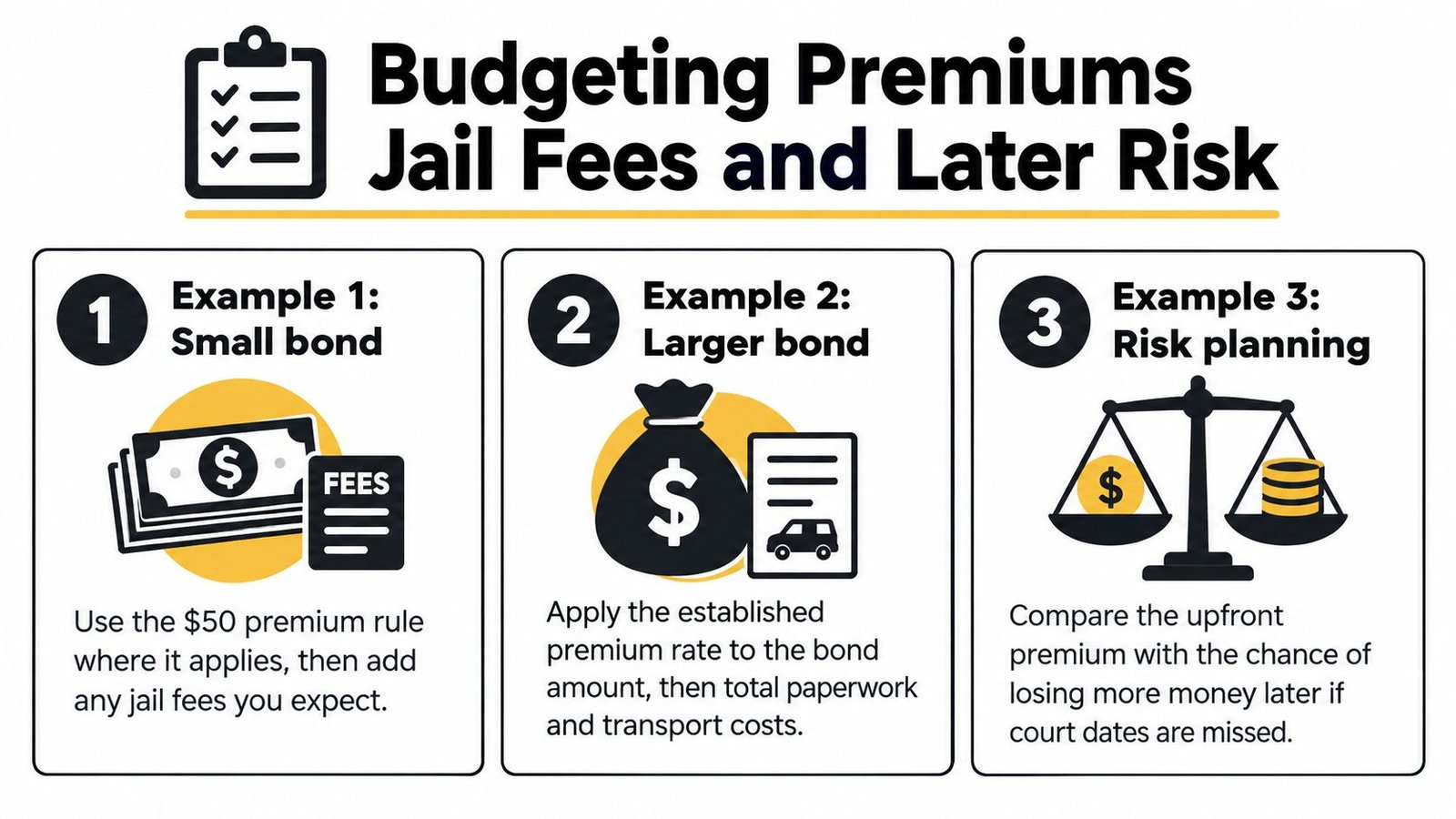
A family weighing release costs should list each amount separately, like sorting monthly bills: the court-set bond, the surety premium, any collateral, and the jail's processing fee. Colorado law caps the jail bond-processing fee at $10, including for bonds posted online. Under Colorado House Bill 25-1015, the jail custodian must ensure the defendant, surety, or another third party is not charged more than that fee. It is separate from the premium and collateral.
Put the immediate costs on one page
- Small bond: The $50 minimum may apply if it exceeds the percentage calculation. Add the jail fee, and ask for any other authorized charges in writing.
- $5,000 bond: At the legal ceiling, the premium is $750. The jail fee is separate, as are any authorized, documented expenses.
- Bond over $5,000: An approved cosigner may qualify for the agency's 10% arrangement. Ask what is due now, whether payment can be made over time, and what terms will be written into the agreement.
The household's immediate cash total is the premium, the jail fee, and any authorized documented charge. The bond amount is a separate figure set by the court, not necessarily money the family pays to the jail. Still, a premium can mean hundreds or thousands of dollars upfront, while missed work, transportation, and emergency legal costs add pressure to the same budget.
A surety premium pays for the bond service and is generally not returned just because charges are dismissed. Before signing, check the contract and read about whether bail is refundable. Collateral is different from the premium: it secures the agreement and may be affected if its conditions are not met.
Release also leaves future responsibilities. The defendant must follow court conditions and attend required appearances. If they miss court, the bond may be at risk, and the cosigner or pledged collateral may be affected under the contract. A household budget should account for that possible exposure, not only the amount needed to arrange release.
For comparison, Tarrant County bond payment methods describes payment and release steps in another county. Colorado families should confirm the local order and add up the actual written charges rather than budgeting from a headline percentage alone.
Choosing a Colorado Surety That Posts Quickly
At midnight, a family may be weighing the bond amount against rent, groceries, and money available for release. Once the court allows a surety bond, choosing a provider means checking how the transaction will work, not just comparing premiums. A quote helps only if the family understands the contract, can reach the agency, and knows how the bond will be sent to the jail.
Use these questions to compare providers:
- Confirm licensing: Ask whether the agency is licensed to write bonds in Colorado.
- Check the premium: Confirm the quote is within Colorado's legal limit. Ask whether a reduced rate needs approval.
- Get terms in writing: Request the premium, payment schedule, financing terms, and any authorized extra charge before paying.
- Understand the cosigner's role: Ask what the cosigner agrees to do and how the contract could affect collateral.
- Ask about posting: Confirm the agency can contact the jail holding the person and explain what information or documents are needed.
A household cash plan should separate the court's bond amount from the premium paid to the surety. The bond amount is the court's condition for release, while the premium is the fee for the service. Collateral, if required, is separate again: it may secure the agreement rather than act as a payment toward the premium. Ask how each amount is due and what the written contract says.
Express Bail Bonds is a licensed Colorado agency based in Denver that serves city and county detention facilities statewide. It handles surety bonds, not cash-only bonds, and accepts applications, payments, and contract documents electronically. Electronic paperwork may save a trip to a detention center, though the court's order and jail process determine when release can proceed.
Agents are available around the clock by call or text at 720-984-2245, or by email, to discuss fees, court requirements, and next steps. The website also links to local jails, courts, and county search tools. Use a guide to comparing bond companies to prepare questions before choosing a provider.
For local details, families can consult the relevant county or city information. The agency's statewide and location-specific pages provide those resources.
Start the Bond Only After the Court Allows It
At midnight, a family may have the booking details ready and money set aside, yet still need to wait. First confirm the defendant's full name, date of birth, and detention center. Then ask whether the court has authorized a surety bond or may allow a lower-cost option, such as release on recognizance or supervision. The court decides which paths are available. For a plain explanation of timing, see when bail is set.
Once a surety bond is permitted, separate the costs before paying. The court bond amount is the amount secured for release. The premium is the fee paid to the bonding agency, and it is generally nonrefundable. Collateral is property or money pledged under the agreement, while the jail may charge a separate $10 fee. Ask for the premium and any other charge in writing, and make sure the contract explains collateral and the cosigner's responsibilities in plain language. These amounts affect a household budget in different ways.
For example, a family might have enough cash for the premium but not for collateral, or a cosigner may need time to review the agreement. Ask how the premium can be paid, what collateral is required, and what could put the cosigner at risk. The person's release does not cancel court dates. They must attend required appearances and follow the court's other conditions.
A clear first call can save time: give the booking information, confirm what release path the court allows, and request the written price and next steps. Express Bail Bonds can explain the process and take applications electronically. Call or text 720-984-2245 to ask whether the authorized bond can be posted and what the premium will be. Have the booking details ready so the agent can discuss the court's order without guessing.