
A PR bond in Colorado is a release on the defendant's signed promise to appear in court, with no cash, property, or bail-bond premium required up front. It's an unsecured release decision, not a dismissal, and the case continues while the defendant remains out of custody.
The phone call often comes late at night. A spouse, parent, sibling, or close friend says someone has been booked into a Colorado county jail and asks the same urgent questions: Will they come home tonight? Does someone need to bring money? Do we need a bail-bond agency? What happens next?
The answer depends first on the type of bond the court sets. A personal recognizance bond, commonly called a PR bond, can be the simplest route to release because it relies on the defendant's promise and legal obligation rather than an upfront payment. But PR release isn't automatic, and “no money required” doesn't mean “no rules apply.”
A Late-Night Call and the Question of Release
Suppose your brother calls from a county detention facility after an arrest. He sounds tired and confused. He says officers told him the court may release him on his own recognizance, but nobody has explained whether that means someone must pay a bondsman or whether a family member must sign paperwork.
The first thing to understand is that a PR bond is different from a cash or commercial surety bond. If the judge grants PR release, the defendant generally doesn't need to deposit cash, pledge property, or pay a bail-bond premium to leave custody. The defendant signs an agreement promising to appear for required court proceedings and follow the conditions imposed by the court.
That distinction can ease one kind of pressure, but it doesn't answer every practical question. The court still has to decide whether an unsecured promise reasonably addresses the person's appearance and safety risks. The judge may also impose supervision, treatment, testing, communication, or location-related conditions.
The immediate question isn't simply whether bail costs money. It's whether the court believes a legally enforceable promise, possibly combined with conditions, is enough to support release.
Families can also feel confused because jail staff, court clerks, attorneys, and commercial bail agencies use different terms. “Own recognizance,” “personal recognizance,” and “PR bond” generally describe the same basic release concept, while an unsecured bond can refer to a bond that isn't paid at release but still creates legal obligations under its terms.
The safest first step is to find out whether the court has granted PR release or has only scheduled a bond hearing. A person who hasn't received a PR order may still be waiting for a judge to decide between unsecured release, a secured monetary bond, additional conditions, or another lawful option.
Families should also remember that a PR bond doesn't resolve the criminal case. The defendant hasn't been found innocent, and the prosecutor's case hasn't disappeared. The person is released while the case remains pending and must handle every court requirement seriously.
What a PR Bond Actually Means in Colorado
A PR bond is best understood as an unsecured signature bond. The defendant signs a legally significant promise to appear at scheduled court dates and comply with the order. No cash deposit, property pledge, or commercial surety premium is required for the PR release itself.
Colorado law allows a court to issue an unsecured PR bond for an amount specified by the court and to add nonfinancial conditions. The governing statute, Colorado Revised Statutes section 16-4-104, describes the court's authority to set release terms intended to reasonably assure appearance and protect individuals or the community.
A simple analogy is a handshake backed by the court's authority. In an ordinary handshake, the parties rely on trust. With a PR bond, the defendant's promise has legal consequences because the court can enforce the bond and respond when the defendant doesn't follow the order.
That doesn't mean the defendant hands over nothing and walks away without responsibility. A judge may require regular court appearances, supervision, treatment, testing, contact with pretrial services, or restrictions involving people and places. The exact conditions depend on the charge, the person's history, and the judge's individualized assessment.
What happens after the signature
If the defendant appears as required and follows the order, the PR arrangement continues while the case moves through the court process. If the defendant fails to appear, the court can take enforcement action, and the person or other signers may face financial exposure under the bond's terms. A missed hearing can also lead to a warrant and additional difficulty securing release.
The word unsecured describes when money is paid, not whether the promise matters. No money is deposited at the moment of release, but the bond remains a court order with enforceable consequences.
A PR bond also isn't a dismissal, acquittal, or reduction of charges. The criminal case stays open unless it's later resolved through the court process. Families looking for a plain-language comparison can review Colorado release on own recognizance information while confirming the actual order with the assigned court or detention facility.
How a PR Bond Decision Gets Made
A family may receive a late-night call saying the judge is considering release without an upfront payment. The next question is usually, “Does that mean release is automatic?” In Colorado, the judge makes an individualized decision. The court considers whether an unsecured promise can reasonably address the person's risk of missing court or creating a safety concern, then decides whether conditions are needed.
The judge generally works through four practical questions:
- What is the current charge? The charge classification and alleged facts may determine whether Colorado law directs or permits PR release.
- Does a statutory limitation apply? Certain recent convictions, another qualifying criminal bond, or a recent failure to appear can restrict eligibility for an unsecured PR bond.
- What information can the court verify? The bond application and pretrial process may provide details about identity, residence, contacts, criminal history, and other release factors.
- Can conditions address the concern? Supervision, treatment, testing, contact limits, or location restrictions may reduce a risk without requiring money as the only safeguard.
A judge may review the bond application, pretrial information, arguments from the parties, and specific safety concerns. A PR bond is therefore not always an automatic result. Some offense categories receive special statutory treatment. Other cases require the judge to examine the facts more closely.
For a plain-language walkthrough of the hearing itself, learn what happens at a Colorado bail hearing before the judge decides on PR release.
Colorado judicial guidance identifies situations where an unsecured PR bond is generally unavailable without prosecutorial consent or additional qualifying conditions. Examples include certain recent felony or class 1 misdemeanor convictions, being free on another qualifying criminal bond, and a recent failure to appear in a qualifying case. The Colorado bond guidelines describe those restrictions.
Automatic direction versus an argued release
Certain lower-level offenses receive special treatment under Colorado law. The law directs PR release for certain class 3 misdemeanors and some unclassified offenses carrying a maximum penalty of no more than six months, unless an exception applies. The court still must confirm the charge, check for an exception, and set any required conditions.
Other defendants may receive PR release only after the judge reviews the facts and hears why an unsecured promise is appropriate. A defense attorney can present information about housing, work, family support, prior court compliance, or a proposed supervision plan. A prosecutor may raise concerns, while the judge makes the release decision under the applicable law.
Once a PR bond is set, Colorado's six-hour release rule gives families a concrete timeframe: the jail must release the person within six hours, subject to applicable statutory exceptions and the facility's release procedures.
Ask whether PR release is legally directed, available for judicial consideration, or restricted by a specific exception. The bond paperwork should show which situation applies.
Who Qualifies for a PR Bond in Colorado
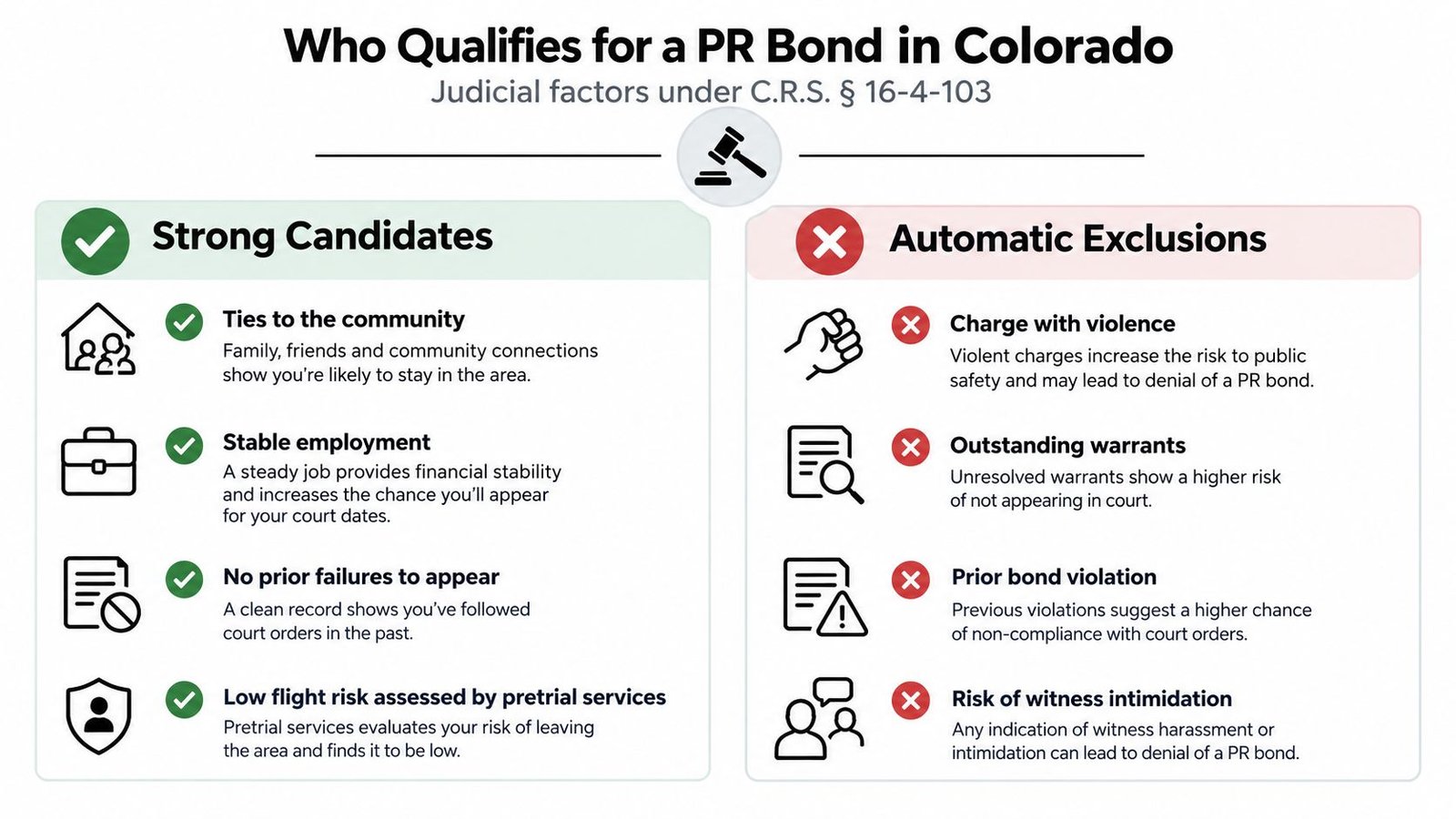
A family member may hear “PR bond” and assume the person automatically walks out without paying. Colorado eligibility works differently. The charge, court history, current release status, available records, and safety concerns all affect whether the court can use an unsecured promise instead of money.
The judge is making a practical risk decision. The question is whether the defendant is likely to return to court and follow release requirements without a cash deposit or surety. The Colorado Judicial Branch bond guidelines provide the framework courts use when considering these decisions. Broader use of PR bonds in some lower-level cases does not guarantee release in an individual case.
What the court reviews
At the bond hearing, the court may examine the current allegation, prior appearances, pending cases, and information collected during the pretrial process. A defendant with stable contact information, a clear plan for attending court, and a record of following prior orders may present a stronger case for PR release. A recent failure to appear, another qualifying criminal bond, or certain convictions can limit that option under Colorado procedures.
Families can learn how Colorado pretrial services evaluates release information to understand why address, phone, employment, treatment, and court-history details may matter. Pretrial information works like a fact-checking file for the judge. Missing or inconsistent details can leave the court with unanswered questions.
Before the hearing, prepare answers to these questions:
- Court history: Did the defendant attend earlier hearings?
- Current status: Is the defendant already released on another qualifying criminal bond?
- Record: Could a recent conviction restrict unsecured release?
- Reliable information: Can the court verify the address and phone number?
- Compliance plan: How will the defendant attend court and follow each order?
Eligibility may be automatic for certain offenses, available for the judge's consideration, or limited by a statutory exception. The paperwork and hearing record should clarify which category applies.
Once the judge sets a PR bond, Colorado's six-hour release rule gives the family a concrete timeframe. Subject to statutory exceptions and jail release procedures, the jail must release the defendant within six hours. That deadline starts with the bond being set, not with a family member arranging payment.
Common Conditions a Judge Can Attach
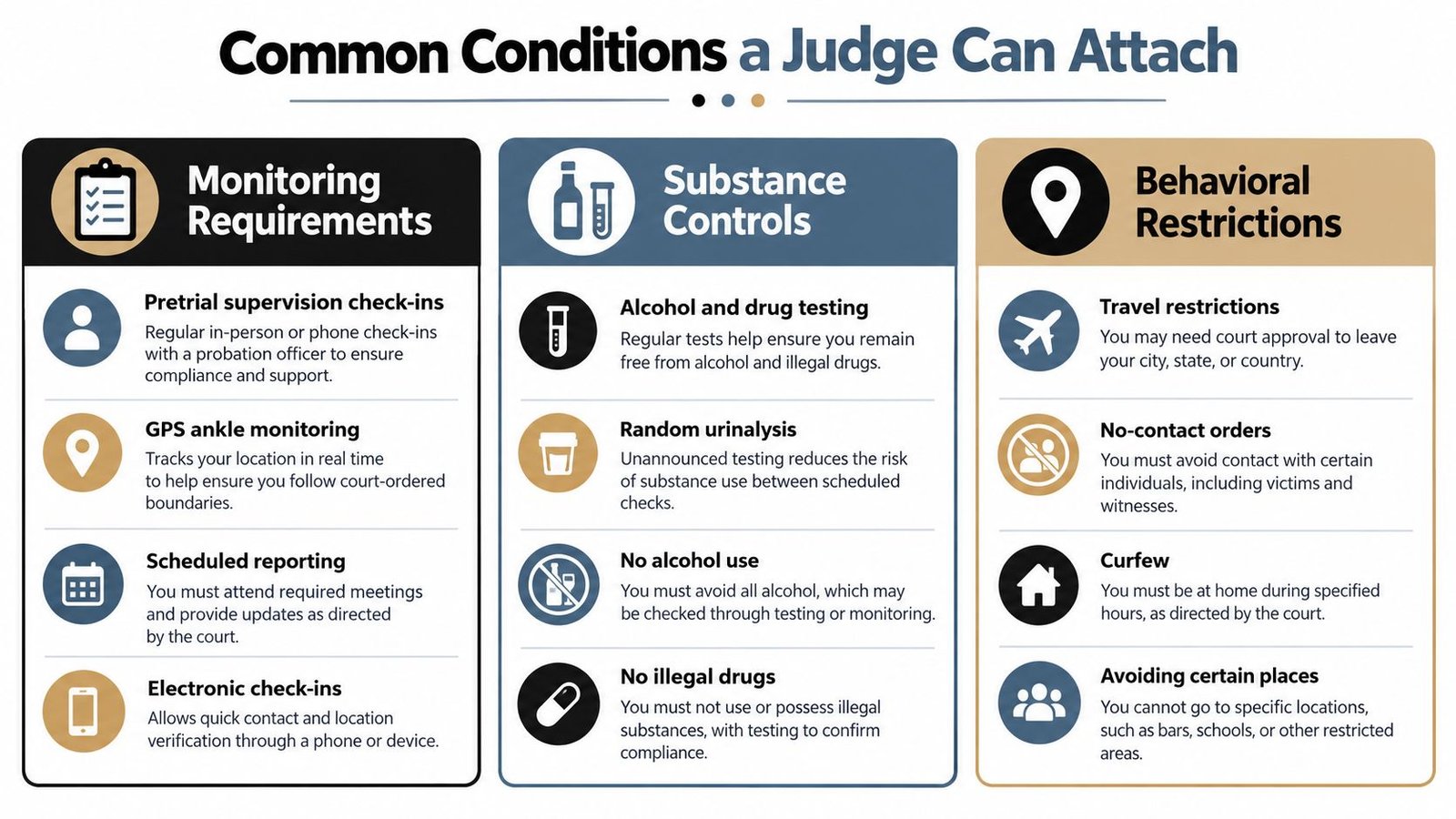
A PR bond can carry substantial obligations even though no money is deposited at release. Colorado judicial materials recognize conditions customized to the person's appearance and safety risks, so the signed order matters more than the label “PR.”
Court and supervision duties
The most basic condition is appearing at every required court date. A judge may also require the defendant to maintain accurate contact information, check in with pretrial supervision, or follow a treatment plan.
For example, if the order requires contact with a supervision officer, the defendant shouldn't assume that one successful check-in completes the obligation. The written order may specify how and when contact must occur. If the defendant changes phone numbers or addresses, the person should follow the court's reporting procedure rather than waiting for the next hearing.
Conduct and location restrictions
A court may restrict contact with designated people or places. A no-contact condition can reach beyond phone calls. Depending on the wording, the defendant may need to avoid texts, social media messages, emails, in-person contact, or communication through another person.
Stay-away terms also require careful reading. A defendant may be prohibited from entering a particular location or contacting someone connected to the case. Families should keep a copy of the order and avoid guessing about exceptions. The Colorado bond conditions guide offers a practical starting point, but the court's own written terms control.
Treatment and testing requirements
The court can order treatment, testing, or other measures connected to the identified risk. Missing a test, ignoring a treatment appointment, or failing to follow a supervision instruction can place the release in jeopardy.
When circumstances change, defense counsel can ask the court to review or modify conditions. Until a judge changes the order, the defendant must follow the existing terms. Keep the bond paperwork, appointment notices, testing instructions, and contact details together so nobody has to reconstruct the requirements from memory.
PR Bond vs Cash Bond vs Surety Bond
These three options differ in what supports release. A PR bond relies primarily on the defendant's legally enforceable promise. A cash bond requires financial security to be deposited according to the court's instructions. A surety bond uses a licensed bail-bond agency to post the required bond under a commercial agreement.
| Feature | PR Bond | Cash Bond | Surety Bond |
|---|---|---|---|
| What supports release | The defendant's signed promise and compliance with court terms | Money deposited as security | A commercial surety arrangement posted through a licensed bail-bond agency |
| Upfront payment | No cash, property, or commercial premium is required for the PR release itself | The required cash must be deposited | A premium and contract obligations apply under the agency's terms |
| Who decides availability | The court, based on statutory eligibility and individualized review | The court sets or approves the secured bond | The court must set a bond that permits surety posting |
| Main family concern | Following every court date and condition | Tying up funds and meeting court deposit procedures | Understanding the premium, signer duties, collateral terms, and appearance obligations |
| Best fit | A defendant the court finds suitable for unsecured release | A case where the court requires secured money and the family can deposit it | A case where the court requires a surety-backed release and the family needs an agency to post it |
Colorado recognizes secured monetary bonds when money is reasonably necessary to ensure appearance or safety. That means a judge may choose a cash or surety-backed option rather than PR release.
A PR bond doesn't require the family to select a commercial bond agency. A surety bond becomes relevant when the court sets a secured or surety requirement. Families comparing secured options can review cash bond versus surety bond in Colorado and then confirm the exact bond type with the jail or court.
The practical choice isn't always a choice the family gets to make. The judge determines the release terms, and the family must meet those terms or seek a court-approved change.
Release Timing and What to Expect at the Jail
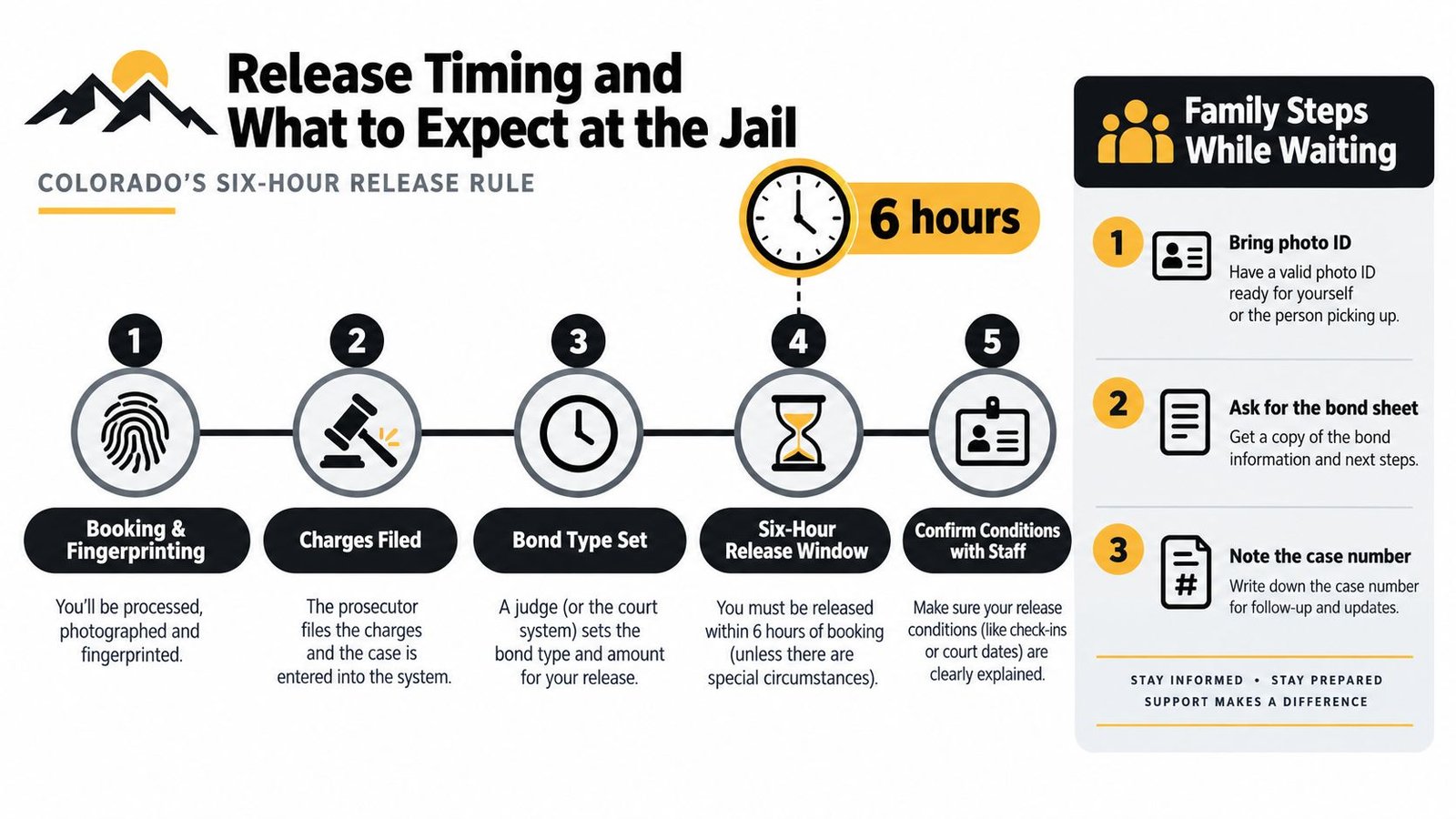
Colorado provides a specific timeline after a PR bond has been granted. Unless extraordinary circumstances exist, a jail custodian must release the defendant as soon as practicable and no later than six hours after the defendant is physically present in the jail. The rule appears in the relevant Colorado session law concerning PR release timing.
That six-hour period starts after the PR bond has been granted and the defendant is physically present at the jail. It doesn't mean every arrested person receives PR release, and it doesn't mean a person leaves immediately after arrest.
While waiting, families should focus on verification rather than assumptions:
- Confirm the bond type: Ask jail staff whether the court granted PR release, another unsecured bond, cash, or surety.
- Request the paperwork: Get the bond sheet or release order and read every condition.
- Record the case number: The number helps when contacting the court, pretrial services, or detention facility.
- Ask about pickup rules: Confirm whether the defendant may leave independently or whether an approved person or custodian must participate.
- Check contact details: Find out how the defendant will receive court dates, supervision instructions, and future notices.
Booking steps can include identification processing, photographs, medical screening, and paperwork review. The release clock doesn't turn the arrest into an instant departure because staff still need to process the court order and conditions.
A weekend, holiday, staffing issue, or extraordinary circumstance may affect practical timing. If the family believes the six-hour period has passed after PR release was granted, ask the facility to explain the status and document who provided the information. Do not arrange a commercial surety bond until you know whether the court required one.
Next Steps for Families and a Clear Path Forward
After a PR bond is approved, the defendant's next job is to follow the written conditions. Treat the bond order like a checklist: court dates, check-ins, treatment appointments, testing, travel limits, and no-contact rules all require attention. A missed date or outdated phone number can create a new problem even when the original charge has not changed.
Create one case file for the bond order, court notices, supervision instructions, testing records, and contact information. Put every deadline on a shared calendar. Keep one reliable contact with the assigned officer or court office, and record important calls.
Watch for mistakes such as:
- Missing court because notice went to an old address.
- Leaving an allowed area without permission.
- Contacting a protected person through someone else.
- Treating curfew, supervision, or testing as optional.
- Relying on a verbal explanation that conflicts with the written order.
Colorado law directs PR release for certain class 3 misdemeanors, petty offenses, and some unclassified offenses with a maximum penalty of no more than six months, subject to statutory exceptions. Once PR release is granted, the jail's six-hour release rule still requires staff to complete processing and apply the court's conditions. Other cases may require financial security when the court finds it reasonably necessary or PR eligibility is limited.
If a surety bond is required, Express Bail Bonds helps families submit applications and documents electronically and coordinates release with Colorado detention facilities. Use the Jefferson County and Golden bond information page or the Centennial bail bond resource for those communities.
If secured release is ordered, contact the company for application guidance, required documents, and next steps.