You're halfway through a loan application when the requests start multiplying: a pay stub, bank statements, tax returns, identification, insurance, and a document with an unfamiliar name. Uploading files is only part of the process. Each required loan document answers a specific underwriting question, and a missing page, stale statement, or mismatch can send the file back for clarification.
This guide covers personal loans, mortgage loans, auto loans, and business loans. It organizes the paperwork into five practical categories, identity, income, assets, debts, and transaction contracts, then explains what lenders verify after approval and how electronic signing is changing the closing process. Requirements vary by lender, loan type, loan size, jurisdiction, and whether you apply online or at a branch, so use this as a preparation guide alongside your lender's checklist.
Getting a Handle on Required Loan Documents
Most applicants don't receive one perfectly complete checklist. A lender may start with identification and income records, then request bank statements, contracts, insurance, or explanations after an underwriter reviews the first submission. That sequence can feel inefficient, but each request usually fills a different evidentiary gap.
For a personal loan, the focus is identity, income, credit obligations, and available cash flow. A mortgage adds property, title, appraisal, insurance, and closing disclosures. An auto loan connects the borrower to a specific vehicle, VIN, title, lien, and insurance policy. A business loan expands the review to entity formation, business financial statements, revenue concentration, existing obligations, and sometimes the owner's personal finances.
Across all four products, most files eventually touch the same five questions:
- Who are you? Identity and Social Security verification answer this.
- Can you repay the debt? Pay records, tax filings, and business statements address income.
- What resources do you have? Bank and investment records show assets and reserves.
- What do you already owe? Credit reports and loan statements reveal existing debts.
- What transaction is the lender financing? Purchase agreements, leases, invoices, and formation records establish the deal.
Processor's rule: A document matters because of what it proves, not because its filename appears on a checklist.
Keep names, dates, signatures, and account information consistent before uploading. If you need a broader explanation of how documents become legally usable, review this guide to requirements for court-ready documents. The same habits, accurate identity details, complete pages, and reliable signatures, reduce friction when you're also handling the release process.
The Five Universal Document Categories
Lenders may use different names for their forms, but most required loan documents fit into five functional buckets. Once you understand the bucket, an unfamiliar request becomes easier to interpret and replace appropriately.
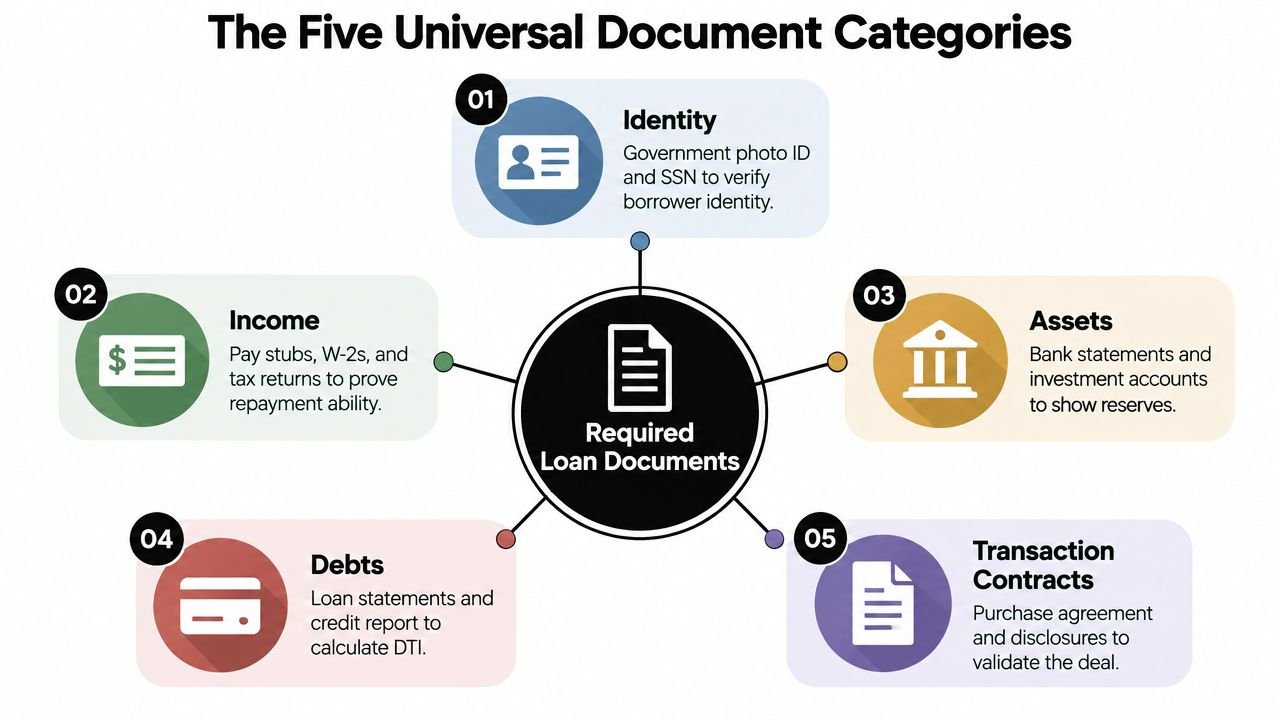
Identity records establish that the applicant is the person applying. A government-issued photo ID and Social Security verification are common examples. Name-change records may be needed when the identification, credit file, tax return, and application don't match.
Income records show the source and reliability of repayment funds. Pay stubs, W-2s, 1099s, tax returns, profit-and-loss statements, and employment verification each provide a different view of earnings. An underwriter isn't merely checking a number. They're checking whether the income belongs to the borrower, is documented, and can reasonably continue.
Assets demonstrate available funds and financial reserves. Bank statements, retirement accounts, investment summaries, and documentation for gifted funds may show the money available for a down payment, closing costs, reserves, or a business contribution. Large deposits often need an explanation and supporting source records.
Debts help the lender calculate the effect of the new payment on existing obligations. A credit report may be obtained directly by the lender, while current loan statements, lease obligations, and support payments may require applicant-supplied documentation.
Transaction contracts explain what the loan supports. A purchase agreement, lease, vehicle bill of sale, equipment invoice, or business formation document gives the lender a legally relevant description of the transaction.
This framework also helps when a requested item is unavailable. Ask the lender what question the document answers, then ask whether an equivalent record can satisfy that question. Before appearing for any formal proceeding, applicants can use this court document preparation guide to apply the same organized approach.
Required Documents for a Personal Loan
A personal loan file usually starts with basic identity and repayment evidence rather than collateral paperwork. Prepare a government-issued photo ID and your Social Security number or other requested identity verification. The lender uses these records to match the application to the correct credit history and comply with its verification process.
Income proof comes next. A practical packet may include pay stubs covering the most recent 30 days, two years of W-2s or 1099s, and, for self-employed or higher-balance applicants, federal tax returns. The lender is checking employment, income consistency, and the amount of money left after existing monthly obligations.
Bank statements serve a different purpose. Two to three months of statements may help confirm available reserves, recurring deposits, and the source of unusual credits, as reflected in common preapproval guidance from Bankrate's mortgage document checklist. A personal loan may not require collateral contracts, but the lender can still request statements for existing loans or use a credit report to identify debts.
| Document | What It Proves |
|---|---|
| Government-issued photo ID | Identity and application ownership |
| Social Security verification | Credit-file and identity matching |
| Recent pay stubs | Current employment income |
| W-2s or 1099s | Reported earnings and income source |
| Tax returns, when requested | Broader income history, especially for self-employed applicants |
| Bank statements | Available funds, deposit patterns, and possible reserve support |
| Existing loan statements | Current balances and required monthly payments |
Don't crop statements, omit pages, or send screenshots when the lender requests official PDFs. If a deposit doesn't look like ordinary payroll, provide the source before the underwriter has to ask. That small step can prevent a second review.
Required Documents for a Mortgage Loan
Mortgage underwriting uses a larger file because the lender evaluates both the borrower and the property. The Uniform Residential Loan Application, Form 1003 or URLA, is the master record. It collects the borrower's identity, income, assets, liabilities, property information, and transaction details. Fannie Mae's application package requirements also identify supporting materials such as the ratified sales agreement, credit report, appraisal, inspection reports, and related project documents.
For a conventional borrower, gather two years of W-2s or 1099s, two years of federal tax returns, the most recent 30 days of pay stubs, and two months of asset statements for checking, savings, retirement accounts, or gift funds. The CFPB's application-packet guidance also emphasizes signed federal tax returns for the last two years and recent bank statements as core verification records. A lender can't require a W-2 or pay stub merely to issue a Loan Estimate, because early pricing disclosure and later underwriting verification serve different stages.
The transaction file then establishes the property and closing conditions. Expect the signed purchase contract, lender-ordered appraisal, homeowner insurance binder, title commitment, escrow or closing instructions, and the applicable Loan Estimate and Closing Disclosure. Under CFPB guidance, certain refinance or home-equity transactions may also involve a Notice of the Right to Rescind, while the closing package commonly includes an Initial Escrow Statement and promissory note. The Loan Estimate and Closing Disclosure replaced older, more variable disclosure practices to make key costs and terms easier to compare across lenders. See what mortgage lenders look for for additional preparation context.
| Document | What It Proves | Underwriting Use |
|---|---|---|
| Signed Form 1003 or URLA | Complete borrower and transaction information | Master application record |
| W-2s, 1099s, and tax returns | Reported income and filing history | Income qualification and consistency review |
| Recent pay stubs | Current earnings and employment status | Repayment-capacity analysis |
| Asset statements | Funds available for closing and reserves | Source-of-funds verification |
| Purchase contract | Agreed property price and terms | Transaction validation |
| Appraisal report | Property value and condition evidence | Collateral-risk review |
| Insurance binder | Hazard coverage for the property | Closing and collateral protection |
| Title commitment | Ownership and lien information | Title and security-interest review |
| Loan Estimate and Closing Disclosure | Loan costs, terms, and settlement figures | Required consumer disclosures |
Self-employed borrowers often provide business returns, a year-to-date profit and loss statement, and business bank records. Rental properties may require lease agreements. Gift letters, divorce decrees, and bankruptcy discharge papers are requested when the borrower's income, assets, obligations, or credit history makes them relevant.
Required Documents for an Auto Loan
An auto loan ties the credit decision to a specific vehicle, so the lender needs transaction records that identify the collateral. Start with the dealer's bill of sale or purchase order, the vehicle identification number confirmation, and the current title or lien-payoff information for any trade-in.
The VIN must match across the purchase documents, insurance binder, and title work. If a trade-in has an existing lien, the lender needs enough information to coordinate payoff and establish who will receive the title after the transaction. A missing payoff figure can delay funding even when the borrower has already been approved.
The borrower side resembles a personal loan file. Prepare a government-issued photo ID, proof of residence, and income records such as recent pay stubs. A self-employed applicant may need a tax return and additional business-income evidence. The insurance binder should name the new lender as lienholder, because the lender needs confirmation that the vehicle is insured before releasing funds.
Dealer financing and outside financing can feel different. A dealership finance office may use the vehicle as immediate collateral and may request a narrower package, while a bank or credit union can review the application more like an unsecured consumer loan. Outside lenders may request two to three months of bank statements, trade-lien details, and renewed income verification before disbursal.
Funding checkpoint: Approval answers whether the borrower appears eligible. Funding also requires the vehicle, title, insurance, lien, and borrower information to match.
Required Documents for a Business Loan
A business lender must verify that the borrower exists as a legal entity, earns revenue, manages cash flow, and can support the requested obligation. The file often begins with articles of incorporation or organization, EIN confirmation, an operating agreement or bylaws, and a state certificate of good standing. These records identify who owns and controls the business and whether it can enter contracts.
Financial documents explain how the company makes and uses money. Prepare two to three years of business tax returns, a year-to-date profit and loss statement, a balance sheet, and three to six months of business bank statements. For self-employed borrowers, lenders commonly request personal and business returns with all schedules, current profit-and-loss statements, and bank records, as summarized by HSH's mortgage application document guidance.
Commercial underwriters also examine the quality of revenue. A customer or product-line breakdown, accounts-receivable aging report, and debt schedule help distinguish recurring cash flow from one-time activity. Existing business obligations should show the creditor, balance, payment, maturity, and collateral where applicable.
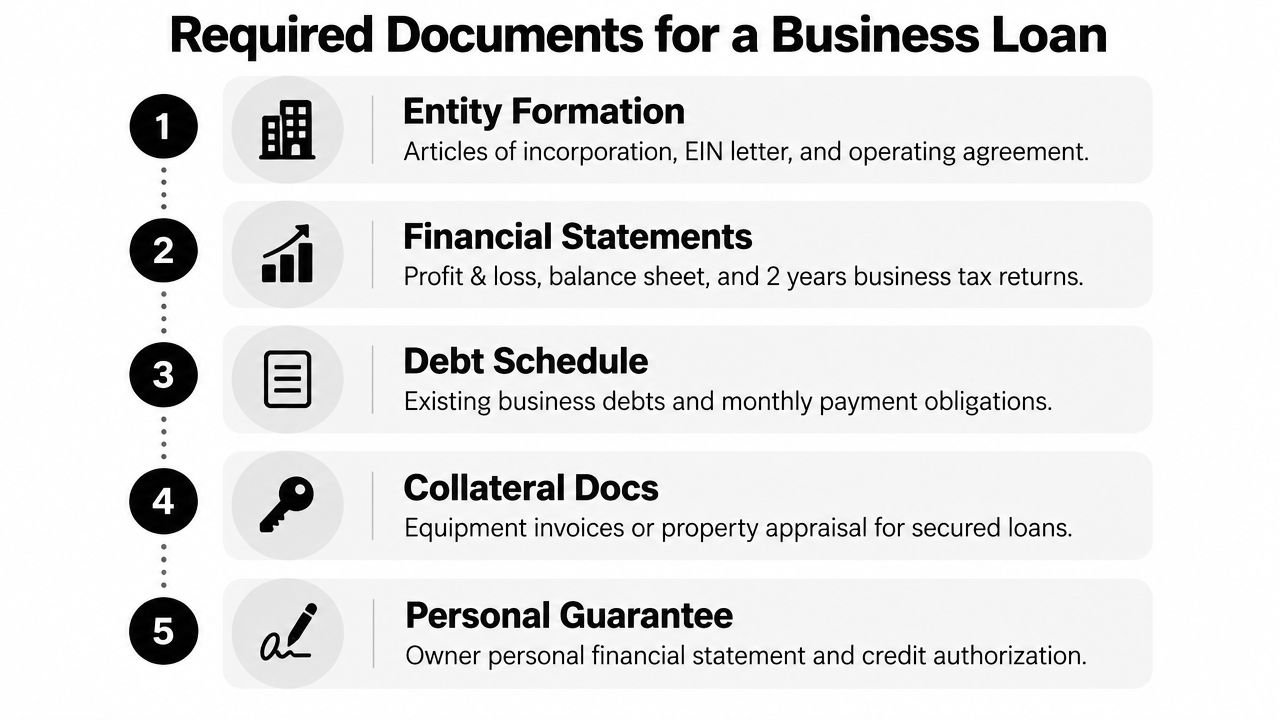
A business plan or use-of-funds memo explains why the company needs capital. Growth or SBA financing may also call for projections. If the owner guarantees the debt, expect a personal financial statement and personal tax returns. The lender may separately obtain a business credit report and UCC search, so you won't necessarily supply those records yourself, but you should anticipate questions about their contents.
For a second checklist to compare against your lender's request, review Business Loan Warrior's checklist. Don't treat any online list as a substitute for the lender's exact conditions.
Why Lenders Re-Verify Documents After Approval
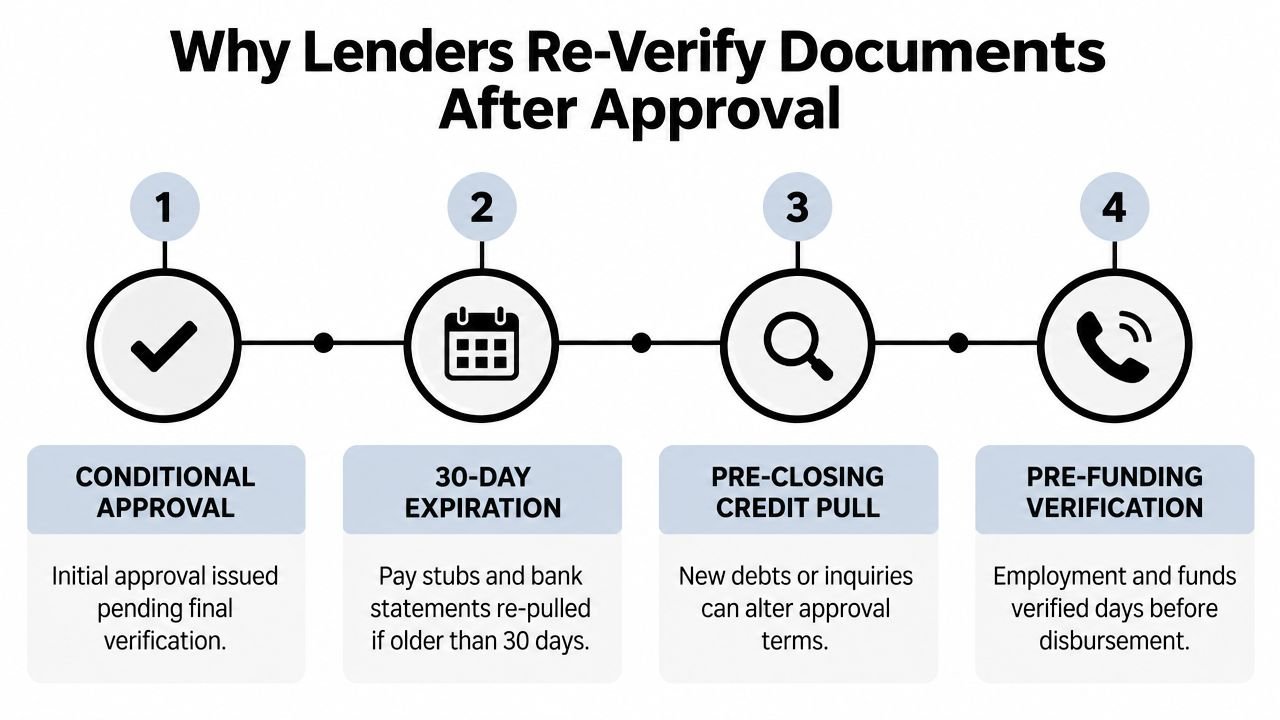
Approval is often a conditional milestone, not an unconditional promise to disburse. Before funding, lenders may re-check bank statements, income proof, employment records, business filings, address information, and KYC details because fraud risk, mismatches, and changes between sanction and disbursal can affect the decision. Recent lending coverage notes that re-verification can move funding from hours to a few days when the lender finds a sudden income increase, inconsistency, or a long gap between approval and disbursal, as discussed in this re-verification overview.
Common triggers include:
- Stale income records: The lender requests current pay evidence when the original file is no longer recent.
- Changed account activity: New deposits, withdrawals, or reduced reserves require an updated explanation.
- Employment uncertainty: A lender confirms that the borrower still works for the stated employer.
- Information mismatch: Different addresses, names, or business details can pause release.
- Long processing gaps: The lender refreshes records when circumstances may have changed.
A salary reduction or depleted reserve can cause more than a simple upload request. It may lead to a renewed assessment of repayment capacity, collateral, or loan conditions.
Digital Signatures and E-Delivery Are Now Required
A modern loan file is more than a folder of PDFs. It can include electronically signed applications, disclosures, consent records, delivery logs, identity checks, and tamper-evident audit trails. In India, the 2025 Digital Lending Directions require the KFS, sanction letter, terms and conditions, account statements, and privacy policies to be digitally signed and automatically delivered after execution. Lenders must also collect verified phone and email information before disbursal, according to this summary of the 2025 digital lending requirements.
That shift changes the borrower's responsibilities. Keep one stable email address and phone number active throughout the file. Open signing requests promptly, review every page, download completed copies, and confirm that the signed version shows the correct borrower, loan terms, and execution record.
For practical guidance on the formalities surrounding electronic execution, see electronic signature requirements. The principle is simple: a document that hasn't been properly signed, delivered, or recorded may not satisfy the lender's closing condition, even if the underlying information is correct.
Digital-file habit: Save the executed document and its completion certificate together. The signature record explains who signed, when they signed, and whether the file changed afterward.
Tips to Gather Your Loan Packet Quickly
A 48-hour assembly window can be realistic when you request records in parallel rather than waiting for one item before starting the next. Begin with the documents that depend on another organization, then collect files you can download yourself.
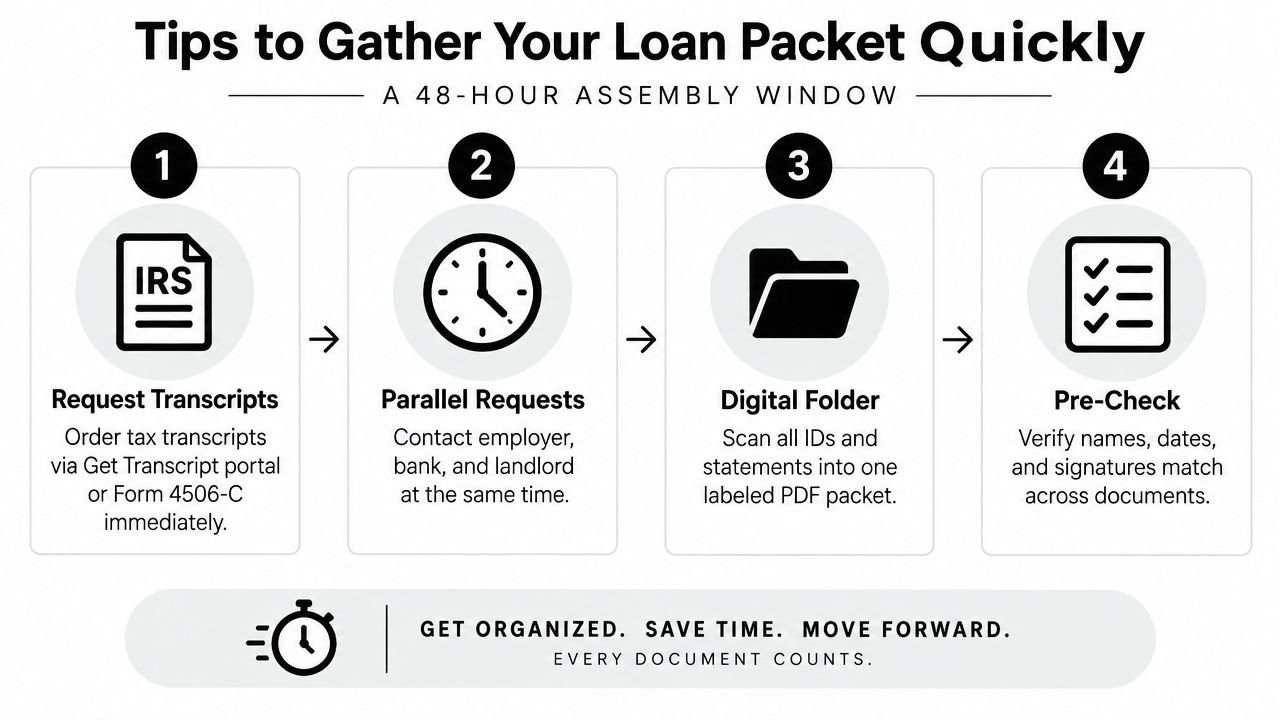
- Request tax records immediately: Use the IRS Get Transcript portal or complete Form 4506-C if the lender requires transcript retrieval. Postal transcripts can take up to ten business days, so don't leave this step until the end.
- Download bank statements directly: Retrieve 60 days of statements from each institution's online portal in PDF format when the lender asks for that period. Complete statements are easier to validate than screenshots.
- Contact the employer and other sources together: Ask for a written verification of employment on company letterhead and the most recent pay stubs dated within the lender's acceptable freshness window. Request sales contracts, seller disclosures, lease records, or business documents at the same time.
- Build one labeled folder: Name each PDF with the borrower's name and document type. Keep one shared folder, check every page, and compare names and dates before uploading.
The lender should order the official credit report. Don't substitute a self-pulled copy unless the loan officer specifically approves it. For assistance understanding what paperwork may be needed in an urgent application, review this bail bond application guide.
Common Mistakes That Slow Down Approval
Many delays come from documents that look complete to the borrower but fail the underwriter's validation rules. A pay stub outside the lender's accepted date range may prompt a refreshed employment request. A bank statement with missing pages can make the account balance impossible to verify, even when the first page shows the ending amount.
Name discrepancies create another avoidable pause. If the application uses a married name but the ID, tax records, or credit file uses a former name, provide the legal name-change record before submission. An unexplained large deposit can also trigger a sourcing request because the lender needs to determine whether the funds are borrowed, gifted, or otherwise restricted.
Self-employed applicants face added scrutiny when tax-return income doesn't align with business deposits. The fix isn't to hide the difference. Reconcile the figures with a current profit-and-loss statement, business bank records, and a clear explanation of legitimate transfers or timing differences.
| Mistake | Likely Lender Response | Fix Before Uploading |
|---|---|---|
| Stale pay stubs | Updated income or employment verification | Request current payroll records |
| Missing bank-statement pages | Complete statement request | Download the original PDF again |
| Name mismatch | Identity clarification or re-submission | Add legal name-change evidence |
| Unexplained deposit | Source-of-funds request | Provide the deposit source and supporting record |
| Inconsistent self-employed income | Expanded financial review | Reconcile returns, P&L, and bank activity |
| Unreadable scan or cropped ID | Rejected upload | Scan the full document clearly |
Before clicking upload: Open every PDF, confirm the page count, and check that the borrower name appears consistently.
Quick-Reference Document Checklist by Loan Type
Use the table as a working page while you assemble the file. “Application” means the lender needs the information to begin review. “Processing” covers records used to verify, price, or document the transaction. “Funding” includes final conditions that must be satisfied before money is released. Some items vary by lender, program, jurisdiction, and transaction, so confirm the final list with the loan officer.
| Loan Type | Application Documents | Processing Documents | Funding Documents |
|---|---|---|---|
| Personal | Government ID, Social Security verification, income information, employer details, debt information | Recent pay stubs, W-2s or 1099s, bank statements, existing loan statements, explanations for unusual deposits | Signed loan agreement, final identity or income confirmation, verified disbursement account |
| Mortgage | Signed Form 1003 or URLA, ID, income records, asset statements, credit authorization, purchase contract | Federal tax returns, pay stubs, appraisal, title commitment, insurance binder, inspection or project records, gift letter when applicable | Closing Disclosure, promissory note, escrow statement when applicable, signed closing package, final funds and employment verification |
| Auto | Government ID, income information, residence proof, vehicle purchase order, VIN, trade details | Title or lien payoff, insurance binder, bank statements when requested, lender lien instructions | Signed retail installment or loan agreement, confirmed insurance, title and lien documentation, final payoff coordination |
| Business | Formation records, EIN confirmation, ownership information, business tax returns, requested use-of-funds description | P&L, balance sheet, bank statements, debt schedule, accounts-receivable aging, revenue breakdown, projections when required | Signed loan documents, collateral records when applicable, personal guarantee documents, final entity and funding verification |
The CFPB's mortgage application-packet guidance reinforces the central pattern: identity, income, assets, debts, and transaction evidence support both initial pricing and final underwriting. For a separate document-readiness reference, see what documents do I need, then return to your lender's conditions for the controlling answer.
Next Steps and When to Get Help
Start before the application portal opens. Create a folder for identity, income, assets, debts, and transaction records. Request tax transcripts, download digital bank statements, gather current income evidence, and collect the purchase contract or business formation records that define the transaction.
Professional help is useful when the file doesn't fit a simple salaried-borrower pattern. Self-employed income can require business and personal records that need reconciliation. Mortgage gift funds may need a properly documented gift letter and source trail. A business loan can become more complicated when ownership, entity structure, or guarantees are changing during the application.
The same discipline applies to a surety bond. The provider may need government identification, residence information, income records, tax documents, asset or collateral details, and signed contracts. Preparing those records in one organized packet makes it easier to answer questions quickly, whether you're dealing with a lender, a bonding company, or another financial reviewer.
Colorado readers who need a surety bond can contact Express Bail Bonds for electronic application, payment, and contract processing, with guidance on fees, court requirements, and next steps. The agency serves Colorado detention facilities statewide and is available by call or text at 720-984-2245, or by email, for urgent bond coordination.
If you need a Colorado surety bond, visit Express Bail Bonds to begin the electronic application and review the documents needed for your situation. Keep your identification, income, residence, and financial records ready so an agent can help move the bond process forward without avoidable paperwork delays.