
You search a county detention center roster late at night and find nothing. The arrest happened hours ago, family members have conflicting stories, and nobody can tell you whether the person is still being processed, already released, or missing from the online list. That uncertainty feels personal, but it often comes from the way detention systems handle booking, classification, records, and updates.
Finding county detention center inmates is usually a process, not a single search. You need to separate physical custody from booking completion, understand what a roster displays, search the correct Colorado county, and then confirm bond, communication, or release details through an official channel. This guide walks through those steps in plain language, with Colorado-specific guidance for families, attorneys, and cosigners.
When Someone You Know Is in a County Detention Center
At 11:30 p.m., a family member may know only three things: someone was arrested, the arrest happened somewhere in Colorado, and the person's phone now goes unanswered. A name search on a county website returns no result. That doesn't automatically mean the person wasn't booked. Intake can take several hours because staff may need to fingerprint the person, complete medical screening, check warrants, inventory property, and enter information into several systems.
The first useful step is to write down everything you know, even if it seems incomplete. Record the person's legal name, possible spelling variations, date of birth, arresting city, likely county, approximate arrest time, and the name of any attorney or officer who provided information. Those details help you avoid searching the wrong facility or confusing two people with similar names.
Practical rule: Treat an online roster as a custody snapshot, not as an instant notification system.
A county roster exists to help identify people currently held and to provide limited operational information. It isn't a final court record, a conviction record, or a complete explanation of what happened. A person may be held before trial, waiting for a bond decision, awaiting transfer, or moving through release processing.
For a calm checklist of immediate actions, see this guide on what to do when someone gets arrested. The most important early decision is whether you need to confirm location, arrange communication, contact counsel, or begin a bail inquiry. Those goals overlap, but they require different calls and documents.
The sections ahead build that understanding in order. First, you'll learn how to read a roster. Then you'll see how booking and classification create delays, how to search Colorado counties, what information stays private, and how to choose between contact, visitation, and bail steps.
What County Detention Center Inmate Rosters Really Show
An inmate roster is best understood as a custody status snapshot. Think of a hospital check-in board. The board may show that a patient arrived, but it won't explain the diagnosis, treatment decisions, or final outcome. A detention roster works similarly. It can show that a person has been entered into custody, while leaving out private, incomplete, or changing information.
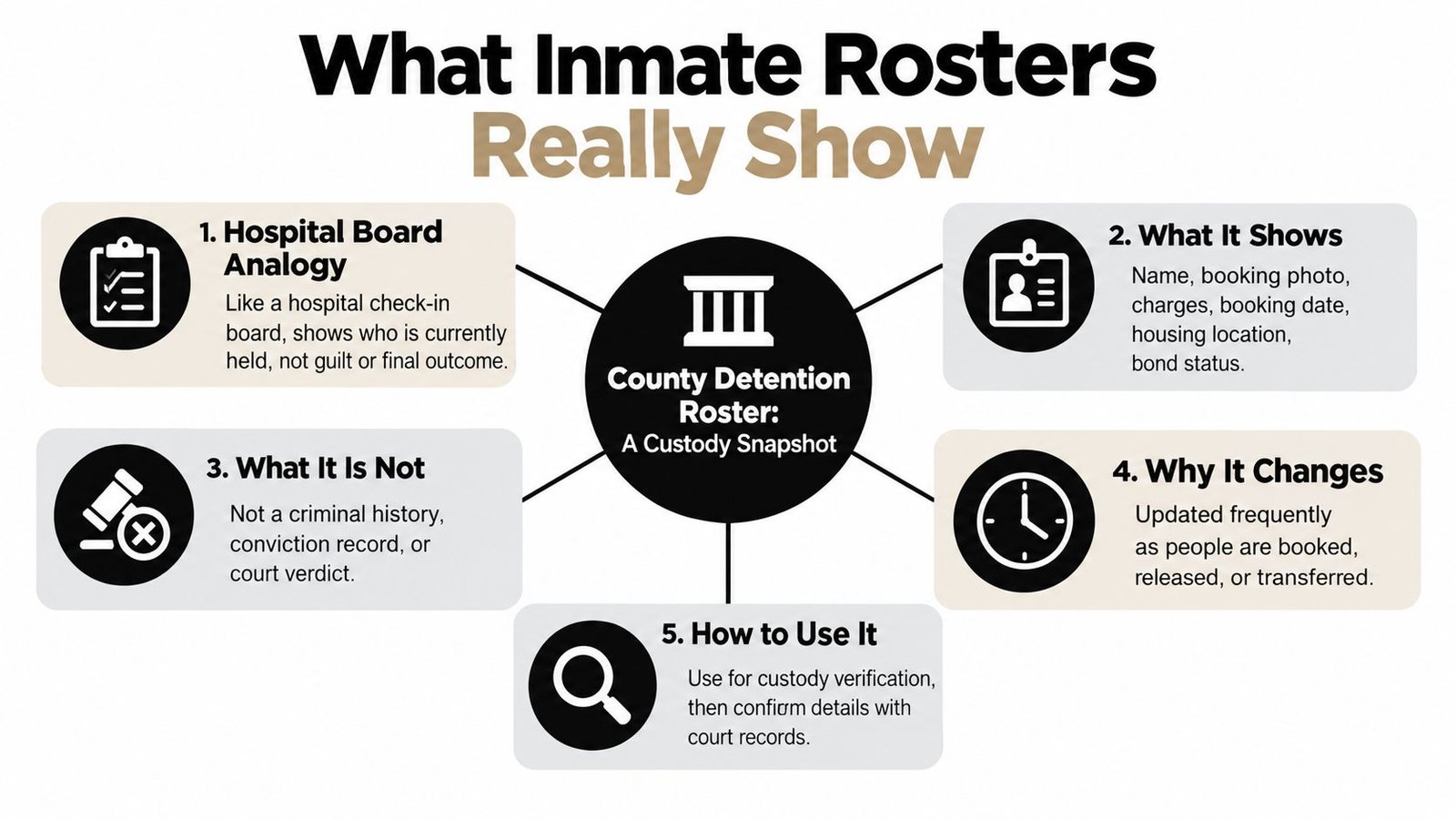
Read each field as a limited clue
Depending on the county, a roster may display a person's name, booking photograph, booking date, booking number, listed charges, bond status, and housing location. Some systems include court dates or release information. Others provide only a name and booking identifier.
A booking number helps staff distinguish one custody event from another. The charge field reflects what has been entered into the jail's system, not a court verdict. A bond field may show that a bond exists, but you may still need the detention center, court clerk, or bonding agency to confirm the exact conditions and whether paperwork has been accepted.
Custody, booking, and visibility are different
A person can be physically present at a detention center while the online roster remains unchanged. The person may still be completing intake, awaiting identity confirmation, undergoing screening, or waiting for a batch update. The reverse can also happen during a release or transfer, when a roster record remains visible briefly after the person's status has changed.
County detention centers often hold people awaiting court processing rather than people serving final sentences. Global prison reporting includes both sentenced prisoners and pre-trial or remand detainees, which is why detention center records can reflect short-term custody as well as longer stays. The Prison Reform International global prison trends report estimates the worldwide prison population at about 11.5 million people, with roughly 143 to 144 incarcerated people per 100,000 worldwide, and explains that men made up nearly 93% of the prison population in 2024.
Use the Colorado county jail lookup resource as a starting point, but confirm important details through the official detention center or court. A roster answers, “Does this person appear in the current custody record?” It doesn't answer every question about release timing, court strategy, health, or guilt.
How Booking and Inmate Classification Work Step by Step
Booking is a chain of checkpoints. Each checkpoint protects identity, safety, record accuracy, or facility security. A delay at any point can postpone roster visibility even when the person has already arrived.
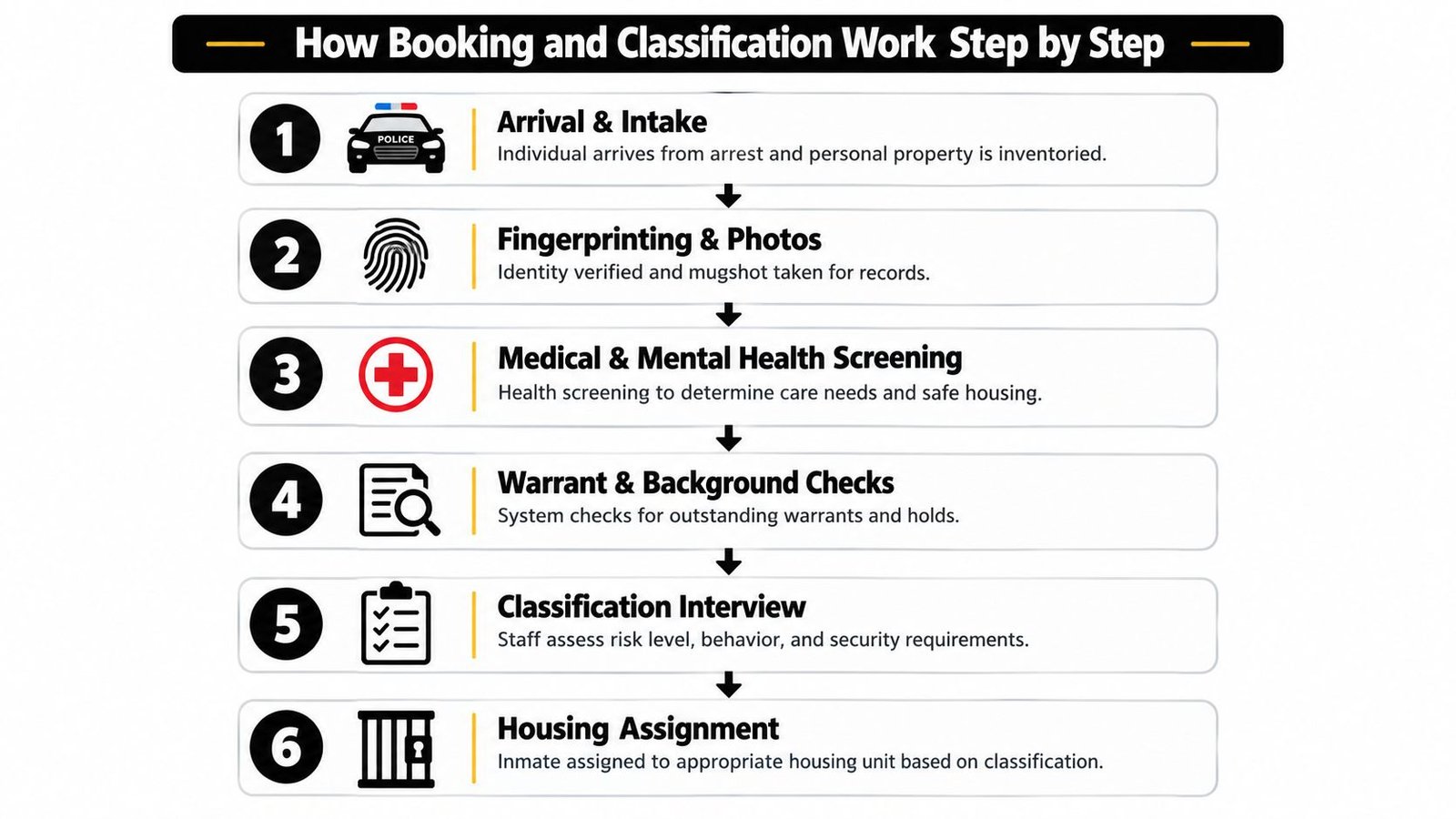
The intake sequence
Arrival and property inventory: Staff receive the individual from the arresting agency and document personal property. Missing or disputed property can require additional verification.
Fingerprinting and photographs: Fingerprints and a booking photograph help confirm identity and connect the custody record to the correct person. A name-only search can fail when spelling, aliases, or identity records differ.
Medical and mental health screening: Staff look for immediate care needs, medication concerns, infectious disease risks, and conditions that affect safe housing. The CDC reports that nearly 46% of people in correctional or detention facilities have a history of traumatic brain injury or concussion, which shows why intake screening can affect both care and classification. See the CDC correctional health overview for the underlying information.
Warrant and background checks: Staff check for outstanding warrants, holds, and other records that may change where the person goes next or whether release is available.
Classification interview: Personnel assess behavior, vulnerability, safety concerns, prior custody information, and supervision needs. Classification isn't a judgment about guilt. It's a housing and management decision.
Housing assignment: The person is placed in a unit that matches the information available from screening and classification. Housing location may change, and some counties don't publish it online.
Suicide-risk triage is another reason intake can't be treated as a quick data-entry task. A validated screening instrument flags high risk at a score of 3 or more across factors that include age 40 or older, unstable housing before incarceration, limited prior incarceration, certain combinations of drug and alcohol use, prior attempts or self-injury, and current suicidal thoughts or attempts. The instrument and its factors appear in this peer-reviewed screening study. Immediate concerns should be communicated directly to detention staff or qualified medical personnel.
Booking totals and daily population also measure different things. Los Angeles County reported an average daily inmate population of 12,428 in the second quarter of 2024 and 12,738 in the first quarter of 2025. The county recorded 14,833 bookings in that 2025 quarter, compared with 14,367 in the prior quarter, a 3% increase, showing how intake activity and headcount can move differently. The figures come from the Los Angeles County custody population report.
For families coordinating calls, documents, or attorney intake during this period, bilingual intake specialists for law firms can help legal offices gather accurate information from clients and relatives. For booking-specific timing questions, use this explanation of how long booking takes in jail.
How to Search County Inmate Records in Colorado by County
Colorado doesn't have one public roster that reliably replaces every county system. Start with the county connected to the arrest, then check the sheriff or detention center's official inmate search. If the arrest occurred in Denver, begin with Denver's custody records. For arrests associated with Arapahoe, Jefferson, Douglas, Weld, or El Paso County, use that county's detention or sheriff resource before expanding the search.
Use a repeatable search method
Have the person's full legal name and date of birth ready. If the website accepts it, add a booking number. Search common spelling variations, but don't assume that a nickname, middle name, or shortened surname will produce the same result as the booking record.
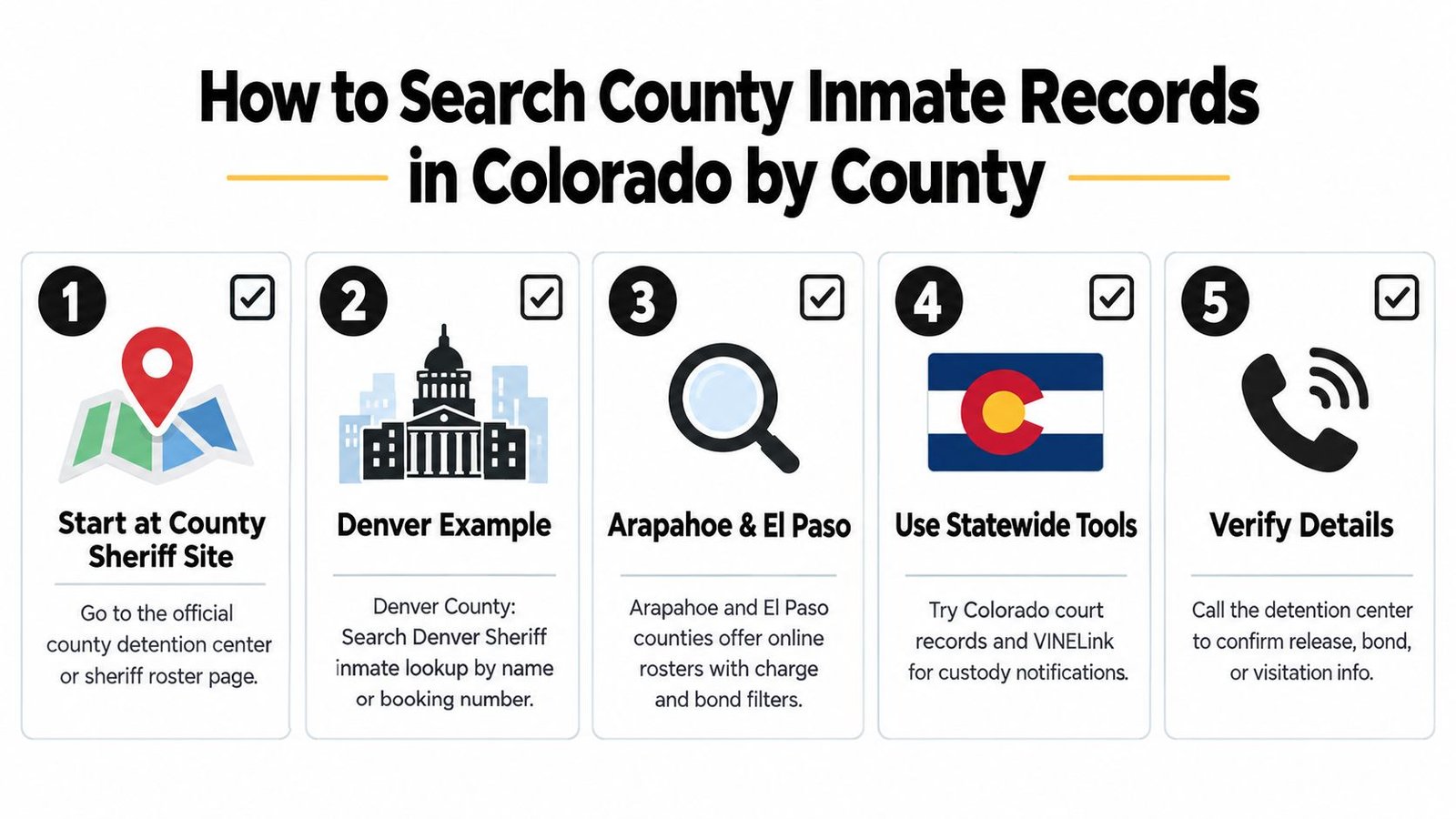
The practical order is:
- Start with the official county site: Look for the county sheriff, detention center, or inmate roster page rather than relying on an unaffiliated listing.
- Use county-specific search fields: Denver may organize its lookup around a name or booking number. Arapahoe and El Paso resources may provide charge or bond-related filters, depending on the current system.
- Check statewide records when appropriate: Colorado court records and VINELink may provide additional custody or notification information, but they don't replace confirmation from the holding facility.
- Call when the search fails: Ask whether the person has arrived, whether booking is complete, whether a transfer occurred, and whether bond information is available.
- Record the details: Save the booking number, listed charges, bond status, facility telephone number, and the time you checked.
The hidden problem is the gap between arrest, booking, and online visibility. Intake may take several hours because fingerprinting, medical screening, warrant checks, and clerical work happen before a record reaches a public page. During nights, weekends, or high-volume periods, systems may update in batches instead of continuously.
That means a missing name has several possible explanations. The person may still be in intake, the arresting agency may not have completed the transfer, the record may use a different spelling, or the person may have moved to another facility. Don't treat an empty result as proof that the arrest did not occur.
For a broader starting point, use the Colorado inmate locator tool. Families searching near Jefferson County can also review the Jefferson County and Golden detention guide, while people dealing with an Arapahoe County arrest may find the Centennial bail and detention resource more relevant.
Search habit: Write down the time of each search. If the roster updates later, you'll know whether the change reflects a new booking entry, a transfer, or a release process.
Privacy Limits and What Information You Will Not Find Online
Public rosters are designed for limited custody verification, not complete access to a person's file. A county may withhold or delay information that could expose medical needs, create a safety risk, reveal protected classification details, or identify a juvenile. The absence of information can reflect privacy rules and operational judgment rather than a technical failure.
Medical and safety information stays restricted
You generally won't find diagnoses, medication lists, treatment notes, trauma history, or detailed suicide-risk findings on an inmate roster. That information belongs in protected health and safety processes. The CDC's correctional health material describes the medical risks that detention staff must identify, including infectious disease exposure, chronic-care interruption, and traumatic brain injury history.
Classification details are also limited for a reason. Publishing a person's vulnerability, separation needs, behavioral alerts, or housing rationale could endanger that person or others. A roster may show a housing location, or it may omit it entirely, depending on facility policy.
Public records still have timing limits
Even information that can eventually be shared may not appear immediately. Staff must reconcile booking data, identity records, charges, court information, and release status. A public page may also update on a schedule that differs from the internal jail system.
Juvenile records, sealed matters, sensitive victim information, and certain administrative holds may not appear in the same way as adult booking records. Third-party websites can be incomplete, outdated, or copied from older data, so use them only as a lead.
If the person doesn't appear, call the detention center and ask focused questions. Confirm whether the individual is in custody, whether booking is complete, whether the person is held under another name, and which office handles bond or visitation. Don't ask staff to disclose private medical or classification details. They may be unable to answer, and the request won't speed up custody verification.
A roster can tell you less than you want, but that limit protects people inside the facility. The safest approach is to verify public information through official channels and let the attorney, court, or authorized family contact handle matters that require access to protected records.
Next Steps for Contact Visitation and Bail in Colorado
Once custody is confirmed, choose the next step based on the immediate need. A family member who needs reassurance may need a telephone or video contact option. A person trying to arrange release needs bond information, payment instructions, and a clear understanding of what the detention center accepts.
Communication has become more complicated than a simple “can inmates call?” question. Some facilities use video-only visitation, paid messaging, or digital calling systems, while staffing shortages can limit appointment availability. In-person visits may be reduced or unavailable even when video contact is offered. A report on free communication says that eliminating user fees produced nearly 600 million more phone calls and 6.4 billion more minutes of connection, illustrating how access rules can change contact volume at scale. Read the report on video-only jail visits and communication access for the broader discussion.
Before scheduling, ask the facility which channel is active today, whether registration is required, what identification visitors need, and whether the person's housing status affects access. For visitation-specific questions, use this guide to visiting someone in jail.
Match the action to the goal
| Your Goal | Best Action Now | What to Have Ready |
|---|---|---|
| Confirm custody | Call the detention center after checking the official roster | Legal name, date of birth, arrest county, approximate arrest time |
| Arrange a call or visit | Ask the facility about current phone, video, and in-person rules | Visitor identification, inmate name, booking number if available |
| Understand release conditions | Confirm bond type and amount with the detention center or court | Booking number, listed charges, court information |
| Explore a surety bond | Contact a licensed Colorado bail bond agency | Defendant details, bond information, cosigner identification and payment information |
Colorado's bail cost rules also deserve careful attention. For an insurance producer who writes a bail bond, Colorado law caps the premium or commission at the greater of $50 or 15% of the amount of bail furnished, as described in the Colorado bail bond premium rule. Colorado law also limits extra charges for professional cash-bail or cash-bonding agents, allowing only specific costs such as a court or law-enforcement filing fee, actual collateral storage cost, or premium financing under the circumstances listed in the Colorado cash-bonding statute.
A Routt County Detention Center handbook states that courts hold a bond-setting hearing within 48 hours after an arrestee arrives, under HB21-1280 beginning April 1, 2022, and that the public may view bond hearings. Read the Colorado bond-setting provision alongside the local facility's current instructions.
For families who need remote paperwork or statewide surety assistance, Express Bail Bonds offers electronic applications, payments, and contract documents, with service available by call or text at 720-984-2245. It handles surety bonds rather than cash-only bonds, so confirm the bond type before beginning an application.
Your Clear Path Forward After Finding an Inmate Record
The confusing part is usually the timing. A person can be in custody before the roster updates, a booking record can appear before bond details are finalized, and a bond can be posted before release processing is complete. Those are separate operational events.
Use this short checklist:
- Verify the facility: Confirm the county and detention center through an official source.
- Capture the record: Save the legal name, booking number, charges, bond status, and search time.
- Choose the next need: Contact, visitation, attorney coordination, or bail each has a different procedure.
- Confirm before paying: Ask who accepts payment, what bond type applies, and whether additional court conditions exist.
- Plan for processing: Posting paperwork doesn't always mean the person walks out immediately. The facility still has to complete its release steps.
You don't need to solve every part at once. Confirm custody first, preserve accurate details, then choose the action that moves the situation forward without guessing.
Express Bail Bonds helps families and attorneys with county detention center inmates, Colorado roster questions, and surety bond paperwork through electronic processing and statewide support. Visit Express Bail Bonds to start an application or get guidance on the next practical step.