
The call usually comes when the house is quiet. A family member says someone has been arrested, the person is still in custody, and nobody knows whether to ask about money, a lawyer, transportation, or the next court date. The words conditions of bond may not come up until later, but they can shape nearly every decision after release.
In Colorado, posting a bond is only the first step. The court may also require check-ins, travel limits, testing, electronic monitoring, curfew compliance, or no contact with a protected person. These rules form a layered compliance system. Understanding that system early can help a defendant avoid a preventable violation and help a family respond calmly instead of guessing.
The Phone Call That Starts Everything
The first call from a jail rarely sounds organized. Your loved one may know the arrest happened but not understand the charge, the bond amount, or what must happen before release. You may be standing in a kitchen with a phone in one hand and a list of questions forming faster than you can write them down.
How much will release cost? When will they come home? Who needs to sign? What happens after the bond is posted? Those questions are practical and urgent. A family often focuses on getting the person out, understandably, because custody interrupts work, childcare, transportation, housing, and communication with counsel.
The release process itself involves more than arranging money. The court order may require the defendant to appear at every hearing, follow a reporting schedule, stay within an approved area, submit to testing, avoid certain people, or comply with monitoring. A surety bond also creates responsibilities for the person who signs the agreement, because the bond depends on the defendant following the court's appearance requirements.
First rule: Don't treat the release paperwork as something to skim at the jail counter. Read every condition before the defendant leaves.
A missed check-in can become a documented compliance problem. An unapproved trip can create a court issue. Contact that feels harmless to a family may violate a no-contact order. The person is out of custody, but the case now has a daily structure.
Families can review the basic release sequence in this guide to bailing someone out. The immediate task is release. The continuing task is understanding the rules attached to it.
What Conditions of Bond Actually Mean
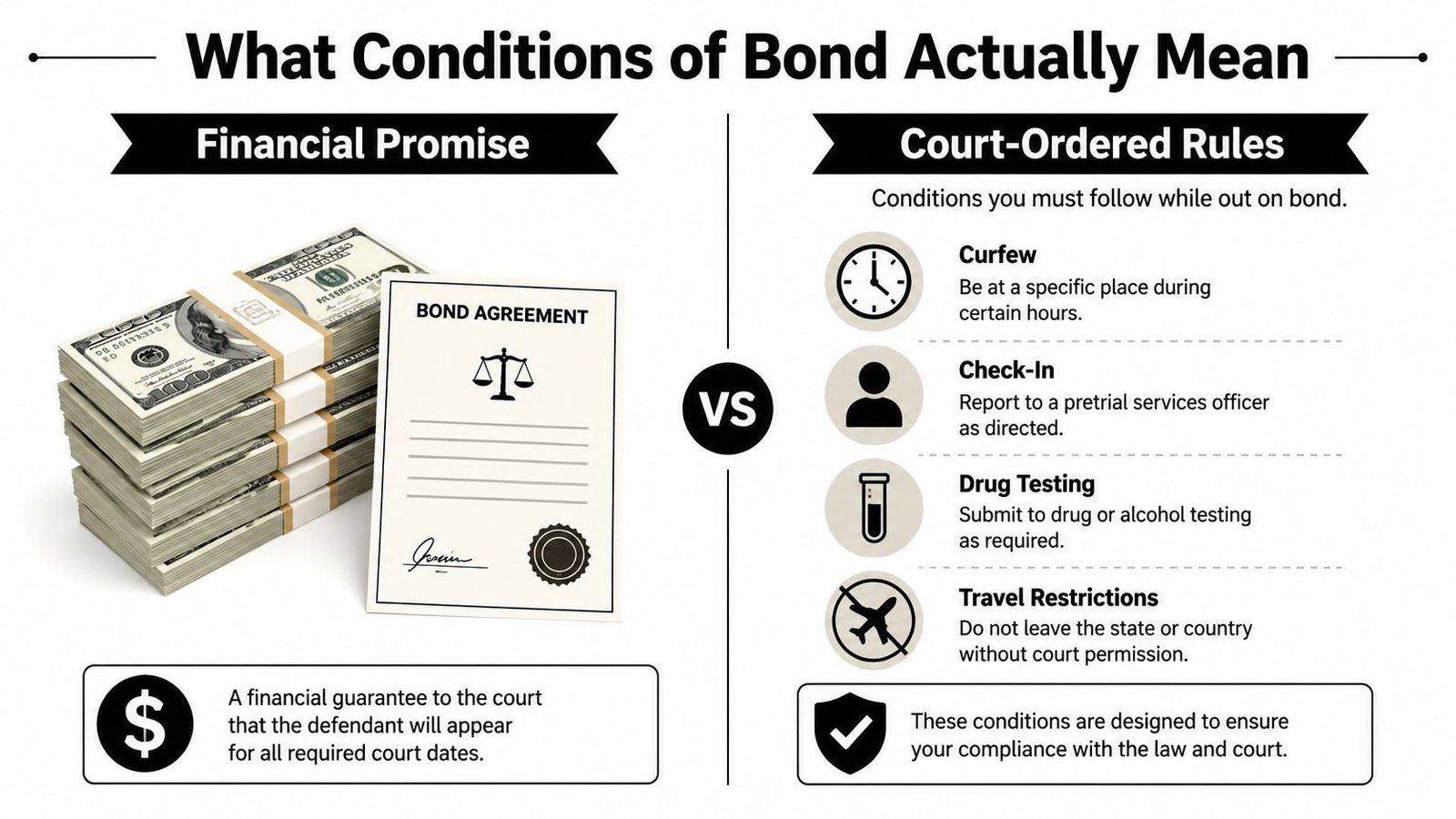
Conditions of bond are court-ordered rules that apply after release. They sit alongside the financial promise posted by the defendant, a family member, or a licensed Colorado surety. The money or bond amount addresses the financial side of release, while the conditions tell the defendant what conduct and appointments the court requires during the pending case.
Colorado law requires the court to set the bond type and release conditions in a way that reasonably ensures court appearance and community safety. Under Colorado's bond statute, the court may consider factors such as employment history, family ties, and residence history. Monetary conditions must be reasonable, and additional conduct conditions must be narrowly connected to a specific concern.
The older recognizance model
The modern financial model can make bond seem like a payment-first system. Historically, English and early American release practice commonly used recognizance bonds instead. A defendant promised to appear, and one or two sureties backed that promise by pledging a specified sum if the defendant failed to appear. A 2024 Harvard Law Review analysis found no indication in the sources it reviewed that the accused person or surety had to produce cash or other collateral as a condition of release, making the founding-era model largely an unsecured pledge system rather than today's cash-first approach. The historical analysis of bail at the founding explains why reputation, promise, and surety accountability were central.
Colorado's current approach can add supervision and behavioral restrictions because the court is addressing more than a financial promise. A condition may manage an identified concern about appearance, safety, contact, substance use, or location. The court's order controls unless a judge changes it.
That means a condition isn't a suggestion. If the defendant thinks a rule is unclear, impractical, or unnecessary, the safe response is to seek clarification or modification through the court, not to make an independent exception. Colorado's core bail-bond condition is appearance in court, and Colorado's failure-to-appear statute establishes criminal penalties for certain knowing or intentional failures to appear.
For a plain-language explanation of the distinction between money and rules, review this Colorado condition of release guide.
The Most Common Conditions in Colorado
A useful way to understand Colorado conditions is to connect each rule to the concern it addresses. Courts don't impose every possible restriction in every case. The actual order depends on the allegations, the defendant's history, the court's assessment, and the available supervision plan.
| Purpose | Typical Condition | What Compliance Looks Like |
|---|---|---|
| Appearance assurance | Court reminders, check-in calls, curfew | The defendant tracks every hearing, responds to required contacts, and returns home by the ordered time. |
| Community safety | No-contact order, geographic exclusion, firearm surrender | The defendant avoids protected people and locations and follows any weapon restriction exactly. |
| Public health and stability | Drug or alcohol testing, treatment referral, mental health compliance | The defendant attends the assigned program, completes tests as directed, and keeps records of attendance. |
| Supervision intensity | GPS monitoring, house arrest, pretrial services reporting | The defendant keeps the device charged, remains within approved boundaries, and reports as scheduled. |
Appearance assurance
A check-in may be an in-person appointment, a phone call, a text response, or a requirement managed through pretrial services. Curfew can affect evening work, transportation, family responsibilities, and emergencies. The defendant needs the exact time, location, method, and consequences of a missed contact, not just the general idea of “checking in.” This Colorado check-in requirements resource can help families identify questions to ask.
Community safety
A no-contact order can prohibit direct messages, calls, social media contact, and messages delivered through another person. It may also restrict a return to a shared home. Don't assume that a spouse, partner, alleged victim, or witness can waive the order. A different instruction, sometimes called peaceful contact, may permit limited interaction, but the wording of the actual order controls.
Geographic exclusions can bar entry into a residence, workplace, neighborhood, or other named location. Firearm surrender or non-possession rules require careful attention to guns in a home, vehicle, workplace, or storage location.
Public health and stability
Testing may involve a scheduled facility or a monitoring program. Compliance includes knowing where to go, when to report, how transportation will work, and how prescription medication or work hours may affect the process. Treatment or mental health conditions can also involve appointments and documentation.
Supervision intensity
GPS monitoring and house arrest change ordinary movement. The defendant may need permission before leaving an approved area, and the device may need charging and inspection. A larger supervision stack creates more opportunities for confusion, so the family should keep one written calendar and one copy of the current order.
What Happens When a Condition Is Violated
A violation usually starts with an event that looks small to the family. The defendant gets home after curfew because work ran late. A phone dies before a check-in text is answered. A test produces a positive result. The court or pretrial officer may treat each event differently, but the response depends on the order, the documentation, the explanation, and the perceived risk.
A pretrial officer may document the event and contact the defendant. The prosecutor may request court action. A judicial officer decides whether to issue a notice, set a hearing, modify release, revoke bond, or issue a warrant. The surety may also become concerned, particularly when the defendant cannot be located or fails to appear.
Three ordinary scenarios
Missed curfew: The defendant arrives home late and immediately contacts the supervising officer. The officer records the explanation and may give a warning, or may report the event to the court if the pattern or circumstances raise concern.
Ignored check-in: The defendant sees a required text after the deadline and says the phone was lost. A prompt call, written explanation, and proof of replacement may help, but silence makes the event harder to explain.
Positive test: The defendant tests positive and believes medication, timing, or a testing error may be involved. The defendant should preserve prescriptions, receipts, appointment records, and testing information and speak with counsel promptly rather than arguing informally with the testing provider.
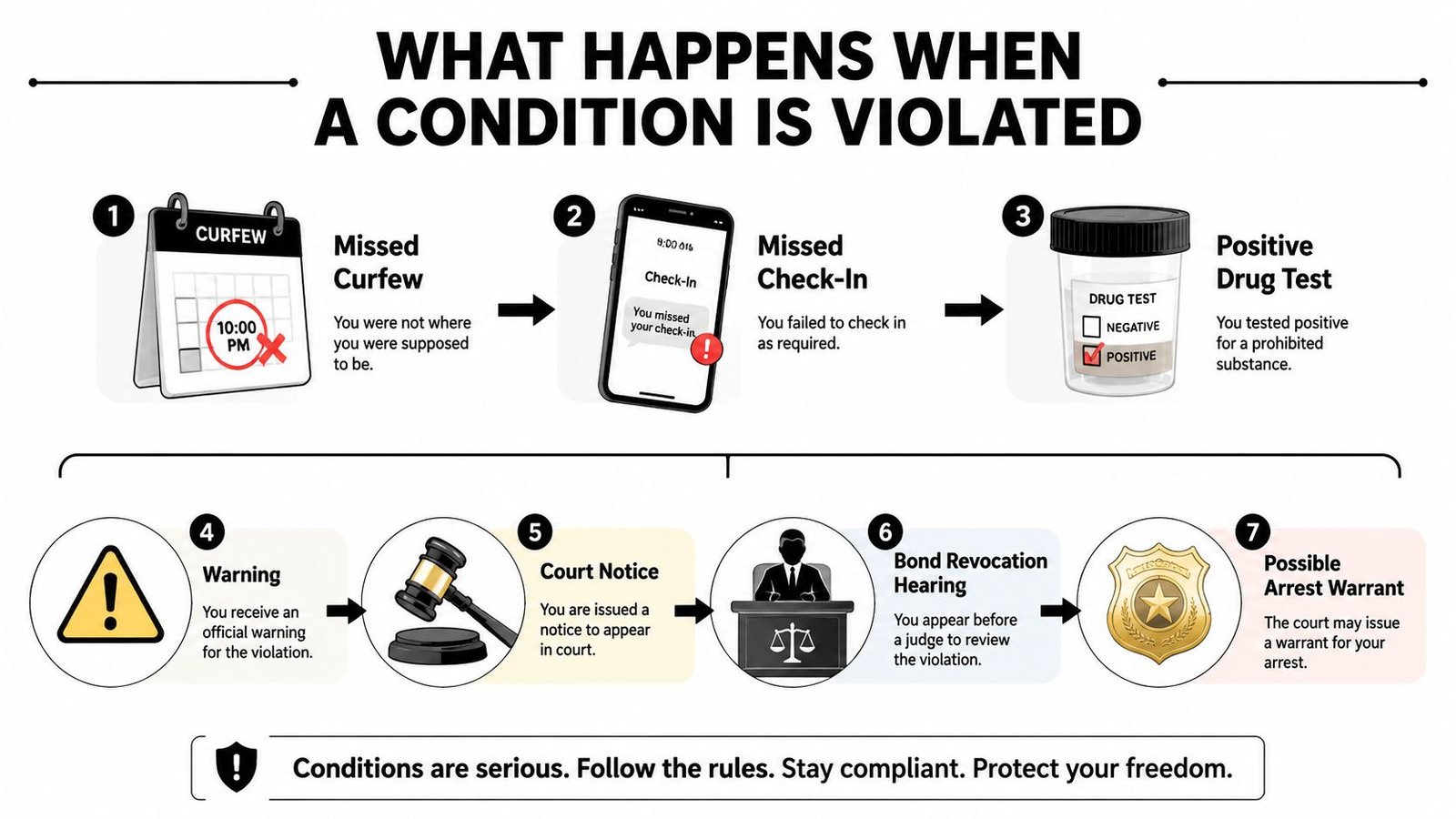
A formal response can include a bond violation hearing. The judge may hear from the prosecution, defense, supervision provider, and sometimes the surety. Possible outcomes include continued release, a warning, stricter terms, added monitoring, revocation, or an arrest warrant. Under the federal appearance-bond rule, a court must declare a bond forfeited when a bond condition is breached, although the court may later set aside or remit the forfeiture in circumstances described by Federal Rule of Criminal Procedure 46.
A surety bail bond is an appearance bond. It secures appearance, not fines or restitution, and failure to appear is the classic forfeiture trigger in the surety-bond model, as described in Montana's surety-bond provision. That doesn't make other violations harmless. A condition violation can lead to revocation, which can then create a serious appearance and financial problem.
For a focused explanation of the response to noncompliance, see this Colorado bail-bond violation guide.
How Courts Set and Change Bond Conditions
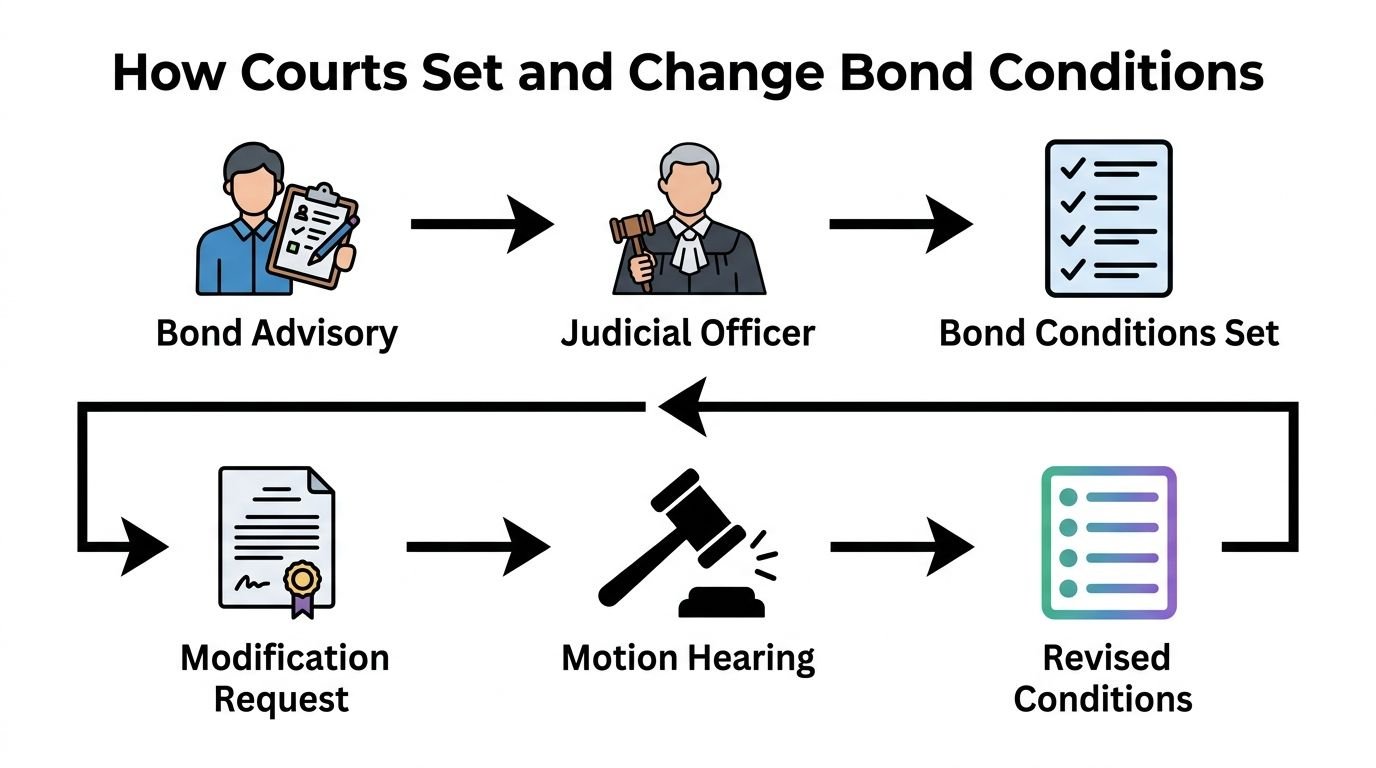
At the bond hearing, the judicial officer reviews the available information and sets the bond type and conditions. A bond advisory or pretrial services recommendation may inform the decision, but the judge or magistrate enters the enforceable order. The court's task is to choose terms that address appearance and safety without imposing unrelated restrictions.
A defendant, prosecutor, or pretrial services officer may later seek a change. The request should identify the precise condition, explain what has changed or why the condition is impractical, and offer a workable alternative. A request to remove GPS monitoring, expand travel for employment, or adjust a curfew is stronger when it includes a schedule, employer documentation, transportation details, testing arrangements, or records showing prior compliance.
What the court needs to evaluate
The court generally needs more than a statement that a rule is inconvenient. It needs a reason to believe the proposed change still protects the concern that led to the original condition.
- Travel request: Provide destination, purpose, dates, employer information, and a plan for reporting or testing while away.
- Monitoring request: Show consistent compliance and explain why a less restrictive tool can address the same concern.
- Contact request: Identify the necessary communication and propose counsel, a third party, or another controlled method if the order permits court-approved exceptions.
- Curfew request: Document work shifts, transportation limits, or caregiving responsibilities and suggest specific replacement terms.
The filing method and hearing schedule vary by court and county. Denver and surrounding counties can have different calendars and procedures, so families should ask defense counsel or the clerk which motion, notice, and hearing date apply. Until the judge signs a revised order, the original conditions remain in force.
This Colorado bail hearing explanation can help a family understand why preparation matters before the judicial officer reviews release terms.
A Practical Compliance Checklist for Defendants and Families
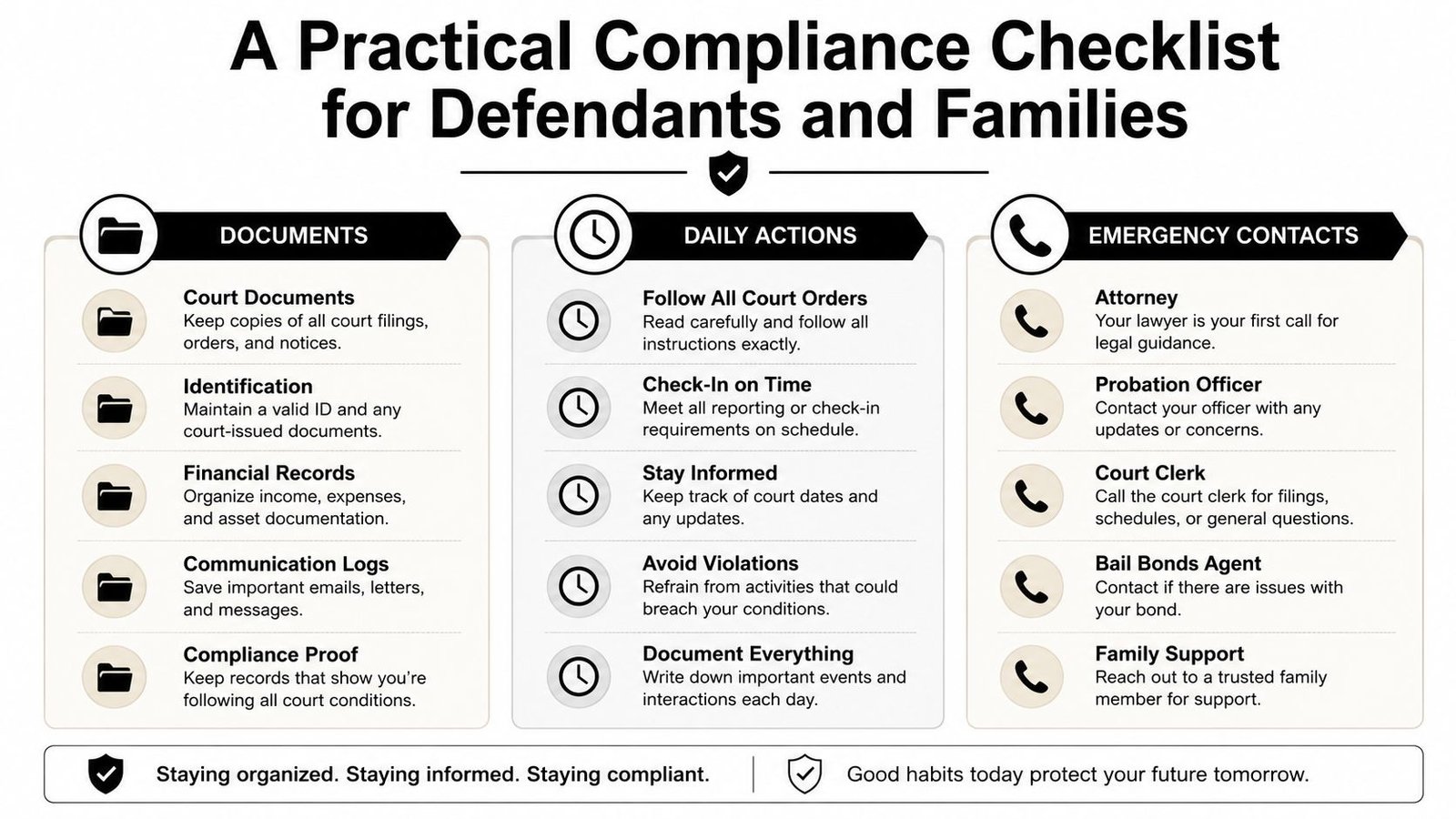
Put the checklist next to the refrigerator, in the defendant's phone, and in the car used for court or testing. The purpose isn't to create more paperwork. It's to turn a complicated release order into repeatable habits.
Documents to keep available
- Bond order: Keep the complete, current order, not just a photograph of the signature page.
- Testing information: Save the provider's address, hours, instructions, receipts, and attendance records.
- Court calendar: Record every hearing, check-in, treatment appointment, and deadline.
- Contact list: Include defense counsel, pretrial services, the testing provider, and the surety.
Daily actions
- Check the calendar: Confirm the next required appearance and any supervision appointment.
- Check the device: Charge monitoring equipment as directed and report damage or malfunction immediately.
- Check travel plans: Don't leave an approved area or cross a geographic boundary without confirming permission.
- Check household contact: Make sure family members understand who is protected by a no-contact order and what indirect contact can mean.
- Check testing obligations: Plan transportation and arrive with enough time to complete the test.
If something slips
Call the supervising officer and defense counsel as soon as possible. Write down what happened, when it happened, who was contacted, and what instructions you received. Keep supporting records, such as a work schedule, medical note, transportation receipt, phone repair record, or testing-center communication.
Don't wait for a letter from the court before asking for help. A prompt, documented explanation can't guarantee a favorable result, but it gives counsel a chance to address the issue before silence or confusion makes the situation worse.
Getting Back to the Plan That Matters
Release is supposed to let the defendant remain connected to work, family, treatment, housing, and legal preparation while the case moves forward. Each condition the defendant follows supports that plan. Each unexplained violation can pull the case in the opposite direction, toward stricter supervision, a bond review, revocation, or an appearance problem.
The financial side matters as well. Colorado law caps a professional bail-bond premium at the greater of $50 or 15% of the bail amount, and treats the premium as non-refundable once the bond is posted, under Colorado's bail-bond premium statute. A separate Colorado provision applies the same greater-of-$50-or-15% pricing limit to licensed insurance producers writing bail bonds, as stated in the licensee pricing rule. Ask for the fee, any collateral requirement, and each signer's responsibility before paperwork is completed.
Before release
Confirm:
- The exact bond amount and bond type.
- The premium and whether collateral is required.
- Every court date and appearance method.
- The name and contact method for pretrial services.
- Testing, treatment, monitoring, and curfew instructions.
- Travel boundaries and permission procedures.
- No-contact, location, firearm, and household restrictions.
- What the defendant and cosigner should do if contact is lost or a violation is alleged.
Families in Jefferson County can review bail bond services in Golden and Jefferson County, while families in Arapahoe County can find Centennial bail bond information. The right next step is to contact a Colorado bondsman before release, organize the documents, and make sure the defendant understands the compliance plan before leaving custody.
Express Bail Bonds helps families arrange Colorado surety bonds, complete application and contract paperwork electronically, and get guidance on fees, court requirements, and release steps. If someone you love is in custody, visit Express Bail Bonds to start the process and ask what must be ready before the bond is posted.