
Colorado's standard premium for a surety bond is 15% of the total bail amount, and many bonds over $5,000 may qualify for a reduced 10% rate with an approved cosigner. The exact check-in requirements after release depend on the court order, supervision level, and facility procedures.
A family member may be waiting for a bond to post while another person is trying to learn where the defendant must report, what documents are needed, and whether the first check-in happens at a jail, courthouse, or by phone. Those are separate stages that often get blended together under the phrase “check in requirements.”
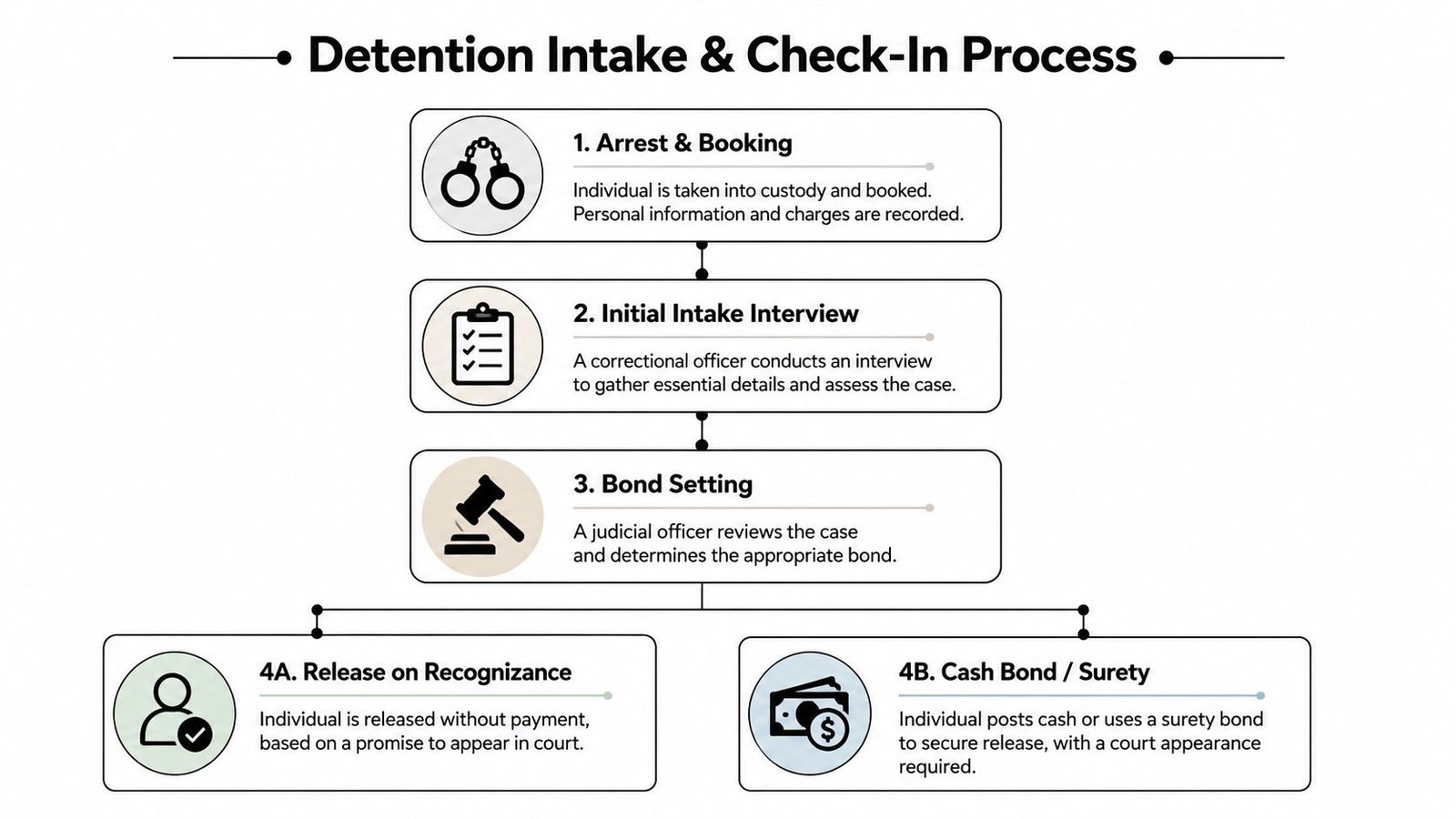
The first stage is detention intake, where officials establish who the person is and create a custody record. The next stage is post-release compliance, where the defendant must follow court dates, reporting instructions, travel restrictions, and conduct conditions. Confusing those stages can lead to missed deadlines, rejected paperwork, or a preventable return to custody.
Understanding Detention Intake and Check-In
Check-in requirements begin with identity control at admission. Detention facilities routinely copy and file identification documents when a person arrives and again when the person is released. Federal detention standards require identification documents to be provided to ICE Enforcement and Removal Operations and placed in the detention file, while admission procedures include recording personal information, checking criminal history, taking photographs and fingerprints, conducting medical and mental health screening, and inventorying personal property. These requirements create a verified record instead of relying on a name spoken at the counter. (ICE 2025 National Detention Standards)
What happens during intake
The practical sequence varies by facility, but the core functions are consistent:
- Booking establishes the arrest record. Staff record identifying information, the reason for detention, and the custody event.
- Biometrics confirm identity. Fingerprints and photographs help match the person to existing records and reduce mistaken identity.
- Screening identifies immediate needs. Medical and mental health questions help staff determine housing and care requirements.
- Property is documented. Personal belongings are inventoried and secured under facility rules.
- Release paperwork follows the verified record. A detention or release order accompanies the newly arriving person, and required book-in materials remain connected to that custody file. (ICE 2025 National Detention Standards)
A government-issued ID can help a representative, but the jail controls the defendant's identity process. Families should still gather the defendant's legal name, date of birth, known aliases, case information, medications in original packaging, and contact details before communicating with the jail or a bond agency. For a practical explanation of timing and bottlenecks, review how long booking takes in jail.
| Check-In Element | Purpose in Custody Management |
|---|---|
| Identification documents | Creates a documented identity record |
| Photograph and fingerprints | Supports positive identification |
| Personal information and criminal history | Connects the person to custody and court records |
| Medical and mental health screening | Helps determine safe housing and care |
| Property inventory | Protects the facility and reduces later disputes |
| Detention or release order | Establishes the legal basis for continued custody or release |
The key point is simple. Booking check-in verifies the person in custody; it doesn't satisfy later reporting duties. Once the court releases the defendant, the operative requirements come from the bond order, pretrial services, probation-related instructions when applicable, and the court's own schedule.
Types of Pretrial Supervision in Colorado
After release, the defendant may have to report in person, by telephone, through video, or through a technology-based monitoring program. The court or pretrial services staff determine the approved method based on the case and supervision conditions. Public pretrial guidance confirms that check-ins may be weekly or monthly and may occur by phone, videoconference, or another authorized method, depending on release level and staff direction. (Sonoma County pretrial guidance)
| Supervision Type | Typical Use Case |
|---|---|
| In-person reporting | Used when staff need direct contact, document review, or a formal office visit |
| Telephone reporting | Useful when the order authorizes phone contact and the defendant can reliably answer or call |
| Videoconference | Provides face-to-face contact without requiring travel to an office |
| Electronic monitoring | Used when the court imposes location or movement controls in addition to reporting |
In-person reporting offers direct confirmation, but it creates transportation, work, and childcare problems. Phone reporting is easier to complete from another location, yet it depends on the correct number, operating hours, and proof that the call was completed. Video reporting adds visual confirmation but requires a working device, a stable connection, and a quiet setting. Electronic monitoring can reduce uncertainty about location, but it may impose separate equipment, charging, movement, and troubleshooting duties.
Match the method to the written order
Don't assume a defendant can switch from an office appointment to a phone call because travel is difficult. The permitted method must come from the release paperwork or supervising office. A person who uses an unapproved channel may believe they complied while the supervising agency records a missed report.
Families should obtain the following before the first deadline:
- The reporting office or program name: Confirm who receives the report.
- The approved channel: Ask whether contact must be in person, by phone, by video, or through a specified system.
- The reporting schedule: Record every date, time window, and follow-up instruction.
- Confirmation requirements: Learn whether the defendant receives a receipt, email, case note, or other proof.
- Escalation instructions: Ask whom to contact if the system fails or the defendant cannot appear.
The distinction between release and bond can also affect expectations, so Fiscella Law LLC legal help can provide useful legal context when families are trying to understand the paperwork. For a broader explanation of the release process, see what pretrial release means.
Colorado Legal Mandates for Court Appearance
Colorado bond conditions aren't optional scheduling preferences. The court must set conditions sufficient to reasonably ensure the defendant's appearance and protect public safety, while considering the defendant's financial condition. The bond must require appearance at a specific place and date, which means the defendant's continuing obligation begins with the written order and extends through every listed court event. (Colorado Revised Statutes, Section 16-4-103)
A felony arrest adds a specific interstate consequence. The defendant must execute a waiver of extradition, consenting to return to Colorado and waiving formal extradition procedures if arrested in another state while released on bond. That doesn't mean every trip is automatically prohibited, but it does mean leaving Colorado can create serious legal exposure if another arrest occurs. Families should ask the attorney or court about travel permission instead of treating an out-of-state trip as harmless.
The conduct condition matters too
Every bond includes a condition that the released person not commit another felony while free on bond. If probable cause exists that a new felony was committed, the court may revoke release or change the bond conditions. The statute therefore connects check-in requirements to conduct, appearance, and custody status rather than treating them as isolated administrative tasks. (Colorado Revised Statutes, Section 16-4-105)
A missed reporting appointment can become more serious when it occurs alongside a missed court appearance, an address change, or another alleged violation. The defendant should preserve appointment confirmations, call records, emails, and messages showing efforts to comply. If a problem occurs, contact the supervising office and defense counsel promptly, then follow the exact corrective instruction.
Practical rule: Read the bond order as a checklist of legal duties, not as a general outline. The specific date, location, reporting method, and travel language control.
A missed court appearance creates its own procedural risk. Families seeking a plain-language overview can review what failure to appear means, but they shouldn't rely on a general article instead of the actual court order or legal advice.
Connecting Booking Procedures to Ongoing Compliance
A person can leave jail after posting bail and still face detailed reporting duties. Booking and post-release supervision handle different stages, yet both depend on accurate identity information. Jail intake records the defendant's name, identifying details, photograph, fingerprints, charges, booking number, intake time, and physical description. An Indiana county jail rule shows how detailed an admitted inmate record can be, requiring those elements in the record. (Indiana county jail record rule)
Jail admissions occur at substantial volume. A 2024 Prison Policy Initiative analysis estimated that over 5.6 million unique people are booked into U.S. jails annually, while about 1.2 million people are jailed multiple times in a single year. (Prison Policy Initiative analysis of jail bookings) Repeated admissions make informal recognition unreliable. Standardized records and biometrics help staff confirm the correct person and case.
The custody record follows the case
Booking information supports court processing, housing decisions, release paperwork, and later identity confirmation. A missing fingerprint, incorrect birth date, or incomplete property record can delay movement from arrest to housing or release while staff resolve the discrepancy.
Post-release reporting uses that verified identity record for a separate purpose. Pretrial services or the court may check whether the defendant appeared, contacted the assigned office, followed location instructions, and complied with release conditions. Booking answers, “Who is this person, and why are they in custody?” Ongoing supervision asks, “Is this person following the terms of release?”

Use one compliance calendar for court dates, reporting appointments, phone numbers, video links, transportation plans, and confirmation records. Keep booking paperwork, bond documents, and supervision instructions together. One document does not replace another, because each agency may require its own confirmation.
Modern Remote Check-In and Reporting Flexibility
Many people still picture check-in as a physical appearance at a courthouse or probation office. That assumption is incomplete. Public pretrial guidance recognizes phone, videoconference, and other approved reporting methods, sometimes on a weekly or monthly schedule, depending on the defendant's release level and the supervising staff's instructions. (Sonoma County pretrial guidance)
Remote reporting can solve genuine problems. A defendant may live outside the county, work a fixed shift, care for children, or lack dependable transportation. Video contact can provide a more direct interaction than a phone call, while phone reporting may work when a defendant cannot travel but has consistent service.
The convenience creates a different risk, however. The method and the proof matter as much as the intention. Calling the wrong number, texting an employee who isn't authorized to receive reports, joining an outdated video link, or leaving a voicemail outside the required window may not count as completed check-in. A person can make a sincere effort and still fail the written condition.
Build a remote reporting record
Use a practical process:
- Save the official contact information: Store the exact number, email address, portal, or video link supplied by the supervising office.
- Confirm the time requirement: Ask whether the report must occur at a specific time or within a stated window.
- Capture proof immediately: Keep confirmation emails, portal receipts, call logs, screenshots, and staff names.
- Report technical failure: If a platform fails, contact the office through a second approved channel and document the attempt.
- Escalate uncertainty: Ask the supervising officer whether a replacement appointment is required.
Electronic documents can also affect release paperwork, so review the electronic signature requirements before signing contracts or court-related forms. Electronic convenience doesn't change the duty to use the approved process.
Consequences of Missing a Mandatory Check-In
A defendant who misses an in-person report because transportation fails can turn an administrative problem into a release issue by waiting several days to respond. The supervising office may record noncompliance, notify the court or bond provider, and require an explanation or court appearance.

The court reviews the written release conditions and the surrounding facts. A missed report may receive different treatment than a new felony allegation, but both require prompt attention. The defendant should contact the supervising office, defense counsel, and any relevant bond representative as soon as possible.
A missed appointment is a problem to address immediately, not a deadline to hope disappears.
Do not create a second compliance problem by ignoring calls, changing addresses without notice, or missing a replacement appointment. These tips for staying out on bail can help families organize the practical steps after release.
For a focused explanation of what constitutes a bail bond violation, review the alleged conduct and the written bond terms carefully. Express Bail Bonds can explain the bond provider's role, but the court decides whether release is revoked or conditions change. Prompt communication helps the defendant identify the next required step and gives the supervising office a clear record of the response.
How Express Bail Bonds Supports Your Compliance
Families need two separate forms of clarity: the financial terms of the bond and the conditions that apply after release. Colorado law caps a bail bond premium at the greater of $50 or 15% of the bail amount, and it generally bars additional court-posting fees except for limited items such as an actual court or law-enforcement filing fee, specified collateral storage costs, or premium financing charges. (Colorado bail bond premium statute)
For example, a family should ask for the premium calculation, any approved cosigner requirements, payment terms, and any permitted additional charge before signing. A premium is generally non-refundable once the surety service has been provided, so the contract deserves careful review.
Express Bail Bonds is a licensed Colorado agency serving detention facilities statewide. Its process allows families and out-of-state cosigners to provide defendant information, complete bond paperwork, make payments, and use electronic contract documents when available, reducing the need to spend hours at a detention center. The company focuses on surety bonds rather than cash-only bonds and can explain the documents needed for posting.
The agency also directs released defendants to contact its office within 24 hours to complete paperwork, a practical post-release step that should be handled alongside the court's own reporting instructions. That contact doesn't replace pretrial check-in, court attendance, or supervision conditions. It gives the bond file a completed record while the defendant manages the legally controlling obligations.
Local information can also matter. Families in the western Denver area can review Jefferson County and Golden bail bond services, while people dealing with an Arapahoe County arrest can see bail bonds in Centennial. The right provider should explain what it handles and what must be confirmed directly with the court or supervising agency.
Frequently Asked Questions About Check-In Requirements
What documents are needed at intake?
The facility records identity information, photographs, fingerprints, charges, physical description, booking details, screening information, and property. Representatives should have accurate legal information and government identification available, but the jail determines which documents it will accept and retain.
Is every check-in in person?
No. Approved reporting may include in-person contact, telephone calls, videoconference, or another authorized method. The order and supervising office control the method, schedule, and confirmation process.
What should happen after a missed check-in?
Contact the supervising office and defense counsel immediately, explain the problem accurately, and ask for the next authorized step. Keep call logs, emails, screenshots, and appointment confirmations. Waiting can turn a fixable scheduling problem into a more serious compliance issue.
Does posting bond end the defendant's obligations?
No. Release begins the compliance period. The defendant must follow the bond order, attend court at the required place and date, complete authorized reports, obey conduct restrictions, and address any travel limitations.
What should families ask before release?
Ask for the bond amount, premium calculation, cosigner terms, reporting agency, first check-in date, approved contact method, court dates, and emergency contact procedure. Write the answers down rather than relying on memory during a stressful release.
Express Bail Bonds provides statewide surety bond processing, electronic paperwork, payment support, and practical guidance about the steps that follow release. Visit Express Bail Bonds to start the application process and get help organizing bond paperwork and check-in responsibilities.