
A loved one has just been booked into a Colorado jail. The family is calling relatives, checking the county roster, and trying to learn whether a judge has set bond. Every hour matters. The person in custody may miss work, lose access to medication, or sit in a cell while the jail count continues to rise.
Jail overcrowding isn't solved at one level. Policy changes can reduce unnecessary admissions, courts can shorten delays, and release professionals can turn an approved bond into an actual release during the same shift. The most useful jail overcrowding solutions connect those decisions to what happens at the booking desk.
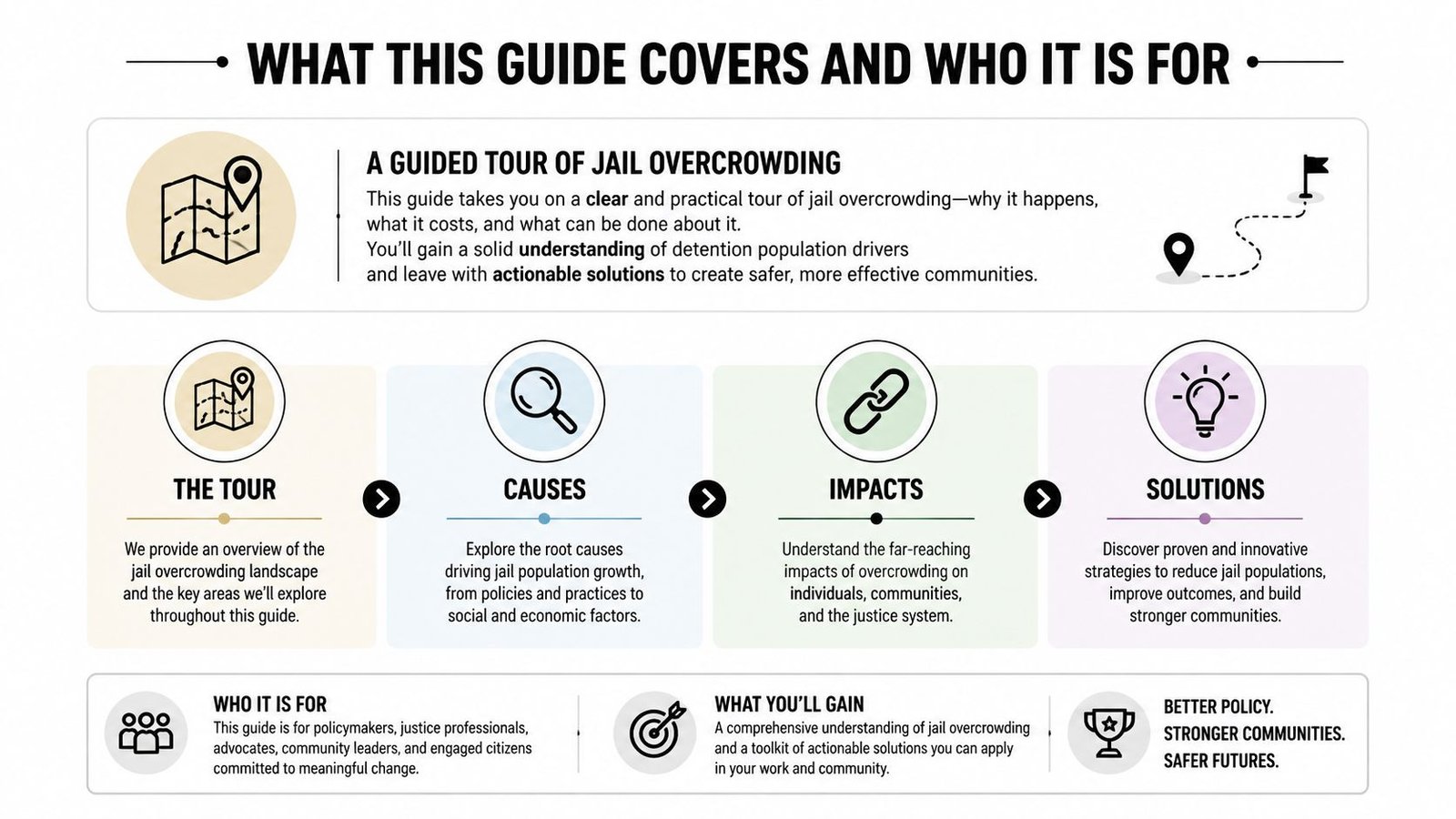
What This Guide Covers and Who It Is For
This guide is for families trying to help someone get home, defendants weighing pretrial release, attorneys coordinating a client's next step, and community advocates following detention reform. It treats overcrowding as both a public policy problem and a practical release problem.
At the policy level, overcrowding grows when too many people enter custody, stay too long, or lack a workable path out. At the booking-floor level, pressure builds when a person has an approved release option but paperwork, payment, staffing, or communication delays keep the bed occupied. Those are different problems, but they interact constantly.
The system and the family experience
The discussion starts with the causes of population pressure, including pretrial detention, slow case processing, treatment gaps, and repeated bookings. It then examines why adding cells often fails to address the underlying flow, followed by the policy and operational toolkit that jurisdictions can use before sentencing.
Surety bail bonds belong in that conversation because they operate at the outflow point. When a judge allows release on a bond and a licensed agent can process the paperwork electronically, the defendant may leave custody without waiting for a family member to produce the full bond amount in cash. That doesn't replace judicial review, pretrial services, diversion, or supervision. It provides one release channel within the larger system.
What readers should take away
You should finish with two kinds of clarity:
- System clarity: Understand whether a jurisdiction's pressure comes mainly from admissions, long stays, limited release pathways, or staffing and court backlogs.
- Practical clarity: Know what information to gather, which questions to ask, and how to move a lawful release forward when someone is detained tonight.
The strongest approach combines risk-based decisions, faster hearings, community supervision, diversion, structured release, and efficient bond processing. Families can't redesign a jail system during an emergency, but they can avoid preventable delays by acting with the right information.
Why Jails Overflow in the First Place
A jail population is a moving count, not a fixed condition. People enter through arrest and booking, remain while courts process their cases, and leave through release, transfer, dismissal, sentence completion, or another authorized pathway. Overcrowding develops when admissions rise faster than departures or when people remain in custody longer than the system can absorb.
Pretrial detention creates immediate pressure
Jails often hold people who haven't been convicted. A defendant accused of a misdemeanor may wait 11 days for arraignment if the docket is slow, even though the person might ultimately qualify for release. A cash-bail requirement can create another barrier. Someone who poses limited flight or safety risk may remain detained because the family can't assemble the full amount quickly.
The Prison Policy Initiative jail toolkit identifies pretrial detention as a major driver of jail population growth and discusses money-bail reform, pretrial release, diversion, and sentencing options. The same source describes a five-year research effort from 1973 to 1977 that identified diversion, pretrial release, and sentencing approaches as core overcrowding responses.
A jail with mostly pretrial detainees needs faster screening, release decisions, court scheduling, and bond processing. A facility carrying many people serving longer sentences faces a different challenge, one involving sentence structure, transfers, parole, and outflow capacity.
Longer stays and repeated returns add bed-days
Case delays matter because each additional day occupies a bed and requires staff attention. A transient person with co-occurring mental health and substance use disorders may remain in custody because no stabilization placement is available. A person on probation or parole may return to booking for a violation, even when a structured community response could address the conduct without extended detention.
Sentencing policy can also move lower-level cases toward custody rather than community supervision. These pressures stack. A person may enter on a low-level charge, wait for an assessment, miss a hearing because of transportation problems, receive a warrant, and return to jail after release.
| Driver | Stage Most Affected | Example |
|---|---|---|
| Cash-bail barrier | Pretrial | A low-risk defendant remains detained because the household can't produce the full amount |
| Slow case processing | Pretrial and court administration | A misdemeanor defendant waits 11 days for arraignment |
| Treatment shortage | Booking and pretrial | A person with co-occurring disorders remains in custody while awaiting stabilization |
| Supervision violation | Reentry and booking | A probation or parole return adds another jail admission |
| Sentencing pressure | Disposition | A lower-level case receives custody instead of community supervision |
The practical question is simple: Where does the count accumulate? If a majority of individuals are awaiting trial, release and court-processing reforms offer the fastest pressure relief. If longer sentences dominate, officials need a stronger outflow plan.
Beyond Building More Cells
Building capacity can help in a narrowly defined situation, but it doesn't control the reasons people enter or remain in custody. The United Nations Office on Drugs and Crime says overcrowding can be addressed by expanding capacity or reducing the number of people held, and it recommends sentencing reform, shorter terms for selected offenses, non-custodial sanctions, wider parole, diversion, community service, victim-offender mediation, and restorative justice in appropriate cases. The UNODC alternatives-to-incarceration framework places those measures within a broader international response.
The pressure is widespread. Penal Reform International reported that prisons in more than 118 countries were above maximum occupancy, with 11 national systems operating at more than double capacity, as cited in the UNODC reference material. Those figures point to a structural problem, not a shortage that every jurisdiction can solve by pouring concrete.
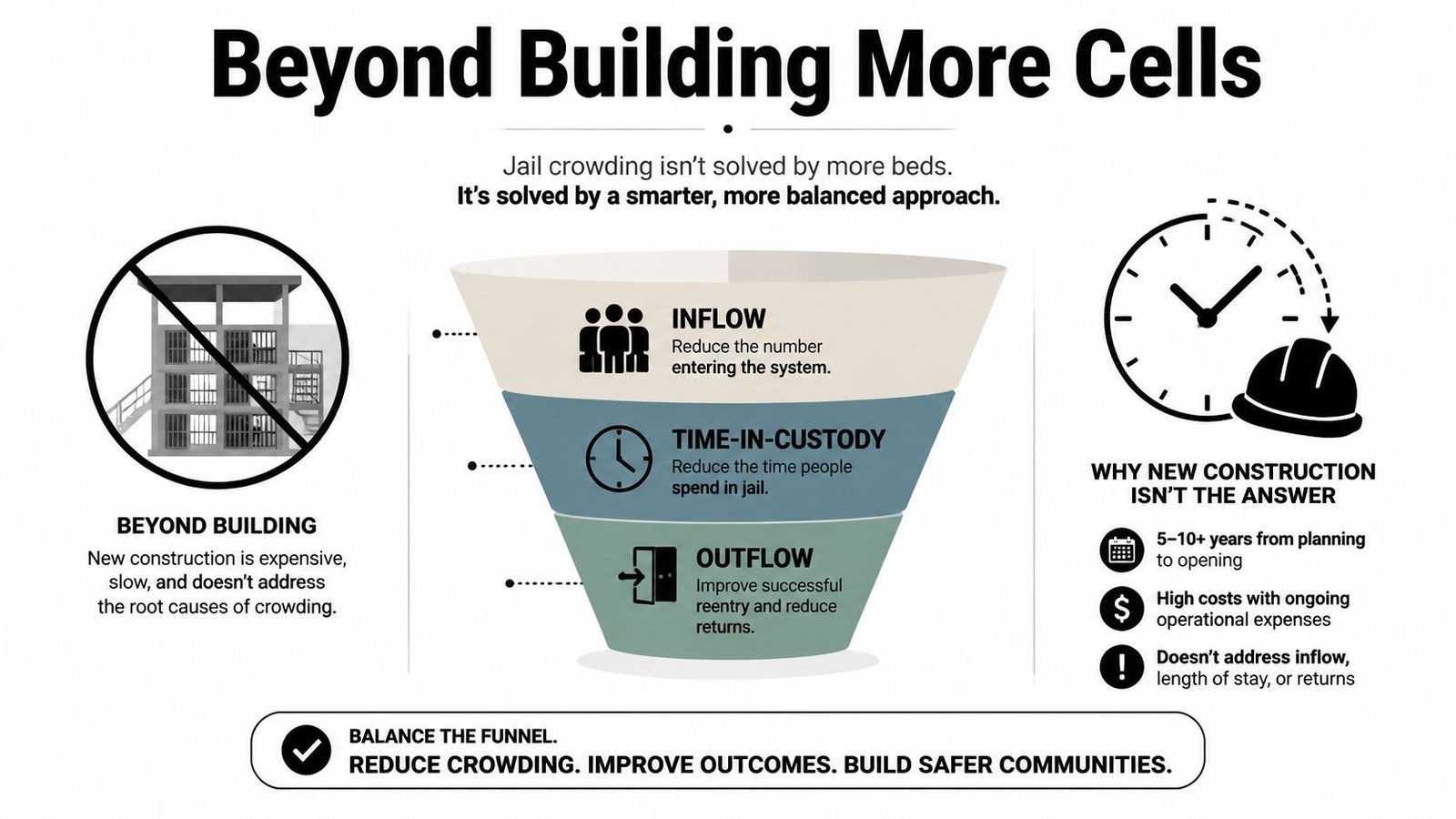
Three levers control the count
Inflow concerns who enters. Citation releases, diversion, and carefully designed arrest alternatives can keep eligible people from occupying a bed in the first place.
Time in custody concerns how long each person stays. Prompt assessments, pre-arraignment review, accessible hearings, and efficient release paperwork reduce unnecessary bed-days.
Outflow concerns how people leave. Options include release on recognizance, pretrial-services supervision, surety bail, electronic monitoring, transfer, structured early release, and sentence completion.
New construction affects capacity, but it doesn't automatically improve any of those three levers. It can also become politically fragile when the public sees new beds filled soon after opening. The 2025 European prison-overcrowding review states that no single solution is sufficient and recommends combining non-custodial sanctions, structured early release, open regimes, halfway houses, forecasting, and budget-linked capacity planning.
A family member may encounter this framework without using the policy terminology. A release assessment addresses inflow and custody duration. A judge's order affects outflow. A bond agent's electronic filing can remove the administrative delay between the order and the jail's release process.
The point isn't to dismiss construction when a facility is unsafe or unusable. It is to avoid treating beds as the only answer. This overview of getting out of jail early for good behavior reflects the practical reality that lawful release pathways, not just physical expansion, determine how quickly a population can fall.
The Policy and Operational Toolkit
The most effective toolkit begins before sentencing. It gives decision-makers several points where they can prevent an unnecessary admission, shorten a stay, or create a safe departure route.
A first-time shoplifting arrest illustrates the sequence. Officers may use a citation or diversion pathway instead of booking, where law and policy permit. If booking occurs, a pretrial assessment can identify whether release on recognizance, supervision, or another condition is appropriate. If the court sets a bond, the family may use cash or a surety channel. If the court requires closer oversight, electronic monitoring or alcohol monitoring can support release.
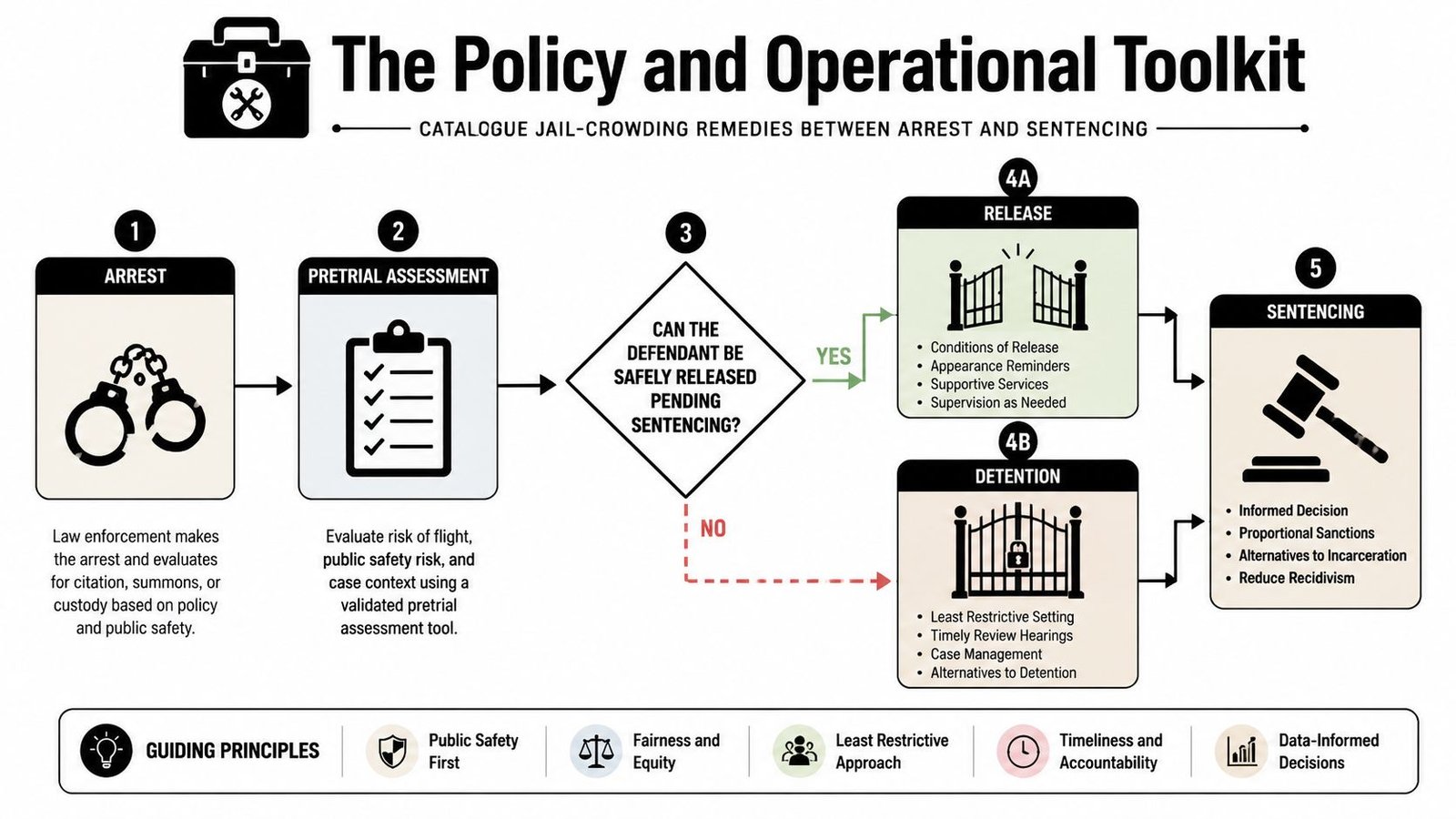
Matching the tool to the decision point
Pretrial release assessments help sort cases according to risk and support needs rather than relying on a single financial condition. The Colorado pretrial-services resource can help families understand the distinction between supervision, court conditions, and financial release.
Diversion can redirect eligible people into treatment, mental health programming, restorative processes, or other services before a jail stay grows. This matters in cases involving substance use or behavioral health needs, where custody may stabilize the immediate crisis without addressing the cause.
Citation and release practices bypass booking for eligible lower-level cases. A weekend DUI stop may still require formal processing, but jurisdictions can examine whether every eligible person needs a physical jail admission.
Electronic supervision can add structure without using a full-time jail bed. GPS, alcohol monitoring, curfews, and regular reporting may fit a case where the court wants accountability but doesn't require secure custody.
The clock is an operational tool
Compressed court calendars, prompt arraignment, and same-day communication can reduce the time between arrest and a release decision. A low-level warrant pickup may need rapid identity verification, a hearing date, and a clear instruction set more than it needs extended detention.
Transfers can rebalance populations between facilities or counties, but they don't reduce the total number of people held. They also create transportation, family-access, attorney-access, and staffing trade-offs. A transfer is a pressure-management tool, not a substitute for reducing admissions or shortening stays.
The pretrial risk assessment resource is useful for understanding the questions that inform release decisions. In practice, the tool only works when intake staff, judges, pretrial officers, attorneys, treatment providers, and jail administrators communicate quickly.
Booking-floor rule: A release option that nobody can process until the next business day isn't functioning as a same-day solution.
The U.S. National Institute of Justice describes a systems approach built around diversion, pretrial release, and sentencing changes. Its evaluation work found that project sites screened pretrial detainees more effectively and saved thousands of jail days compared with control sites, as reported in the NIJ review of jail-crowding reduction.
How Surety Bail Bonds Speed Up Release
A surety bond begins after the court or authorized official sets a financial bond. The defendant or an indemnitor, usually a family member or friend, signs an agreement with a licensed bail agent. The agent guarantees the bond to the court, the customer pays the required premium, and the indemnitor may pledge collateral according to the agreement.
For Colorado consumers, the required cash portion is commonly described as 10 percent in the surety-bond process, with the final premium and collateral terms depending on the bond, the agency, and the approved arrangement. Families should ask for the total cost, payment schedule, collateral conditions, court obligations, and what happens if the defendant misses court before signing.
Cash bail and surety bail are different
Cash bail requires the payer to provide the full court-ordered amount through an accepted payment method. A surety bond uses a licensed agent's guarantee, so the family doesn't have to produce the entire bond amount at once. The agent then submits the bond to the jail or court and coordinates the release steps.
That distinction matters most at night. A judge may have already authorized release, but the defendant remains in custody because the family lacks the full amount, can't reach the right office, or doesn't know which documents the jail requires. Electronic processing allows the indemnitor to complete applications, payments, and contracts remotely while the agent submits the bond through the available jail process.
What the timeline looks like
A domestic arrest in El Paso County may receive a bond order overnight. A family that gathers the booking details, confirms the bond, completes the agreement, and supplies required information can move the release request forward before the next court date. In Adams County, a failure-to-appear matter may require careful review of the warrant and court instructions before an agent can proceed. In Denver County, a low-level drug case may be handled through a remote electronic filing process when the bond order and jail procedures allow it.
These examples don't promise identical outcomes. Release depends on the charge, hold status, court order, warrant language, jail procedures, identity verification, and paperwork. A bond agent can't override a no-bond hold or release condition.
The surety bail bond explanation gives families a useful starting point for understanding the contract and the agent's role. From the overcrowding perspective, the value is operational: once the court has authorized release, efficient surety processing can convert that order into an empty bed rather than leaving the person in custody through an avoidable administrative delay.
Stacked Solutions That Multiply the Impact
A single reform rarely carries the full load. Pretrial release can lower admissions, but it won't solve a slow docket. Electronic monitoring can support community release, but it requires officers, equipment, instructions, and follow-up. A county transfer can create breathing room in one facility while moving the pressure somewhere else.
A layered model works better:
- Risk-based release: Screen eligible defendants and reserve secure detention for cases that require it.
- Accelerated hearings: Move arraignment, assessment, and review decisions quickly.
- Reliable release processing: Use recognizance, supervision, surety bonds, or monitoring according to the court's order.
- Community support: Connect people with treatment, transportation, reminders, housing assistance, and court information.
- Structured outflow: Use parole, open regimes, halfway houses, sentence review, and other lawful pathways where appropriate.
The international handbook on reducing prison overcrowding identifies diversion, probation, suspended sentences, house arrest, victim-offender reconciliation, and community service as core alternatives. The ICRC and UNODC overcrowding handbook also places these measures within a system that must protect safety and preserve judicial oversight.
Measure the system every night
Officials need a short operational dashboard, not just an annual report. Useful signals include:
- Average daily population: Shows whether the total count is rising or falling.
- Average length of stay: Identifies whether court or release delays are consuming bed-days.
- Pretrial failure-to-appear rate: Helps distinguish genuine supervision concerns from administrative barriers.
- Release within 24 hours of booking: Shows whether approved pathways work promptly.
- Bond-forfeiture recovery rates: Helps agencies evaluate financial-release performance and accountability.
These measures should be read together. A lower population paired with a rising failure-to-appear rate may signal a supervision problem. A stable population with a longer average stay may indicate court congestion. A strong release rate with persistent crowding may mean admissions remain too high.
What To Do Tonight If a Loved One Is Detained
Waiting doesn't make the jail process simpler. It can cost work hours, childcare arrangements, medication access, and the opportunity to resolve a release issue before an early court appearance. Start with facts, then move directly to the authorized release pathway.
- Gather identifying details. Write down the person's full legal name, date of birth, booking number if available, arresting agency, charges, and any known warrant information.
- Locate the facility. Confirm which county jail has custody. An arresting agency and the housing facility aren't always the same.
- Check the public roster. Look for bond amount, hold status, court date, and release restrictions. Verify the information with the jail because online rosters can lag.
- Ask about eligibility. Determine whether the person has a personal-recognizance option, pretrial-services requirement, cash-only condition, surety bond, or another release route.
- Contact a licensed agent. If the court permits a surety bond, ask about the premium, any collateral, cosigner requirements, documents, electronic signing, and filing process.
- Plan for compliance. Confirm the next court date, transportation, check-ins, treatment conditions, monitoring rules, and restrictions before release.
The guide on what to do when someone gets arrested can help organize those first calls. Don't assume that paying a bond guarantees immediate release. Jail holds, additional warrants, protection orders, immigration detainers, or incomplete records can change the timeline.
Express Bail Bonds serves Colorado detention facilities with 24/7 phone and electronic processing, including remote contract completion and bond filing where county procedures allow. If someone is in custody now, make the decision before the night disappears. Gather the booking information, confirm the bond status, and call a licensed professional who can tell you what can happen next.
Express Bail Bonds helps Colorado families arrange professional surety bonds through 24/7 phone, text, and electronic processing, reducing avoidable delays between a court's bond order and the jail's release procedure. Visit Express Bail Bonds now to review your options and start the release process.